
AI for Clinical Workflow: 2026 Healthcare Efficiency Guide

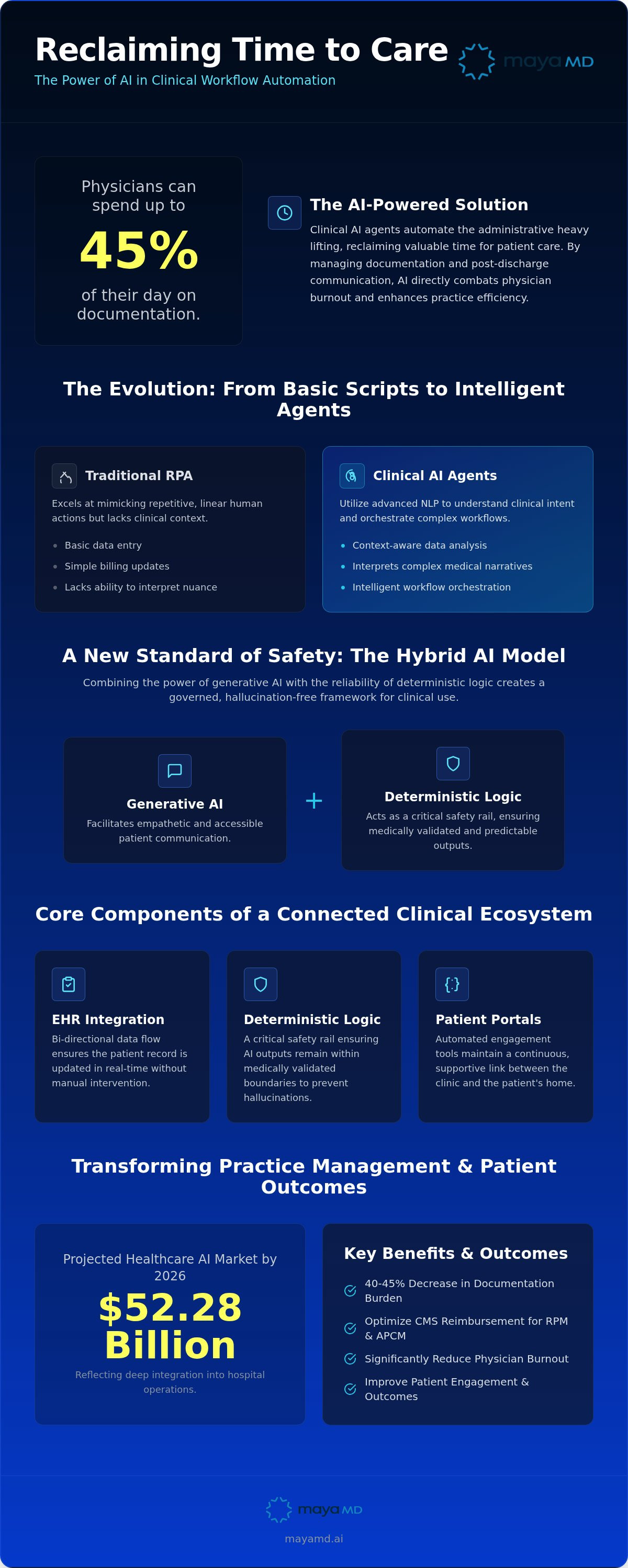
If your clinical staff could reclaim 45% of their day from the crushing weight of documentation, your practice would finally achieve the operational stability it deserves. You've likely felt the strain of fragmented data in chronic care management and the persistent challenge of maintaining patient engagement between visits. Implementing AI for clinical workflow automation isn't just a technological upgrade. It's a strategic shift toward a governed, hallucination-free environment where clinical AI agents handle the administrative heavy lifting while you focus on delivery of care.
This 2026 guide demonstrates how deterministic logic and generative AI work in harmony to eliminate physician burnout and ensure regulatory adherence. We'll examine the latest FDA guidance on clinical decision support alongside the updated 2026 Medicare reimbursement rates for RPM and APCM, such as the new G0556 and G0557 codes. You'll discover how automated post-discharge communication solutions bridge the gap in care, leading to improved reimbursement accuracy and better patient outcomes. This methodical approach transforms high-level artificial intelligence into a reliable, real-world application for modern practice management.
Key Takeaways
• Transition from basic task execution to sophisticated clinical AI agents that manage medical data and patient interactions with context-aware precision.
• Discover how deterministic logic provides a medically validated framework to eliminate the risks of hallucinations inherent in unconstrained generative AI.
• Leverage AI for clinical workflow automation to optimize longitudinal care and capture the full value of 2026 CMS reimbursement rates for RPM and APCM.
• Follow a structured two-phase implementation strategy to audit administrative friction and integrate AI agents directly into your existing EHR infrastructure.
• Reduce physician burnout by automating documentation and post-discharge communication, ensuring consistent patient engagement between clinical visits.
Defining AI for Clinical Workflow Automation: Beyond Basic Task Execution
AI for clinical workflow automation represents the systematic application of intelligent agents to manage medical data and patient interactions with clinical precision. It is no longer sufficient to view automation as a series of disconnected scripts. In 2026, the healthcare sector has shifted toward "governed AI," a framework where technology operates under rigorous oversight to ensure safety and clinical validity. This transition is driven by the necessity to return "time to care" to physicians by automating the administrative drudge work that currently consumes nearly half of their professional lives. By deploying agents that understand the nuances of a patient's journey, providers can move past the limitations of legacy systems into a more connected ecosystem.
The global market for Artificial Intelligence in Healthcare is projected to reach up to $52.28 billion in 2026, reflecting a deep integration of these technologies into hospital operations. This growth isn't merely about adoption; it's about the evolution of how we define efficiency. While 80% of hospitals now utilize AI in some capacity, the leaders are those who have moved beyond simple task execution to embrace context-aware orchestration. The primary goal remains clear: reducing the physician documentation burden, which has been shown to decrease by 40-45% following the deployment of advanced AI scribe and automation tools.
The Evolution from RPA to Clinical AI Agents
Traditional Robotic Process Automation (RPA) excels at mimicking repetitive human actions, such as data entry or basic billing updates. However, clinical environments require more than just linear task-bots. Modern Clinical AI Agents utilize advanced natural language processing (NLP) to understand clinical intent, allowing them to interpret complex medical narratives rather than just structured fields. This shift from simple automation to intelligent orchestration is detailed in our guide on clinical workflow automation solutions. These agents don't just move data; they analyze the context of a patient encounter to ensure that the resulting documentation reflects the actual clinical reasoning of the provider.
Key Components of an Automated Clinical Ecosystem
A robust automated ecosystem requires seamless connectivity between disparate data points. The Clinical AI Agent serves as the central orchestrator, bridging the gap between the EHR, billing systems, and patient portals. For this system to be reliable, it must include specific technical components:
EHR Integration
Bi-directional data flow ensures that the patient record is updated in real-time without manual intervention.
Deterministic Logic
This acts as a critical safety rail, ensuring that AI outputs remain within medically validated boundaries to prevent hallucinations.
Patient Portals
Automated engagement tools maintain a continuous link between the clinic and the patient's home environment.
By focusing on these integrations, healthcare organizations create a stable framework that supports both the practitioner and the patient. This methodical approach ensures that AI for clinical workflow automation remains a tool for enhancement rather than a source of additional complexity.
Eliminating Hallucinations: The Role of Deterministic Logic in Medical AI
Unconstrained generative AI presents a significant risk in high-stakes clinical environments. While large language models excel at synthesizing information, their probabilistic nature can lead to "hallucinations" or medically inaccurate assertions that compromise patient safety. In contrast, deterministic logic operates as a system where specific inputs always produce the same, medically validated outputs. This reliability is foundational for AI for clinical workflow automation, ensuring that the technology acts as a predictable extension of the physician's expertise rather than an unpredictable black box.
MayaMD utilizes a sophisticated hybrid architecture to navigate these complexities. We employ generative AI to facilitate empathetic, accessible patient communication while anchoring the underlying clinical decision support in deterministic logic. This dual-layer approach ensures that every recommendation or documentation entry adheres to strict medical protocols. By isolating the creative aspects of language from the rigid requirements of medical science, this framework maintains HIPAA compliance and rigorous accuracy; it allows providers to trust the technology as a clinical-grade partner. If you're ready to implement a secure, logic-driven solution, you can learn more about the Clinical AI Agent designed for modern practice.
Why Clinical Logic Must Be Deterministic
Deterministic logic serves as the essential medical guardrail that prevents AI hallucinations by enforcing rigid adherence to clinical pathways. By embedding evidence-based protocols, such as ACC/AHA guidelines, the system ensures that patient care management remains consistent and safe. Unlike "probabilistic" models that guess the next most likely word based on statistical patterns, deterministic systems follow established medical truths. This distinction is vital for maintaining the integrity of the patient record and ensuring that automated actions don't deviate from standard care practices.
Building Trust Through Governed AI Frameworks
Governed AI allows healthcare organizations in major hubs like Chicago and Phoenix to scale their operations without compromising patient safety. These systems offer full auditability; every decision or recommendation can be traced back to a specific medical rule or data point rather than a hidden algorithmic weight. This transparency is crucial for meeting the FDA's 2026 guidance on clinical decision support software, which emphasizes the need for non-device software to be interpretable by human clinicians. For a deeper technical view, practitioners can explore the infrastructure behind healthcare ai without hallucinations. This methodical oversight transforms AI for clinical workflow automation from a speculative tool into a high-stakes clinical asset.
Optimizing Longitudinal Care: Automating RPM, APCM, and PCM Workflows
Managing chronic conditions requires a level of vigilance that exceeds the capacity of traditional, visit-based care models. AI for clinical workflow automation provides the necessary infrastructure to manage longitudinal care by continuously processing data from Remote Patient Monitoring (RPM) devices. Instead of care teams manually sorting through thousands of daily alerts, the system uses clinical logic to prioritize patients who deviate from their baseline. This shift ensures that interventions are timely and data-driven, directly addressing the administrative burden that often prevents practices from scaling their chronic care programs.
The financial sustainability of these programs is tied to accurate documentation. For instance, the 2026 national average reimbursement for CPT 99454, covering 16 or more days of device readings, is $52.11, while the new CPT 99445 supports 2-15 days of data collection. Automated systems track these metrics with precision, ensuring that every minute of care management, such as the 10-19 minutes required for the new CPT 99470, is captured for billing. This level of oversight extends to newer quality metrics, including the 2026 MIPS oral-health screening requirement, which the Clinical AI Agent captures automatically during routine patient interactions.
Streamlining APCM for Primary Care Providers
Advanced Primary Care Management (APCM) relies on the capture of "between-visit" data to justify Level 1 through Level 3 reimbursements, ranging from $16.37 for G0556 to $117.24 for G0558. The Clinical AI Agent automates care plan updates and patient check-ins, ensuring that the care team has a real-time view of patient status. By maintaining this constant connectivity, practices can more effectively manage high-risk populations while meeting the rigorous documentation standards outlined in our definitive guide to APCM. This automation ensures that no billable activity is overlooked due to manual entry errors.
Enhancing PCM and Specialist Coordination
Principal Care Management (PCM) focuses on single, high-risk chronic conditions that often require intense coordination between specialists and primary care providers. Automated alerts identify early signs of decompensation, allowing for proactive adjustments that prevent emergency department readmissions. The Clinical AI Agent acts as a bridge, synthesizing specialist recommendations into the primary care workflow and providing automated post-discharge communication solutions. To ensure these communications are accessible to all patients regardless of language, you can discover Ubestream - AI Translation Service Provider for specialized semantic and voice algorithms. This ensures that patients remain engaged and supported during the critical windows following a hospital stay or a change in treatment protocol, fostering a unified approach to complex disease management.
Successful deployment of AI for clinical workflow automation requires a deliberate, multi-stage framework that respects the unique operational nuances of each facility. Rather than a singular, disruptive overhaul, the integration process follows a methodical path from initial audit to enterprise-wide scaling. This phased approach ensures that the technology remains a supportive tool for clinicians rather than an additional administrative burden. By grounding the rollout in clinical reality, organizations can achieve a steady, predictable ROI while maintaining high standards of patient care.
Phase 1: Workflow Audit
We identify the highest-friction administrative points within the clinic, focusing on where documentation delays most significantly impact patient throughput.
Phase 2: Integration
The Clinical AI Agent is connected to the EHR and patient monitoring devices, establishing a bi-directional data flow that eliminates manual entry.
Phase 3: Pilot
Launching in localized hubs like Indianapolis or Las Vegas allows the care team to refine the deterministic logic against specific patient demographics.
Phase 4: Scaling
Once the pilot demonstrates stability, we expand automated documentation and patient engagement solutions across the entire health system.
Phase 5: Continuous Optimization
The system utilizes AI-generated performance statistics to identify further opportunities for improving clinical outcomes and operational efficiency.
Addressing Local Healthcare Dynamics in Hub Cities
Healthcare delivery isn't uniform across the country; local regulatory and market factors in cities like Chicago and Houston significantly influence how technology is adopted. In these high-density markets, the ability to scale care safely through governed AI is a competitive necessity. Successful deployment relies on local support and a deep understanding of the regional provider landscape. MayaMD provides specialized support for providers in Phoenix and Las Vegas, ensuring that the Clinical AI Agent is optimized for the specific challenges of those patient populations. If you're looking to modernize your practice's infrastructure, you can explore our Clinical AI Agent solutions.
Security and HIPAA Compliance Checklist
A sober approach to cloud-based medical data is essential for maintaining trust and regulatory adherence. When evaluating vendors for AI for clinical workflow automation, health systems must prioritize data sovereignty and rigorous encryption standards. Deterministic logs are a critical component of this framework, as they provide a clear, auditable trail for compliance reviews. Use the following checklist to evaluate your AI integration:
Data Sovereignty
Ensure the vendor provides clear documentation on where data is stored and who has access.
HIPAA Compliance
Verify that the platform utilizes end-to-end encryption for all patient-identifiable information.
Auditability
Confirm the system generates deterministic logs that allow for the review of every AI-driven clinical suggestion.
Integration Security
Check that EHR connections utilize secure, authenticated APIs to prevent unauthorized data exposure.
The MayaMD Framework: A Sovereign Approach to Clinical AI Governance
MayaMD stands as the authoritative partner for organizations seeking to navigate the complexities of modern healthcare technology. Our framework represents a sophisticated balance of clinical authority and technological ambition, providing a sovereign environment for AI for clinical workflow automation. Unlike unconstrained models, our Clinical AI Agent utilizes a hybrid architecture that prioritizes safety and precision through rigorous oversight. This approach ensures that every automated interaction is governed by medically validated logic, effectively eliminating the administrative burden that has historically hindered provider performance. It is a system designed to bridge the gap between disparate data points and the human connection of care. Explore the future of digital healthcare for chronic disease and the shift to AI-governed continuous care.
Measurable Outcomes: Efficiency and Patient Satisfaction
The transition from manual documentation to automated orchestration yields immediate, quantifiable benefits for the entire health system. By deploying specialized agents, practices have reported a 40-45% reduction in physician documentation time, which significantly mitigates the primary drivers of professional burnout. This capability-to-outcome flow extends beyond time savings; the average ROI for healthcare AI investments is now reported at 3.2:1. Beyond the clinic walls, AI-driven engagement tools maintain a constant connection with the patient, a factor that directly improves HCAHPS scores and fosters patient loyalty. When patients receive consistent, automated support between visits, their adherence to care plans improves, resulting in a 30% reduction in administrative friction and a profound increase in the quality of care delivered. To further optimize these administrative gains, visit Lead Lock Tek to explore automated tools designed to keep your schedule full and your office operating smoothly around the clock.
Implementing AI for clinical workflow automation is a strategic investment in the operational stability of your practice. The MayaMD platform offers the scalability required to support both independent clinics and large Indianapolis-based health systems. Our methodical onboarding process begins with a tailored consultation to align the agent's deterministic logic with your specific clinical protocols. This is followed by a comprehensive demo that illustrates how the system integrates with your EHR to automate RPM and APCM workflows. By choosing a partner that understands the nuances of clinical governance, you ensure a high-stakes reliability that protects both your providers and your patients. Streamline your clinical workflows with MayaMD today to experience the next generation of healthcare efficiency.
Securing the Future of Clinical Excellence
The shift toward AI for clinical workflow automation is no longer a speculative trend but a fundamental requirement for operational stability in 2026. By integrating deterministic logic with generative accessibility, healthcare organizations can effectively bridge the gap between complex data management and patient-centric care. You've seen how this governed approach eliminates the risks of hallucinations while maximizing reimbursement accuracy for critical RPM and APCM services. This evolution allows your care team to focus on clinical outcomes rather than administrative friction.
MayaMD provides the HIPAA-compliant, cloud-based infrastructure needed to support this transformation across multi-city health systems. Our hybrid model ensures that your clinical decision support remains accurate and evidence-based, providing a reliable foundation for long-term growth. It's time to reclaim your "time to care" and reduce the documentation burden that currently hinders your practice's potential. Request a Demo of the MayaMD Clinical AI Agent today to see how our specialized solutions for RPM, APCM, and PCM can modernize your workflow. We look forward to partnering with you on this journey toward a more efficient, connected future in healthcare.
Frequently Asked Questions
How does AI for clinical workflow automation reduce physician burnout?
AI for clinical workflow automation assumes the heavy lifting of administrative tasks, allowing providers to reclaim up to 45% of their workday. By automating documentation and clinical notes, the technology mitigates the primary drivers of professional exhaustion. This shift moves the focus from data entry to direct patient interaction. In high-volume markets like Indianapolis and Chicago, this efficiency is essential for maintaining operational stability and staff retention within busy practices.
Is clinical AI documentation HIPAA compliant?
Clinical AI documentation is fully HIPAA-compliant when deployed through MayaMD’s cloud-based infrastructure. We utilize end-to-end encryption and secure, authenticated APIs to protect patient-identifiable information at all times. Our platform adheres to strict data sovereignty standards, ensuring that all clinical data remains within a governed, secure environment. This rigorous approach to regulatory adherence provides healthcare executives with the confidence needed to scale automation across multi-city health systems without compromising security.
What is the difference between deterministic logic and generative AI in healthcare?
Deterministic logic follows a fixed set of medically validated rules to ensure specific inputs always produce the same, accurate output. Generative AI is a probabilistic model used primarily for synthesizing natural language and facilitating empathetic patient communication. MayaMD’s hybrid approach uses deterministic logic as a medical guardrail to eliminate hallucinations while leveraging generative AI for accessibility. This combination ensures that clinical decision support remains reliable, safe, and aligned with evidence-based protocols.
Can a Clinical AI Agent integrate with my current EHR system?
The Clinical AI Agent is designed for seamless, bi-directional integration with existing EHR systems. It acts as a central orchestrator, bridging the gap between disparate data points and the patient record. This connectivity ensures that clinical notes, monitoring data, and care plan updates are synchronized in real-time without manual intervention. For practices in Phoenix and Las Vegas, this integration eliminates data silos and creates a more cohesive, automated clinical ecosystem that supports longitudinal care.
How does AI automation improve Remote Patient Monitoring (RPM) outcomes?
AI automation improves RPM outcomes by continuously processing data from connected devices to identify early signs of patient decompensation. Instead of manual review, the system uses clinical logic to prioritize high-risk alerts for immediate intervention. This proactive management reduces emergency department visits and captures the full value of 2026 CMS reimbursement rates. By automating the capture of metrics for codes like CPT 99454 and 99445, the platform ensures both clinical and financial success.
What are the costs associated with implementing clinical workflow automation?
Implementing clinical workflow automation involves an initial investment in platform integration and staff training, though the average ROI for healthcare AI is reported to be 3.2:1. Costs vary based on the scale of the health system and the depth of EHR integration required. While specific pricing depends on organizational needs, the efficiency gains from reduced administrative friction and improved reimbursement accuracy for APCM and RPM often offset the initial expenditure. Providers should evaluate the total cost of ownership against projected time savings.
Does MayaMD offer clinical AI support in Las Vegas and Houston?
MayaMD provides dedicated clinical AI support for healthcare organizations in Las Vegas and Houston, alongside our presence in Indianapolis, Chicago, and Phoenix. We understand that local regulatory landscapes and market dynamics influence technology adoption in these major hubs. Our team offers specialized assistance to ensure the Clinical AI Agent is optimized for regional patient demographics and specific operational challenges. This local presence facilitates a more effective implementation strategy, allowing providers to scale their automated care solutions with confidence.
How does AI prevent hospital readmissions after discharge?
AI prevents hospital readmissions by deploying automated post-discharge communication solutions that monitor patient recovery in real-time. The system identifies deviations from established recovery protocols and alerts the care team before a minor issue escalates into a crisis. By maintaining a continuous link between the hospital and the home, the Clinical AI Agent ensures that patients remain engaged with their care plans. This persistent oversight is vital for managing complex conditions and improving longitudinal outcomes in high-density urban environments.




See The MayaMD Difference
Fill the form below
Download Our Apps
MayaMD for patients and MayaPro for physicians - available on iOS and Android.
FOR PATIENTS
MayaMD App
AI-powered symptom assessment, triage, and secure access to your care team.

FOR PHYSICIANS
MayaPro App
MayaPro brings patient vitals, RPM/PCM care plans, and clinical decision support to your pocket.