
AI for Clinical Decision Support: 2026 Governed Care Guide

The medical community has reached a critical inflection point where the sheer volume of digital noise often obscures the path to patient recovery. If you've felt the mounting pressure of physician burnout or the persistent anxiety surrounding AI hallucinations, you aren't alone. Most practitioners recognize that current systems often provide more friction than foresight. This guide explores the evolution of AI for clinical decision support from a source of alert fatigue into a high-precision clinical partner. We'll show you how a governed approach transforms raw data into actionable insight without compromising safety.
Precision is no longer optional. You'll discover how the Clinical AI Agent utilizes deterministic logic to eliminate the risks associated with unrefined generative models. By integrating these advanced frameworks into your workflow, you can expect improved clinical outcomes and significantly streamlined documentation. We'll detail the mechanics of seamless chronic care management and the integration of Advanced Primary Care Management (APCM) protocols for 2026. This is the blueprint for a future where technology serves as a reliable, HIPAA-compliant bridge between complex data points and the human touch of care.
Key Takeaways
• Understand the evolution from static medical alerts to dynamic intelligence, signaling the definitive end of the "black box" era in healthcare technology.
• Learn how the Clinical AI Agent functions as an "agentic" partner rather than a passive tool, streamlining patient triage and the digital front door experience.
• Discover the role of deterministic logic in providing a safe, hallucination-free foundation for AI for clinical decision support in high-stakes medical environments.
• Identify strategic methods for integrating AI into primary care to eliminate documentation bottlenecks and improve outcomes in chronic care management.
• Explore how a governed framework bridges the gap between disparate clinical data and the human-centric focus of modern patient engagement.
Defining AI for Clinical Decision Support in 2026
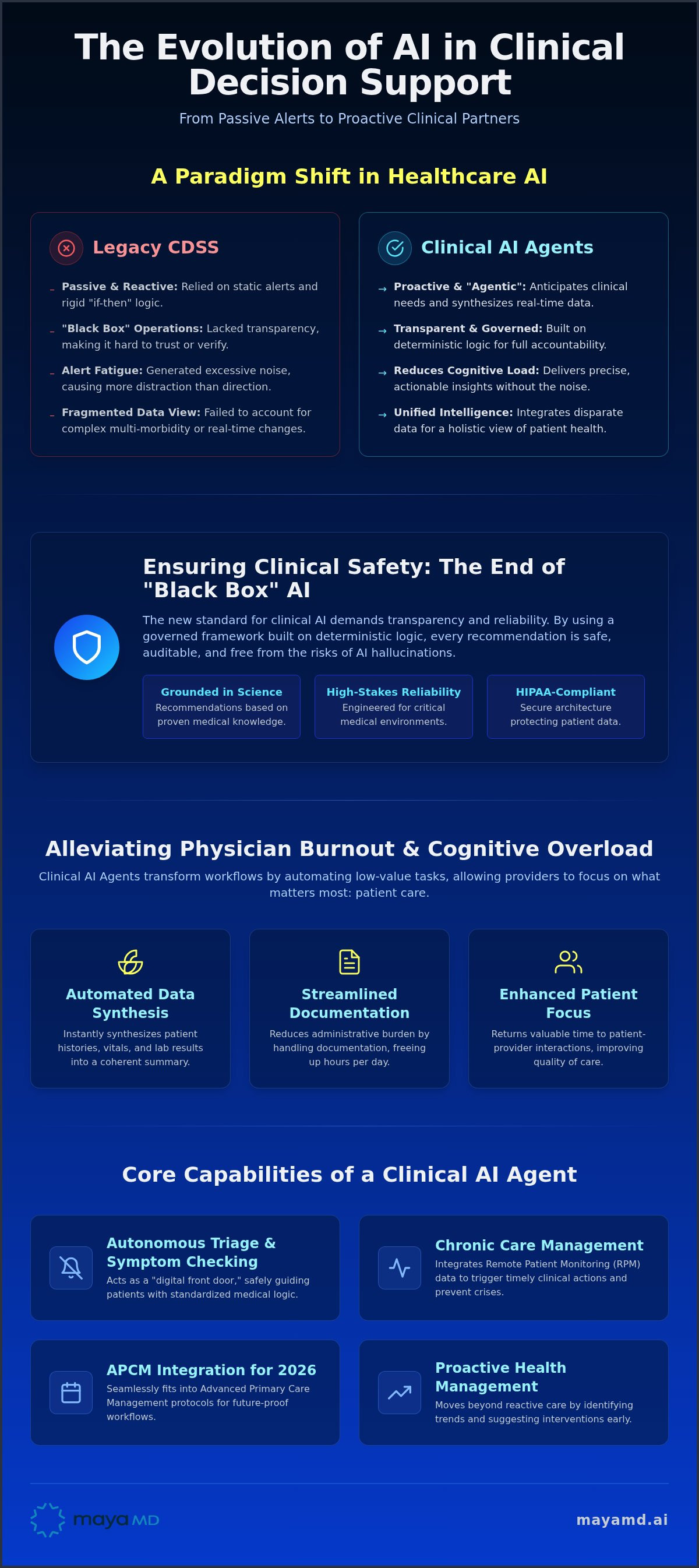
2026 represents a definitive paradigm shift for healthcare technology. The industry has moved beyond the era of fragmented data and into a period of unified, governed intelligence. Modern AI for clinical decision support has transitioned from a passive repository of knowledge into an active, reliable partner in patient care. This evolution is driven by the need for high-stakes reliability and rigorous oversight in every clinical interaction. Traditional systems often relied on static alerts that caused more distraction than direction, but today's frameworks prioritize precision and clinical validity.
The "black box" era of artificial intelligence is over. Providers now demand transparency and deterministic logic to ensure patient safety. By integrating disparate data points into a cohesive, HIPAA-compliant cloud architecture, these systems provide a stable foundation for scalable decision support. This infrastructure allows for the delivery of actionable insights that are both timely and contextually relevant, moving the needle from reactive care to proactive health management.
The Evolution of CDSS: From Rules to Agents
Legacy Clinical Decision Support Systems (CDSS) were built on rigid "if-then" logic. While these tools were effective for simple drug-allergy checks, they often failed to account for the complexity of multi-morbidity or real-time physiological shifts. Clinical AI Agents represent the next generation of this technology. These agents don't simply wait for a manual trigger; they synthesize real-time data to predict clinical needs before they escalate into emergencies. By moving beyond simple rules toward dynamic intelligence, these systems achieve a level of clinical precision that supports, rather than interrupts, the provider's workflow.
Addressing the Crisis of Physician Burnout
While technology helps mitigate the professional causes of burnout, maintaining a fulfilling personal life is just as critical for long-term career satisfaction. For healthcare professionals looking to connect with others who share their unique lifestyle, DownToDate offers a specialized community designed for those who understand the demands of a medical career.
Cognitive overload remains a primary driver of the current provider crisis. Modern AI reduces this burden by automating the synthesis of patient histories and current vitals, allowing primary care providers to focus on complex diagnostic reasoning. This streamlining of clinical documentation returns valuable minutes to the patient-provider interaction. Implementing robotic process automation in healthcare allows for the seamless handling of administrative tasks that previously consumed hours of a physician's day. When technology manages the data, the provider can focus on the human impact of care, significantly improving both patient outcomes and professional satisfaction.
A governed approach to AI for clinical decision support prioritizes safety and regulatory adherence. By utilizing a deterministic logic framework, the system eliminates the risk of hallucinations, ensuring that every recommendation is grounded in proven medical science. This connectivity between advanced data science and the daily reality of patient management reflects a brand that values long-term partnerships and measurable performance over fleeting technological trends.
The Shift from Passive Alerts to Clinical AI Agents
The transition from passive software to agentic intelligence marks a new era in healthcare efficiency. While traditional tools wait for a clinician's input, agentic AI operates with a level of autonomy that anticipates clinical needs. This shift is fundamental to modern AI for clinical decision support. It moves the technology from a background utility to a proactive participant in the care team. These agents integrate seamlessly with Advanced Primary Care Management (APCM) frameworks, ensuring that data from Remote Patient Monitoring (RPM) doesn't just sit in a dashboard but triggers necessary clinical actions. When evaluating AI for clinical decision support, the distinction between a search tool and an agentic partner is the difference between data retrieval and clinical resolution.
Agents act. This proactive nature allows for a more fluid interaction between the patient and the provider. Rather than reacting to an alarm, the system identifies trends and suggests interventions before a crisis occurs. This capability is essential for managing complex patient populations where timely data interpretation can prevent adverse outcomes. The result is a more stable, reliable clinical environment that prioritizes patient safety through rigorous oversight.
Autonomous Triage and Symptom Checking
Standardized medical logic is the backbone of safe patient intake. By serving as a digital front door, the Clinical AI Agent conducts initial symptom assessments that are far more sophisticated than simple chatbots. It generates high-probability condition lists based on deterministic logic, which reduces the risk of triage errors. This capability allows clinicians to enter the exam room with a pre-validated clinical insight, significantly reducing the diagnostic burden. The system effectively filters the noise, presenting only the most relevant data to the provider. These governed systems can be tailored to your specific clinical workflow to enhance facility-wide triage accuracy.
Post-Discharge and Continuity of Care
The period immediately following a hospital stay is often the most vulnerable for a patient. Automating post-discharge communication ensures that no patient falls through the cracks during this transition. By reengineering the hospital discharge process, agents can monitor for red-flag symptoms and adherence to medication protocols. This proactive continuity is vital for effective chronic care management (CCM). It transforms the discharge summary from a static document into a living care plan that adapts to the patient's recovery in real time. This systematic framework prevents readmissions by identifying complications before they require emergency intervention, fostering a deeper connection between the patient and their care team. The agent acts as a bridge, maintaining the quality of care long after the patient has left the clinical setting.
Ensuring Clinical Safety: Eliminating Hallucinations
High-stakes clinical environments leave no room for the ambiguity of probabilistic reasoning. While large language models (LLMs) excel at natural language processing, their inherent design is statistical rather than logical. This creates a significant risk of hallucinations, where the system generates plausible but medically inaccurate information. For effective AI for clinical decision support, the transition from probability to certainty is essential. A governed framework replaces guesswork with systematic oversight, ensuring that every clinical recommendation is anchored in validated medical protocols. Human-in-the-loop oversight remains a cornerstone of this process, providing a final layer of clinical authority that technology alone cannot replace.
Achieving hallucination-free outputs requires more than just better prompts; it demands a fundamental architectural shift. By implementing deterministic logic as a primary layer, the system can cross-reference generative outputs against established clinical guidelines in real time. This "guardrail" approach ensures that the Clinical AI Agent remains a reliable partner, providing high-precision support that clinicians can trust without secondary verification of every data point. The result is a streamlined documentation process that maintains the highest levels of clinical integrity while reducing the administrative burden on the provider.
Deterministic vs. Generative AI in Healthcare
Raw LLMs are insufficient for diagnosis because they lack a true understanding of medical causality. They predict the next word, not the next clinical outcome. The MayaMD approach solves this by fusing deterministic logic with generative efficiency. This hybrid model uses the conversational ease of GenAI to capture patient data while the deterministic engine processes that data through evidence-based frameworks. This ensures clinical validity and maintains a rigorous standard of care that probabilistic models alone cannot achieve. This connectivity between disparate data points and human care is what defines a sophisticated clinical partner, much like how specialized research tools like a peptide reconstitution calculator provide essential precision for clinicians managing complex protocols.
Navigating the 2026 regulatory landscape requires a platform built on transparency and data security. As oversight bodies increase their scrutiny of "black box" algorithms, the demand for explainable AI has never been higher. A HIPAA-compliant, cloud-based architecture provides the necessary infrastructure for secure AI for clinical decision support. This architecture supports the seamless integration of patient data across disparate systems, fostering a more connected care environment. This ensures that patient data remains protected while enabling the continuous care cycles necessary for modern health management. To understand how this fits into the broader ecosystem, it is helpful to examine the digital healthcare for chronic disease shift toward AI-governed continuous care. This transition ensures that innovation never comes at the expense of patient privacy or regulatory adherence.
Strategic Implementation: Integrating AI into Primary Care
Successful integration of AI for clinical decision support requires a methodical approach that respects existing workflows while dismantling inefficient data silos. The initial phase demands a sober assessment of clinical workflow bottlenecks where manual data entry or fragmented patient histories delay care. Identifying these friction points allows for a targeted application of technology. Once the foundation is set, deploying the Clinical AI Agent provides a centralized point for patient engagement. This transforms patient intake from a reactive task into a structured, governed data stream that informs every subsequent clinical decision.
Alignment with modern reimbursement models is the critical next step. Synchronizing these tools with APCM and PCM frameworks ensures that the financial viability of the practice is supported by high-precision technology. The implementation cycle concludes with continuous outcome monitoring and the iteration of clinical insights. This systematic process allows clinicians to refine their care protocols based on real-world performance data, ensuring the technology evolves alongside the needs of the patient population. It's a journey from fragmented data to unified, actionable intelligence.
Optimizing Advanced Primary Care Management (APCM)
Practices utilizing Advanced Primary Care Management protocols can leverage AI to automate complex documentation standards. This automation ensures that quality metrics are consistently met without increasing the administrative load on clinical staff. Proactive AI outreach serves as a persistent link between the clinic and the home, identifying rising risks in chronic populations before they manifest as acute events. This capability directly improves patient outcomes by maintaining a continuous cycle of governed oversight and personalized care coordination.
Scaling Principal Care Management (PCM)
Managing single, high-complexity chronic conditions requires a specialized approach that bridges the gap between specialists and primary care providers. Principal Care Management tools driven by AI facilitate this coordination by ensuring that specialist insights are immediately accessible within the primary care workflow. This connectivity prevents the fragmentation of care that often plagues complex cases. By scaling PCM through automated monitoring and intelligent triage, clinics can provide specialist-level oversight at a primary care scale, ensuring no patient detail is overlooked. To begin your integration journey, contact our clinical integration team for a tailored strategy session.
MayaMD: The Governed Framework for Clinical Excellence
MayaMD serves as the critical bridge between disparate clinical data points and the human delivery of care. By utilizing a platform that integrates deterministic logic with generative efficiency, MayaMD ensures that technology supports the provider's intuition rather than replacing it. This governed approach is essential for 2026 healthcare, where regulatory scrutiny and the demand for high-precision AI for clinical decision support have reached an all-time high. A reliable partner provides the stability needed to move past experimental phases into proven, scalable applications that deliver measurable value.
The integration of Mayared significantly impacts clinical documentation by transforming conversational data into structured, actionable insights. This capability reduces the cognitive burden on practitioners, allowing them to focus on the nuanced needs of their patients. As healthcare leaders look toward the future, the transition from pilot programs to full-scale deployment requires a partner that understands the complexities of clinical workflows and the importance of HIPAA-compliant architecture. This connectivity fosters a deeper level of patient engagement and long-term clinical excellence.
A Finalist for Innovation in Digital Health
Recognition within the industry validates the rigor of a governed framework. MayaMD was honored as a finalist for the 2025 Digital Health Hub Foundation Awards at HLTH. This accolade reflects a commitment to safety, precision, and the elimination of hallucinations in clinical settings. In complex chronic care environments, this proven reliability is the foundation of trust between technology and the medical community. The platform’s ability to maintain clinical validity across diverse patient populations demonstrates its role as a visionary leader in the digital health space.
Ready to Transform Your Clinical Workflow?
Customization is the key to achieving a high return on investment. Every patient population has unique needs, and the Clinical AI Agent can be tailored to address specific clinical challenges within your practice. By focusing on improved clinical outcomes and streamlined operations, MayaMD ensures that the deployment of AI for clinical decision support results in long-term success. The path from technological ambition to practical application is clear. If you're prepared to evolve your care delivery models, contact us to discuss your deployment strategy. Our team is ready to help you navigate the complexities of modern healthcare with a partner you can trust.
Advancing the Standard of Governed Care
The landscape of medical technology has evolved from static alerting systems to dynamic, agentic intelligence. By prioritizing a governed approach, you ensure that AI for clinical decision support serves as a high-precision partner that enhances rather than complicates the provider experience. We've explored how deterministic logic provides the essential guardrails to eliminate hallucinations, maintaining the clinical validity required in high-stakes environments. This transition isn't merely about software; it's about fostering a deeper connection between data and human care.
MayaMD stands as a finalist for the 2025 Digital Health Hub Foundation Awards, offering a HIPAA-compliant platform designed for the rigors of modern primary care. Whether you're optimizing APCM workflows or scaling chronic care management, our framework delivers the stability and security your practice demands. The path to streamlined documentation and improved patient outcomes is clear. If you're ready to move beyond experimental tools into proven, reliable application, we invite you to request a demo of the Clinical AI Agent today. Let's build a more connected future for healthcare together.
Frequently Asked Questions
What is AI for clinical decision support?
It is a set of intelligent tools that provide clinicians with evidence-based data and insights to enhance the quality of patient care. Unlike legacy systems that rely on passive alerts, modern AI for clinical decision support utilizes advanced algorithms to synthesize patient histories, labs, and vitals in real time. This allows for proactive interventions and more accurate diagnostic reasoning, ensuring that the care team has the right information at the point of care.
How does a Clinical AI Agent differ from a standard symptom checker?
A Clinical AI Agent operates with a level of autonomy and integration that standard symptom checkers lack. While a symptom checker provides a static list of possibilities, the agent functions as a digital front door that actively triages patients using deterministic logic. It connects directly to the clinical workflow, providing high-probability condition lists and clinical insights that streamline the provider's decision-making process. It is a proactive partner rather than a reactive tool.
Can AI help reduce physician burnout and administrative burden?
AI significantly reduces cognitive load by automating the synthesis of complex patient data and streamlining clinical documentation. By handling the heavy lifting of data retrieval and initial triage, these systems return valuable time to the provider for direct patient interaction. This reduction in administrative friction helps mitigate the primary drivers of physician burnout, allowing practitioners to focus on the human impact of care rather than the mechanics of data entry.
Is MayaMD's clinical AI platform HIPAA-compliant?
MayaMD utilizes a cloud-based, HIPAA-compliant architecture to ensure the highest standards of data security and regulatory adherence. Every component of the platform is designed to protect sensitive patient information while facilitating seamless integration across disparate data points. This secure framework allows healthcare organizations to deploy advanced AI for clinical decision support with confidence, knowing that their data management protocols align with national healthcare privacy standards and legal requirements.
How does deterministic logic prevent AI hallucinations in healthcare?
Deterministic logic acts as a rigorous medical guardrail for generative AI by cross-referencing outputs against established clinical frameworks. Unlike probabilistic models that predict the next likely word, deterministic systems follow fixed medical rules to ensure clinical validity. This hybrid approach eliminates the risk of hallucinations, providing high-precision outputs that clinicians can rely on for high-stakes decision support. It ensures that every insight is grounded in proven medical science rather than statistical probability.
What is the role of AI in Advanced Primary Care Management (APCM)?
AI supports Advanced Primary Care Management by automating the documentation and quality metrics required for 2026 reimbursement models. The Clinical AI Agent facilitates proactive outreach and continuous monitoring, which are essential for managing complex patient populations. By integrating these tools, practices can achieve the high-precision care coordination necessary for APCM success. This systematic framework ensures that patients receive consistent oversight while the practice maintains financial and operational stability through improved performance metrics.
How does AI support Remote Patient Monitoring (RPM) for chronic conditions?
AI serves as the bridge between raw RPM data and actionable clinical insight. It continuously monitors patient vitals and identifies red-flag trends before they escalate into acute emergencies. By automating post-discharge communication and chronic care management, the system ensures that patients remain connected to their care team between visits. This proactive oversight improves clinical outcomes for chronic conditions by enabling timely interventions based on real-time physiological data, fostering a more stable environment for continuous care.
Does clinical AI replace the need for human clinicians?
Clinical AI is designed to support, not replace, human clinicians. The platform functions as a sophisticated assistant that handles data synthesis and preliminary triage, but the final diagnostic and treatment decisions remain with the practitioner. By providing high-precision insights and reducing administrative noise, AI empowers clinicians to practice at the top of their license. It strengthens the patient-provider connection by allowing more time for empathetic, human-centric care delivery and long-term clinical partnerships.




See The MayaMD Difference
Fill the form below
Download Our Apps
MayaMD for patients and MayaPro for physicians - available on iOS and Android.
FOR PATIENTS
MayaMD App
AI-powered symptom assessment, triage, and secure access to your care team.


FOR PHYSICIANS
MayaPro App
MayaPro brings patient vitals, RPM/PCM care plans, and clinical decision support to your pocket.