
Advanced Primary Care Management Platform: The 2026 Selection Guide

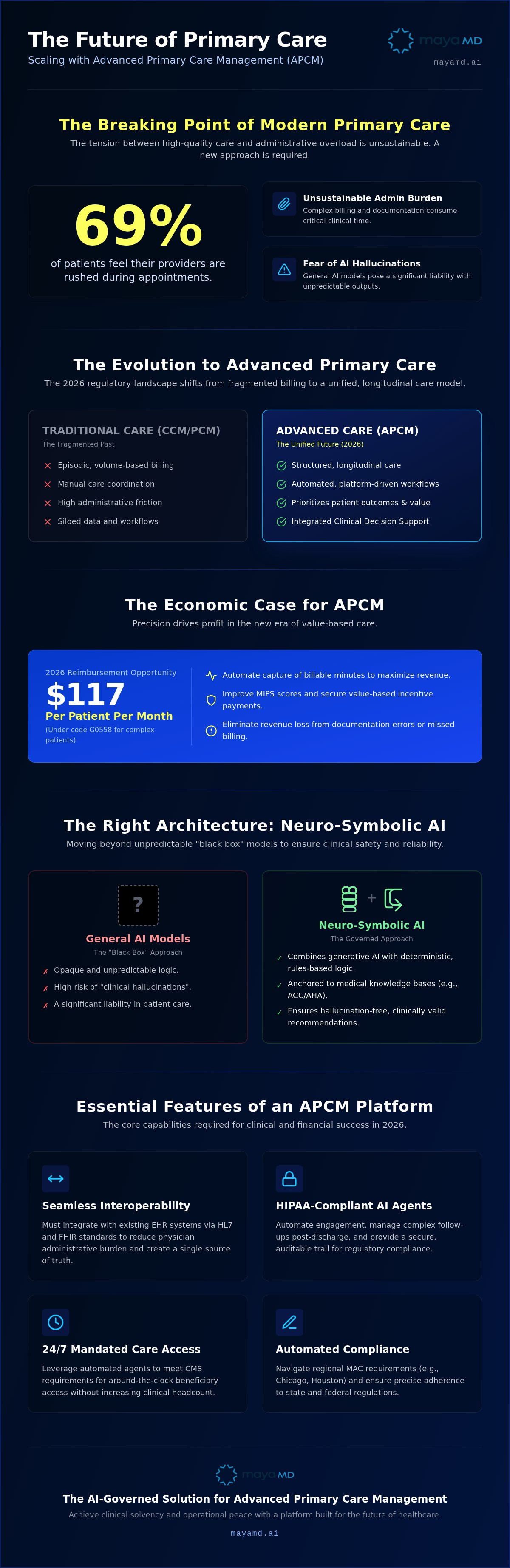
Did you know that 69% of patients feel their providers are rushed during appointments, a statistic that underscores the unsustainable administrative burden currently facing primary care? You're likely managing the tension between providing high-quality chronic care and the complex billing requirements of the latest Medicare updates. It's natural to hesitate when adopting new technology, especially as you face the fear of AI hallucinations and a growing patchwork of state regulations like Alabama’s SB 63. You need a solution that offers more than just digital documentation; you need a system that acts as a sophisticated partner in clinical excellence.
Selecting the right advanced primary care management platform is the definitive step toward clinical solvency and operational peace. This guide will show you how to integrate clinical AI agents and deterministic logic to scale your workflows without compromising safety. We'll explore how to maximize 2026 reimbursement rates, including codes like G0558 that offer up to $117 per patient per month. By the end of this article, you'll understand how a governed AI ecosystem reduces physician burnout and secures your practice's financial future through precise, automated compliance.
Key Takeaways
• Understand how the transition from fragmented CCM and PCM to a unified APCM model enables superior longitudinal care and streamlines practice operations.
• Learn why a robust advanced primary care management platform must utilize neuro-symbolic AI to combine generative engagement with deterministic, hallucination-free clinical logic.
• Identify critical interoperability standards, such as HL7 and FHIR, that ensure your platform integrates seamlessly with existing EHR systems to reduce physician administrative burden.
• Discover strategies for navigating regional Medicare Administrative Contractor (MAC) requirements in major markets like Chicago and Houston to optimize clinical revenue.
• Explore how HIPAA-compliant AI agents act as a bridge between disparate data points and patient-centric care, effectively reclaiming time for providers.
Scaling Care: Why Your Practice Needs an Advanced Primary Care Management Platform
The healthcare industry has reached a pivotal junction where traditional fee-for-service models no longer support the complexity of modern chronic care. Advanced primary care management (APCM) represents the 2026 evolution of chronic care management (CCM) and principal care management (PCM). It moves beyond fragmented, episodic billing toward a structured, longitudinal care model that prioritizes patient outcomes over volume. This shift is necessary because 69% of patients report their providers seem rushed; it's a direct result of administrative systems that haven't kept pace with clinical demands. Precision drives profit in this new era.
Practices often hit an administrative breaking point when manual care coordination consumes more resources than the resulting reimbursement generates. At this stage, an advanced primary care management platform becomes the essential central nervous system of the practice. It integrates disparate data points into a cohesive Clinical Decision Support System that ensures every patient interaction is governed by rigorous logic and safety protocols. By automating the heavy lifting of data synthesis, the platform allows clinicians to focus on the human element of care while the software manages the regulatory and clinical frameworks.
APCM vs. Traditional CCM: The 2026 Regulatory Landscape
The 2026 regulatory environment has simplified the billing landscape by consolidating various G-codes and CPT codes under the APCM umbrella. While this consolidation reduces the complexity of managing multi-condition chronic care, it introduces stricter operational requirements that manual workflows can't sustain. For instance, CMS now mandates 24/7 access to care for beneficiaries enrolled in APCM programs. Meeting this requirement without a massive increase in clinical headcount requires a platform that leverages automated agents to handle after-hours engagement. These systems provide a secure, HIPAA-compliant audit trail that proves compliance during audits.
The Economic Case for Advanced Care Platforms
The financial viability of a modern practice depends on its ability to capture value-based incentives without increasing overhead. In 2026, reimbursement rates for complex patients under code G0558 have reached approximately $117 per patient per month, representing a significant opportunity for practices that can scale. Platforms that automate the capture of billable minutes and clinical outcomes directly improve MIPS scores and value-based incentive payments. For a deeper analysis of these financial shifts, consult our Advanced Primary Care Management (APCM): The 2026 Definitive Guide. By replacing manual entry with deterministic logic, you ensure that no revenue is lost to documentation errors or missed billing windows.
The Architecture of Modern APCM: Integrating Clinical AI with Deterministic Logic
Many general AI models operate as "black boxes," where the path from input to output remains opaque and unpredictable. In a primary care setting, this lack of transparency is a significant liability that can lead to clinical hallucinations. To safely scale, an advanced primary care management platform must move beyond standard generative models to a neuro-symbolic architecture. This sophisticated approach pairs the conversational fluidity of generative AI with the rigid, rules-based safety of deterministic logic. By anchoring every AI output to established medical knowledge bases, the system ensures that clinical recommendations always align with rigorous standards such as ACC/AHA guidelines.
The Clinical AI Agent serves as the bridge between raw data and actionable insight, providing a layer of oversight that manual processes cannot replicate. During pre-visit planning, the agent synthesizes longitudinal patient history to identify care gaps before the provider enters the room. Post-discharge, it manages complex follow-up protocols to reduce the risk of readmission. This level of systematic precision is central to providing high-quality Advanced Primary Care Management services, ensuring that no detail is overlooked during critical care transitions.
Eliminating Hallucinations in Clinical Documentation
Hallucinations, where AI generates plausible but false medical information, are non-negotiable risks in clinical environments. A governed AI framework validates patient data against verified medical ontologies before any documentation is finalized. This capability-to-outcome structure means that when the AI identifies a symptom, it cross-references it against deterministic protocols, resulting in documentation that is both clinically accurate and legally defensible. For a deeper dive into these technical safeguards, see our analysis of Defining the Role of a Clinical AI Agent for Primary Care in 2026.
Seamless Integration with Remote Patient Monitoring (RPM)
Connectivity is the backbone of modern chronic care management. The platform ingests real-time data from cellular-connected devices, such as blood pressure cuffs and glucose monitors, without requiring manual patient entry. Rather than overwhelming staff with raw data, the system uses deterministic logic to triage high-risk biometric alerts. If a patient's reading exceeds a specific clinical threshold, the platform triggers an immediate protocol, ensuring timely intervention while maintaining strict HIPAA compliance across the integrated ecosystem. To see how these tools can transform your practice, you might explore our clinical AI solutions today.
Essential Features for APCM Platform Selection in 2026
Selecting an advanced primary care management platform isn't merely a software purchase; it's a strategic investment in your practice's operational longevity. You shouldn't settle for a glorified tracking tool that adds more clicks to an already bloated workflow. The ideal platform must act as a sophisticated partner that manages the nuances of clinical workflows while ensuring strict regulatory adherence. Interoperability is the non-negotiable foundation of this partnership. Any system you evaluate must communicate seamlessly with existing EMR and EHR infrastructures using HL7 or FHIR standards. Without this connectivity, your data remains siloed, and your administrative burden will only grow as you attempt to bridge the gaps manually.
Physician burnout is often driven by "pajama time," the hours spent on documentation after clinical hours have ended. Your selection criteria must prioritize automated clinical documentation that actually reduces this burden. A platform should synthesize patient interactions into structured, clinically valid notes that require minimal editing. This capability doesn't just save time; it ensures that the longitudinal record is accurate and ready for any future audits. Billing automation is equally critical. The platform must track every minute of care coordination and automatically generate claims for APCM-specific codes to ensure no revenue is lost to documentation errors or missed billing windows.
The Workflow Automation Checklist
Operational efficiency depends on how well a platform handles the "invisible" tasks of care management. You should look for systems that leverage Robotic Process Automation in Healthcare to streamline repetitive actions like patient enrollment and consent tracking. These automated features prevent manual errors and ensure that your practice remains compliant with evolving state laws. To ensure you've covered every technical requirement, refer to our APCM Healthcare Software Selection: The 2026 Provider Checklist before signing any vendor agreements. It's a vital tool for verifying that a platform can scale alongside your patient population.
Clinical Decision Support and Triage
Data without context is a liability. Your platform must provide actionable insights through advanced risk-stratification algorithms that identify high-risk chronic patients before they require urgent intervention. It's about moving from reactive to proactive care. The user interface must be designed for clinical staff efficiency, allowing nurses and coordinators to view the most critical biometric alerts at a glance. When a platform effectively triages data, it allows your team to focus their expertise where it's most needed. This targeted approach improves both the quality of care and the patient experience, which are the ultimate goals of any advanced care model.
Local Implementation: Deploying APCM Platforms in Major US Markets
Regional variations in healthcare infrastructure demand a localized approach to technology deployment. An advanced primary care management platform must navigate the specific interpretations of local Medicare Administrative Contractors (MACs), as these entities often dictate the nuances of APCM reimbursement. In high-density markets like Chicago and Houston, the sheer volume of patients requires a system that can process data at scale while remaining sensitive to regional clinical trends. Success depends on moving past generic software applications toward a governed framework that respects local regulatory environments.
Coordinating care across fragmented specialist networks in cities like Phoenix and Indianapolis poses a significant challenge for traditional practices. Success in these markets depends on the platform’s ability to act as a bridge, ensuring that longitudinal data follows the patient across disparate care settings. In Las Vegas and Houston, the necessity for multi-lingual support is paramount. Inclusive care management requires a system that engages diverse patient bases in their primary language to ensure adherence to chronic care protocols. This connectivity ensures that the quality of care remains consistent regardless of the patient's zip code.
Strategy for Chicago and Indianapolis Clinics
Clinics in Chicago and Indianapolis must prioritize integration with large regional health systems to maintain care continuity. Navigating the 2026 APCM Implementation Strategy for Chicago Clinics is essential for providers looking to align their workflows with urban health initiatives. By utilizing AI-driven clinical agents, these practices can effectively address workforce shortages, allowing smaller teams to manage larger panels of complex patients without increasing provider burnout. This automated oversight ensures that every patient interaction is documented and billable, securing the practice’s financial health.
Scaling in Houston and Phoenix
Houston and Phoenix present unique challenges due to the high prevalence of chronic conditions like diabetes and hypertension. An advanced primary care management platform leverages Remote Patient Monitoring (RPM) to bridge the gap in rural-adjacent suburban areas where physical access to clinics may be limited. As these patient populations grow rapidly, ensuring platform scalability is vital for maintaining the quality of care and capturing the full scope of 2026 Medicare reimbursement opportunities. To learn how to customize these tools for your specific region, you should schedule a clinical workflow consultation to evaluate your practice's readiness.
MayaMD: The AI-Governed Solution for Advanced Primary Care Management
MayaMD functions as the critical bridge between disparate clinical data points and the delivery of compassionate human care. By providing a unified advanced primary care management platform, we enable practices to move beyond the limitations of manual coordination. Our HIPAA-compliant, neuro-symbolic AI architecture ensures that every clinical insight is grounded in deterministic logic, which effectively eliminates the risks associated with standard generative models. This governed ecosystem allows for the seamless integration of RPM, PCM, and APCM within a single, cohesive interface, ensuring that your clinical team has a comprehensive view of the patient journey at all times.
The Clinical AI Agent is not merely a documentation tool; it's a sophisticated partner designed to navigate the complexities of modern primary care. It synthesizes longitudinal patient data into actionable insights, allowing providers to focus on the human impact of technology rather than just the mechanics of the software. By anchoring every AI output to established medical knowledge bases, MayaMD provides a level of clinical validity that is essential for high-stakes healthcare environments. This approach prioritizes safety and precision, ensuring that your practice remains at the forefront of clinical excellence.
The Authoritative Pioneer in Clinical AI
Since our founding in 2018, MayaMD has focused on a singular mission: reducing the administrative burden that leads to physician burnout. We don't view AI as a disruptive outsider but as a reliable, collaborative expert that understands the nuances of clinical workflows. Our "governed" approach to patient engagement and monitoring means that every interaction is validated for accuracy, providing a level of reliability that "black box" systems cannot match. This systematic oversight is what allows practices to scale their chronic care programs without compromising the quality of care. If you're ready to see how this architecture functions in a live environment, you can request a technical deep-dive or a clinical demo through our portal.
Measurable Outcomes and Performance
The transition to an automated ecosystem yields immediate, quantifiable benefits for both the provider and the patient. One of the most significant advantages is the ability to Streamline Chronic Care Workflows through the use of our Clinical AI Agent. This agent handles the heavy lifting of data synthesis and triage, which directly correlates with improved clinical staff retention and documentation accuracy. By removing the repetitive, low-value tasks that clutter the clinical day, your team can refocus on high-stakes decision-making and patient connection.
In the 2026 landscape, where state-led AI regulations like Arizona’s July 1st law require provider review of all AI-submitted claims, MayaMD’s deterministic framework provides the necessary audit trails and transparency. We ensure that your advanced primary care management platform isn't just a tool for today, but a foundation for long-term clinical and financial stability. It's time to move past the experimental phase and into proven, reliable application. Optimize your APCM strategy with MayaMD and secure your practice’s role as a leader in value-based primary care.
Securing the Future of Primary Care
The transition from fragmented CCM and PCM to a unified APCM model represents more than a regulatory shift; it's a fundamental reimagining of how practices deliver longitudinal support. By adopting a robust advanced primary care management platform, you ensure your practice is prepared for the 2026 landscape where precision, 24/7 connectivity, and automated compliance are the expected standards. This evolution allows your clinical team to reclaim their time from administrative tasks and refocus on high-stakes patient interactions.
Success in this new era requires a HIPAA-compliant cloud architecture and neuro-symbolic AI that prioritizes clinical safety through deterministic logic. These systems must be integration-ready for HL7/FHIR environments to truly eliminate the documentation gaps that lead to provider burnout. It's time to move past experimental technology and into proven, governed applications that support both clinician well-being and patient outcomes. Request a Clinical AI Demo from MayaMD today to see how our platform can scale your chronic care workflows. You're ready to lead your practice into a more connected and sustainable future.
Frequently Asked Questions
What is an advanced primary care management platform?
An advanced primary care management platform is a governed software ecosystem designed to coordinate longitudinal chronic care through Clinical AI and deterministic logic. It functions as a central nervous system for value-based care delivery by integrating APCM, CCM, and RPM services into a single workflow. This architecture ensures that patient management is proactive rather than reactive, providing a layer of oversight that manual processes cannot replicate in high-stakes clinical settings.
How does an APCM platform differ from a standard EHR?
An APCM platform differs from a standard EHR by acting as a proactive clinical partner rather than a static digital repository. While an EHR stores patient records, an advanced primary care management platform synthesizes data across disparate points to trigger specific workflows and billing codes. It transforms raw information into actionable insights through automated triage and decision support, ensuring that no clinical detail or revenue opportunity is overlooked during the care process.
Is APCM software HIPAA compliant?
Yes, professional APCM software utilizes a HIPAA-compliant cloud architecture to ensure the total security of protected health information. This includes end-to-end encryption and rigorous audit trails that satisfy both federal mandates and state-specific regulations like Alabama’s SB 63. These systems provide the transparency required for clinical safety, ensuring that all data processing adheres to the highest standards of regulatory compliance and patient privacy in an increasingly digital environment.
Can an APCM platform help with Medicare reimbursement?
A platform maximizes Medicare reimbursement by automatically tracking care coordination minutes and generating claims for specific 2026 G-codes. For complex patients, codes like G0558 can provide approximately $117 per patient per month in revenue. When integrated with behavioral health add-ons or RPM, the total potential reimbursement can reach up to $263 per month, significantly increasing the financial stability of practices focused on value-based care models.
How does clinical AI reduce physician burnout in primary care?
Clinical AI reduces burnout by automating the synthesis of patient data and generating structured documentation, which minimizes the time providers spend on administrative tasks. By handling pre-visit planning and post-discharge follow-up, the AI agent allows physicians to reclaim their time and focus on the human impact of care. This shift from manual entry to automated oversight helps prevent the "pajama time" that often leads to clinical exhaustion.
What technical requirements are needed for APCM implementation?
Technical implementation requires a system that supports HL7 or FHIR standards to ensure seamless interoperability with your existing EHR infrastructure. Your practice must also maintain a stable network environment to handle real-time data ingestion from remote patient monitoring devices. These technical foundations allow the advanced primary care management platform to bridge the gap between fragmented specialist networks, ensuring that longitudinal data remains accessible and accurate throughout the entire care continuum.
How does MayaMD ensure AI safety in chronic care management?
MayaMD ensures AI safety by employing a neuro-symbolic architecture that anchors generative AI outputs to deterministic, rules-based clinical logic. This hybrid framework eliminates the risk of clinical hallucinations by validating every insight against verified medical ontologies and established protocols. By maintaining this rigorous oversight, the system ensures that all recommendations are clinically valid and safe for use in chronic care management, providing providers with a reliable partner.
What is the ROI of deploying an APCM platform for a medium-sized practice?
ROI is achieved through the capture of high-value billing codes and the reduction of overhead associated with manual care coordination. A medium-sized practice can see measurable improvements in revenue by automating the documentation required for APCM and MIPS incentives. Additionally, the impact of automated triage on clinical staff retention reduces the high costs of turnover. It's a sustainable model for ensuring long-term profitability and clinical excellence.




See The MayaMD Difference
Fill the form below
Download Our Apps
MayaMD for patients and MayaPro for physicians - available on iOS and Android.
FOR PATIENTS
MayaMD App
AI-powered symptom assessment, triage, and secure access to your care team.

FOR PHYSICIANS
MayaPro App
MayaPro brings patient vitals, RPM/PCM care plans, and clinical decision support to your pocket.