
APCM Implementation for Primary Care: 2026 Strategy Guide

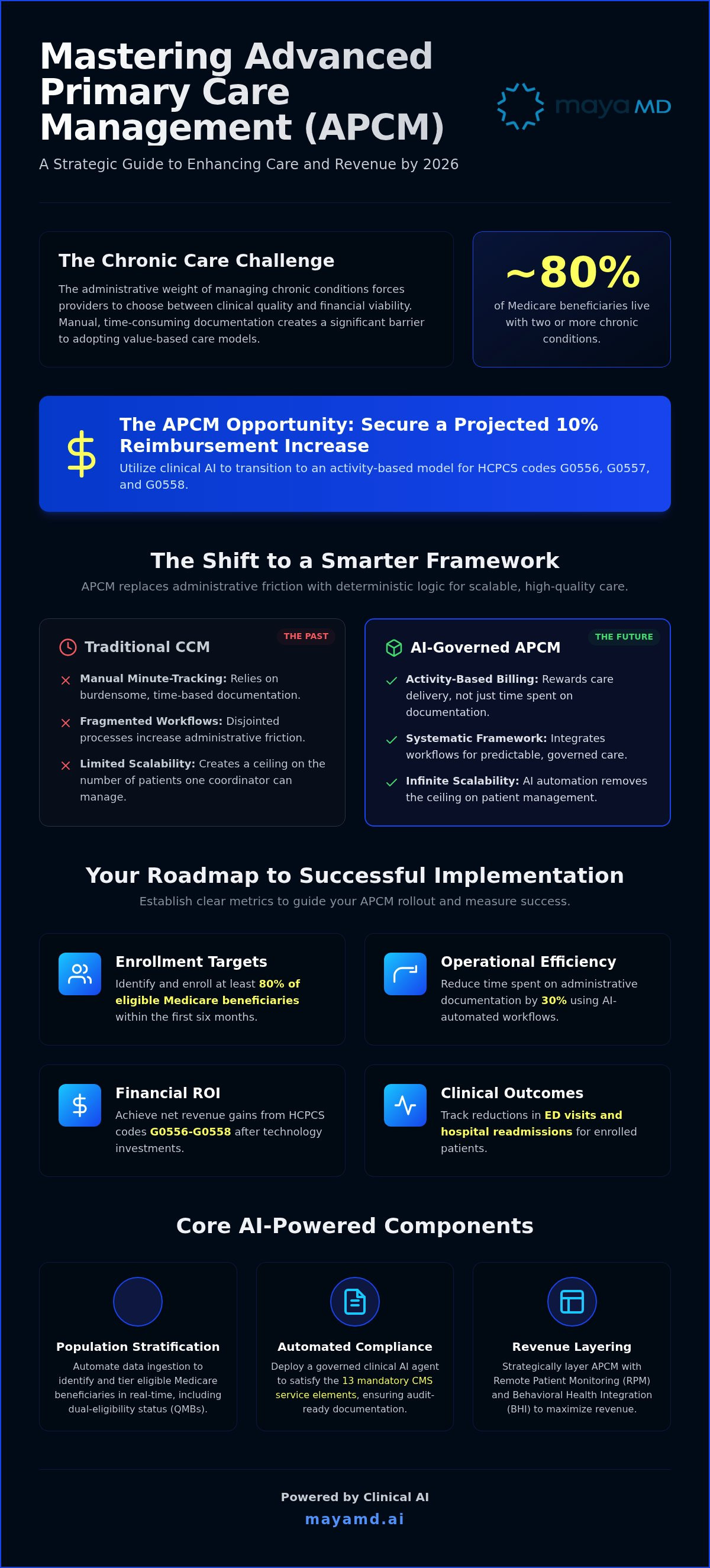
Nearly four in five Medicare beneficiaries live with two or more chronic conditions, yet the administrative weight of managing them often forces providers to choose between clinical quality and financial viability. You likely recognize that the shift toward value-based care is inevitable, but the prospect of documenting 13 distinct service elements without drowning in manual minute-tracking remains a significant barrier to adoption. Successful apcm implementation for primary care requires moving beyond fragmented workflows into a governed, systematic framework that prioritizes both regulatory adherence and patient outcomes.
This 2026 strategy guide provides the technical methodology needed to master the transition to Advanced Primary Care Management. By utilizing clinical AI to replace administrative friction with deterministic logic, your practice can secure the projected 10 percent reimbursement increase for HCPCS codes G0556 through G0558. We will detail how to integrate these new codes with existing Remote Patient Monitoring (RPM) services, creating a high-performance care ecosystem that fosters deeper patient connection through precise data science. You will learn to deploy a step-by-step implementation framework that transforms complex compliance requirements into a streamlined engine for practice growth and clinical excellence.
Key Takeaways
• Evaluate your current infrastructure to transition from manual minute-tracking to a more efficient, activity-based care management model.
• Execute a precise apcm implementation for primary care by stratifying patient populations into the appropriate G0556-G0558 reimbursement tiers.
• Deploy a governed clinical AI agent that integrates deterministic logic with generative capabilities to satisfy the 13 mandatory CMS service elements.
• Maximize 2026 practice revenue by strategically layering APCM with Remote Patient Monitoring and the latest Behavioral Health Integration add-on codes.
Strategic Infrastructure: Preparing for APCM Implementation
Infrastructure is the foundation of clinical excellence. A successful apcm implementation for primary care demands a departure from the fragmented, manual processes that defined earlier care management models. It requires a shift toward a more robust, systematic framework that aligns with the broader value-based care model currently reshaping the industry. To begin, practices must conduct a rigorous audit of their existing Chronic Care Management (CCM) workflows. While CCM relies heavily on manual time-tracking, APCM allows for an activity-based approach that rewards the actual delivery of care rather than the minutes spent documenting it.
Securing executive buy-in is often the first hurdle. You can accelerate this process by emphasizing the elimination of minute-by-minute tracking, a primary driver of physician burnout. When clinical leaders understand that APCM replaces administrative friction with clinical outcomes, resistance typically dissolves. To maintain momentum, establish a multidisciplinary implementation team that bridges the gap between clinical leadership and IT operations. This group must define clear success metrics to guide the rollout, including:
Enrollment Targets
Identifying and enrolling at least 80 percent of eligible Medicare beneficiaries within the first six months.
Operational Efficiency
Reducing the time spent on administrative documentation by 30 percent through automated AI workflows.
Financial ROI
Projecting net revenue gains from HCPCS codes G0556-G0558 after accounting for technology and staffing investments.
Clinical Outcomes
Tracking reductions in emergency department visits and hospital readmissions for patients enrolled in the APCM program.
Assessing Local Market Readiness in Chicago and Houston
Regional dynamics dictate implementation speed. In metropolitan hubs like Chicago and Houston, where Medicare beneficiary density is high and competition for clinical staff is fierce, the need for AI-driven support is acute. Local staffing constraints in these markets often make it impossible to scale care management through human labor alone. By aligning your apcm implementation for primary care with the 2026 Medicare Physician Fee Schedule updates, you ensure your practice is positioned to capture the ~10 percent reimbursement increase while addressing the specific needs of these high-density populations.
The Shift from CCM to AI-Governed APCM
Traditional care management models often fail because they aren't scalable. The requirement to track every 20-minute interval creates a ceiling on how many patients a single coordinator can manage. APCM removes this ceiling by moving to a service-based billing structure. This transition makes advanced primary care management the new standard for practices that value precision and growth. By utilizing a governed clinical AI agent, you can automate the 13 required service elements, ensuring every patient receives systematic preventive care without increasing the burden on your staff.
Step 1: Population Stratification and Eligibility Verification
Precision dictates profitability. When initiating an apcm implementation for primary care, your first operational priority is the accurate stratification of your patient panel. Traditional manual audits are no longer viable; they're prone to human error and create significant lag times in billing. A sophisticated approach relies on automated data ingestion to identify eligible Medicare beneficiaries across your entire population in real time. This ensures every patient is placed in the correct tier from the start of the enrollment period, maximizing the clinical impact of Advanced Primary Care Management services.
Verification must extend beyond clinical diagnosis. Your team must also confirm dual-eligibility status for Qualified Medicare Beneficiaries (QMBs), as these patients represent both the highest clinical complexity and the highest reimbursement potential. By automating this eligibility verification, you create a robust, audit-ready documentation trail that protects your practice against future claim denials. This systematic oversight transforms a complex regulatory requirement into a predictable, governed workflow.
Understanding the Three-Tier APCM Billing Structure
CMS has established three distinct tiers to reflect the varying levels of management required for different patient profiles. Accurate categorization is essential for revenue integrity and resource allocation:
G0556
Targeted at patients with 0 to 1 chronic conditions. This tier focuses on preventive oversight and early intervention for low-complexity cases.
G0557
Designed for patients with 2 or more chronic conditions. These moderate-complexity individuals require more intensive coordination and care plan development.
G0558
Reserved for complex patients, including those with Dual Eligibility. This high-complexity tier carries a national average reimbursement of approximately $117 per patient per month, reflecting the intensive resources required for their care.
Leveraging AI for Real-Time Panel Management
Patient health is dynamic. A patient categorized under G0556 today may develop a second chronic condition tomorrow, necessitating a transition to G0557. Relying on manual updates often leads to missed opportunities and under-billing. By utilizing deterministic logic, a governed clinical AI agent can flag these transitions automatically by monitoring EHR data for new diagnoses or demographic changes.
In markets with high-risk populations, such as Phoenix and Las Vegas, real-time panel management is critical. AI-driven stratification allows your practice to identify high-utilizers before they require emergency intervention. This proactive approach doesn't just improve patient outcomes; it secures your practice's financial stability by ensuring every billing code is supported by real-time clinical data. This logic-driven stratification is the engine that powers a scalable apcm implementation for primary care.
Step 2: Deploying APCM-Compatible Technology and AI Governance
Technology must serve as more than a digital repository; it must function as an active participant in the care continuum. A successful apcm implementation for primary care hinges on selecting a platform that balances the creative potential of generative AI with the rigid safety of deterministic logic. This technological synergy ensures that while patient engagement remains fluid and conversational, clinical decisions remain rooted in evidence-based protocols. By deploying a system that prioritizes 2026 HIPAA compliance and advanced data security standards, practices can mitigate the risks associated with large-scale digital transformation.
Interoperability remains the cornerstone of this infrastructure. Fragmented data silos are a significant liability, often leading to missed clinical cues and administrative redundancies. Your chosen platform must integrate seamlessly with existing EHR systems to ensure a unified view of the patient journey. This connectivity allows for a clinical ai agent for primary care to ingest real-time data, providing the necessary oversight to manage complex panels without increasing manual labor. When data flows freely between systems, the administrative burden of documentation is replaced by actionable insights that drive patient health.
Deterministic Logic vs. Generative AI in Care
Primary care implementation cannot tolerate the unpredictability of "black box" AI. While generative models are excellent for drafting patient communications, they're prone to clinical hallucinations if left ungoverned. MayaMD addresses this by layering generative capabilities over a foundation of deterministic logic. This governed approach ensures that every clinical recommendation is validated against established medical frameworks before reaching the patient. Logic ensures safety. Generative models provide empathy. Together, they create a reliable interface that maintains clinical validity while fostering deep patient connection.
Essential Software Features for APCM Success
To satisfy the 13 mandatory service elements, your technology stack must include specific, high-performance features. These aren't optional luxuries; they're the mechanics of compliance. Key capabilities include:
24/7 Asynchronous Communication
Providing patients with a secure, always-on channel for clinical inquiries, which reduces unnecessary urgent care visits.
Automated Care Plan Distribution
Ensuring that every beneficiary receives a comprehensive, updated care plan that is shared across the entire care team.
Real-Time Dashboards
Health systems in Indianapolis and Houston benefit from centralized data visualization, allowing administrators to monitor enrollment and outcomes across multiple locations simultaneously.
Population Data Analysis
Identifying trends within your patient panel to target preventive screenings and interventions more effectively.
By focusing on these governed technological pillars, your practice moves beyond simple software adoption. You're building a resilient ecosystem designed for long-term performance in a value-based environment. This methodical approach to technology deployment ensures that your apcm implementation for primary care is both scalable and secure.
Step 3: Operationalizing the 13 Service Elements for Compliance
Compliance is not a static checklist; it's an operational reality. To maintain eligibility for APCM reimbursement, your practice must demonstrate the capability to deliver 13 specific service elements. While many organizations struggle with the administrative burden of these requirements, a successful apcm implementation for primary care utilizes automated workflows to ensure every element is met without increasing staff headcount. This transition involves more than just meeting a regulatory bar. It's about evolving into a proactive care model that manages patient health between traditional office visits.
Central to this evolution is systematic preventive care and screening. Your practice must move beyond reactive treatments to deliver regular, data-driven interventions. This includes automated outreach for cancer screenings, immunizations, and annual wellness visits. By enabling patient-centered care planning with digital access for caregivers, you ensure that the entire support network is aligned with the clinical goals. This collaborative approach stabilizes the patient's home environment, which is often where the most significant clinical gains are made.
Automating the 24/7 Care Requirement
Providing 24/7 access to care for urgent clinical needs is often the most daunting APCM requirement. Traditional on-call systems are expensive and prone to delayed response times. By deploying governed AI agents, you can provide patients in Las Vegas and other high-demand markets with immediate access to clinical logic. These agents triage after-hours inquiries in real time, identifying high-risk symptoms that require immediate intervention while resolving routine concerns through evidence-based protocols. Every interaction is documented automatically, creating a comprehensive audit trail that proves compliance without manual entry from your clinical team.
Streamlining Chronic Care Workflows
Effective chronic care management requires high-fidelity coordination across the entire medical neighborhood. When patients transition between settings, such as post-discharge from a hospital, the risk of medication errors and readmissions increases. Automated medication reconciliation and adherence tracking ensure that care plans remain accurate and followed. To further enhance specialist collaboration, your practice can integrate principal care management tools that bridge the gap between primary care and specialty interventions.
Finally, addressing social determinants of health (SDOH) is essential for long-term stabilization. Digital tools can now link patients to community resources automatically based on identified needs, such as food insecurity or transportation barriers. This holistic oversight ensures that the clinical care plan is not undermined by external factors. To see how these automated workflows can secure your practice's compliance and growth, explore our clinical AI solutions for APCM.
Optimizing 2026 Revenue: Layering APCM with RPM and BHI
Strategic revenue management is the final pillar of a resilient apcm implementation for primary care. While the base APCM codes provide a stable foundation, the true financial potential lies in the deliberate layering of concurrent services. By integrating data-driven monitoring and behavioral health interventions, practices provide a more comprehensive care experience while maximizing the reimbursement opportunities established in the 2026 Medicare Physician Fee Schedule. This approach requires a sophisticated billing workflow that captures every eligible clinical interaction without administrative leakage.
The Synergy of APCM and Remote Patient Monitoring
Clinical connectivity is enhanced when APCM is paired with remote patient monitoring software. This integration allows real-time physiological data to feed directly into the APCM care plan, enabling more precise interventions. For instance, hypertension clinics in Chicago have successfully utilized this combined model to improve patient outcomes by providing continuous oversight. Financially, billing APCM alongside RPM can significantly increase the monthly revenue per complex patient, provided that the documentation clearly distinguishes the service elements of each program. You don't have to choose between clinical depth and financial health; a governed AI framework supports both.
Maximizing Value with 2026 Add-On Codes
The introduction of new Behavioral Health Integration (BHI) add-on codes on January 1, 2026, represents a significant shift toward holistic primary care. Practices can now bill for HCPCS codes G0568, G0569, and G0570 when providing services under the Psychiatric Collaborative Care Model (CoCM) in conjunction with APCM. This layering is particularly effective for high-complexity patients who often present with co-occurring mental health conditions. According to the 2026 Medicare Physician Fee Schedule, a single QMB patient with complex behavioral health needs could generate up to $263 per month in reimbursement when codes like G0558 and G0569 are combined.
To capture these opportunities, your billing department must monitor financial performance and adjust patient stratification monthly. A patient’s eligibility for specific add-on codes may change as their clinical needs evolve. Utilizing the right APCM healthcare software selection ensures that these opportunities are flagged automatically, preventing revenue loss. This methodical oversight transforms your apcm implementation for primary care from a simple compliance exercise into a high-performance clinical engine that values long-term performance over fleeting trends.
Securing the Future of Value-Based Primary Care
The transition to Advanced Primary Care Management represents a fundamental shift in how practices manage chronic disease and financial sustainability. By moving away from the constraints of manual time-tracking and embracing a service-based model, your practice can finally prioritize clinical outcomes over administrative documentation. Successful apcm implementation for primary care relies on the seamless integration of governed clinical AI to automate the 13 required service elements and precisely stratify patient panels. This systematic approach ensures that your practice remains compliant while capturing the full scope of 2026 reimbursement opportunities.
As you look to scale these complex workflows, it's essential to have a partner that understands the nuances of clinical logic and regulatory adherence. MayaMD provides a HIPAA-compliant AI architecture specifically designed to support G0556-G0558 billing automation and has a proven track record of reducing physician administrative burden. Request a MayaMD Demo to Streamline Your APCM Implementation and begin your journey toward a more connected, efficient, and profitable clinical future. The era of fragmented care management is ending; the era of data-driven, governed primary care is here.
Frequently Asked Questions
What is the primary difference between CCM and APCM implementation?
APCM is an activity-based model, whereas CCM is a time-based model. APCM eliminates the requirement for minute-by-minute tracking, allowing providers to bill for the bundle of services delivered rather than the cumulative time spent. This shift significantly reduces the administrative friction that typically leads to clinician burnout. By focusing on service delivery rather than duration, practices can scale their care management efforts more effectively across their entire patient panel.
Can I bill for APCM and Remote Patient Monitoring (RPM) in the same month?
Yes, CMS allows for concurrent billing of APCM and RPM for the same patient in the same month. This layering strategy is a key component of a high-performance apcm implementation for primary care, as it integrates physiological data into the broader care plan. While APCM and RPM are compatible, APCM cannot be billed alongside Chronic Care Management (CCM) or Principal Care Management (PCM) for the same beneficiary.
What are the 13 required service elements for APCM compliance?
Compliance requires the capability to deliver 13 distinct elements, including 24/7 access to care, systematic preventive screenings, and comprehensive care planning. Other requirements include transition of care coordination, population data analysis, and the use of a certified EHR. While not every element must be performed monthly for every patient, the practice must maintain the infrastructure and documentation to prove these services are available as clinically necessary.
How much does Medicare reimburse for APCM codes G0556, G0557, and G0558 in 2026?
The 2026 national average reimbursement rates are approximately $16 for G0556, $54 for G0557, and $117 for G0558. These rates reflect a projected 10 percent increase from 2025 levels for APCM services. By accurately stratifying your panel into these low, moderate, and high-complexity tiers, your practice can secure predictable monthly revenue while providing the intensive management required for your most vulnerable beneficiaries.
Is a clinical AI agent necessary for successful APCM implementation?
While not strictly mandated by CMS, a clinical AI agent is essential for scaling the 13 required service elements without increasing staff headcount. AI automates after-hours triage, care plan distribution, and documentation, ensuring that apcm implementation for primary care remains both compliant and profitable. Without AI-driven automation, the manual burden of managing a large patient panel often offsets the financial gains of the program, leading to operational inefficiency.
How do I handle the transition of care requirement within APCM?
Practices must coordinate with specialists and hospitals to manage post-discharge follow-ups and medication reconciliation. This process is optimized through interoperable digital tools that flag hospital admissions in real time, allowing for immediate outreach and care plan updates. Effective coordination reduces readmission rates and ensures that the primary care physician remains the central hub for all patient management activities, which is a core requirement of the APCM model.
Do I still need to track minutes for APCM billing?
No, APCM is an activity-based billing model that does not require the cumulative time-tracking necessary for CCM. Providers must instead document that the required care management services were available and provided as clinically appropriate. This fundamental change allows clinicians to focus on the quality of patient engagement rather than the mechanics of a stopwatch. It streamlines the billing process and ensures that compliance is based on clinical action rather than administrative duration.
How do the new 2026 BHI add-on codes affect my practice revenue?
The 2026 add-on codes G0568, G0569, and G0570 allow for additional reimbursement when integrating behavioral health services with APCM. This layering can generate significant revenue; for example, a complex QMB patient receiving both APCM and subsequent month CoCM services could generate up to $263 per month. This model encourages a holistic approach that addresses both physical and mental health within the primary care setting, maximizing the value of every patient encounter.




See The MayaMD Difference
Fill the form below
Download Our Apps
MayaMD for patients and MayaPro for physicians - available on iOS and Android.
FOR PATIENTS
MayaMD App
AI-powered symptom assessment, triage, and secure access to your care team.


FOR PHYSICIANS
MayaPro App
MayaPro brings patient vitals, RPM/PCM care plans, and clinical decision support to your pocket.