
Top TimeDoc Alternatives for Chronic Care Management in 2026

Relying on legacy time-tracking software for chronic care is no longer a viable strategy for practices aiming to scale in 2026. The administrative burden of manual CCM documentation often forces a difficult choice between increasing patient volume and maintaining clinical precision. You likely recognize that while traditional platforms offered a bridge to digital care, they frequently left providers drowning in time-stamped logs and fragmented data. As you evaluate TimeDoc alternatives for chronic care management, the objective is no longer just finding a tool for compliance, but securing a partner for autonomous clinical documentation.
We understand the hesitation to adopt automated systems when the fear of AI hallucinations in clinical charts remains a valid concern. This article demonstrates how the next generation of Clinical AI agents is replacing legacy services with deterministic, hallucination-free care coordination. By integrating physician-engineered logic with advanced data science, these systems ensure that every patient interaction is safe, accurate, and medically sound. We'll examine the top alternatives that facilitate a seamless transition to Advanced Primary Care Management (APCM) models, allowing you to achieve superior outcomes without the constant pressure to hire additional staff. This overview provides the technical depth and clinical validity required to modernize your care delivery framework.
Key Takeaways
• Understand why the 2026 healthcare landscape necessitates a shift from manual time-tracking to the Advanced Primary Care Management (APCM) model.
• Identify critical selection criteria for TimeDoc alternatives for chronic care management, focusing on bi-directional EHR data flow and multi-morbidity support.
• Learn how deterministic logic frameworks eliminate the risk of AI hallucinations, ensuring clinical documentation remains safe and compliant.
• Discover how the implementation of a Clinical AI Agent reduces physician burnout by automating administrative tasks and pre-visit data capture.
• Evaluate the transition from "tech-enabled services" to autonomous care coordination platforms that prioritize high-stakes reliability and patient connectivity.
Beyond TimeDoc: The Evolution of Chronic Care Management in 2026
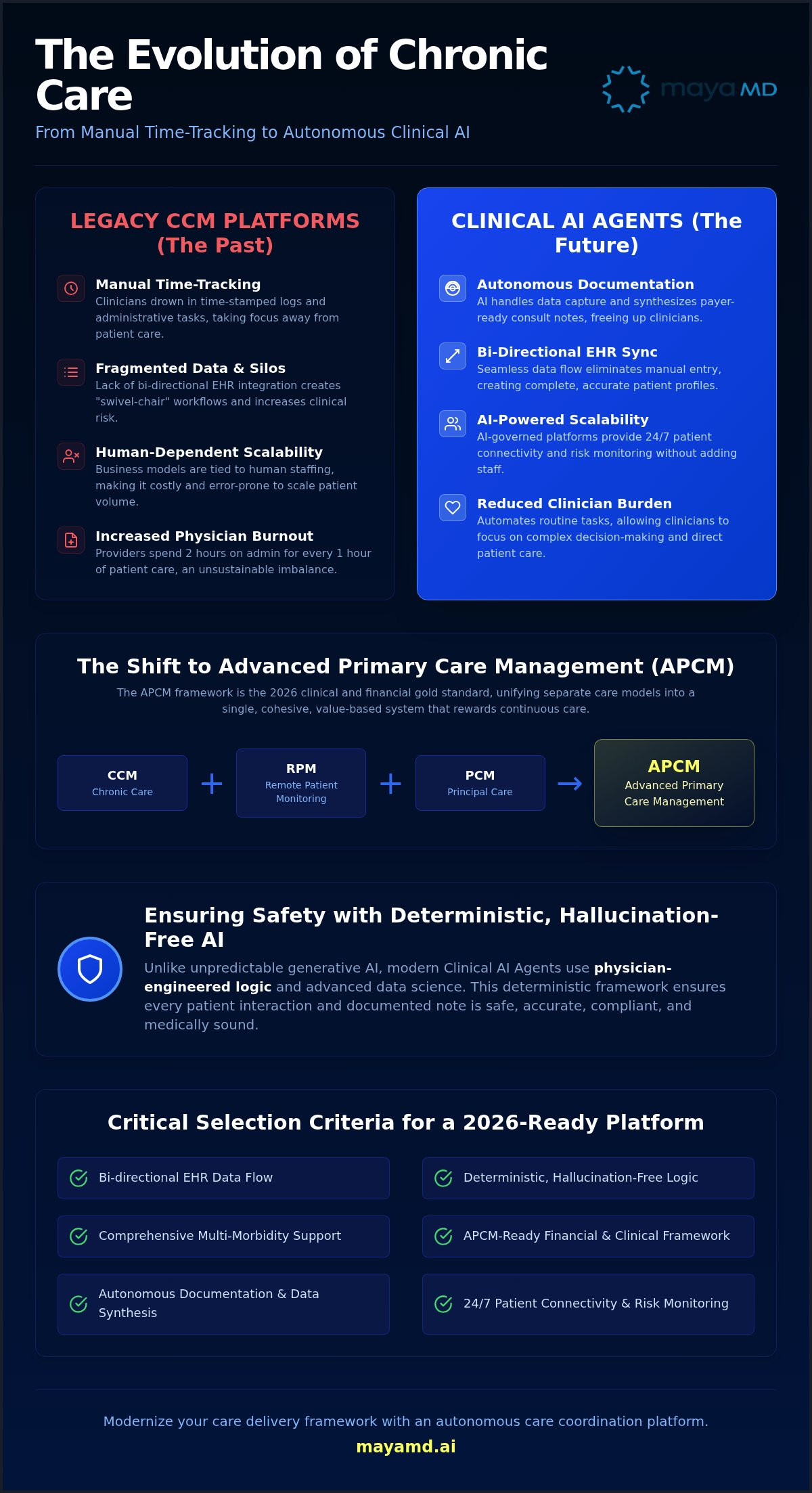
The 2026 healthcare landscape is defined by a decisive shift from volume-based billing toward value-driven, longitudinal support. For years, the industry relied on "tech-enabled services" that paired basic software with large offshore call centers to meet the requirements of Chronic Care Management. While these legacy models provided a necessary bridge, they've become a primary driver of physician burnout. Providers now spend an average of two hours on administrative documentation for every one hour of direct patient care. This imbalance is unsustainable in a labor-short market, leading many organizations to seek TimeDoc alternatives for chronic care management that prioritize automation over human-heavy service layers.
Modern clinical workflows demand a more sophisticated approach. The emergence of the Clinical AI Agent represents a pivotal advancement in how practices manage high-risk populations. Unlike legacy platforms that merely track minutes, these agents utilize deterministic logic to facilitate real-time patient engagement and autonomous documentation. This transition allows clinicians to focus on complex decision-making while the AI handles the rigorous data capture and synthesis required for regulatory compliance and optimal patient outcomes.
The Transition from CCM to Advanced Primary Care Management (APCM)
The Centers for Medicare & Medicaid Services (CMS) launched the Advanced Primary Care Management (APCM) framework to move beyond the constraints of time-based tracking. In 2026, APCM has become the financial and clinical gold standard, effectively unifying Remote Patient Monitoring (RPM) and Principal Care Management (PCM) into a single, cohesive model. This shift rewards practices that maintain continuous, relationship-based care rather than those that simply hit a 20-minute monthly threshold. Implementing TimeDoc alternatives for chronic care management that are built for APCM ensures that your practice is ready for these higher-reimbursement, value-based models without the administrative friction of old-school CCM.
Why 2026 Healthcare Executives are Re-evaluating Legacy Providers
Scalability is the central challenge for healthcare executives today. Legacy providers often struggle to maintain quality as patient volume increases because their business models are tethered to human staffing. When a platform requires more humans to manage more patients, the cost of care remains high and the potential for error grows. Executives are now prioritizing HIPAA-compliant, cloud-based platforms that offer 24/7 connectivity. A Clinical AI Agent provides this perpetual engagement, identifying rising risks in real-time and ensuring that patients with multi-morbidities receive consistent guidance. This shift toward AI-governed platforms allows for a level of precision and reliability that human-heavy service models simply cannot replicate in the current market.
Why Legacy CCM Platforms Struggle with Modern Clinical Workloads
The fundamental limitation of legacy Chronic Care Management (CCM) platforms lies in the "Integration Gap." Most traditional systems operate as data silos, failing to communicate effectively with a practice's primary Electronic Health Record (EHR). This technical disconnect forces clinical staff into "swivel-chair" workflows, where they must manually transcribe data between disparate screens. For organizations evaluating TimeDoc alternatives for chronic care management, this lack of bi-directional synchronization is more than a nuisance; it's a source of clinical risk. Fragmented data leads to incomplete patient profiles, which can result in missed interventions or conflicting care plans for patients with multiple chronic conditions.
Even platforms that claim to be "automated" often rely on human staff to perform the heavy lifting of clinical documentation. These systems provide a dashboard for data entry but don't actually synthesize information into a payer-ready consult note. Clinicians are still burdened with the task of reviewing hours of patient data to find actionable insights. Without proactive, deterministic logic, these tools remain passive observers of patient decline rather than active participants in care coordination. This reliance on manual oversight prevents practices from achieving the efficiency required for modern value-based care models.
The Problem with "Black Box" AI in Care Coordination
Generative AI holds immense potential, yet its use in clinical settings requires rigorous governance to ensure patient safety. Purely generative models are prone to hallucinations, where the system may fabricate patient history or incorrectly summarize a discharge event. In high-stakes environments, a "black box" approach to documentation is insufficient. Clinical intelligence must be grounded in physician-engineered frameworks that prioritize accuracy over creative output. Research into AI applications for self-management suggests that while AI can significantly enhance patient engagement, it must operate within a deterministic logic structure to remain medically sound. This governed approach ensures that every summary generated is a factual reflection of the patient's clinical state.
Scaling Care Without Increasing Administrative Headcount
Legacy CCM models are tethered to a linear growth pattern, typically requiring one full-time care manager for every 100 to 200 patients. This staffing requirement makes it nearly impossible to scale care without a proportional increase in administrative overhead. Advanced TimeDoc alternatives for chronic care management break this cycle by shifting the burden of routine monitoring to autonomous agents. By utilizing Remote Patient Monitoring (RPM) integrated with clinical AI, practices can manage thousands of patients with the same core team. Clinical AI agents handle initial patient triage and medical history capture without human intervention, allowing staff to focus exclusively on patients who require immediate, complex care. If you're ready to move past the limitations of staff-heavy models, you can connect with our team to explore a more scalable framework.
Evaluating TimeDoc Alternatives: AI Accuracy and Hallucination Prevention
When vetting TimeDoc alternatives for chronic care management, the primary differentiator is no longer the user interface, but the underlying safety framework. Most generative AI models are designed for creativity, which introduces a significant risk of hallucinations in a clinical setting. In contrast, a governed approach to AI prioritizes precision by anchoring generative capabilities within deterministic logic. This neuro-symbolic architecture ensures that the system doesn't "guess" a patient's medical history or fabricate vitals in a summary. For healthcare organizations, this distinction is critical; a single inaccurate note in a chronic care plan can lead to adverse events and compromised regulatory standing.
The MayaMD approach integrates these two worlds by using physician-engineered logic frameworks to oversee generative outputs. This ensures that every interaction the Clinical AI Agent has with a patient is medically sound and adheres to established standards of care. By utilizing governed AI, practices can confidently manage Principal Care Management (PCM) for high-risk patients, knowing that the documentation generated is a factual, audit-ready reflection of the patient's status.
Deterministic Logic: The Guardrail for Patient Safety
Deterministic logic functions as a rigid set of rules that the AI must follow, preventing it from deviating from clinical protocols. This framework is essential for maintaining liability protection and ensuring regulatory compliance. When an AI agent operates within these guardrails, it provides a level of high-stakes reliability that purely generative models cannot match. You can explore the technical validation of this approach in our detailed post on Deterministic Logic in Clinical AI for Care Safety. This methodology transforms the AI from a simple transcription tool into a rigorous partner in clinical oversight.
Eliminating Documentation Hallucinations in Post-Discharge Care
The transition from hospital to home is the most vulnerable period in the patient journey. Hallucinations in discharge summaries or follow-up notes can obscure rising risks, leading to avoidable readmissions. Our framework for Reengineering the Hospital Discharge focuses on verifying patient vitals and symptoms against deterministic medical knowledge in real-time. This verification process ensures that the AI identifies actual clinical decline rather than generating false positives or missing critical red flags. By grounding the AI in factual medical data, practices can ensure a safer transition for patients with complex, multi-morbid conditions.
To assist in your evaluation of TimeDoc alternatives for chronic care management, consider this safety checklist:
Protocol Grounding
Does the AI follow peer-reviewed clinical protocols or rely on probabilistic patterns?
Auditability
Can the platform provide a clear logic path for every clinical suggestion it makes?
Vitals Verification
Does the system cross-reference patient-reported data with deterministic medical standards?
Hallucination Mitigation
What specific technical frameworks are in place to prevent the fabrication of clinical data?
Selection Criteria for 2026: From EHR Integration to APCM Readiness
Choosing a partner for long-term patient support requires a rigorous technical audit that extends beyond basic feature lists. In the current regulatory environment, TimeDoc alternatives for chronic care management must demonstrate a high degree of interoperability and clinical intelligence. The first step involves auditing bi-directional data flow capabilities. A platform that can't write back to your primary EHR creates a "documentation tax" that burdens clinicians and introduces data latency. Second, evaluate the platform's capacity to manage multi-morbidity through Principal Care Management (PCM) frameworks. Chronic care is rarely isolated to a single diagnosis; your system must be capable of synthesizing data across multiple disease states to provide a unified care plan.
Interoperability and the "Digital Front Door"
A sophisticated "Digital Front Door" serves as the primary interface between the patient and the care team. Implementing Virtual Triage solutions ensures that patient access is both immediate and medically governed. In 2026, adherence to FHIR API standards is the benchmark for true interoperability. This standardized connectivity enables the Clinical AI Agent to pull real-time clinical insights and push structured documentation directly into the patient record. This seamless exchange reduces administrative friction, allowing providers to focus on high-value clinical interventions rather than data entry.
Testing the AI's ability to generate compliant SOAP notes and clinical summaries is equally vital. The system shouldn't only capture data; it should organize it into a structured, payer-ready format. This capability ensures that every patient interaction is documented with the precision required for high-stakes clinical audits and quality reporting.
Maximizing Reimbursement through Automated Documentation
Revenue integrity in chronic care depends on the accurate capture of every billable minute. Traditional models often miss significant portions of clinical staff time due to manual logging errors. Modern TimeDoc alternatives for chronic care management utilize automated documentation to ensure that all activity related to CCM and PCM is recorded in real-time. As the industry transitions to Advanced Primary Care Management (APCM) billing codes, having a system that can automatically map clinical activities to these new value-based structures is essential. This automation closes gaps in care, identifying opportunities for quality bonuses and ensuring that the practice is fully compensated for the complexity of the care provided. If your organization is ready to modernize its reimbursement strategy, you can speak with our implementation specialists to evaluate your readiness for the APCM transition.
MayaMD: The Clinical AI Agent for Advanced Chronic Care
MayaMD serves as the bridge between disparate data points and high-stakes human care. As practices evaluate TimeDoc alternatives for chronic care management, they increasingly seek partners that have moved past the experimental phase into proven application. MayaMD provides a HIPAA-compliant platform that integrates deterministic logic with generative capabilities, ensuring that every patient interaction remains medically sound. This commitment to precision was recently recognized when MayaMD was named a finalist for the 2025 Digital Health Hub Foundation Digital Health Awards. This accolade underscores our position as an established leader in the clinical AI space, offering a sober, governed approach to patient safety.
A Partner in Clinical Excellence, Not Just a Software Vendor
We present as an "Authoritative Pioneer," a visionary partner that understands the nuances of clinical workflows. Implementing the Clinical AI Agent is a collaborative process designed to integrate seamlessly into your existing infrastructure. We don't just provide a tool; we provide a governed framework for continuous care. This partnership allows healthcare executives to navigate the complexities of a highly regulated industry with calm confidence. If you're preparing for the shift to value-based care, you can contact us for a tailored APCM readiness audit to ensure your practice is optimized for 2026 reimbursement standards.
Real-World Impact: Improving Patient Outcomes with AI
The transition to AI-governed continuous care is driven by the need for measurable performance and improved quality of life. By grounding our technology in physician-engineered logic, we address the core challenges of chronic disease management that legacy platforms often overlook. You can explore the broader implications of this shift in our detailed analysis of improving patient outcomes with AI. In practice, our deterministic AI leads to better medication adherence and a documented reduction in avoidable readmissions. This systematic approach ensures that patients receive the support they need between visits, fostering a deeper connection through rigorous oversight.
The future of healthcare belongs to those who view technology as a catalyst for human connection rather than just a mechanism for documentation. By replacing legacy services with autonomous clinical agents, we can finally achieve a model of care that is both scalable and deeply personalized. MayaMD remains committed to this vision, providing the stability and security required to lead the next generation of chronic care into an era of AI-governed excellence.
Modernizing Your Chronic Care Strategy for 2026
The transition from legacy time-tracking to the Advanced Primary Care Management model requires more than just a software update; it demands a shift toward high-stakes reliability and clinical autonomy. By prioritizing deterministic AI frameworks over standard generative models, practices can eliminate the risk of hallucinations while significantly reducing the administrative burden on providers. As you evaluate TimeDoc alternatives for chronic care management, the focus must remain on bi-directional EHR integration and the ability to scale without increasing headcount through staff-heavy models.
MayaMD stands as a proven partner in this evolution, recently recognized as a finalist for the 2025 Digital Health Hub Foundation Digital Health Awards. Our HIPAA-compliant, cloud-based architecture provides the stability and security necessary for modern care coordination, anchored by a proven deterministic AI framework. We invite you to experience how a governed Clinical AI Agent can transform your patient outcomes and operational efficiency. You can Request a Clinical AI Agent Demo today to begin your journey toward a more sustainable and connected clinical future. We're ready to help you navigate the complexities of 2026 healthcare with precision and confidence.
Frequently Asked Questions
What makes a Clinical AI Agent different from standard CCM software?
Standard CCM software is typically a passive time-tracker. A Clinical AI Agent doesn't just track minutes; it actively manages the patient's clinical journey by automating engagement and documentation. It captures medical history and screenings before visits, generating structured, payer-ready notes. This shifts the burden from manual data entry to autonomous oversight, allowing clinicians to focus on complex decision-making. This proactive approach distinguishes it from conventional TimeDoc alternatives for chronic care management.
How does MayaMD prevent AI hallucinations in clinical documentation?
We utilize a neuro-symbolic approach that integrates deterministic logic with generative AI. This means the system isn't relying solely on probabilistic patterns; it's anchored by physician-engineered clinical protocols. By grounding the AI in factual medical knowledge, we ensure that every clinical summary is accurate and medically sound. This rigorous governance eliminates the fabrication of data, providing the high-stakes reliability required for professional clinical environments and ensuring patient safety across all care settings.
Can MayaMD integrate with my existing EHR like Epic or Cerner?
MayaMD is designed for seamless connectivity with major Electronic Health Records like Epic and Cerner through FHIR API standards. This bi-directional integration allows the Clinical AI Agent to pull real-time data and push structured documentation directly into the patient's chart. Practices don't need to worry about manual transcription or repetitive data entry between disparate platforms. This automated flow eliminates the documentation tax, ensuring a unified record across the entire care continuum.
Is the platform HIPAA-compliant for remote patient monitoring?
MayaMD is a fully HIPAA-compliant, cloud-based platform engineered to meet the highest security and regulatory standards. Every data point captured during remote patient monitoring is encrypted and stored within a secure framework that prioritizes patient privacy and data integrity. This robust architecture ensures that healthcare organizations can scale their chronic care programs nationally. It's designed to maintain strict adherence to federal compliance requirements and clinical safety protocols for high-risk patient populations.
How does switching to an AI-driven platform affect Medicare CCM reimbursement?
Moving to an AI-driven platform enhances reimbursement integrity by ensuring that every billable interaction is captured with precision. Automated documentation closes gaps in care that often lead to missed billing opportunities in manual systems. By providing structured, audit-ready SOAP notes, the platform supports accurate coding for CCM and PCM. It's an essential tool for practices that want to maximize revenue while preparing for the higher-value payment structures found in modern models like APCM.
What is the role of deterministic logic in chronic care management?
Deterministic logic acts as a clinical guardrail, forcing the AI to follow established medical protocols without deviation. In chronic care, where patients often have multiple comorbidities, this logic doesn't deviate from peer-reviewed standards. It provides a predictable, rule-based framework that manages complexity with cold, hard data science. This approach fosters a sense of high-stakes reliability, ensuring that care coordination remains safe, precise, and medically valid across the entire national patient population.
Does MayaMD support the transition to Advanced Primary Care Management (APCM)?
MayaMD is specifically engineered to facilitate the transition to Advanced Primary Care Management. Our platform unifies Remote Patient Monitoring and Principal Care Management into a single, cohesive workflow that aligns with 2026 APCM standards. By automating the required service elements, including systematic risk stratification and 24/7 patient access, the platform isn't just a software layer; it's the technical infrastructure necessary for practices to thrive under these new value-based reimbursement frameworks.
How does AI-driven triage improve the patient discharge process?
AI-driven triage streamlines the transition from hospital to home by providing continuous, automated communication during the most vulnerable post-discharge period. The Clinical AI Agent monitors patient vitals and symptoms in real-time, identifying rising risks before they escalate into readmissions. This proactive oversight ensures that patients receive immediate guidance and support, bridging the gap between acute care and long-term management with a level of connectivity that traditional TimeDoc alternatives for chronic care management can't replicate.




See The MayaMD Difference
Fill the form below
Download Our Apps
MayaMD for patients and MayaPro for physicians - available on iOS and Android.
FOR PATIENTS
MayaMD App
AI-powered symptom assessment, triage, and secure access to your care team.

FOR PHYSICIANS
MayaPro App
MayaPro brings patient vitals, RPM/PCM care plans, and clinical decision support to your pocket.