
Technology for Annual Wellness Visits: Tools and Workflows

A Medicare Annual Wellness Visit is preventive planning, not a routine physical. Medicare covers one every 12 months, according to the Centers for Medicare & Medicaid Services, and technology for annual wellness visits can help organize the information and follow-up that support that planning.
The value of the visit depends on more than completing a form: clinicians need a clear view of a patient’s health risks, preventive care needs, and priorities. Yet information collected before the appointment, in the clinical record, and after the visit can be difficult to bring together in a coherent workflow.
This article explains how technology for annual wellness visits can support care without replacing clinical judgment or the patient-care team. You’ll learn how health risk assessments, information workflows, analytics, and follow-up fit together, and what to consider when applying them in practice. The goal is to make preventive care more connected, structured, and patient-centered.
Key Takeaways
• Medicare covers an Annual Wellness Visit once every 12 months, according to the Centers for Medicare & Medicaid Services; distinguish this preventive planning visit from a routine physical.
• Use a health risk assessment to organize patient-reported concerns and help clinicians identify topics that may need further evaluation.
• Connected software and reporting workflows can bring relevant information together and support timely follow-up while keeping clinical decisions with the care team.
• Integrating wellness visits with existing appointments can help align preventive planning with the patient’s broader care workflow.
• Technology can support staff involvement in telehealth workflows, while preserving the relationship between patients and their primary care team.
What are Medicare annual wellness visits?
A Medicare Annual Wellness Visit focuses on prevention, not a head-to-toe physical. According to the Centers for Medicare & Medicaid Services, Medicare covers an Annual Wellness Visit once every 12 months. The visit helps patients and clinicians develop or update a personalized prevention plan. That plan can identify preventive services to consider and organize health priorities for discussion. It supports a preventive function within primary care, rather than replacing evaluation of new symptoms.
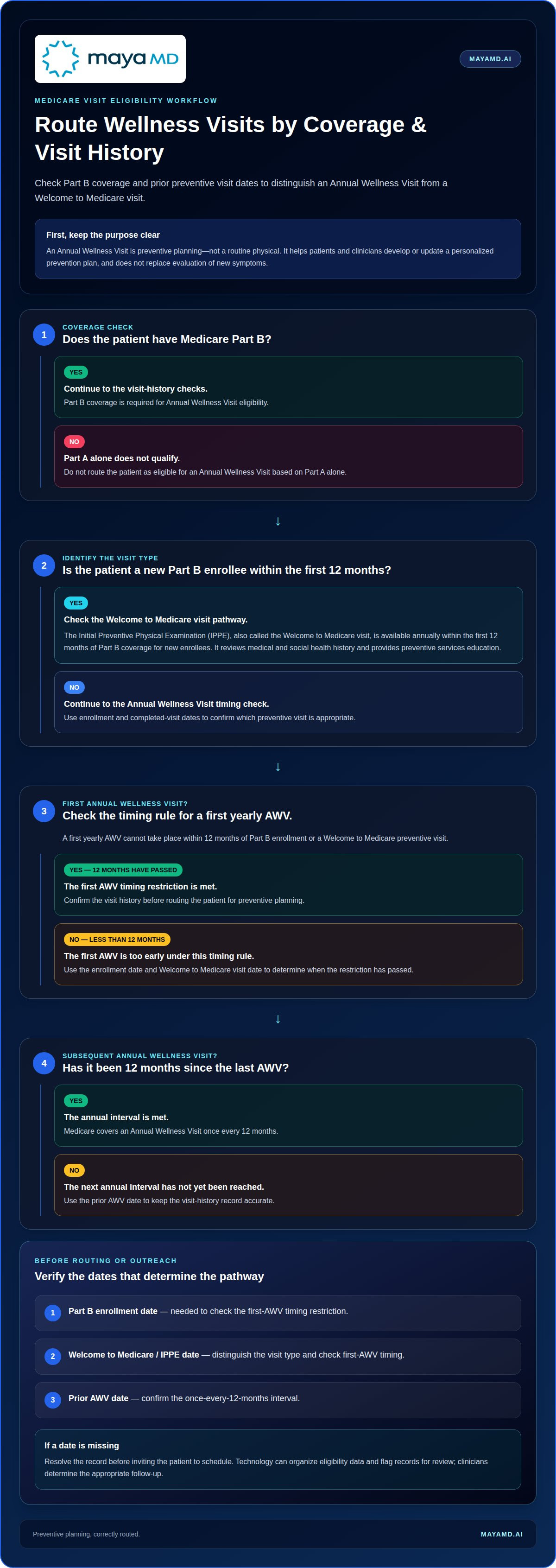
Eligibility identification starts with the patient’s Medicare coverage and visit history. Medicare beneficiaries need Part B coverage to qualify; Part A alone doesn’t qualify. The first yearly wellness visit also has a timing restriction. According to the Centers for Medicare & Medicaid Services, it cannot take place within 12 months of Part B enrollment or a Welcome to Medicare preventive visit, and it is covered annually. Eligibility workflows should therefore capture Part B enrollment and prior preventive visit dates before scheduling.
The Welcome to Medicare visit is also called the Initial Preventive Physical Examination, or IPPE. It is available annually within the first 12 months of Part B coverage for new enrollees. The IPPE reviews medical and social health history and provides preventive services education. It differs from an Annual Wellness Visit, which develops a prevention plan. A scheduling process should distinguish the visit types, then use the patient’s enrollment date and completed-visit record to identify the appropriate appointment.
Prioritization can make outreach more relevant. A practice might group eligible patients by whether they have completed an initial visit, need a subsequent visit, or have an incomplete record. Staff can resolve missing dates before inviting patients to schedule. Within those groups, clinical teams can prioritize people whose records or reported concerns suggest a need for preventive planning. Technology can organize eligibility data and flag records for review, but clinicians determine the appropriate follow-up. For example, a patient reporting balance concerns may need a focused discussion during the visit.
Privacy and security risks include unauthorized access, exposure of sensitive health information, and inaccurate data being attached to the wrong patient. Access controls, secure data handling, and a clear review process help reduce these risks. Patients should understand what information is collected and how it supports their care.
Eligibility technology should also distinguish wellness planning from other care workflows. For instance, heart failure discharge education delivered through conversational agent technology supports post-discharge communication, a separate process from Medicare wellness eligibility. Keeping these workflows distinct helps teams direct patients to the right service and preserve a clear record of each care interaction.
Health risk assessment
A health risk assessment gathers patient-reported information to guide preventive care. Its findings help shape a personalized prevention plan around individual risks, priorities, and needs.
Personalized Prevention Planning
A personalized prevention plan turns assessment findings into priorities to discuss with the care team. It matters because a patient’s concerns, health history, and daily function can point to different next steps. For example, a reported fall concern can prompt a focused conversation about balance and safety. The plan also helps organize follow-up topics rather than treating every patient’s visit as identical.
Measurements and Health Advice
Measurements and health advice add context to patient-reported risks, helping clinicians assess concerns and discuss relevant prevention options. A provider may offer an assessment of physical activity and nutrition during the visit. Advice can then reflect the patient’s reported activity, nutrition, and health priorities. The care team should connect each recommendation to the concern it addresses, making the discussion more useful than a generic checklist.
Medicare Annual Wellness Visit documentation should capture the health risk assessment and the resulting prevention plan. The plan is written and personalized, and covers the next 5 to 10 years. Clear documentation connects identified risks, preventive services discussed, and planned follow-up. It also gives the care team a consistent reference when updating the patient’s plan at a later visit.
Assessment responses can highlight topics that need further clinical discussion. In one Annual Wellness Visit study, 44.2% of patients were at risk for falls or reported balance concerns. Another found that 39.9% had a sedentary lifestyle, while 35.1% were experiencing incontinence. These findings illustrate why a structured assessment should capture distinct concerns rather than reduce them to one general risk score.
Patient outreach technology can support population health workflows by organizing patient-reported information before appointments. Potential AI uses include flagging patients who may need further assessment and suggesting follow-up steps for clinicians to review. For example, a reported mobility concern can be flagged for review while a nutrition concern remains visible in the same assessment workflow. Clinicians interpret those signals; software makes the information easier to review.
Advance care planning is another subject an assessment may bring into view. A study of Annual Wellness Visit patients found that 42.3% did not have a documented advance directive. That finding can prompt a sensitive conversation about the patient’s preferences, without assuming what decision they will make. A well-organized assessment helps the clinician identify the topic, document the discussion, and incorporate appropriate next steps into the prevention plan.
AWV software tools, analytics, and reporting
Annual Wellness Visit software supports a connected workflow, from patient outreach through documentation and follow-up. Its value depends on how effectively it organizes information for clinical review.
AWV Software Tools
AWV software tools include scheduling functions, electronic health record workflows, patient questionnaires, and reporting dashboards. Together, they help teams identify upcoming visits, collect information, and document care consistently. For example, a questionnaire completed before an appointment gives clinicians time to review reported concerns. The tool should support the visit, not replace clinical judgment.
Software costs depend on the case and are provided after a quote request. Factors include implementation scope, integration needs, user access, and required reporting functions. Practices should consider how each factor relates to their existing workflow, rather than viewing software costs separately from staff processes and system connectivity.
Tracking Preventive Care Gaps
Preventive care gap tracking uses patient records and screening recommendations to flag items for review. A visible gap can guide outreach and help clinicians prepare focused discussions. Useful technology connects relevant patient information, displays the status of preventive items, and lets staff update records after review. A flag should prompt assessment, not automatically determine care.
To track gaps, a practice needs reliable patient records, a way to organize screening information, and reporting that shows what requires attention. For example, a dashboard might separate completed items from those needing clinician review. Staff can check the underlying record, resolve missing or outdated information, and route the item into the visit workflow. This sequence helps prevent an automated flag from being mistaken for a verified clinical conclusion.
Analytics can help teams understand patterns across a patient population. A report might show which eligible patients have scheduled visits, where documentation is incomplete, or which follow-up items remain open. These views help leaders identify workflow bottlenecks and assess whether outreach is reaching its intended groups. Reporting is most useful when definitions stay consistent and staff can trace a summary back to the source record.
Documentation bridges data collection and follow-through. A structured record should distinguish patient-reported information, clinician-reviewed findings, preventive services discussed, and planned actions. When a clinician updates a record, the change can inform later reporting and reduce repeated data entry. Clear distinctions also help prevent an initial questionnaire response from appearing to be a confirmed assessment.
The American Academy of Family Physicians supports thoughtful AI use to help identify eligible patients, summarize health information, identify preventive care gaps, support documentation, and facilitate follow-up. AI-generated summaries or suggested actions should remain visible for clinician review. A governed workflow defines who reviews each suggestion, how corrections are recorded, and how unresolved items return to the care team.
Choose reporting views that answer operational questions: which records need review, what follow-up remains, and where enrollment or scheduling stalls. These measures help practices improve workflows without confusing activity counts with clinical outcomes. Software works best as a connected support layer, with clinicians interpreting the information and deciding what care follows.
AWVs integrated with existing appointments
Integrating an Annual Wellness Visit into an existing appointment workflow requires clear boundaries for scheduling, documentation, and follow-up. The goal is to coordinate preventive planning with routine care without treating the visits as interchangeable.
An AWV focuses on prevention planning, while an appointment for a new symptom addresses that concern. A routine physical exam is also distinct from an AWV. Scheduling workflows should label the visit purpose, identify relevant records, and allow time for the appropriate discussion. For example, a patient booked for medication follow-up may also be due for wellness planning, but the team should document both purposes.
Platforms designed for AWVs can provide dedicated eligibility prompts, questionnaires, and reporting views. EHR-based workflows keep documentation in the clinical record and may use existing scheduling and patient data. The practical comparison is about fit: a separate platform may organize wellness-specific tasks, while an EHR workflow can keep information alongside other encounter documentation. Integration and duplicate data entry matter in either approach.
A coordinated program can follow a sequence of operational steps. First, identify patients due for preventive planning through scheduling and record review. Next, invite them to complete relevant information before the appointment. During the visit, clinicians review responses and document the prevention plan. Afterward, staff record follow-up actions and route unresolved items to the appropriate workflow. Each step needs a clear owner so a screening discussion does not disappear between teams.
Existing appointments can provide a useful opportunity for outreach, but they should not automatically become AWVs. A physician or care team can determine whether preventive planning fits the scheduled encounter and patient needs. If the visit includes an acute concern, documentation should distinguish that evaluation from wellness planning. This separation helps reporting show which services were discussed and which outcomes need follow-up.
Technology can support coordination by displaying appointment purpose, prior documentation, reported concerns, and open preventive tasks together. The American Academy of Family Physicians supports thoughtful AI use to summarize health information, support documentation, and facilitate follow-up. In practice, staff review any summary against the record, while clinicians decide what belongs in the care plan.
Measure workflow performance through operational questions, not assumptions. Can staff identify eligible patients? Are pre-visit responses available to clinicians? Does each follow-up task have a documented owner? Reviewing these points helps a practice improve its program while keeping preventive care connected to the patient’s broader appointments.
Clinical staff involvement in telehealth AWVs
Telehealth Annual Wellness Visits depend on coordinated clinical roles, clear documentation, and a workflow that keeps the patient’s primary care team involved. Medicare AWVs can be delivered by telehealth through December 31, 2027, while the Welcome to Medicare visit must be performed in person.
Clinical staff can help patients prepare, collect patient-reported information, and organize the visit. The clinician remains central to interpreting responses and guiding preventive discussions. The American Academy of Family Physicians cautions that technology-enabled AWVs should strengthen, not bypass, a patient’s existing primary care team. This principle keeps digital workflows connected to ongoing care.
Staff responsibilities should be explicit before the appointment. A workflow can identify who contacts the patient, who reviews submitted information, and who documents the encounter. The stated CMS rules allow clinical staff to administer telehealth AWVs without direct supervision when one or two qualifying criteria are met. Practices should define the applicable workflow and role boundaries before assigning visit tasks.
A practice’s scheduling process should distinguish a telehealth visit from a telephone-only encounter, then route patients accordingly. This matters when staff confirm the visit format, prepare documentation, and record what occurred. It also reduces confusion between an attempted contact and a completed clinical encounter.
Telehealth can also change how teams distribute visit work. In an Appletree Bay Primary Care pilot, RN-led Annual Wellness Visits increased by more than 200%. That result illustrates how staff involvement can expand a program’s capacity, though the workflow still needs clinician oversight and clear escalation paths. For example, a patient response that raises a new clinical concern should be routed for appropriate review, rather than treated as routine wellness documentation.
Billing workflows should match the services performed and the documentation recorded. Staff can capture patient responses and task completion, while clinicians document their review and any resulting recommendations. Separating these steps helps the practice maintain a clear account of who contributed to the encounter. It also supports consistent reporting when the team reviews completed visits and outstanding follow-up.
Technology works best when it makes staff contributions visible without obscuring clinical accountability. A defined telehealth workflow can connect outreach, patient responses, clinician review, documentation, and follow-up. To discuss clinical AI workflows that support coordinated patient care, connect with MayaMD.
MayaMD
MayaMD helps healthcare organizations connect patient engagement with clinical workflows through AI-enabled solutions. For teams evaluating technology for annual wellness visits, these capabilities can support communication and continuity across broader care processes, while clinicians retain responsibility for preventive decisions. MayaMD’s Clinical AI Agent and AI patient engagement solutions can structure patient interactions and support information flow across care journeys. They are most relevant when a practice is considering how digital engagement can complement, rather than replace, its clinical team and systems.
Explore how a Clinical AI Agent can fit into patient-facing workflows, or contact MayaMD to discuss your organization’s needs.
Build the Next Step Into the Care Journey
The next opportunity is to treat preventive care as part of a connected patient journey, not an isolated appointment. As you assess technology for annual wellness visits, consider how each workflow supports patient communication, clinical review, and continuity after a care interaction. A useful design keeps the care team’s decisions central while making relevant information easier to act on.
MayaMD offers a Clinical AI Agent, AI patient engagement solutions, and automated post-discharge communication solutions. These capabilities can support engagement and follow-through across care workflows. A practical starting point is the operational challenge your organization wants to address, such as making patient interactions more consistent or connecting communication with ongoing care.
Use that priority to guide a focused discussion about how digital support could fit your clinical environment. Contact MayaMD to discuss your care workflow and identify a considered next step.
Frequently Asked Questions
What technology is used for Medicare Annual Wellness Visits?
Practices can use EHRs, patient questionnaires, scheduling tools, and reporting dashboards to support these visits. Together, these systems organize patient information and make follow-up tasks easier to track. Technology for annual wellness visits may also include AI-supported summaries for clinical review. For example, a clinician can review a summary alongside the original patient responses before documenting relevant care priorities.
Which EHR features support Annual Wellness Visit workflows?
Useful EHR features include visit templates, structured fields for patient responses, scheduling indicators, and documentation workflows. Practices can configure these elements to distinguish wellness planning from other encounter types. For example, a template can separate patient-reported information from clinician-reviewed findings. Clear field labels reduce ambiguity when another team member later reviews the record or prepares for a subsequent appointment.
What digital tools are used for health risk assessments and preventive screening during wellness visits?
Digital questionnaires can collect patient-reported health information before or during an appointment, while screening prompts organize topics for clinical review. A practice can distinguish completed, incomplete, and uncertain information so staff know what needs attention. For example, an unanswered screening prompt should remain a question for the care team, not appear as a completed assessment or clinical conclusion.
How can telehealth technology be used for Medicare Annual Wellness Visits?
Telehealth workflows can connect appointment scheduling, pre-visit information collection, and clinician review. Before the encounter, a patient may submit relevant responses through a digital process. During the visit, the clinician can discuss those responses and document appropriate next steps. Staff can then route follow-up items through the practice’s established workflow. Telehealth supports the encounter, while clinical decisions remain with the care team.
How can a medical practice implement technology for Annual Wellness Visits?
Start by mapping the existing workflow, from identifying patients to recording follow-up. Then assign clear ownership for outreach, information review, documentation, and unresolved tasks. Test the process with a defined group of appointments before expanding it across the practice. After implementation, review staff feedback and record quality, then adjust templates or handoffs where information is duplicated, unclear, or difficult to find.




See The MayaMD Difference
Fill the form below
Download Our Apps
MayaMD for patients and MayaPro for physicians - available on iOS and Android.
FOR PATIENTS
MayaMD App
AI-powered symptom assessment, triage, and secure access to your care team.

FOR PHYSICIANS
MayaPro App
MayaPro brings patient vitals, RPM/PCM care plans, and clinical decision support to your pocket.