
Remote Heart Failure Monitoring: 2026 Care Team Guide

A stream of home readings isn’t the same as a care plan. Remote monitoring for heart failure can give care teams useful visibility between visits, but its value depends on whether meaningful changes reach the right person and prompt an appropriate response.
Measurements may arrive without timely follow-up, while noisy or incomplete data can make it harder to spot what needs attention. Daily tasks can also become difficult for patients to sustain. Effective monitoring therefore requires more than technology. It needs a patient-centered workflow with clear responsibilities, review criteria, and escalation steps.
This 2026 guide explains what remote monitoring can and can’t do in heart failure care, and how teams can connect home data with coordinated clinical action. It covers patient engagement, review and escalation responsibilities, privacy and data handling, and how to evaluate technology for workflow fit and measurable performance. It also explains where tools such as MayaMD’s Clinical AI Agent can support communication and documentation under clinician-defined oversight, without replacing clinical judgment.
Key Takeaways
• Understand what remote monitoring for heart failure can contribute to care, and why home data alone cannot replace clinical assessment.
• Use a clear sequence to turn patient readings and symptom reports into review, follow-up, documentation, and reassessment.
• Set program criteria, assign a care-team owner, and plan onboarding around patient access, language, and accessibility needs.
• Define escalation and after-hours expectations before launch so patients and staff know how concerns will be handled.
• Assess how technology may support engagement and documentation, while verifying workflow fit, data handling, and clinical oversight.
What Remote Monitoring for Heart Failure Can and Cannot Do
Remote monitoring collects health information outside the clinic so a care team can review it within an established workflow. In heart failure care, that information may include measurements, patient-reported symptoms, and responses to scheduled check-ins. The purpose is to connect changes at home with appropriate clinical review, not simply to accumulate readings. A general overview of remote patient monitoring describes how this approach can support chronic disease management.
Remote monitoring is distinct from a telehealth visit, which involves a remote clinical encounter. It is not an emergency response service or continuous bedside observation. Monitoring may inform clinical decisions, but it doesn’t diagnose or treat heart failure by itself. Clinicians interpret information in context and decide whether follow-up or a change in care is appropriate.
Which heart failure signals might a care plan monitor?
Depending on the patient’s condition and care goals, a plan may include weight, blood pressure, heart rate, or reported symptoms. These inputs are most useful when the patient understands how to collect or report them and the team has a defined process for review. The clinical team should individualize the measures, collection frequency, and response criteria. Avoid applying universal thresholds or protocols without verification against current authoritative guidance.
Why monitoring may matter between visits and after discharge
Scheduled appointments provide important opportunities for assessment, but they offer only snapshots of a patient’s health. Home monitoring and structured communication can help patients share changes between visits, giving the care team additional context to consider. A measurement alone may not explain what’s happening. A symptom report or follow-up conversation can help clarify the patient’s experience without replacing clinical assessment.
Continuity can be especially relevant after discharge, when patients are adapting to care instructions at home. Clear, planned communication gives patients a route to share questions or changes and helps teams organize follow-up. MayaMD’s heart failure discharge education research explores conversational agent technology in this transition. For care teams evaluating technology, MayaMD’s remote patient monitoring support is part of a broader focus on connecting monitoring workflows, patient engagement, and clinical documentation under clinician oversight.
How a Heart Failure Remote Monitoring Workflow Turns Data Into Follow-Up
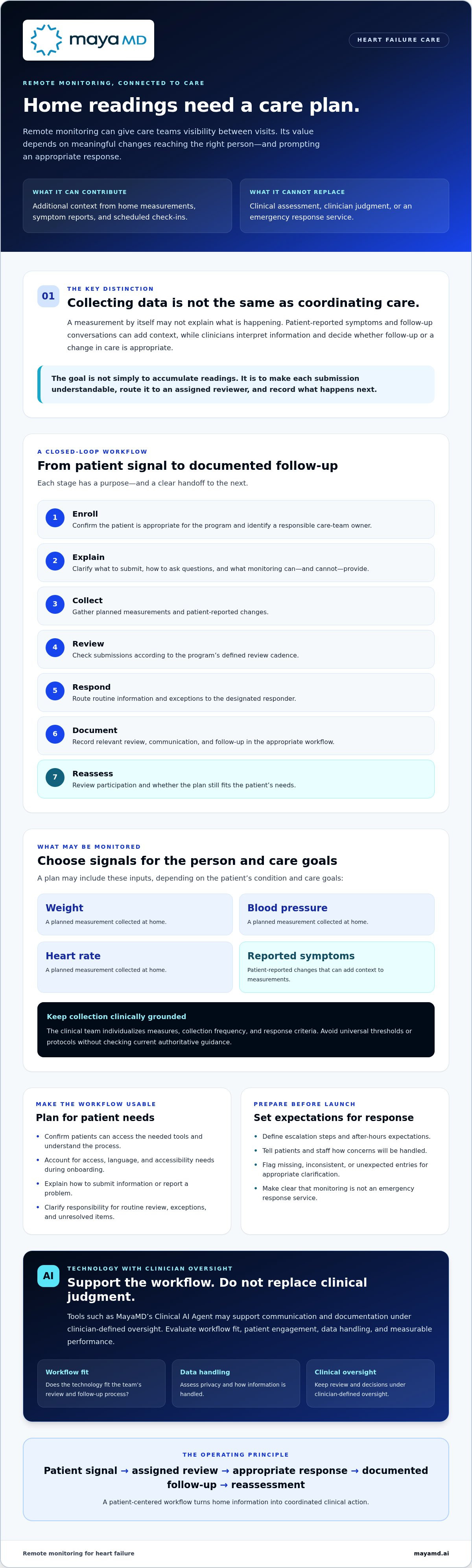
A dependable workflow defines what happens after information leaves the patient’s home. In remote monitoring for heart failure, the goal isn’t to collect the largest volume of data. It’s to make each submission understandable, route it to an assigned reviewer, and record what happens next.
A closed-loop monitoring workflow connects a patient signal to clinical review, an appropriate response, and documented follow-up.
Enroll
Confirm the patient is appropriate for the program and identify a responsible care-team owner.
Explain
Clarify what to submit, how to ask questions, and what monitoring can and can’t provide.
Collect
Gather planned measurements and patient-reported changes.
Review
Check submissions according to the program’s defined review cadence.
Respond
Route routine information and exceptions to the designated responder.
Document
Record relevant review, communication, and follow-up in the appropriate workflow.
Reassess
Review participation and whether the plan still fits the patient’s needs.
Collect usable measurements and patient-reported changes
Onboarding should establish that the patient understands the process, can access the needed tools, and knows how to submit information or report a problem. The workflow should flag missing, inconsistent, or unexpected entries for appropriate clarification before they are interpreted. Symptom reports can add context, such as describing how a patient feels alongside a measurement, but they don’t replace clinical assessment. Device choices and collection frequency should follow the care plan, not a generic recommendation.
Route information to the right clinical responder
Assign responsibility in advance. Decide who reviews routine submissions, who handles exceptions, and how unresolved items are handed off. Clinicians should define and document the review cadence, alert routing, and escalation rules based on the program and the urgency of the concern. Patients also need clear instructions about what to do if they need urgent help. They should not assume a submitted reading is reviewed immediately.
For broader program context, see MayaMD’s remote patient monitoring overview. Care teams evaluating how technology may support communication, monitoring workflows, and documentation can review the options on MayaMD’s contact page.
Does Remote Monitoring Prevent Heart Failure Deterioration or Create Alert Burden?
Collecting readings doesn’t guarantee earlier intervention or better outcomes. Remote monitoring for heart failure can give a care team visibility between visits, but that visibility matters only when submissions are reliable, reviewed within a defined process, and connected to appropriate clinical action. For example, a patient may submit a concerning measurement, but if no one owns its review or follow-up, the data alone does not change care.
Monitoring creates an opportunity to identify and review signals. Evidence for the specific program and population is needed to support claims about patient-level outcomes.
What monitoring can support and where its limits remain
Patterns across measurements or symptom reports may help clinicians decide what to assess next, provided the information is sufficiently complete and the response process is clear. A trend is a prompt for review, not a diagnosis. Remote data can’t independently confirm worsening heart failure or determine treatment, and it shouldn’t be presented as a substitute for clinical visits or assessment.
Claims that a program prevents admissions or detects every episode of deterioration require current clinical evidence that applies to the patients, technology, and care model in question. Before adopting an outcome claim, teams should examine how the study defined its patient population, intervention, comparison, and measured outcomes. Results from one program shouldn’t automatically be generalized to another.
How care teams can manage alerts without overwhelming staff
Not every reading needs the same response. A clinically governed approach can distinguish routine submissions from exceptions and direct each to an assigned reviewer or escalation pathway. Clinicians should define routing rules, documentation expectations, and coverage responsibilities, including what patients should do if they need urgent help. The monitoring platform shouldn’t imply that a submission is being watched continuously unless the program actually provides that coverage.
Alert fatigue can arise when teams receive frequent notifications without enough context or a clear action. Incomplete participation creates a different risk: absent data may be mistaken for reassuring data unless missing submissions are visible and handled according to policy. Review the workflow regularly using operational measures such as alert volume, response time, unresolved escalations, and missing-data patterns. Interpret these alongside patient participation and the program’s clinical aims. A lower alert count alone is not proof of better care.
How to Design a Patient-Centered Heart Failure Monitoring Program
A sound program starts with a defined clinical purpose, not a technology purchase. Specify the population the program is intended to serve, enrollment criteria, the information that will support care, and a care-team owner accountable for the workflow. These decisions help determine what patients are asked to do and what the team can reliably review and act on.
Map the full experience before enrollment: consent, onboarding, data review, escalation, documentation, and reassessment. Include expectations for nights, weekends, and other times when the usual review process may not be operating. Patients should know how submissions are reviewed and what to do if a concern needs attention outside those arrangements.
Prepare patients and care teams before enrollment
Explain in plain language what information patients will submit, who reviews it, and how they can ask questions. Confirm access to required tools, comfort using them, preferred language, and any accessibility needs. If digital participation is difficult, define a suitable non-digital support pathway rather than treating missing submissions as reassurance.
Staff preparation matters just as much. Clarify who reviews routine information, who handles exceptions, how handoffs work, what must be documented, and how escalation follows clinician-defined procedures. A written workflow gives team members a shared reference and makes gaps easier to identify before they affect patient follow-up.
Evaluate program performance with measures that fit its goals
Start with a manageable pilot and decide in advance what success means. Define each measure, its data source, and review interval before launch. Process measures can show whether the workflow functions. Clinical outcomes address a different question and need appropriate evidence and interpretation.
Participation
Track enrollment and ongoing engagement, including where patients stop submitting information.
Data quality
Monitor missing or incomplete submissions and whether they can be resolved.
Follow-up reliability
Measure whether assigned reviews and escalations are completed and documented.
Operational workload
Assess alert volume, staff time, and handoff burden against available capacity.
Use pilot findings to adjust onboarding, routing, and staffing expectations before expanding. Evaluate software against these defined workflows, data handling practices, and documentation needs. Verify device or system compatibility rather than assuming it. MayaMD’s remote monitoring technology supports chronic care workflows, patient engagement, and clinical documentation under clinician-defined oversight. Treat reimbursement as a separate compliance review, and verify current CMS requirements before making billing decisions or publishing reimbursement guidance.
For information about MayaMD’s approach, visit the contact page.
Where MayaMD Fits in Remote Monitoring for Heart Failure
MayaMD provides a cloud-based, HIPAA-compliant clinical AI platform that supports remote patient monitoring and chronic care workflows. In a heart failure program, its role is to help connect patient engagement, monitoring processes, and clinical documentation. The care team remains responsible for reviewing information and making clinical decisions.
Connect patient communication with care-team workflows
Consistent communication can help patients understand care instructions and share information with their team. MayaMD’s capabilities include patient engagement and automated post-discharge communication, which can support continuity as patients move from hospital care to follow-up at home. Its Clinical AI Agent combines deterministic logic with generative AI to support engagement and documentation within clinician-defined oversight. It does not independently diagnose, determine treatment, or replace clinical judgment. Read more about the broader role of the Clinical AI Agent.
MayaMD provides software, not monitoring hardware or clinical staff. Care teams should confirm separately how any required measurements will be collected and who is responsible for reviewing submissions, handling exceptions, and communicating with patients. Establish these responsibilities in the program workflow rather than assuming they are included with a platform.
Evaluate fit before selecting a remote monitoring partner
Assess technology against the program you have designed. Ask vendors how data is handled, what workflow configuration is supported, how documentation needs are addressed, and what clinician oversight is expected. Confirm device, EHR, and other clinical-system integrations directly. Don’t assume compatibility without verification.
Request evidence and clear definitions for any clinical, operational, or financial performance claims. A useful evaluation distinguishes what the software can do from what a care program has demonstrated with its intended patient population. Consider whether the proposed workflow supports your team’s responsibilities and gives patients clear communication about how monitoring works.
If your team is assessing how MayaMD may fit its chronic care workflows, the contact page is available for discussing monitoring workflow requirements, oversight, data handling, and integration questions.
Make Monitoring a Connected Part of Care
Remote monitoring for heart failure is most useful when patient information leads to clearly assigned review, appropriate follow-up, and documentation. Technology can support that connection, but it doesn’t replace clinical judgment or ensure better outcomes on its own. A patient-centered program starts with realistic expectations, defined responsibilities, and a workflow teams can evaluate and improve.
MayaMD’s cloud-based, HIPAA-compliant clinical AI platform supports remote monitoring, patient engagement, and clinical documentation within chronic care workflows. Its Clinical AI Agent combines deterministic logic with generative AI to assist care processes under clinician-defined oversight. The right fit depends on your program’s needs, data handling requirements, and verified workflow capabilities.
Build a model that works for both patients and care teams. Discuss your heart failure monitoring workflow with MayaMD and explore how technology may support your approach. With clear governance and a focus on meaningful follow-up, teams can strengthen the connection between care at home and clinical support.
Frequently Asked Questions
How does remote monitoring for heart failure work?
Remote monitoring for heart failure collects information at home, such as readings or symptom reports, and routes it to a care team for review. A program should explain what patients submit, who reviews it, how concerns are escalated, and what follow-up may occur. The process works best when patients can participate and staff have clear responsibilities. Monitoring supports clinical review; it doesn’t diagnose or treat heart failure by itself.
What should be monitored for a patient with heart failure?
A clinician may include weight, blood pressure, heart rate, or patient-reported symptoms, depending on the individual’s condition and care goals. Not every patient needs the same measures or collection schedule. The care team should specify what to record, how to report it, and what to do if a reading is missing or unexpected. Patients should follow their own care plan rather than apply generic thresholds found online.
Can remote monitoring detect worsening heart failure?
Remote monitoring may give clinicians additional information to review, but it can’t reliably detect every instance of worsening heart failure or confirm a diagnosis on its own. Readings and symptoms need to be interpreted in context, and useful follow-up depends on data quality and a defined review process. Patients should follow their care team’s instructions for urgent concerns rather than assume a submitted measurement is reviewed immediately.
Does remote patient monitoring reduce heart failure hospitalizations?
It may support earlier clinical review in a well-designed program, but monitoring alone doesn’t guarantee fewer hospitalizations. Outcomes depend on factors such as the patient population, care model, participation, and how the team responds to information. Before relying on a reduction claim, review current clinical evidence and check whether the studied program resembles the one being considered. Ask how outcomes were defined and measured, not just what technology was used.
Is remote monitoring for heart failure the same as telehealth?
No. Remote monitoring generally involves collecting health information outside the clinic for review within a care workflow. Telehealth usually refers to a remote clinical interaction, such as a video or phone visit. A heart failure program may use both, but one doesn’t automatically include the other. Neither should be confused with emergency services or continuous bedside observation. Patients should know how to contact their care team and where to seek urgent help.
Does Medicare cover remote patient monitoring for heart failure?
Coverage and billing depend on current Medicare requirements and the details of the service, practitioner, and patient’s circumstances. Don’t assume that a diagnosis alone makes a program eligible or that every plan applies the same terms. Care teams should verify current CMS guidance and applicable payer policies before designing billing workflows or promising coverage. This is a reimbursement question to confirm with qualified compliance or billing staff.
What happens if a heart failure patient misses a reading?
A missed reading should be treated as missing information, not as evidence that the patient is stable. The program should define how the team identifies gaps, when it follows up, and how patients can report access or usability problems. Patients should follow their care team’s instructions if they miss a submission, feel unwell, or have an urgent concern. A monitoring system isn’t a substitute for contacting a clinician when needed.




See The MayaMD Difference
Fill the form below
Download Our Apps
MayaMD for patients and MayaPro for physicians - available on iOS and Android.
FOR PATIENTS
MayaMD App
AI-powered symptom assessment, triage, and secure access to your care team.


FOR PHYSICIANS
MayaPro App
MayaPro brings patient vitals, RPM/PCM care plans, and clinical decision support to your pocket.