
Reduce Physician Burnout with AI: 2026 Workflow Guide

What if the best way to reduce physician burnout with AI is to give the technology a narrower role, not a broader one? Documentation, administrative tasks, and care coordination can compete with time spent listening to patients. AI may help ease that pressure when it supports a clearly defined task, fits the clinical workflow, and leaves professional judgment with clinicians.
It’s reasonable to be cautious. Promising claims aren’t the same as validated outcomes, and a tool that adds review steps or shifts work elsewhere can create new friction instead of reducing it. The goal is to identify specific tasks suitable for AI support, assess the evidence for the tool’s intended use, and measure whether implementation improves the workday without compromising care.
This guide outlines where to start, what to scrutinize, and how to introduce AI with clear oversight and accountability. You’ll explore administrative and care-coordination use cases, ways to distinguish emerging promise from established evidence, and practical measures for evaluating impact. The principle is straightforward: AI should support the work of care, not substitute for clinician judgment or human connection.
Key Takeaways
• Identify how documentation, inbox work, follow-up, and fragmented care coordination affect clinicians differently so you can target the right workflow pressures.
• Explore where AI may support documentation, routine communication, and longitudinal patient engagement without assuming guaranteed time savings.
• Evaluate whether an AI tool removes work or shifts it into review and correction, and keep clinician oversight central to its clinical use.
• Build a measured plan to reduce physician burnout with AI by starting with clinician-identified pain points and monitoring impact before expanding use.
• See how MayaMD’s cloud-based, HIPAA-compliant platform connects clinical AI with chronic-condition support and care-coordination workflows.
Why physician burnout persists, and where AI may reduce the burden
Burnout is more than the tiredness that can follow a demanding shift. It describes a persistent response to chronic workplace stress, commonly associated with emotional exhaustion, detachment or cynicism toward work, and a reduced sense of professional effectiveness. It isn’t a personal failing, and a difficult day alone doesn’t establish burnout. The broader Physician Burnout overview discusses its causes and consequences, including the role of working conditions.
That distinction matters when evaluating technology. AI may help with selected sources of workflow friction, but it can’t resolve understaffing, excessive workload, limited control, or organizational cultures that leave clinicians without adequate support. Treat it as one possible component of a broader response, not a stand-alone burnout intervention.
Which clinical tasks contribute to daily workflow strain?
Different tasks create different kinds of pressure, so they call for distinct solutions. If your team is considering AI for a particular workflow, start by identifying where work accumulates and who handles it. MayaMD can discuss your clinical workflow needs.
Documentation
Recording the encounter, organizing relevant details, and completing clinical records can extend work beyond the patient visit. Assistance with drafting or structuring documentation may help, but clinicians still need time and responsibility to review the record. Track both time spent drafting and time spent correcting or completing notes.
Inbox work
Messages, requests, and routine administrative communications arrive alongside clinical duties. Some communications may be suitable for organization or drafting support. Interpreting symptoms, setting urgency, and making clinical decisions remain distinct responsibilities that require appropriate clinical oversight.
Patient follow-up
Repeated reminders and routine post-visit or post-discharge communication can take staff and clinician attention. Supporting these interactions may help maintain continuity, but a message involving new or worsening symptoms may require clinical assessment rather than an automated response.
Chronic-care coordination
Ongoing care involves tracking needs and maintaining communication across multiple points in time. Fragmented workflows can make it harder to keep information and follow-up connected, increasing coordination demands even when no single task is especially complex. Map how information moves between team members to identify where follow-up gets delayed or duplicated.
These pressures can overlap, but they shouldn’t be treated as interchangeable. A documentation tool won’t necessarily reduce inbox volume, and a communication workflow won’t automatically solve fragmented coordination. Match the proposed tool to the specific task and evaluate that workflow on its own.
What does responsible AI support mean in clinical practice?
“AI workload support assists with defined, repeatable tasks while clinicians retain accountable oversight; it is not, by itself, a complete burnout intervention.” In practice, that means distinguishing administrative or communication assistance from autonomous diagnosis or replacing clinical roles. Clinicians need appropriate review and control over outputs that affect the record or patient care.
For organizations considering how to reduce physician burnout with AI, the first question is not simply whether a tool uses advanced technology. It’s whether the tool addresses a specific, observed source of strain without shifting hidden work into correction, monitoring, or extra handoffs. A clinical AI agent can support patient engagement, clinical documentation, and post-discharge communication within connected care workflows. Assess its role against the task, workflow, and oversight clinicians actually need.
Clinician skepticism is reasonable. Adoption isn’t inevitable, and a tool that doesn’t fit practice may add friction. Start by identifying the burden, then assess whether AI is appropriate for that task and whether the organization can monitor its effects.
How AI can reduce physician burnout across documentation and care workflows
AI is most useful when its capabilities match a specific task. Documentation assistance, routine communication support, and longitudinal patient engagement address different points in care delivery, so evaluate them separately rather than grouping them under a broad promise to save time. The aim is to reduce friction in the workflow while preserving clinical review and accountability.
Can AI documentation tools return attention to the patient?
Documentation tools may generate a draft from a clinical encounter or help organize information for a note. If the workflow is well designed, clinicians may be able to focus more on the conversation instead of composing every detail in real time. But a draft isn’t a final record. Clinicians may need to correct omissions, resolve inaccuracies, and confirm that the note reflects the encounter. Review time is part of the workflow, not an incidental step.
One reported example is a Yale Medicine account of a 30-day evaluation of ambient AI scribes involving 263 physicians across six health systems. That describes a limited evaluation period and participating settings, not proof that every documentation tool produces lasting reductions in burnout or works equally well across specialties. Interpret the findings in the context of the specific tool, users, and study duration.
How can AI support follow-up beyond the visit?
Communication and continuity create other opportunities for targeted assistance. Routine patient engagement can support repeatable interactions, while post-discharge communication addresses a distinct transition from hospital to home. Neither should be confused with clinical decision-making: a symptom report that needs assessment requires an appropriate clinical pathway, not simply a faster message response.
Longitudinal care adds another layer. For people managing chronic conditions, information and follow-up needs recur over time, and care teams may need to coordinate engagement across those touchpoints. Remote patient monitoring workflows can support ongoing chronic-care communication, complementing rather than replacing clinician assessment. MayaMD’s Clinical AI Agent supports patient engagement, clinical documentation, and post-discharge communication. Its platform combines deterministic logic with generative AI for chronic-condition support.
Documentation support
can assist with producing or organizing note content, with clinician review before use.
Routine communication support
can help with repeatable interactions while routing clinical concerns through defined oversight.
Longitudinal engagement
can help connect follow-up across time, especially in chronic-care workflows where continuity matters.
AI’s value depends on task fit and human review. A tool may shift effort rather than remove it if clinicians must repeatedly correct outputs or manage additional handoffs. To reduce physician burnout with AI, assess each use case by its actual workflow effect, not by the sophistication of the technology alone. Organizations considering how clinical AI could fit their care workflows can discuss their implementation needs with MayaMD.
How to evaluate AI burnout solutions without adding new burdens
A credible evaluation asks more than whether an AI tool works in a demonstration. Leaders need to know whether it fits the actual workflow, what level of human review it requires, and whether it removes work or shifts effort into checking, correction, and exception handling. Define the task and establish a baseline before implementation so the team can compare like with like.
| Evaluation dimension | Questions to assess | What to measure |
|---|---|---|
| Workflow fit | Does the tool fit existing steps, roles, and systems, or add handoffs and duplicate entry? | Task completion, workflow delays, and staff-reported friction. |
| Oversight | Which outputs require clinician review? How are uncertain results, exceptions, or urgent concerns escalated? | Review and correction patterns, escalations, and unresolved exceptions. |
| Added burden | Does the tool reduce effort at the source, or transfer it to another clinician or team member? | Time spent on the task, review, correction, and related after-hours work. |
| Evaluation | Are baseline and follow-up measures consistent, and can changes be interpreted in context? | Operational measures, wellbeing measures, and staff feedback over time. |
Which measures show whether a workflow intervention is helping?
Choose operational measures that correspond to the intended change. For documentation support, track time spent documenting and correcting notes. For communication workflows, examine task completion and time spent handling follow-up. Review after-hours work as a separate measure rather than assuming that faster task completion during a shift reduces work later.
Establish baseline measures before rollout, then collect the same measures during evaluation. Pair operational data with staff feedback and, where appropriate, validated wellbeing measures. Workload indicators can show whether a process changed; they can’t, by themselves, establish that burnout improved. Staffing, schedules, leadership, and other concurrent changes may also influence wellbeing, so avoid attributing changes to a single tool without a suitable evaluation design.
What risks should clinical leaders assess before adoption?
Review accuracy, transparency about AI-generated content, privacy, and data governance, including how information is handled and who can access it. Define what happens when outputs are incomplete, incorrect, or outside the tool’s intended task. Set clear procedures for escalation and correction, and identify who remains accountable for clinical decisions and patient-facing communication.
HIPAA compliance alone doesn’t establish clinical effectiveness or workflow fit. It addresses an important dimension of responsible handling, but leaders still need to evaluate performance for the intended use, the review burden, and the consequences of errors or delays. Clinicians should have a defined role in oversight, not be left to discover limitations after deployment.
A disciplined assessment helps organizations reduce physician burnout with AI by testing whether assistance makes work more manageable without creating hidden tasks. Continue only when evidence from the workflow, staff experience, and safety review supports the change.
How to implement AI for physician burnout in a measured way
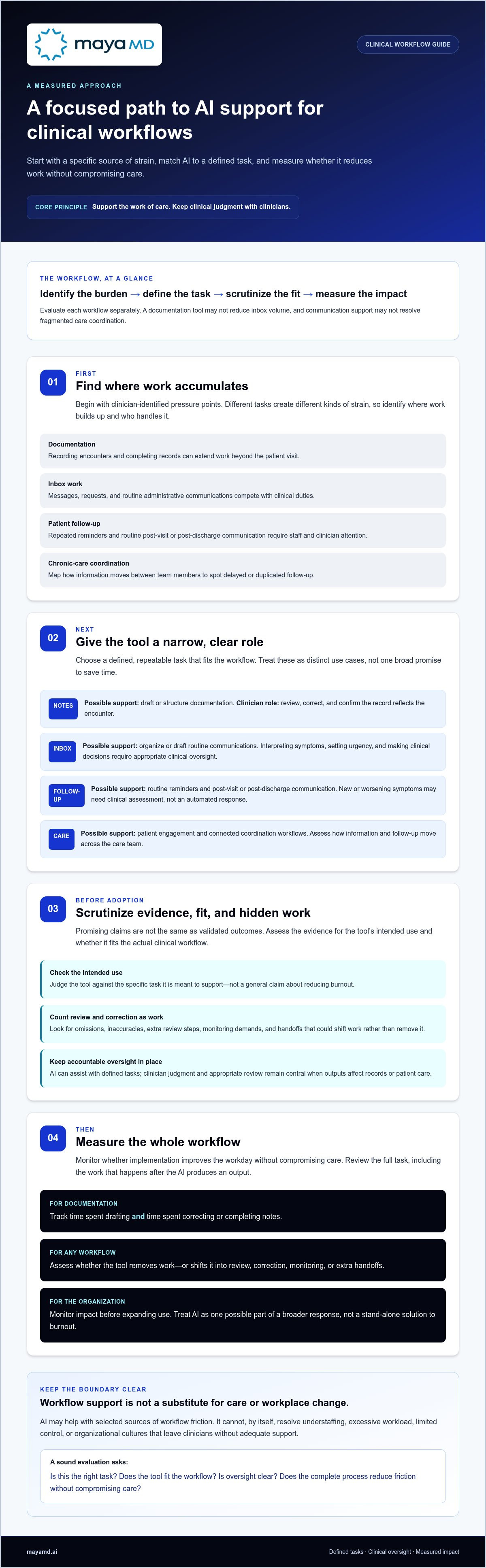
Implementation should begin with the work, not the tool. Clinicians are closest to the repeated steps, bottlenecks, and workarounds that make a workflow burdensome. Involve them in selecting the problem, defining acceptable assistance, and setting conditions for pausing or changing the pilot. This makes the purpose clear and helps keep adoption from becoming another task imposed on already strained teams.
How should an organization choose a first workflow to pilot?
Look for a frequent, bounded task with a clear beginning and end, such as routine communication or a defined documentation step. Confirm that it addresses a source of burden clinicians have identified, and map who completes the task, where delays arise, and what exceptions require escalation. Exclude work that depends on unreviewed autonomous clinical judgment. Before launch, agree on who reviews outputs and how errors will be corrected.
Use a staged sequence so teams can test assumptions before expanding use:
Discover the workflow.
Observe and document the current process with clinicians and staff. Record handoffs, duplicate steps, exceptions, and when work spills beyond scheduled hours.
Set the baseline and scope.
Define the task the pilot will address, the users and patients involved, and the measures that will show whether the process changes. Keep the initial scope narrow enough to review closely.
Specify oversight before launch.
Document which outputs need review, who handles uncertain or incorrect results, how urgent concerns are escalated, and who is accountable for final decisions. Prepare users for the revised process.
Review before expanding.
Compare pilot findings with baseline measures and feedback. Refine the workflow, continue with appropriate monitoring, or stop if the change adds burden or creates unacceptable risk.
Workflow design is central to successful automation because technology must fit the sequence of work and responsibilities around it. A conversation with MayaMD about your clinical workflow needs can help frame where its clinical AI capabilities may align with care processes.
How can teams monitor a pilot responsibly?
Before implementation, choose a defined review period and consistent measures. Monitor accuracy, correction rates, workflow delays, task completion, and time spent on the targeted work. Consider whether review or exception handling shifts effort to another role. Collect feedback from clinicians and affected patients, since operational data alone may miss confusion, communication gaps, or reduced trust.
Use the findings to adjust task boundaries, review procedures, training, or escalation pathways. If the pilot fails to address the documented burden, creates persistent workflow friction, or raises unresolved safety concerns, pause or stop rather than expanding by default. Wider deployment should follow evidence that the revised process is workable, appropriately governed, and acceptable to the people using it.
A measured approach can help organizations reduce physician burnout with AI by treating implementation as an ongoing operational decision, not a one-time technology launch. Expansion is earned through observed fit and responsible oversight.
How MayaMD connects clinical AI with chronic-care support
After identifying a workflow burden and establishing how to evaluate a proposed intervention, organizations can consider how clinical AI fits within broader care delivery. MayaMD provides a cloud-based, HIPAA-compliant clinical AI platform designed to support chronic-condition care. Its Clinical AI Agent combines deterministic logic with generative AI, bringing structured clinical logic and generative capabilities together to support patient engagement, clinical documentation, and post-discharge communication.
These functions address different points in a patient’s care journey. Documentation support relates to the clinical record, patient engagement supports communication, and post-discharge communication can contribute to continuity during the transition from hospital to home. Their potential value depends on how well they fit existing responsibilities and how clinicians oversee relevant outputs. They are workflow capabilities to assess, not a guarantee of reduced workload or burnout.
Where can MayaMD fit within chronic-care workflows?
Chronic-condition support often extends beyond a single visit. Remote Patient Monitoring (RPM), Advanced Primary Care Management (APCM), and Principal Care Management (PCM) workflows can help organize ongoing care around patients’ needs over time. MayaMD provides AI-driven tools for these care workflows, using its Clinical AI Agent to support patient engagement, documentation, and post-discharge care. Communication capabilities can complement ongoing care by supporting continuity across follow-up touchpoints.
For example, a care team can map how patient engagement, documentation, and post-discharge communication fit into its chronic-care process, then identify where oversight and coordination remain necessary. That assessment should reflect the team’s actual workflow: which interactions are routine, which require clinical interpretation, and how information moves to the appropriate care team member. AI support should fit these boundaries rather than blur them.
What should a conversation about implementation establish?
A useful implementation discussion begins with the work. Teams can describe the priority workflow, the burden they observe today, and the operational outcomes they want to assess. They should also establish how the platform fits the intended process, what privacy and data-governance expectations apply, and which roles review outputs or handle exceptions.
Define evaluation expectations before deployment. These may include measures tied to the chosen workflow, review and correction responsibilities, and feedback from clinicians and patients. A cloud-based, HIPAA-compliant platform provides important context for data handling, but those attributes don’t by themselves establish clinical effectiveness, workflow fit, or a reduction in burnout. Continued evaluation remains essential.
MayaMD’s capabilities can be considered as part of a measured approach to reduce physician burnout with AI, particularly where chronic-care communication and coordination are central workflow concerns. The objective is to identify a useful fit, preserve clinician oversight, and assess results without presuming the outcome. Teams ready to explore a specific care process can start a conversation with MayaMD about their workflow.
Make the next workflow decision a human one
The next step doesn’t need to be a sweeping technology rollout. It can start with a focused conversation about what clinicians need more room to do, which workflow barriers stand in the way, and how patients should experience any change. Keeping those questions at the center helps ensure that technology serves care delivery rather than becoming another demand placed on clinicians.
Efforts to reduce physician burnout with AI are strongest when clinician experience continues to shape decisions after a tool is introduced. Make space for people to share what’s working, what feels harder, and what should change. That feedback can help leaders recognize when a workflow needs refinement, when a different approach is warranted, or when the expected benefit isn’t materializing. Listening is not an implementation formality; it’s part of responsible governance.
MayaMD can help your team explore how clinical AI may fit its care priorities. Discuss a clinical AI workflow with MayaMD and identify a practical next step grounded in your team’s needs. With clinician judgment and patient experience guiding the work, progress can remain purposeful, measured, and centered on better care.
Frequently Asked Questions
Can AI actually reduce physician burnout?
AI may help reduce specific sources of work-related strain, but it can’t address every cause of burnout. For example, assistance with a repetitive administrative step may help a team manage that task, while staffing pressures or limited clinician control may require organizational changes. To assess whether AI can help reduce physician burnout, examine its effect on the targeted work separately from changes in clinician wellbeing.
Which AI tools are most relevant to physician burnout?
The most relevant tool depends on the pressure point. Documentation support may suit repetitive record-keeping; patient communication tools may assist with routine interactions; and care-coordination or chronic-care support may help organize ongoing follow-up. For example, a clinic dealing with unanswered routine messages has a different need from a team managing fragmented chronic-care follow-up. Compare the specific task, review requirements, privacy safeguards, and available evidence for each proposed use.
Can AI reduce burnout without increasing clinicians’ workload?
It can, but the result depends on how the process is designed. A tool that generates a draft may still require clinicians to correct errors, resolve missing information, and document exceptions. During a pilot, track time spent on both the original task and these new review steps. Ask users which parts feel easier or harder. If workload simply shifts to another role, revise the process before expanding it.
Does HIPAA compliance mean an AI tool is clinically safe?
No. HIPAA compliance doesn’t establish that an AI tool is clinically accurate, usable, or appropriate for a particular workflow. A clinical review should also consider what information the tool processes, how outputs are checked, and what happens when an output is uncertain or incorrect. For instance, define who handles a message that suggests a patient needs clinical assessment, rather than treating privacy safeguards as a substitute for an escalation process.
How should a clinic measure AI’s effect on physician burnout?
Use complementary measures rather than relying on a single indicator. Compare a defined task’s completion patterns and after-hours work with a baseline, while collecting staff feedback and appropriate wellbeing measures. Also record corrections and new review steps, since apparent efficiency may hide extra work. If workload improves but staff wellbeing doesn’t, that’s useful evidence too. Interpret results cautiously, because other workplace changes may influence outcomes during the same period.
Will AI replace physicians or clinical judgment?
AI should support defined activities, not displace accountable clinical judgment. Before use, specify which outputs clinicians must review, which decisions remain theirs, and how the team handles exceptions. For example, an AI-supported communication workflow might assist with a routine interaction, while a clinically concerning response follows a human assessment pathway. Clear responsibility helps prevent automation from obscuring who is accountable for decisions affecting patient care.
What is a practical first step for introducing AI to reduce burnout?
Ask clinicians to name one repetitive task that interrupts patient care or routinely spills into other work. Map how that task is handled now, including who receives it and what happens when it falls outside routine practice. Then choose a limited use case with clear review responsibilities and a way to collect feedback. A focused test gives the team a chance to learn and adjust before considering broader use.



See The MayaMD Difference
Fill the form below
Download Our Apps
MayaMD for patients and MayaPro for physicians - available on iOS and Android.
FOR PATIENTS
MayaMD App
AI-powered symptom assessment, triage, and secure access to your care team.

FOR PHYSICIANS
MayaPro App
MayaPro brings patient vitals, RPM/PCM care plans, and clinical decision support to your pocket.