
Patient Engagement Guide for Chronic Illness Care Teams

What if a missed check-in could flag a concern that a routine appointment might not uncover for weeks? Patient engagement for chronic illness means more than sending reminders between visits. Patients need relevant communication and a clear way to share what is changing. Care teams need a reliable process for recognizing when a response calls for clinical follow-up. Digital outreach can help, but it should not feel impersonal or create another stream of work for busy staff.
Chronic conditions require ongoing attention, yet staying connected outside appointments can be difficult. The goal is not simply to send more messages. It is to create a useful, two-way feedback loop that helps patients take part in care in ways that suit their needs and preferences, while helping clinicians respond to meaningful concerns. This guide explains how to build that kind of engagement, identify when a patient may need support, and use monitoring and conversational tools to strengthen continuity between visits. It also considers how AI can support timely communication within the care workflow without replacing clinical judgment or the patient-clinician relationship.
Key Takeaways
• Define patient engagement for chronic illness as active participation in care, not simply portal use or adherence to a plan.
• Match communication channels, language, timing, and frequency to each patient’s preferences and access needs.
• Choose measures that distinguish outreach activity from patient experience and meaningful clinical outcomes.
• Build a repeatable workflow with clear ownership for reviewing check-ins, monitoring information, and following up on concerns.
• Explore how a Clinical AI Agent and remote patient monitoring can support care-team communication without replacing clinical judgment.
What patient engagement for chronic illness means in everyday care
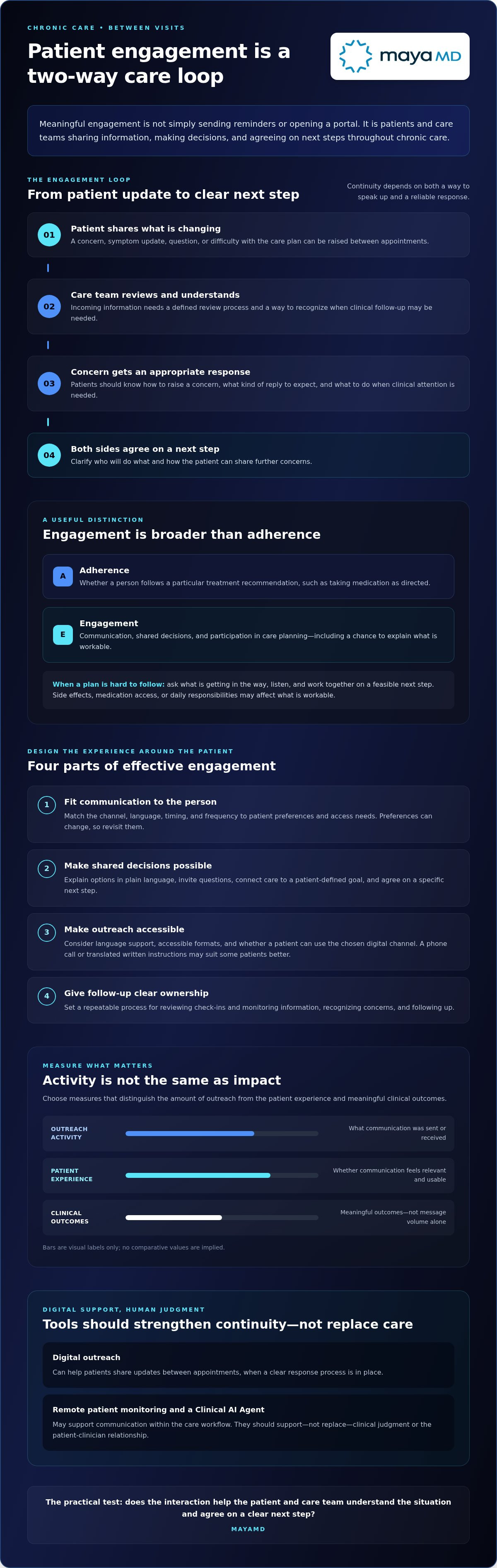
Patient engagement for chronic illness is the ongoing, two-way participation of patients and care teams in decisions, communication, and actions related to managing a chronic condition. It includes sharing concerns, discussing care options, and agreeing on next steps, not simply opening a message or logging in to a portal.
This definition puts the relationship at the center. A portal, phone call, or digital check-in provides a channel for communication, but its presence alone does not establish meaningful engagement. The exchange matters: patients need opportunities to raise questions and explain what is workable, and care teams need a clear way to understand and respond. The broader concept of patient participation is closely connected to shared decision-making and patient-centered care.
How patient engagement differs from adherence
Adherence describes whether a person follows a particular treatment recommendation, such as taking medication as directed. It can be one part of care, but it does not show whether the patient feels heard, understands the plan, or has had a chance to discuss alternatives. Engagement is broader: it involves communication, shared decisions, and participation in care planning.
This distinction matters because a care plan may be difficult to follow for reasons the team has not yet identified. A patient might be experiencing side effects, struggling to obtain a medication, or finding that a recommended routine does not fit daily responsibilities. These circumstances call for curiosity and problem-solving, not blame. Ask what is getting in the way, listen to the answer, and work with the patient to identify a feasible next step.
Why chronic illness calls for continuity between visits
For people managing long-term conditions, needs and circumstances can shift between appointments. Symptoms may change, questions may arise, or a treatment plan may become harder to manage. If the next scheduled visit is the only opportunity to discuss these changes, relevant context may not reach the care team promptly.
Accessible check-ins can give patients a way to share updates and ask questions between appointments. But contact supports continuity only when there is a defined response. Patients should know how to raise a concern, what kind of reply to expect, and what to do if the issue needs clinical attention. Care teams also need a process for reviewing incoming information and routing concerns appropriately.
Digital communication is one possible channel, not an outcome in itself. An unanswered message may add frustration rather than connection. The practical test is whether an interaction helps both sides understand the current situation and agree on a clear next step, while keeping clinical judgment and the patient-clinician relationship central.
The elements of effective chronic illness engagement
Effective patient engagement for chronic illness depends on more than choosing a communication tool. Care teams need to bring together understandable information, patient-defined goals, accessible ways to respond, and reliable follow-up. Each touchpoint should make it easier to share relevant information and clarify what happens next.
Start by asking patients how they prefer to communicate, what matters most to them in managing their condition, and what could make the care plan difficult to follow. Their answers can guide the channel, language, timing, and frequency of outreach. A brief text may suit one patient; another may prefer a phone conversation or translated written instructions. Preferences can change, so revisit them instead of treating them as fixed.
The National Library of Medicine’s evidence map of engagement strategies for adults with chronic conditions offers a foundation for considering how approaches can be tailored to patients and care contexts.
Communication that supports shared decisions
Use plain language to explain care options and why a recommendation may be relevant. Then invite questions and feedback with prompts such as, “What feels manageable?” or “What concerns do you have about this plan?” Connect the conversation to a goal the patient has identified, such as maintaining a daily routine, and agree on a specific next step. Before ending the interaction, confirm who will do what and how the patient can raise a concern. This turns reminders into a two-way exchange.
Accessible outreach and responsive follow-up
Accessibility belongs in the workflow from the start. Check whether a patient needs language support, accessible formats, help using a digital channel, or an alternative such as a phone call. Agree on a suitable contact frequency and timing, and make it easy to update those preferences. Teams considering between-visit data collection can review MayaMD’s remote patient monitoring capabilities as one option for supporting chronic care workflows.
Monitoring information should prompt appropriate review, not automatic alarm. A single reading or missed check-in may need context; on its own, it does not prove an emergency or a clinical change. Care organizations should define which team member reviews incoming information, what requires clinician assessment, and how unresolved concerns are handed off. Escalation criteria and response steps must fit the organization’s clinical protocols and be explained clearly to patients.
For teams assessing how these elements fit existing workflows, discuss chronic-care engagement needs with MayaMD.
How to measure engagement without mistaking activity for impact
Each measure should answer a clear question. A completed check-in shows that a process occurred; by itself, it does not show that the patient felt heard or that care improved. For patient engagement for chronic illness, separate operational activity from patient experience and clinical outcomes, then interpret each in the context of care.
Which engagement measures can care teams track?
Choose a small set of measures that matches the program’s purpose. Teams might track whether patients respond to planned check-ins, whether agreed follow-up is completed, and whether patient-reported concerns are documented and reviewed. Where appropriate, collect brief feedback about the communication experience and ask patients to explain the next step in their care plan.
Define each measure before reviewing results. Specify its data source, reporting period, and who will interpret it. A patient engagement scale, such as the measure discussed in this paper on measuring patient engagement, can inform assessment, but teams should select measures suited to their population and use case.
How to avoid misleading engagement metrics
Portal logins, message volume, and device readings are activity signals, not proof of understanding, shared decision-making, or meaningful participation. Establish a baseline, then review trends on a consistent schedule alongside patient feedback and relevant clinical context. Compare results across relevant patient groups, including people using different channels, to identify possible access barriers rather than treating lower activity as a lack of interest.
There is no universal response-rate target that fits every program. Set thresholds only when they are supported by evidence and appropriate to the measure and population. Interpret results cautiously: if clinical indicators change, do not assume a digital tool caused the change without an evaluation designed to assess that relationship.
How care teams can build a sustainable engagement workflow
A reliable workflow makes each digital touchpoint part of a defined care process. For patient engagement for chronic illness, start with a manageable patient group and a specific purpose, such as checking whether patients can follow an agreed care plan. Refine the process using patient feedback and operational data before expanding it.
Assess patient needs.
Identify the group’s communication preferences, accessibility needs, care goals, and likely barriers to participation.
Agree on outreach.
Confirm the preferred channel and contact frequency. Explain what information the team will collect, how it will be used, and how patients can ask for help or update their preferences.
Set expectations.
Tell patients who reviews incoming messages and what response time they can reasonably expect. Clarify that the channel may not be appropriate for urgent needs, and direct patients to the organization’s established urgent-care options.
Review and route information.
Assign a team member to review check-ins and monitoring information, document actions, and route concerns requiring clinical assessment to the appropriate clinician.
Close the loop.
Follow up on unresolved concerns, communicate the next step to the patient, and record whether the issue was addressed.
Evaluate and refine.
Review workflow completion, patient feedback, and operational bottlenecks. Adjust the process before extending it to additional patient groups.
Design outreach around patient needs and consent
Make participation understandable and voluntary within the organization’s care process. Document the patient’s preferred channel, language, accessible format, and contact timing, and explain what types of information the team is asking them to share. Avoid promising instant responses unless the service can support them. Clear expectations help patients know where routine questions belong and which established options to use for urgent concerns.
Connect digital touchpoints to human follow-up
Every incoming message or monitoring signal needs an owner, a review path, and a documented disposition. Routine updates can follow the team’s standard process; a concern that appears clinically significant should be routed for clinician assessment according to established protocols. Define coverage and handoffs so information does not sit unreviewed or remain unresolved.
A Clinical AI Agent can be considered as a workflow-support capability for connected communication. It should not be presented as making autonomous clinical decisions or replacing clinician judgment. Care teams should assess how it fits the existing workflow, what information it supports, and where staff review and act on its outputs.
Care teams evaluating how a Clinical AI Agent could fit their engagement workflow can connect with MayaMD about care-team needs.
How MayaMD can support patient engagement for chronic illness
Once a care team has defined its communication and follow-up processes, technology can help support consistent execution. MayaMD provides a cloud-based, HIPAA-compliant clinical AI platform that includes a Clinical AI Agent and supports remote patient monitoring for chronic care workflows. These capabilities can support patient engagement, documentation, and information flow between visits, while the care team remains responsible for interpreting information, making clinical decisions, and arranging appropriate follow-up.
Where a Clinical AI Agent fits in chronic care
MayaMD’s Clinical AI Agent combines deterministic logic with generative AI. In a chronic-care setting, the platform can support patient engagement workflows and clinical documentation processes, depending on intended use and implementation. It is workflow infrastructure, not a substitute for a clinician’s judgment or the relationship between clinicians and patients.
Remote monitoring can provide another channel for sharing information between appointments. Review MayaMD’s remote patient monitoring information to assess its relevance to chronic care. Before adopting any capability, care teams should confirm what it does, how it fits current processes, and who is responsible for reviewing and acting on the information it helps surface. No technology alone guarantees stronger engagement or improved clinical outcomes.
Questions to ask before evaluating a platform
Assess the operational details alongside the technology. A structured evaluation can help determine whether a platform supports your team’s model of patient engagement for chronic illness:
Workflow fit
Which current communication or documentation steps could the platform support, and where will staff review its outputs?
Information governance
What information is collected, how is it handled, and what safeguards and oversight apply? Confirm the current scope of any compliance claims.
Integration requirements
Which existing systems or processes need to connect, and what technical requirements should your organization verify?
Patient preferences
How can the workflow accommodate patients’ preferred channels, language, accessibility needs, and contact preferences?
Clinical oversight
Who evaluates incoming information, determines whether clinician review is needed, and follows unresolved concerns through to completion?
These questions help teams determine whether a platform supports a defined care process or adds disconnected activity. Assess MayaMD’s capabilities and implementation requirements against your organization’s specific workflows and clinical governance. If you are considering how the platform may fit, contact MayaMD to discuss your needs.
Make Every Touchpoint Count
Sustained patient engagement for chronic illness depends on a dependable cycle: communicate in ways patients can use, invite their input, and ensure concerns reach the right member of the care team. Measure more than clicks or completed check-ins. Pair workflow data with patient experience and relevant clinical context, then use what you learn to refine outreach over time.
Technology can help organize that connection, but it should support clinical judgment and the patient-clinician relationship, not replace them. MayaMD describes its platform as cloud-based and HIPAA-compliant, and its Clinical AI Agent combines deterministic logic with generative AI. Care teams should evaluate current capabilities, information governance, integration requirements, and oversight processes against their own needs.
Discuss your chronic care engagement needs with MayaMD to explore whether its capabilities align with your workflows and implementation requirements. With clear ownership and thoughtful follow-up, care teams can build a more consistent, responsive experience for people living with chronic conditions.
Frequently Asked Questions
What is patient engagement for chronic illness?
Patient engagement for chronic illness is ongoing, two-way participation between a person and their care team in communication, decisions, and care activities. It may include asking questions, sharing changes in symptoms, discussing treatment options, and agreeing on next steps. It is broader than portal use or adherence to a care plan. The aim is to make care responsive to the patient’s needs while recognizing that practical barriers can affect participation.
How can healthcare providers improve engagement for patients with chronic conditions?
Healthcare providers can improve engagement by making communication clear, accessible, and responsive. Ask patients which channels, language, and contact timing work for them, then connect discussions to goals they identify. Invite questions instead of relying only on reminders. Assign team members to review incoming information, route concerns for clinical assessment when needed, and close the loop with patients. Review feedback and workflow data to identify where the approach may need adjustment.
Can digital tools improve patient engagement in chronic care?
Digital tools can support chronic care communication by offering channels for check-ins, education, or information sharing between visits. Their value depends on how well they fit patients’ preferences and the care team’s workflow. A portal message or automated prompt alone does not demonstrate meaningful engagement. Teams should ensure patients can access the tool, understand how to use it, and know what happens after they respond. Digital communication should complement, not replace, appropriate human follow-up.
What role does remote patient monitoring play in chronic illness engagement?
Remote patient monitoring can give patients and care teams a way to share health information between appointments, supporting continuity within a chronic care workflow. The information needs context: a reading or missed transmission is not automatically an emergency or proof of a clinical change. Care teams should define who reviews monitoring information, how it is documented, and when clinician assessment is appropriate. Patients also need clear instructions about the monitoring process and what to do with urgent concerns.
How do you measure patient engagement for chronic illness?
Measure patient engagement for chronic illness using a combination of process, experience, and clinical measures. Process indicators might include completed check-ins, response rates, and follow-up on reported concerns. Patient feedback can show whether communication is understandable and useful, while condition-relevant clinical measures provide health context. Establish a baseline, define data sources and review cadence, and compare results across relevant patient groups. Avoid treating logins or message volume as proof of meaningful engagement.
What are common barriers to chronic illness patient engagement?
Common barriers include difficulty accessing or using digital channels, language or accessibility needs, limited time, competing responsibilities, and care plans that do not fit a patient’s circumstances. Unclear instructions or uncertainty about who will respond can also discourage patients from sharing concerns. Ask patients what makes participation difficult, offer suitable communication options, and explain follow-up expectations. Low response should prompt a review of access and workflow barriers, not an assumption that the patient is uninterested.
Does AI replace clinicians in chronic care patient engagement?
No. AI can support communication and care-team workflows, but clinicians remain responsible for interpreting clinical information, making decisions, and determining appropriate follow-up. MayaMD’s Clinical AI Agent combines deterministic logic with generative AI. Care teams evaluating AI should confirm its capabilities, information governance, integration requirements, and oversight processes. Patient-facing technology should support clinical judgment and the relationship between patients and their care team, not replace them.




See The MayaMD Difference
Fill the form below
Download Our Apps
MayaMD for patients and MayaPro for physicians - available on iOS and Android.
FOR PATIENTS
MayaMD App
AI-powered symptom assessment, triage, and secure access to your care team.


FOR PHYSICIANS
MayaPro App
MayaPro brings patient vitals, RPM/PCM care plans, and clinical decision support to your pocket.