
Overcoming Patient Barriers to Technology Adoption: A 2026 Clinical Implementation Guide

According to the March 2026 Hyro and Pixel Health report, 51% of patients have abandoned seeking care because digital onboarding processes were simply too complex. This friction often leads to high attrition in remote patient monitoring programs, leaving providers frustrated by non-compliance and the perceived loss of the human clinical touch. You likely recognize that technology should serve as a conduit for care, yet it frequently acts as a gatekeeper that patients are unwilling to pass. Successfully overcoming patient barriers to technology adoption requires more than just better software; it demands a shift toward governed, deterministic systems that mirror clinical logic.
You'll discover a systematic, evidence-based framework designed to dismantle patient resistance and foster deep engagement with digital health tools. We'll explore how the 2026 CMS reimbursement shifts, including CPT 99445 for partial monitoring periods, provide the financial flexibility needed to support hesitant users. By integrating neuro-symbolic AI that prioritizes safety and precision, your organization can achieve higher engagement scores and improved clinical outcomes. This guide details the transition from fragmented digital tools to a comprehensive ecosystem that reduces administrative burdens while maintaining the integrity of the provider-patient relationship.
Key Takeaways
• Analyze the psychological shift from viewing technology as a clinical replacement to a supportive extension of the care team, effectively addressing the "human touch" paradox.
• Learn how implementing deterministic logic provides the necessary "safety rails" for overcoming patient barriers to technology adoption by ensuring reliable, error-free clinical interactions.
• Explore the 2026 paradigm shift from static patient portals to dynamic Clinical AI Agents that drive continuous engagement through personalized, automated communication.
• Apply a structured 5-step methodology to accelerate onboarding and deliver measurable patient value within the first 24 hours of digital implementation.
• Discover how clinical AI governance reduces provider frustration and administrative burden while simultaneously improving long-term patient outcomes in chronic care management.
Identifying the Psychological and Structural Hurdles in Digital Health
In 2026, the digital divide has evolved from a matter of hardware access to a challenge of cognitive load. While 11.9 million Americans still live in broadband deserts according to September 2026 JAMA Health Forum data, the larger barrier for most patients is the mental energy required to interact with complex interfaces. We must move beyond simple connectivity to address cognitive accessibility. Patients often experience the "Human Touch" paradox, where they fear that digital tools are intended to replace, rather than augment, their relationship with their physician. This fear is a primary driver of resistance in chronic care populations.
Clinical leaders utilize the technology acceptance model to understand these behaviors, as it posits that perceived usefulness and ease of use are the twin pillars of adoption. If a patient perceives a tool as a barrier to their doctor, they'll reject it regardless of its technical merit. Successfully overcoming patient barriers to technology adoption requires a design philosophy that prioritizes psychological safety alongside clinical utility. When technology feels like a burden, clinical outcomes suffer.
The Trust Deficit in Generative AI
Patients with chronic conditions are increasingly wary of "black box" AI models that cannot explain their clinical reasoning. The rise of probabilistic generative AI has introduced the risk of hallucinations, where an agent might provide incorrect advice that sounds deceptively confident. These errors don't just damage trust; they present genuine safety risks that can lead to total program abandonment. The Trust Deficit is the specific gap between technological capability and patient psychological safety.
Socio-Economic and Physical Barriers
Addressing visual and motor impairments is essential for software design in 2026. Data indicates that 88% of individuals in broadband deserts live in rural regions, which often correlates with limited access to on-site clinical support. Consequently, remote patient monitoring must adapt to varied home environments where technical support is scarce. Integrating advanced primary care management into these settings requires platforms that function on low-bandwidth connections. Addressing these multifaceted hurdles is the first step toward overcoming patient barriers to technology adoption in a landscape that demands both clinical precision and human empathy.
The Role of Deterministic Logic in Building Patient Trust
Trust is a fragile commodity in clinical settings. Pure generative AI models, while impressive in their conversational fluidity, often lack the reproducibility and rigorous guardrails required for medical safety. Deterministic logic operates on structured, physician-engineered "if-then" pathways, ensuring that identical clinical presentations always yield consistent, safety-netted outcomes. This predictability is a vital component in overcoming patient barriers to technology adoption because it eliminates the erratic behavior and "hallucinations" often associated with unconstrained large language models. By adhering to regulatory considerations for healthcare AI, platforms can provide a governed environment that prioritizes patient safety over mere conversational flair.
The most effective digital health systems utilize neuro-symbolic AI. This sophisticated architecture combines the empathetic natural language processing of generative models with the clinical rigor of symbolic systems. This synergy allows a Clinical AI Agent to interact with a human-like cadence while remaining anchored to validated medical protocols. Clinical data supports this governed approach; for instance, heart failure patients utilizing conversational agents with deterministic guardrails saw a 31% reduction in 30-day hospital readmissions. When a patient realizes the tool isn't guessing but is instead following a logical clinical path, their anxiety regarding "robot doctors" dissipates.
Governed AI as a Clinical Safeguard
Reliability is the cornerstone of clinical adoption. A governed system ensures HIPAA compliance and maintains data integrity by preventing the AI hallucinations that cause patient anxiety and potential clinical errors. When digital tools mirror a physician's decision-making process, they remove the "fear of the unknown" that often stalls digital health initiatives. You can consult with our team to see how these logic-based safeguards integrate into existing workflows to protect both patients and providers.
Clinical Validity as an Adoption Catalyst
Patients embrace technology faster when it feels like a legitimate extension of their medical team. Medically-validated symptom checking and triage logic provide the clinical weight necessary to move beyond the stigma of generic healthcare apps. Clinical validity serves as the foundation for long-term patient retention. When patients receive accurate, consistent insights that align with their doctor's advice, their confidence in the digital front door grows. This creates a logical, cause-and-effect flow where technical precision leads directly to overcoming patient barriers to technology adoption and fostering deeper engagement.
Strategic Frameworks: Designing for Accessibility and Clinical Validity
The transition from passive patient portals to proactive Clinical AI Agents represents the defining paradigm shift of 2026. Traditional portals often failed because they required excessive cognitive labor and manual data entry, which discouraged long-term engagement. Clinical AI Agents move beyond this by providing a conversational interface that mimics human interaction while maintaining clinical rigor. A systematic review on barriers to and facilitators of digital health adoption identifies that technical complexity remains a significant deterrent for older or less tech-literate populations. By prioritizing an "Invisible Tech" strategy, such as voice-driven interactions and minimized click-paths, providers can lower the barrier to entry. This approach is essential for overcoming patient barriers to technology adoption in complex chronic care environments.
Integrating Advanced Primary Care Management into a patient's daily routine ensures that technology feels like a supportive companion rather than an administrative burden. This strategy aligns perfectly with established digital healthcare for chronic disease pathways. It fosters a sense of continuous care that persists between office visits, making the digital tool a vital part of the patient's health journey. When technology is woven into the care plan, it stops being a separate task and starts being a facilitator of wellness.
The Digital Front Door Strategy
A "Digital Front Door" serves as the primary point of contact for tech-wary patients. By utilizing AI for virtual triage, clinics can significantly reduce patient anxiety associated with long wait times or uncertain symptoms. Providing immediate value through automated symptom checking before asking for a long-term commitment to remote monitoring builds necessary trust. MayaMD Virtual Triage acts as this critical entry point, offering clinical insights that justify the patient's engagement with the platform from the very first interaction.
Workflow Harmonization for Providers
Effective technology must serve the provider as much as the patient. We design these frameworks to ensure that increased patient touchpoints don't translate to physician burnout. Automated documentation becomes a natural byproduct of patient engagement, capturing clinical insights during AI-led interactions and syncing them with the EHR. This reduces administrative friction and allows clinicians to focus on high-acuity human-to-human care. By streamlining the backend, we enable a more empathetic front-end experience for the patient, further overcoming patient barriers to technology adoption through consistent, high-quality interactions.
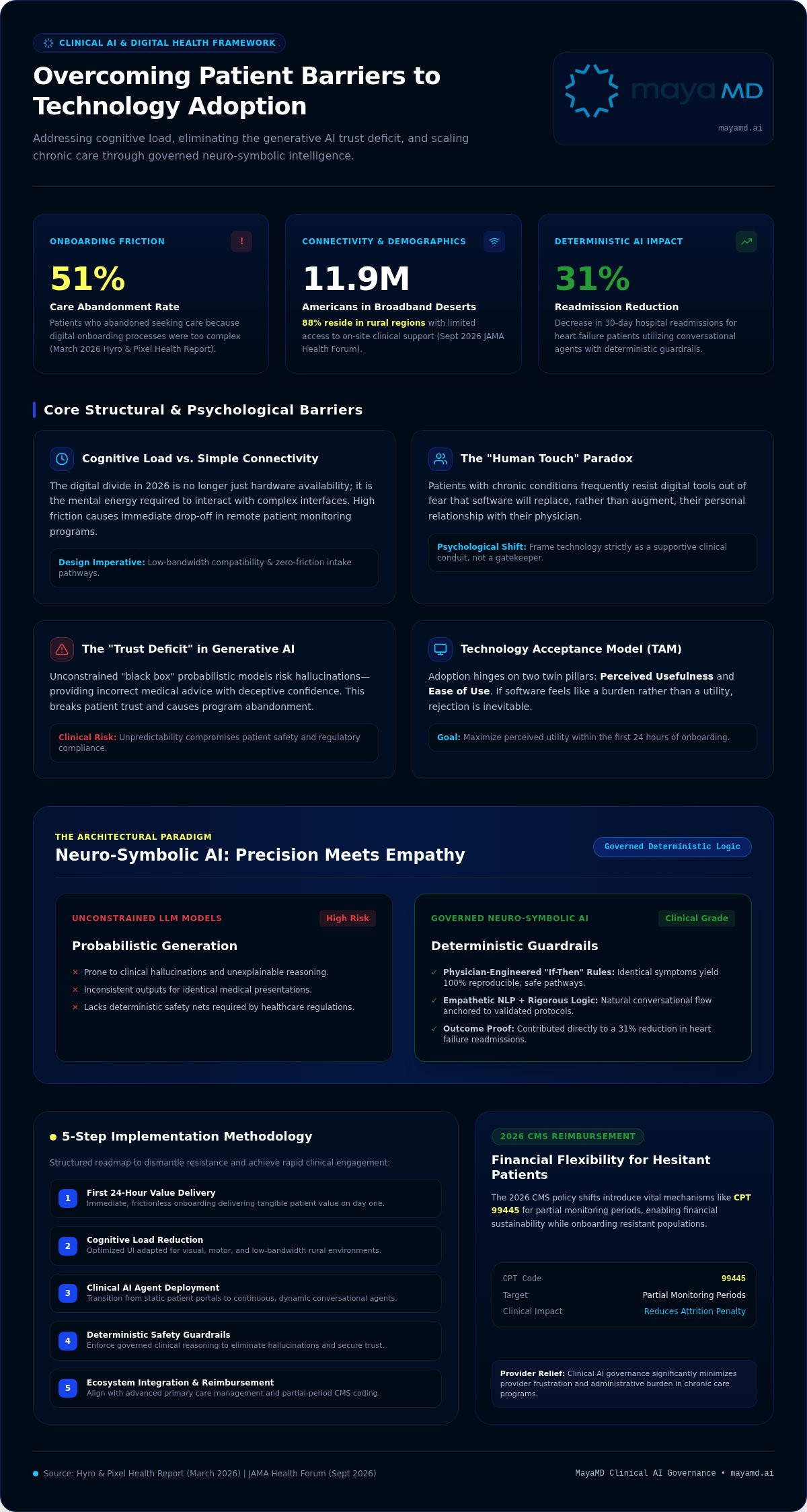
5-Step Methodology for Increasing Patient Engagement
Engagement is a clinical outcome, not just a technical feature. To achieve high patient engagement scores in 2026, providers must follow a structured implementation process that prioritizes trust and utility from the first interaction. This 5-step methodology is the blueprint for overcoming patient barriers to technology adoption in a digital-first clinical environment. By treating technology as a member of the care team rather than a standalone tool, you can foster a more cohesive patient experience.
Step 1 involves clinical onboarding. Rather than presenting the platform as a generic app, introduce the Clinical AI Agent as a dedicated extension of your practice. Step 2 focuses on immediate value delivery. Solving a minor but urgent concern, such as a medication clarification or a symptom query, within the first 24 hours cements the tool's usefulness in the patient's mind. Step 3 utilizes Principal Care Management tools that operate with minimal input, reducing the cognitive burden that often leads to attrition. Step 4 implements automated feedback loops. AI provides instant positive reinforcement for health milestones, such as consistent blood pressure readings. Step 5 ensures hybrid care escalation. Patients must understand exactly when and how the AI connects them to a human provider, ensuring the clinical safety net remains visible.
Reengineering the Discharge Transition
The period immediately following hospital release is a high-risk window for patient non-compliance. Implementing automated post-discharge solutions allows for continuous monitoring during this vulnerable transition. These systems personalize education for heart failure and other chronic conditions, ensuring patients stay aligned with their care plans. Data indicates that closed-loop discharge education can cut 30-day hospital readmission rates by 31% by addressing complications before they require emergency intervention.
Gamification and Behavioral Incentives
Behavioral economics plays a critical role in overcoming patient barriers to technology adoption. By applying nudge theory, AI agents can encourage daily app check-ins through subtle prompts and micro-incentives. These digital reinforcements foster a sense of accomplishment and accountability in patients managing long-term illnesses. While technology provides the necessary data, behavioral science ensures the patient remains an active participant in their own health journey. To learn how to deploy these engagement strategies in your practice, contact our clinical specialists for a consultation.
MayaMD: Bridging the Gap with Clinical AI Governance
MayaMD addresses the core of the 2026 adoption crisis by replacing clinical uncertainty with rigorous governance. The Clinical AI Agent is engineered to function as a sophisticated "Digital Front Door," easing patients into technological workflows through familiar, conversational interfaces. This approach prioritizes human connection by using software to facilitate support rather than replace it. Central to this success is the use of deterministic logic. This acts as a critical "safety rail" for generative AI interactions. While large language models handle conversational fluidity, MayaMD’s underlying logic governs clinical reasoning. This ensures that every patient interaction follows physician-validated pathways. By eliminating the risk of AI hallucinations, we directly address the Trust Deficit, which is essential for overcoming patient barriers to technology adoption.
This governed approach allows health systems to scale chronic care management effectively. You can expand your reach without a proportional increase in headcount or administrative overhead. The result is a seamless bridge between disparate data points and human care. It creates a logical, cause-and-effect flow where technical precision leads directly to improved patient trust. Patients don't just use the tool; they rely on it because it speaks with the sober, governed authority they expect from their medical providers.
Proven Outcomes in Patient Engagement
MayaMD’s architecture delivers measurable performance that traditional apps can't match. Deployed systems have demonstrated a 40% reduction in patient intake documentation time and a 31% reduction in 30-day hospital readmissions. Being recognized as a finalist for the 2025 Digital Health Awards validates our commitment to clinical precision and patient safety. These efficiencies don't just improve the quality of care; they directly enhance practice revenue by streamlining data capture for RPM and APCM billing codes. High-stakes reliability is now an operational reality.
Ready to Transform Your Patient Experience?
Customizing the Clinical AI Agent for your specific patient population is a methodical, clinical process. Our platform is designed for seamless integration into existing workflows, transitioning from legacy systems to AI-governed care without disrupting daily operations. This adaptability is the final piece in overcoming patient barriers to technology adoption, as it ensures the technology fits the patient's life rather than forcing the patient to adapt to the software. Consult with a MayaMD specialist to dismantle your patient barriers today.
Unifying Clinical Logic and Patient Trust
The evolution of healthcare delivery in 2026 demands a transition from passive digital tools to active, governed partnerships. We've demonstrated that overcoming patient barriers to technology adoption is not merely a matter of digital literacy, but a challenge of clinical trust and cognitive accessibility. By replacing the probabilistic nature of generic models with a deterministic, hallucination-free AI architecture, providers can offer the high-stakes reliability that chronic care patients require. Implementing a structured methodology, from clinical onboarding to immediate value delivery, ensures that digital tools like RPM and APCM solutions become permanent, supportive fixtures in the patient journey.
MayaMD, recognized as a 2025 Digital Health Hub Foundation Finalist, provides the national coverage and clinical rigor necessary to scale these programs without increasing administrative friction. Our neuro-symbolic approach ensures that your patient-facing technology remains a bridge to human care, never a barrier. Request a clinical demo to see how MayaMD overcomes patient barriers and integrates seamlessly into your existing workflows. We look forward to partnering with you to create a more connected, empathetic future for clinical management.
Frequently Asked Questions
What are the most common barriers to patient technology adoption in 2026?
The primary barriers in 2026 include cognitive load, broadband deserts affecting 11.9 million Americans, and a significant trust deficit in probabilistic AI models. Patients often fear that technology will replace their physician's human touch. Successfully overcoming patient barriers to technology adoption requires addressing these psychological hurdles through governed, deterministic interfaces. By reducing the mental energy required for interaction, providers can transition patients from tech-wary skeptics to engaged participants in their own care.
How does Clinical AI differ from standard patient portals?
Standard patient portals are passive repositories of data that often require high cognitive effort to navigate. In contrast, a Clinical AI Agent is a proactive conversational partner that utilizes natural language processing to deliver immediate value. While portals often lead to care abandonment due to complexity, Clinical AI simplifies the "Digital Front Door" experience. It automates intake and triage, ensuring patients receive clinical insights in real-time rather than waiting for portal updates.
Can elderly patients with chronic conditions successfully use AI agents?
Statistics from 2025 and 2026 indicate that 76% of adults aged 55 and older have utilized digital health portals. This demographic doesn't suffer from inherent technophobia but rather from non-intuitive user interfaces. AI agents that prioritize voice-driven interaction and minimal click-paths successfully bridge this gap. By reducing technical friction and providing clear clinical utility, these agents enable elderly patients with chronic conditions to maintain high adherence rates in complex care programs.
How does deterministic logic prevent AI hallucinations in healthcare?
Deterministic logic functions as a clinical safety rail by following fixed, physician-engineered "if-then" pathways. Unlike pure large language models that guess the next word in a sequence, deterministic systems such as MayaBrain use symbolic logic to ensure consistent outcomes. This architecture prevents the hallucinations that cause patient anxiety and clinical errors. By anchoring conversational AI to these rigorous protocols, healthcare organizations provide the reliability necessary for establishing long-term patient trust and safety.
What is the role of the Clinical AI Agent in Remote Patient Monitoring (RPM)?
In Remote Patient Monitoring (RPM), the Clinical AI Agent serves as the primary engagement layer between office visits. It automates daily check-ins and symptom tracking, ensuring that patients remain compliant with monitoring protocols. This is critical for meeting 2026 CMS billing requirements, such as the new CPT 99445 code for partial monitoring periods. The agent provides the continuous oversight needed to detect complications early, which has been shown to reduce readmission rates by 31%.
How can I measure patient engagement with new health technology?
You can measure engagement through objective metrics such as session frequency, documentation completion rates, and clinical outcome improvements. High patient engagement scores often correlate with a 40% reduction in documentation time and improved adherence to chronic care plans. Monitoring these data points allows providers to identify friction early. Overcoming patient barriers to technology adoption is a measurable process, where increased interaction consistency directly reflects the patient's trust in the governed AI system.
Does technology adoption actually reduce physician burnout?
Strategic technology adoption significantly reduces physician burnout by automating administrative burdens. MayaMD’s platform cuts intake documentation time by 40%, which alleviates the "pajama time" often spent on EHR data entry. By utilizing an AI healthcare assistant for virtual triage and automated post-discharge communication, clinicians can focus their energy on high-acuity patient management. This shift from manual data entry to clinical oversight restores the provider's ability to deliver meaningful, human-to-human care.
Is MayaMD’s Clinical AI Agent HIPAA compliant?
MayaMD’s Clinical AI Agent is a fully HIPAA-compliant, cloud-based platform designed for the 2026 regulatory environment. It adheres to the latest ASTP/ONC HTI-1 algorithm transparency standards and USCDI v3 baseline requirements. The system employs advanced encryption and deterministic logic to maintain data integrity and patient privacy across all interactions. This rigorous adherence to compliance ensures that healthcare organizations can deploy AI-driven engagement solutions with full confidence in their security and regulatory standing.




See The MayaMD Difference
Fill the form below
Download Our Apps
MayaMD for patients and MayaPro for physicians - available on iOS and Android.
FOR PATIENTS
MayaMD App
AI-powered symptom assessment, triage, and secure access to your care team.

FOR PHYSICIANS
MayaPro App
MayaPro brings patient vitals, RPM/PCM care plans, and clinical decision support to your pocket.