
How to Measure PCM Program Success: A Leader's Guide

Routine CPT reimbursement may generate short-term revenue, but billing activity alone cannot prove clinical efficacy. Specialty practices and health systems frequently struggle with how to measure the success of a PCM program when conventional reporting reduces complex, high-acuity interventions to mere minutes logged in an EHR. If your clinical staff faces mounting burnout from manual care coordination while executive leadership questions whether single-condition management genuinely prevents hospitalizations, you aren't alone.
Evaluating a targeted service line requires moving beyond standard chronic care benchmarks to analyze clinical stabilization, documentation velocity, and revenue cycle integrity as an integrated framework. In this guide, you'll discover the clinical, operational, and financial metrics required to evaluate and optimize your Principal Care Management program. We outline how to construct an objective performance scorecard, maintain audit-proof documentation for CMS compliance, and demonstrate sustained reductions in acute care utilization for your highest-risk patient cohorts.
Key Takeaways
• Establish precise baseline criteria that isolate single-condition clinical stabilization from broad chronic care metrics, focusing directly on targeted disease management.
• Discover how to measure the success of a PCM program by tracking reimbursement capture across CPT codes 99424 through 99427 against direct clinical labor allocation.
• Quantify clinical impact using high-fidelity endpoints, including disease-specific biomarker trends and longitudinal reductions in 30-, 60-, and 90-day acute care utilization.
• Implement a structured evaluation workflow that aggregates remote telemetry data and enforces recurring monthly audits to secure audit-proof CMS documentation.
• Deploy governed Clinical AI Agent solutions to passively capture care coordination time, eliminating documentation latency while protecting care teams from administrative burnout.
Defining Principal Care Management Success: Core Objectives and Baseline Benchmarks
Quantifying clinical performance requires decoupling targeted interventions from generalized care routines. For healthcare leadership, understanding how to measure the success of a PCM program starts with establishing whether a single unstable disease trajectory has achieved measurable clinical stabilization without exhausting practice resources. Success isn't simply logging billable coordination hours. It's the systematic reduction of disease acuity alongside sustainable operational integration.
Principal Care Management differs fundamentally from generalized Chronic Care Management programs. While CCM addresses patients with two or more chronic illnesses across primary care domains, PCM focuses exclusively on a single complex condition. This focused scope demands higher clinical governance, specialized oversight, and precise longitudinal tracking. Leaders shouldn't apply CCM operational templates directly to PCM cohorts without risking regulatory non-compliance or skewed performance evaluations.
The Clinical Scope of PCM Under CMS Guidelines
Centers for Medicare & Medicaid Services (CMS) directives mandate that enrolled patients present with a high-acuity condition expected to persist between three months and one year, or until terminal decline. This designation requires disease-specific care plans managed directly by or under the direct supervision of an authorized physician or qualified healthcare professional. Managing these critical windows depends on targeted specialist adjustments, rigorous telemetry oversight, and clear stabilization endpoints rather than open-ended support.
Establishing Program Baselines Prior to Measurement
You cannot evaluate post-implementation velocity without historical reference points. When assessing how to measure the success of a PCM program, practices must establish pre-enrollment benchmarks across three critical operational pillars:
Acute Care Velocity
Document emergency department presentations and uncoordinated hospital readmissions across the prospective cohort for the preceding 12 months.
Clinical Biomarker Baselines
Record baseline values for target indicators such as glycated hemoglobin (HbA1c), baseline left ventricular ejection fraction, or forced expiratory volume to gauge stabilization trajectory.
Administrative Workload
Audit uncompensated clinician time previously spent on off-schedule triage, pharmacy authorizations, and manual follow-ups to measure operational recuperation post-launch.
Establishing these parameters transforms ambient coordination efforts into clear analytical comparisons, providing leadership with audit-ready baselines that demonstrate clinical value.
Essential Clinical Outcome Metrics for Single Chronic Condition Management
Objective clinical tracking separates high-performing specialty programs from passive administrative logging. When leaders evaluate how to measure the success of a PCM program, clinical markers must serve as the primary proof of stabilization. Care teams need clear, reproducible clinical scorecards that connect daily remote observations directly to standardized disease endpoints.
Disease-Specific Biomarkers and Clinical Stabilization
Programs manage single, high-risk conditions, which means biomarker evaluation must remain tightly specialized. In congestive heart failure cohorts, track quarterly N-terminal pro-b-type natriuretic peptide (NT-proBNP) alongside daily dry-weight variances. For severe endocrine disorders, evaluate mean glucose time-in-range (TIR) via continuous glucose monitoring instead of waiting for retrospective HbA1c panels. Rapid stabilization velocity post-exacerbation confirms that protocol adjustments are working before secondary complications arise.
Acute Care Utilization and Readmission Avoidance
Preventing acute decompensation protects health system margins and preserves patient functional independence. Care management studies show that structured chronic interventions can reduce emergency room visits by 25% to 60%. Leaders should monitor:
30-, 60-, and 90-Day Readmission Rates
Track post-discharge cohorts against matched controls to measure the durability of post-acute care transitions.
Avoidable Emergency Department Presentations
Log emergency visits triggered specifically by the target condition versus unrelated acute issues.
Exacerbation Triage Latency
Measure the operational elapsed time between initial biometric decompensation alerts and clinical care plan modifications.
This acute-care mitigation directly aligns with initiatives like the CMS ACCESS Model for outcome-based care, which rewards measurable stability over care volume.
Patient Adherence and Quality of Life Indicators
Sustained disease control requires verifiable self-management behaviors between clinical touchpoints. Calculate the Proportion of Days Covered (PDC) through longitudinal prescription refill records to confirm pharmacological compliance. Supplement pharmacy claims with Patient-Reported Outcome Measures (PROMs), such as the Kansas City Cardiomyopathy Questionnaire (KCCQ) or the COPD Assessment Test (CAT), to track functional status over time. Measuring active patient response rates within patient portals provides leadership with early warnings of disengagement.
Establishing these clinical telemetry frameworks can strain existing staff capacity. If your clinical organization needs support building structured digital protocols to monitor high-risk cohorts, speak with our clinical integration team to align your remote care architecture with validated outcomes.
Financial and Operational Performance: Evaluating Revenue and Resource Allocation
Gross reimbursement figures frequently mask operational inefficiencies. When specialty groups examine how to measure the success of a PCM program from a fiscal standpoint, they must look past top-line billing collections to calculate net program yield. A successful service line balances maximum legitimate code utilization against clinical labor expenditure while protecting against post-payment audit clawbacks.
Reimbursement Capture and Audit-Ready Compliance
Principal Care Management billing relies on four dedicated Medicare Physician Fee Schedule codes: 99424 and 99425 for physician or qualified healthcare professional (QHP) time, and 99426 and 99427 for clinical staff coordination under general supervision. Capturing these codes demands rigorous verification of the initial 30-minute monthly threshold before claims submission. Leaders must track:
Clean Claim Velocities
The proportion of PCM encounters adjudicated on first submission without procedural modifier or medical necessity rejections.
Labor-Specific Code Stratification
The precise distribution between physician-directed units (99424) and auxiliary staff coordination (99426) to ensure direct clinical oversight aligns with CMS documentation mandates.
Add-on Billing Frequencies
The conversion rate of complex cases reaching secondary 30-minute increments via 99425 or 99427, indicating high-touch management for unstable cohorts.
Clinical Labor Efficiency and Staff Utilization
Care coordination time carries significant clinical overhead. If a registered nurse spends 45 minutes manually transcribing telemetry numbers or copying notes across disparate EHR interfaces to satisfy a 30-minute threshold, net program margin erodes rapidly. Practices should calculate the exact fully loaded labor cost consumed per enrolled patient per calendar month. When administrative logging displaces proactive patient interventions, staff experience burnout and clinical value degrades.
Long-Term Value-Based Care and Risk Contract Performance
Understanding how to measure the success of a PCM program requires evaluating performance beyond fee-for-service collections. Under Medicare Shared Savings Programs (MSSP) and commercial risk contracts, effective single-condition management directly protects medical loss ratios. Preventing a single intensive care admission or specialized surgical revision for an unstable heart failure patient saves tens of thousands of dollars in shared savings pools. These operational controls also strengthen Merit-based Incentive Payment System (MIPS) quality category scores, transforming localized care coordination into enterprise-wide financial durability.
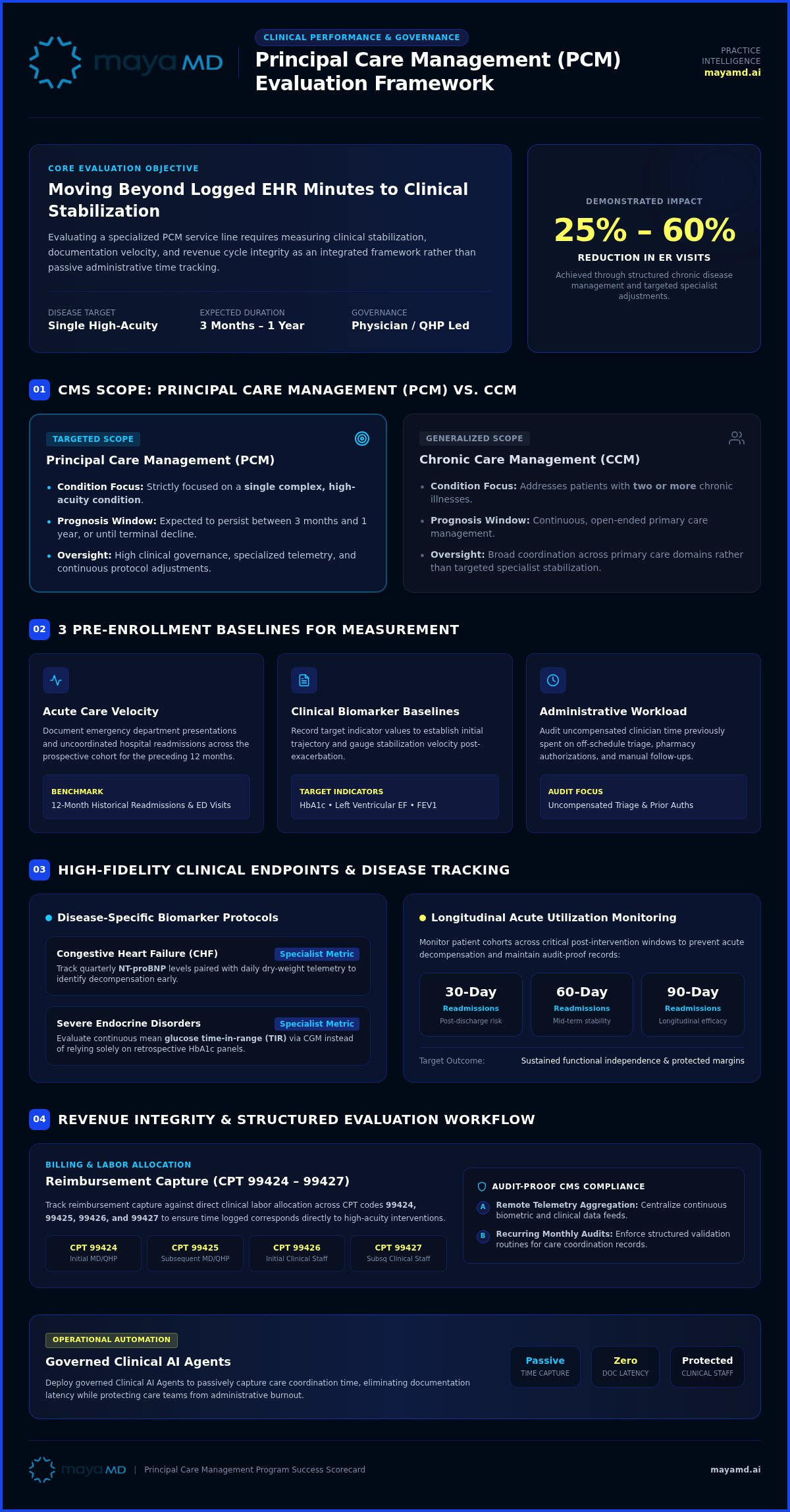
How to Implement a Structured PCM Program Evaluation Workflow
Sustainable quality oversight requires moving from passive retrospection to active operational governance. Systematically operationalizing how to measure the success of a PCM program demands an explicit, repeatable cadence that unifies fragmented system data, verifies regulatory validity, and refines specialty intervention protocols on a predictable schedule.
Steps 1 and 2: Data Aggregation and Documentation Audits
First, establish unified pipelines connecting your electronic health record, remote telemetry feeds, and practice management billing modules. Disjointed software creates clinical blind spots, leaving qualifying care minutes unlogged and early deterioration signals buried. Consolidating these streams into a centralized data layer enables real-time cohort visibility across clinical and operational indicators.
Second, mandate a recurring 30-day documentation audit cadence. Clinical directors should pull stratified random samples of billed records across both physician and staff codes. Reviewers must confirm three elements: explicit documentation of specialist-directed care plan modifications, timestamped logs demonstrating the required 30-minute threshold, and clear clinical rationale reflecting the single high-risk condition. Catching documentation deficits internally eliminates regulatory recoupment exposure and preserves clean claims rates.
Steps 3 and 4: Patient Engagement Reviews and Pathway Refinement
Third, evaluate cohort attrition and interaction metrics monthly. Leaders tracking how to measure the success of a PCM program should examine thirty-day churn rates, touchpoint completion percentages, and digital engagement responsiveness. Distinguish intentional graduations, where a patient achieves sustained clinical stability, from premature disenrollments caused by communication friction or out-of-pocket deductible confusion.
Fourth, conduct monthly multidisciplinary reviews between attending specialists, advanced practice providers, and care coordinators. Systematically dissect any acute hospitalization or emergency department visit within the enrolled cohort to determine clinical root causes. Did remote biometric alerts fail to trigger timely outreach, or did patient comprehension falter during early exacerbation? Use these empirical findings to recalibrate alert thresholds, adjust outreach frequency, and refine specialty clinical pathways.
Building this programmatic discipline requires robust digital infrastructure. To construct a clinical workflow that automates these tracking checkpoints while protecting staff capacity, schedule a consultation with MayaMD to evaluate our clinical AI architecture.
Optimizing Measurement Precision Through Advanced Clinical AI and Automation
Manual documentation mechanisms inevitably introduce recording delays and calculation errors into specialty care. When determining how to measure the success of a PCM program with absolute clinical precision, relying on staff memory to track asynchronous minutes leaves vital revenue uncaptured and exposes clinics to audit penalties. Deploying intelligent automation creates a continuous operational layer that passively logs qualifying activities, categorizes clinical engagement time, and normalizes complex data streams without adding administrative drag.
Eliminating Documentation Latency with Governed AI
Unregulated generative models introduce clinical safety risks that specialty practices cannot tolerate. Operating with deterministic clinical logic, MayaMD's Clinical AI Agent executes structured triage protocols and care coordination logging without generative hallucinations. The system synthesizes patient interactions into discrete, timestamped encounters that write directly into host electronic health records. This capability eliminates documentation latency, ensuring that every minute of physician oversight or clinical staff follow-up meets CMS compliance standards immediately.
Predictive Analytics and Continuous Biometric Synthesis
Evaluating clinical trajectories requires turning continuous data streams into clear stabilization signals. Synthesizing telemetry from remote patient monitoring allows the platform to reconcile daily patient vitals against specialist care protocols. Rather than overwhelming staff with raw biometrics, the system isolates high-risk deviations, surfacing actionable updates directly to the clinical dashboard:
Biometric Trend Synthesis
Converts high-frequency device readings, such as continuous blood pressure or glucometry patterns, into dynamic risk stratification scores.
Preemptive Exacerbation Alerts
Flags multi-day physiological decompensation trends before patients require acute emergency interventions.
Longitudinal Care Alignment
Coordinates targeted specialist adjustments alongside broader longitudinal initiatives like advanced primary care management to maintain shared care continuity.
Rigorous tracking shouldn't come at the cost of clinical burnout. Implementing governed automation allows specialty networks to answer how to measure the success of a PCM program through validated biometric stability, seamless time capture, and reliable clinical oversight.
Advancing Specialty Care Through Measurable Clinical Governance
Evaluating single-condition longitudinal care requires reconciling clinical stabilization, operational efficiency, and revenue cycle integrity into a unified scorecard. True program success doesn't hinge on sporadic billing spikes; it's proven through sustained biomarker control, reduced hospital readmissions, and protected staff capacity. When clinical leadership masters how to measure the success of a PCM program, specialized care evolves from an administrative burden into a predictable, high-impact clinical engine.
Modernizing this workflow demands reliable, compliant technology. Recognized as a finalist at the 2025 Digital Health Hub Foundation Awards, MayaMD delivers a comprehensive platform supporting automated engagement, continuous remote monitoring, and intelligent documentation. Built on deterministic clinical logic designed to prevent generative hallucinations, our Clinical AI Agent captures qualifying care coordination time accurately while safeguarding clinical safety. Schedule a consultation to evaluate how MayaMD elevates PCM outcomes and establish an audit-ready foundation for your specialty practice.
Frequently Asked Questions
What are the primary CMS CPT codes used to track PCM performance?
CMS evaluates Principal Care Management performance using four dedicated CPT codes: 99424 and 99425 for physician or qualified healthcare professional time, and 99426 and 99427 for clinical staff coordination. Codes 99424 and 99426 cover the initial 30 minutes of care per calendar month. Codes 99425 and 99427 cover each additional 30-minute increment. Tracking the ratio of base codes to add-on units reflects the clinical intensity of your patient panel.
How do clinical metrics for PCM differ from standard Chronic Care Management?
Principal Care Management focuses exclusively on stabilizing a single, high-risk complex condition rather than managing broad, multi-morbid primary care health. Clinical metrics for PCM emphasize disease-specific endpoints, such as targeted biomarker stabilization or post-exacerbation triage velocity, rather than general preventive health markers. Understanding these distinctions is critical when learning how to measure the success of a PCM program, as PCM interventions carry explicit expectations of specialist-driven stabilization.
How does continuous remote patient monitoring impact PCM evaluation metrics?
Integrating continuous telemetry provides real-time physiological visibility, transforming retrospective monthly reviews into proactive clinical management. Continuous biometric feeds establish immediate correlation between clinical care plan adjustments and daily vital sign trends. By detecting decompensation early, remote patient monitoring directly accelerates stabilization timelines and significantly reduces acute hospital readmissions, generating quantifiable proof of longitudinal program efficacy across enrolled cohorts.
What represents an acceptable patient retention rate in a PCM program?
High-performing programs typically sustain active monthly retention rates between 75% and 85% across qualifying cohorts. Unlike open-ended care coordination, PCM anticipates planned patient transitions once clinical stabilization goals are met. Leaders evaluating program turnover must clearly distinguish between intentional clinical graduations back to primary care and involuntary dropouts driven by patient disengagement or unexpected copay friction.
How can specialty practices audit care coordination time to prevent claim denials?
Practices must institute recurring monthly documentation audits that review stratified samples of billed encounters prior to claims submission. Auditors should verify exact timestamped logs showing 30 minutes of qualifying care, explicit physician care plan oversight, and a direct clinical nexus to the designated complex condition. Establishing this internal verification cadence prevents post-payment CMS clawbacks and ensures billing records remain entirely audit-proof.
Can clinical AI tools capture billable PCM coordination time automatically?
Governed AI solutions can passively track, timestamp, and categorize care coordination interactions directly within host clinical workflows. MayaMD's Clinical AI Agent applies deterministic logic to document qualifying engagement time and clinical touchpoints accurately without generating hallucinations. This automated logging eliminates documentation latency, relieves clinical staff of manual time tracking, and establishes a clear, compliant audit trail for every billed calendar month.
What role do patient-reported outcomes play in evaluating PCM effectiveness?
Standardized patient-reported outcome measures quantify symptom burden and functional status improvements that clinical lab values cannot capture alone. Tracking validated surveys alongside routine biometric data reveals whether medical stabilization translates into tangible quality-of-life gains. Measuring longitudinal functional progress provides healthcare executives with compelling clinical evidence when demonstrating how to measure the success of a PCM program under value-based risk contracts.




See The MayaMD Difference
Fill the form below
Download Our Apps
MayaMD for patients and MayaPro for physicians - available on iOS and Android.
FOR PATIENTS
MayaMD App
AI-powered symptom assessment, triage, and secure access to your care team.


FOR PHYSICIANS
MayaPro App
MayaPro brings patient vitals, RPM/PCM care plans, and clinical decision support to your pocket.