
How to Improve Patient Outcomes with AI: A 2026 Clinical Case Study

The era of treating artificial intelligence as a speculative experiment has ended, replaced by a mandate for rigorous, governed applications that prioritize patient safety above all else. You’ve likely felt the strain of clinician burnout from endless documentation or the anxiety caused by episodic care gaps in chronic disease management. These challenges are often compounded by a legitimate fear of AI hallucinations in high-stakes clinical settings. However, the path to modernize your practice doesn't require compromising on precision or reliability.
To truly improve patient outcomes with ai, organizations must transition toward deterministic frameworks that marry clinical logic with continuous remote monitoring. This approach ensures that every automated interaction is grounded in established medical protocols rather than unpredictable generative patterns. By deploying a Clinical AI Agent designed for Advanced Primary Care Management, providers can bridge the distance between office visits and maintain a constant, supportive presence in the patient’s home.
In this 2026 clinical case study, we examine the measurable impact of integrating these sophisticated tools into daily workflows. You’ll discover how a governed AI ecosystem reduces hospital readmissions and streamlines documentation while significantly improving patient engagement scores. We will detail the specific methodologies that turn remote data into actionable insights, providing a blueprint for safer, more efficient chronic care management.
Key Takeaways
• Transition from reactive, episodic care models to a proactive, continuous framework that addresses chronic disease management outside the traditional clinical setting.
• Understand how to leverage deterministic clinical logic to safely improve patient outcomes with ai while eliminating the risks associated with unmanaged generative models.
• Analyze a 2026 case study detailing the deployment of a Clinical AI Agent to streamline routine patient inquiries and complex data collection.
• Identify actionable steps for integrating RPM and PCM into existing workflows to reduce administrative burden and prevent hospital readmissions.
• Explore methodologies for scaling Advanced Primary Care Management (APCM) through targeted pilot programs in high-need local markets like Phoenix and Las Vegas.
The Crisis of Episodic Care: Why Providers Must Improve Patient Outcomes with AI
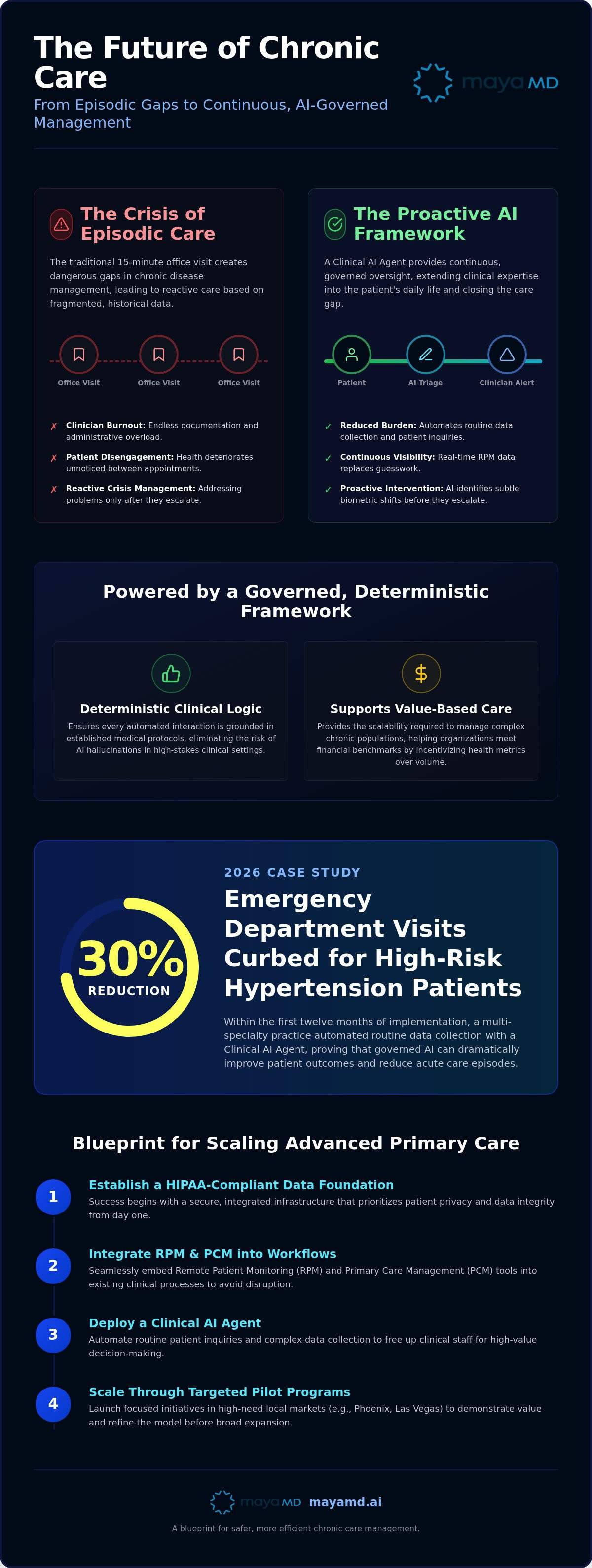
The traditional 15-minute office visit was never designed to manage the complexities of modern chronic disease. It provides a static snapshot of a dynamic condition, leaving providers to make critical decisions based on fragmented, historical data. To truly improve patient outcomes with ai, the healthcare industry is shifting toward a model of continuous, governed oversight that extends clinical expertise into the patient's daily life. This evolution addresses the "episodic care gap" where most patient health deteriorates unnoticed between scheduled appointments.
Moving from reactive crisis management to proactive intervention requires a fundamental change in how data is utilized. The various applications of AI in medicine have evolved to fill the void between visits, using Remote Patient Monitoring (RPM) to capture physiological trends that would otherwise remain invisible. Clinical AI governed logic is the standard for 2026 patient safety, serving as a deterministic framework that ensures every automated interaction adheres to rigorous medical protocols. This systematic approach provides several key advantages:
Continuous Visibility
Real-time data streams replace the guesswork of patient self-reporting.
Early Detection
Algorithms identify subtle biometric shifts before they escalate into emergency room visits.
Patient Engagement
Automated, logic-based interactions keep patients adherent to their care plans.
Addressing Clinician Burnout in High-Demand Markets
Administrative overload in high-volume markets like Chicago and Houston has reached a breaking point for many practitioners. Documentation requirements often consume more time than actual patient interaction, which directly impacts the quality of care delivered. When providers utilize a Clinical AI Agent to automate routine data collection and initial triage, they reclaim the bandwidth necessary for complex clinical decision-making. It's clear that provider well-being is a primary driver of measurable clinical outcomes; a supported clinician is a more effective clinician.
The Shift Toward Value-Based Care and APCM
Advanced Primary Care Management (APCM) models are redefining the financial landscape by incentivizing health metrics over volume. These frameworks demand a level of population oversight that's impossible to achieve through manual effort alone. AI is now a financial necessity for managing complex chronic populations, providing the scalability required to meet value-based care benchmarks. The deployment of a Clinical AI Agent automates the synthesis of RPM data, resulting in a 24/7 safety net that alerts clinicians only when a patient’s metrics deviate from their established baseline.
Case Study: Implementing AI-Governed RPM for Chronic Care Excellence
Transitioning a multi-specialty practice to AI-enabled RPM represents a shift toward data-driven stability. This specific 2026 clinical implementation focused on high-risk hypertension cohorts, utilizing a Clinical AI Agent to manage routine patient inquiries and physiological data collection. By automating these baseline interactions, the practice successfully extended its reach beyond the clinical walls without increasing the burden on nursing staff. The results were definitive. The practice recorded a 30% reduction in emergency department visits for hypertension patients within the first twelve months, proving that it's possible to improve patient outcomes with ai when the technology is governed by clinical logic.
To understand the broader regulatory and operational framework supporting these health metrics, consult our Advanced Primary Care Management (APCM): The 2026 Definitive Guide. A Clinical AI Agent serves as the bridge between raw data and clinical action, ensuring that no patient falls through the cracks of a traditional episodic model.
Step 1: Establishing the HIPAA-Compliant Data Foundation
Success begins with a secure infrastructure that prioritizes patient privacy and data integrity. By integrating automated clinical documentation tools, the practice successfully synchronized secure data flow from patient-owned devices directly into the clinical dashboard, which significantly reduced the time required for post-discharge care notes. This cloud-based, HIPAA-compliant architecture ensures that sensitive health information is both accessible to the care team and protected from unauthorized access. This foundation allows providers to improve patient outcomes with ai by providing a reliable, real-time view of patient health trends, often utilizing white-label solutions like Olympus AI Technologies to convert complex laboratory PDFs into interactive, gamified health cards.
Step 2: Leveraging Deterministic Logic for Patient Safety
MayaMD utilizes deterministic logic to ensure all AI-driven responses remain strictly within established clinical guidelines. This methodology is critical for maintaining patient trust, as it provides healthcare AI without hallucinations or unpredictable outputs. Unlike standard generative models that may speculate on medical advice, a governed system relies on a systematic framework of medical facts. This logic-based approach ensures that the Clinical AI Agent only provides information that's clinically validated, providing a safe and reliable experience for patients managing complex chronic conditions.
Scaling Success: How Local Providers Can Adopt Clinical AI Agents
Implementation starts with a rigorous audit of current Chronic Care Management (CCM) and Principal Care Management (PCM) workflows. This assessment identifies where manual processes create bottlenecks that hinder patient safety. For many practices in high-demand regions like Las Vegas or Phoenix, initiating a Remote Patient Monitoring pilot program for a specific high-risk cohort is the most logical first step. This modular approach allows the clinical team to validate the technology's performance before expanding the service to the entire patient population.
Staff training must focus on the synthesis of data rather than the mechanics of the software. When nurses and medical assistants learn to interpret AI-generated insights as actionable clinical intelligence, they become more efficient at triage. Providers should prioritize platforms that offer seamless integration with existing electronic health records to ensure that they improve patient outcomes with ai without adding to the documentation burden. To evaluate which systems best meet these criteria, review our guide on The Future of Remote Patient Monitoring Software.
Navigating the 2026 Reimbursement Landscape
Maximizing Medicare RPM and PCM codes requires a systematic approach to time-tracking and documentation. Automated systems capture every minute of patient engagement, ensuring that digital healthcare for chronic disease remains financially sustainable. This efficiency transforms a practice's cost structure, as the platform effectively pays for itself by reducing administrative overhead and capturing previously unbilled clinical time. By aligning technology with regulatory requirements, providers can maintain a stable, high-performance care model.
The Human-AI Partnership in Primary Care
Pioneering a Governed Future for Chronic Care Management
The transition from reactive, episodic care to a continuous, data-driven model is no longer a future aspiration; it's a clinical necessity. By integrating deterministic logic with remote monitoring, providers can effectively bridge the gaps that lead to avoidable hospitalizations. This governed approach ensures that every automated patient interaction is grounded in safety, providing the stability required to truly improve patient outcomes with ai. The shift toward a governed AI ecosystem represents more than a technological upgrade; it's a commitment to a higher standard of chronic disease management.
By leveraging a HIPAA-compliant, cloud-based architecture, your practice can deploy a Clinical AI Agent that utilizes deterministic logic to eliminate the risk of hallucinations. This sophisticated framework provides specialized support for RPM, PCM, and APCM, ensuring that your clinical team remains focused on high-impact interventions. As the 2026 landscape continues to favor value-based care, embracing this level of clinical oversight will position your practice as a leader in healthcare innovation. Now is the time to transition your workflows into a proactive, continuous care model that supports both your staff and your patients.
To see these capabilities in action, schedule a demo of MayaMD’s Clinical AI Agent today. Taking this step will empower your team to deliver more precise, reliable care while navigating the complexities of modern medicine with confidence.
Frequently Asked Questions
How does AI improve patient outcomes in chronic care management?
AI facilitates continuous, proactive oversight by analyzing real-time data from RPM devices to identify biometric shifts before they become emergencies. This systematic approach allows clinicians to improve patient outcomes with ai by intervening early in the disease progression. It effectively bridges the gap between episodic office visits, ensuring patients remain adherent to their prescribed care plans through automated, logic-based engagement.
What is the difference between deterministic AI and generative AI in healthcare?
Deterministic AI follows a fixed, rule-based logic where the same input always produces the same clinically validated output, ensuring absolute reliability. In contrast, generative AI uses probabilistic models to create new content, which can lead to unpredictable medical inaccuracies. In high-stakes clinical settings, a governed, deterministic framework is the standard for maintaining patient safety and regulatory compliance.
Can AI help reduce hospital readmission rates for RPM patients?
Yes, AI-enabled RPM platforms significantly reduce readmission rates by providing a safety net that identifies early warning signs of deterioration. By automating the synthesis of biometric data, these systems alert care teams to deviations from a patient's baseline in real time. This capability allows for immediate adjustments to treatment, preventing the acute exacerbations that typically result in emergency department visits or re-hospitalization.
Is AI-driven clinical documentation HIPAA compliant?
Professional platforms are built on cloud-based, HIPAA-compliant architectures that prioritize end-to-end data encryption and strict access controls. These systems automate the capture of clinical notes while ensuring that sensitive health information remains protected throughout the transmission process. This secure foundation allows providers to improve patient outcomes with ai while maintaining full adherence to federal privacy regulations and data integrity standards.




See The MayaMD Difference
Fill the form below
Download Our Apps
MayaMD for patients and MayaPro for physicians - available on iOS and Android.
FOR PATIENTS
MayaMD App
AI-powered symptom assessment, triage, and secure access to your care team.


FOR PHYSICIANS
MayaPro App
MayaPro brings patient vitals, RPM/PCM care plans, and clinical decision support to your pocket.