
How to Ensure Patient Data Privacy in RPM: A 2026 Guide

An RPM program can secure every device connection and still leave a critical question unanswered: who can access patient data, and why? To understand how to ensure patient data privacy in RPM, look beyond individual security features to the full flow of information, from collection and clinical review to vendor access, AI processing, and retention. Privacy depends on clear governance at each step.
If your team is unsure how privacy obligations translate into everyday monitoring workflows, or whether a vendor’s assurances reflect its actual practices, that concern is well founded. Patient trust requires more than policy language. It calls for defined access, documented purposes, and clear accountability when data needs review or escalation.
This guide presents a practical, risk-based framework for protecting patient information across RPM workflows. You’ll find an implementation checklist, a repeatable approach to assessing vendors and business associate relationships, and questions to ask about clinical AI data use and oversight. The goal is a patient-centered program where privacy safeguards support timely care rather than complicate it.
Key Takeaways
• Map each stage of the RPM data lifecycle to see where information is collected, accessed, shared, and retained.
• Use a risk-based checklist to assess access permissions, authentication, auditability, transmission safeguards, and retention practices.
• Document the purpose of each data collection and disclosure, and assign an accountable owner.
• Compare vendors using evidence about business associate agreements, subcontractors, data use, incident notification, and offboarding procedures.
• Establish ongoing reviews of access, staff training, vendor changes, incident trends, and patient concerns.
How patient data moves through an RPM program: where privacy risks arise
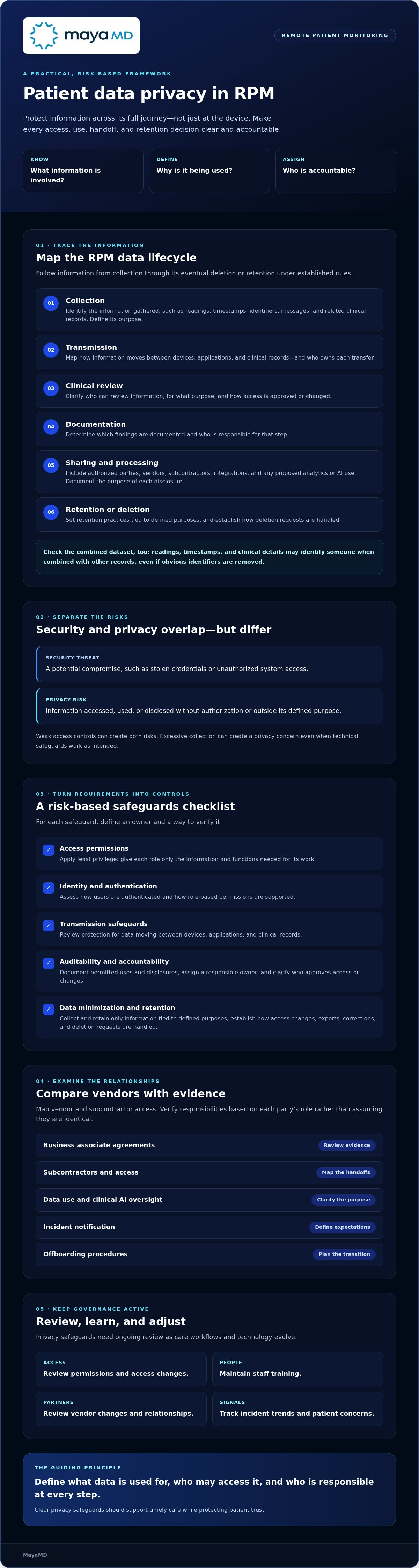
Privacy in remote patient monitoring (RPM) is a lifecycle governance issue, not simply a matter of securing a connected device. A Remote patient monitoring (RPM) program can involve data collection, transmission, clinical review, documentation, sharing, and retention. At every stage, teams need to know what information is involved, why it is used, who can access it, and when it should no longer be kept. Reviewing remote patient monitoring workflows as connected steps can help reveal gaps between technology and day-to-day practice.
Which patient information does RPM collect and use?
RPM records may include readings such as blood pressure or glucose measurements, timestamps, patient identifiers, messages, and related clinical records. Together, these details help clinicians interpret a measurement in context. But not every data use supports direct care. Separate information needed to deliver and document monitoring from data proposed for optional analytics or product improvement. Define the purpose and permitted use of each category before collection or disclosure.
Identifiers aren’t the only privacy concern. A pattern of readings, timestamps, and clinical details may point to a specific person when combined with other records, even if obvious identifiers have been removed. Assess the combined dataset and its intended use, not just individual fields.
Who handles RPM data across the care journey?
Patients may generate measurements or send messages. Clinicians review information and make care decisions, and providers document relevant findings. Technology vendors may host, process, or route data, while other authorized parties may receive it for defined purposes. Map each handoff, including integrations with clinical records and any vendor or subcontractor access. Assign a responsible owner to each transfer and clarify what that party is permitted to do.
HIPAA obligations depend on the parties involved and their roles. Verify whether and how the rules apply to each relationship rather than assuming every participant has identical responsibilities.
Where do privacy risks and security threats overlap?
A security threat is a potential compromise, such as stolen credentials or unauthorized system access. A privacy risk is broader: information could be accessed, used, or disclosed in a way that isn’t authorized or consistent with its defined purpose. Weak access controls can create both risks, while excessive collection may raise a privacy concern even when technical safeguards work as intended.
Every organization that handles identifiable health data needs defined responsibilities for access, use, disclosure, and retention. That principle is central to how to ensure patient data privacy in RPM: trace the information from enrollment and measurement through clinical review, documentation, and eventual deletion or retention under the organization’s established rules.
How to ensure patient data privacy in RPM with system and workflow safeguards
Turn privacy expectations into controls staff can apply and verify. The steps below help teams move from written requirements to system configuration and recurring oversight. Use the NIST RPM cybersecurity framework as a reference for considering risks across the connected monitoring environment, then confirm proposed safeguards with your security and compliance teams.
Define requirements and owners.
Document permitted data uses, applicable obligations, clinical workflows, and who approves access or changes. Specify which team owns each safeguard, from user provisioning to incident escalation.
Set access and data-minimization rules.
For each role, identify the information needed and its clinical or operational purpose. Apply least privilege so users can access only the data and functions necessary for their work. Collect and retain only information tied to defined purposes. Establish how access changes, exports, correction requests, and deletion requests are handled.
Assess identity and transmission controls.
Ask how the system authenticates users, supports role-based permissions, protects data moving between devices, applications, and clinical records, and restricts administrative access. Review integration pathways, including how credentials are managed and what happens if a connection or account is compromised.
Confirm auditability and response procedures.
Determine whether access and relevant system actions can be reviewed, who examines those records, and how suspected incidents are escalated. Ask for evidence and documentation, not just a summary of capabilities.
Set retention and review cycles.
Define retention and disposal expectations for each data type, including copies in exports, logs, and connected systems. Reassess controls when workflows, integrations, or vendor practices change.
Assess connected devices and clinical AI
Device connectivity and AI introduce additional data paths. Confirm how identity controls, audit logs, secure integrations, and incident escalation work in the specific configuration you plan to use. Verify product-level details with the vendor and your internal teams. Don’t assume a capability exists because it appears in a general security statement.
For AI workflows, ask directly whether patient information enters model training, prompts, logs, or third-party services, and how outputs are documented and reviewed. The Clinical AI Agent overview can help frame questions for evaluating an AI-enabled workflow, but confirm product-specific data handling before implementation.
A platform’s compliance description is not a substitute for an organization’s complete privacy program. A vendor may describe its platform as HIPAA-compliant, but your team still needs to assess the actual configuration, contractual terms, access practices, and workflow responsibilities. This distinction is central to how to ensure patient data privacy in RPM. If you’re evaluating MayaMD after defining your requirements, discuss the platform and privacy questions with the team.
How to compare RPM vendors on privacy, compliance, and accountability
Vendor diligence should test how safeguards work in the service you plan to use, not simply collect assurances. A HIPAA compliance claim can be relevant, but it doesn’t replace your organization’s legal and security assessment. Request current documentation through approved diligence processes, then compare it with the proposed configuration, contract, and clinical workflow. Record gaps and assign someone to resolve each one before implementation.
| Evidence requested | Vendor response to document | Follow-up owner |
|---|---|---|
| Business associate agreement and permitted data uses | Which services and data uses are covered? What safeguards, incident reporting, subcontractor terms, and return or destruction procedures are addressed? | Privacy or legal lead |
| Subcontractor list and data-flow description | Which subcontractors may process or access data, for what purpose, and where does information flow? | Vendor manager and security lead |
| Incident notification procedure | How does the vendor escalate a suspected incident, communicate relevant facts, and coordinate with the organization? | Security and incident-response leads |
| Data use, access, and retention documentation | What data is collected, who can access it, whether it is used beyond care delivery, and how retention or deletion is managed? | Privacy lead and clinical owner |
| Termination and transition procedures | How are data returned or destroyed, access ended, and any retained copies handled when the relationship ends? | Legal and operations leads |
Review the agreement and the operating model together
Ask counsel to review the business associate agreement (BAA), including permitted uses, safeguards, subcontractors, incident reporting, and return or destruction of data. A contract summary or template can help organize questions, but it isn’t legal advice or a substitute for counsel. Check that the agreement aligns with the system’s configuration and clinical workflow. For example, if the workflow requires a vendor to process patient messages, confirm that the relevant use and access are addressed in the applicable documentation.
For AI-enabled services, ask what information each component processes, where it flows, and which parties may access it. Determine whether patient data enters prompts, logs, model training, or third-party services. Then establish who reviews clinical outputs, how concerns are escalated, and how corrections are documented. This operational governance is essential to AI-governed chronic care workflows.
Separate evidence from promotion. A security overview or compliance statement may describe an approach, but request current supporting materials through your organization’s approved review process and clarify any limitations. This comparison gives teams a repeatable way to assess how to ensure patient data privacy in RPM, while keeping legal interpretation, security validation, and clinical accountability with the appropriate organizational owners.
How to implement patient-centered RPM privacy step by step
A repeatable process makes privacy part of care delivery rather than a document that sits apart from it. Assign an accountable owner to every step, record decisions, and involve clinical, privacy, security, and operations teams where their responsibilities intersect.
1. Inventory data flows. Owner: RPM program lead.
Trace information from enrollment and measurement through transmission, clinical review, documentation, vendor processing, and retention. For each collection and disclosure, document what data is involved, its purpose, who receives it, and which system or party handles it.
2. Review risks and approve requirements. Owner: privacy or security lead.
Identify unnecessary collection, unclear access, vulnerable handoffs, and gaps in responsibility. Record mitigations and route legal questions to counsel. Check current authoritative guidance rather than relying on assumptions about legal deadlines or requirements.
3. Prepare patient-facing information. Owner: patient engagement or clinical operations lead.
Explain what the program collects, why it supports care, who may access it, and how patients can raise questions or concerns. Use accessible language and communication methods suited to the patient population. Document preferences and applicable permissions according to organizational policy and legal review.
4. Translate requirements into staff procedures. Owner: clinical operations lead.
Define which roles may access information, approved communication channels, and the steps for handling data appropriately. Train clinical and support staff on minimum-necessary access and how to escalate unusual readings, privacy complaints, misdirected data, or suspected incidents.
5. Test and maintain the process. Owner: RPM program lead with privacy and security partners.
Walk through realistic scenarios, such as a message sent to the wrong recipient or a staff member who changes roles. Review access periodically, and repeat assessments when vendors, integrations, or clinical workflows change. Record findings, assign corrective actions, and update training materials.
Make escalation clear and usable
Staff need to know where to send a concern, what details to record, and who decides the next step. Separate clinical escalation for a concerning reading from privacy or security escalation, while allowing teams to coordinate when a situation involves both. Test these pathways with the people expected to use them, then revise procedures when a handoff is unclear.
Patient-centered privacy is more than notice and consent language. Patients should be able to understand the program’s data practices and raise concerns without having to decipher technical or legal terminology. This practical sequence supports how to ensure patient data privacy in RPM while preserving clear accountability throughout care. To discuss how a clinical AI platform may fit within your established privacy requirements, contact the MayaMD team.
How to sustain RPM privacy as care and technology evolve
RPM privacy needs ongoing governance. A new integration, updated care pathway, change in staff responsibilities, or added AI capability can alter who handles patient information and how it moves. Treat each meaningful change as a reason to revisit the data-flow inventory, access rules, vendor documentation, and escalation procedures. Assign owners and record decisions so the program can adapt without losing accountability.
What should an RPM privacy review measure?
Choose operational indicators that show whether safeguards are being carried out, not just written down. With privacy and security teams, define the measure, accountable owner, review cadence, evidence source, and escalation threshold. Examples include:
Access governance
completion of scheduled access reviews and resolution of identified access issues.
Training
completion of assigned privacy training and follow-up when staff procedures change.
Vendor oversight
review of vendor or subcontractor changes and completion of related risk assessments.
Issue management
incident trends, time to assign an owner, and closure of corrective actions under internal procedures.
Patient experience
privacy concerns received, their disposition, and recurring themes that may indicate unclear notices or workflow friction.
Use approved records, such as access-review logs, training documentation, vendor change notices, incident records, and patient feedback. A metric is a signal for review, not proof that a program complies with every applicable obligation or that risk has been eliminated. Investigate patterns and document what the organization changed in response.
Reassess technology against documented requirements
Before a vendor change or new capability enters production, compare its data flows and responsibilities with the requirements your organization has already approved. Ask whether integrations introduce new recipients, whether AI processing changes data use or access, and whether updated clinical pathways affect documentation or escalation. Include relevant clinical, privacy, security, legal, and operational owners in the review.
MayaMD describes its cloud-based clinical AI platform as HIPAA-compliant and supports RPM and chronic care management workflows. Treat that description as a starting point for evaluation, not a substitute for program governance. Compare documented capabilities with your organization’s requirements, and verify current security controls, contractual terms, subprocessors, data flows, retention options, and generative AI data handling directly before implementation.
That discipline is central to how to ensure patient data privacy in RPM over time: measure whether governance activities happen, respond to findings, and reassess when care or technology changes. To discuss your RPM privacy requirements in relation to MayaMD’s platform, contact the MayaMD team.
Make privacy an enduring part of RPM care
Protecting patient information in remote monitoring is an ongoing responsibility, not a one-time technology decision. The practical answer to how to ensure patient data privacy in RPM is to govern the full data lifecycle, assign clear ownership, and revisit safeguards as vendors, workflows, and clinical tools change.
Start with documented purposes for collection and disclosure, then evaluate whether access, contracts, staff procedures, and escalation pathways support those purposes in practice. Regular review of access, vendor changes, incidents, and patient concerns helps teams identify gaps and respond before they become embedded in routine care. No single platform or metric can replace that organizational accountability.
MayaMD supports RPM and chronic care management through its clinical AI platform, which the company describes as cloud-based and HIPAA-compliant. As with any platform, evaluate it against your own requirements and verify the current scope and supporting documentation, including relevant data handling and contractual details.
Discuss your RPM privacy and workflow requirements with the MayaMD team as you assess potential fit. With clear governance and patient-centered practices, your program can strengthen privacy while supporting connected, responsive care.
Frequently Asked Questions
Is RPM patient data protected by HIPAA?
HIPAA may apply when covered entities and business associates handle protected health information, but applicability depends on the organizations, their roles, and the data flows involved. A platform’s compliance statement alone doesn’t establish that an entire RPM program meets its obligations. Have privacy or legal counsel assess the specific program, contracts, configurations, and workflows, including how information moves between providers, vendors, and other authorized parties.
How can a healthcare provider protect patient data in an RPM program?
Start by mapping information from collection through clinical use, sharing, and retention. Limit access by role and purpose, assess vendors and subcontractors, document data-use terms, train staff, and establish incident escalation procedures. Review safeguards regularly, especially when workflows, integrations, or AI capabilities change. To determine how to ensure patient data privacy in RPM for your organization, confirm the applicable legal and technical requirements with qualified internal experts.
Can RPM vendors use patient data to train AI models?
Whether a vendor can use patient data for model training depends on the product, contract, configuration, and applicable rules. Ask whether patient information enters model training, prompts, logs, analytics, or third-party services, and what controls govern each use. Review current documentation and contractual terms with privacy, security, and legal teams. Don’t rely on a general marketing statement; request explanations that address the specific service and configuration under consideration.
What should an RPM business associate agreement include?
Ask counsel to review permitted uses and disclosures, safeguards, subcontractor responsibilities, incident reporting, and what happens to data when the relationship ends. Check that the agreement reflects the product’s actual behavior and the parties’ operational responsibilities, rather than relying on standard language alone. Requirements can depend on the relationship and circumstances. This overview is for general information and isn’t legal advice or a substitute for review by qualified counsel.
How should patients be informed about RPM data collection?
Explain in accessible language what information the program collects, why it supports care, who may access it, and how patients can ask questions or raise concerns. Choose communication methods suited to the patient population, and align notices and permission processes with organizational policy and applicable requirements. Keep patient-facing explanations consistent with actual practices, including relevant vendor and technology use, so patients aren’t given an incomplete picture of how their information is handled.
What privacy risks should providers review when using AI in RPM?
Review which patient data AI components process, where it flows, who may access it, and whether it’s retained or reused. Assess human oversight, escalation, documentation, and correction processes for AI-supported outputs. Verify these details for the specific system and configuration, including whether information enters prompts, logs, model training, or third-party services. Don’t assume every AI product handles data in the same way, even when tools serve similar clinical purposes.
How often should an RPM privacy program be reviewed?
Set a review cadence based on organizational policy, risk, and applicable requirements, then reassess when vendors, integrations, data uses, AI capabilities, or care workflows change. Track who owns each review and retain evidence of completion. Periodically test staff procedures to confirm escalation paths work in practice. There’s no single interval that suits every organization, so confirm review timing with privacy, security, and legal leaders.




See The MayaMD Difference
Fill the form below
Download Our Apps
MayaMD for patients and MayaPro for physicians - available on iOS and Android.
FOR PATIENTS
MayaMD App
AI-powered symptom assessment, triage, and secure access to your care team.


FOR PHYSICIANS
MayaPro App
MayaPro brings patient vitals, RPM/PCM care plans, and clinical decision support to your pocket.