
How AI Can Improve Diagnostic Accuracy in Primary Care

A patient’s symptoms have changed since the last visit, but the detail that explains how is buried in a fragmented history. This is where the question of how AI can improve diagnostic accuracy in primary care becomes practical: AI may help bring useful information into view for a clinician to assess. It should not make the diagnosis on the clinician’s behalf.
Primary care decisions often involve uncertainty, evolving symptoms, and information spread across visits. Depending on its design, AI may help organize patient-reported details, surface patterns, or support documentation. But a polished answer isn’t proof of clinical reliability. Performance can depend on data quality, the system’s intended use, and the setting in which it was evaluated.
This article explains how AI may support diagnostic reasoning, where its limitations can affect reliability, and what evidence and safeguards to consider before adoption. It also outlines practical ways to evaluate AI in primary care workflows, including how it fits with existing processes and keeps clinicians responsible for decisions. The goal is a clear-eyed view of AI as a potential aid to judgment, not a substitute for it.
Key Takeaways
• Learn how AI can improve diagnostic accuracy in primary care by organizing information and surfacing details for clinician review, rather than replacing clinical judgment.
• Assess how incomplete records, evolving symptoms, and data quality can affect the usefulness of AI-supported insights.
• Recognize why AI outputs need human review and evaluation for fit with individual patients and clinical workflows.
• Use a structured evaluation process, including baseline measures and a defined comparison method, before concluding that diagnostic accuracy has improved.
• See how MayaMD’s Clinical AI Agent supports patient engagement, chronic-care workflows, and documentation without functioning as an autonomous diagnostic system.
Why diagnostic accuracy is challenging in primary care
Primary care clinicians make decisions while information is still taking shape. A consultation may be brief, a patient’s history may be spread across records, and symptoms may be new, changing, or shared by several conditions. Clinicians need to decide what to consider, what evidence is missing, and whether follow-up or further assessment is needed.
Diagnostic accuracy is not the same as speed, complete documentation, or patient satisfaction. These factors can matter to care, but none alone shows whether an assessment identified relevant conditions and appropriately considered alternatives. Diagnostic accuracy in primary care is the degree to which a clinical assessment correctly identifies or excludes possible conditions for a patient, given the available evidence.
Why symptoms and patient histories can be difficult to interpret
Symptoms rarely arrive as a complete, neatly ordered account. Fatigue, pain, dizziness, or shortness of breath can fit multiple explanations. Their significance may depend on when they began, how they have changed, and what else is happening in the patient’s health. A medication, prior condition, or new symptom between appointments can also change how the situation should be assessed.
Important context may be missing or disconnected. A detail recorded in another setting may not be visible during the visit, while a patient’s account may clarify how symptoms have evolved. Without that context, the clinical picture can be harder to assess. AI’s potential role is part of the wider field of artificial intelligence in healthcare, but each system’s capabilities need to be assessed on their own merits.
What diagnostic accuracy means in a clinical setting
Accuracy is not simply whether a tool suggests a plausible condition. It concerns whether an assessment handles relevant possibilities appropriately, including whether it overlooks a condition that needs consideration or gives undue weight to an unlikely explanation. The appropriate reference point depends on the clinical task and how the assessment is evaluated.
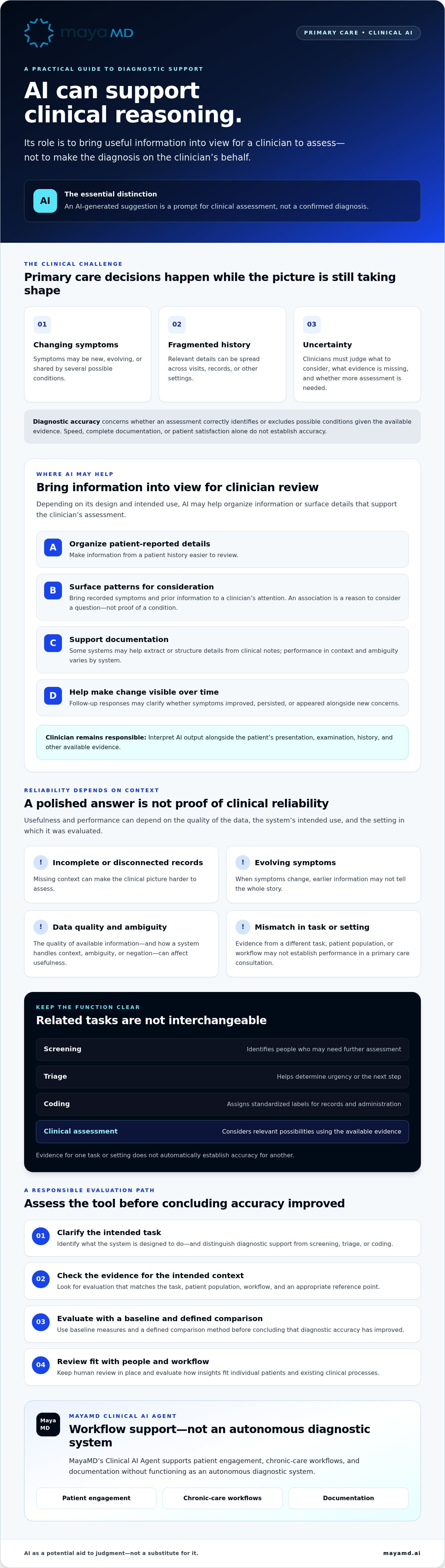
Diagnostic support is also distinct from related functions. Screening identifies people who may need further assessment. Triage helps determine urgency or the next step. Coding assigns standardized labels for records and administration. None is automatically equivalent to a clinician’s final assessment. When considering how AI can improve diagnostic accuracy in primary care, ask what the system is designed to do and how its results were compared with an appropriate reference in the intended patient population. Evidence for one task or setting may not establish accuracy in another.
How AI can support diagnostic accuracy in primary care
AI is most useful in diagnostic workflows when it helps clinicians work with information, not when it is treated as a substitute for clinical reasoning. Depending on the system and its intended use, it may organize details from a patient history, surface patterns for review, or bring relevant information into view. These capabilities can help clinicians consider a differential, but they don’t establish what condition a patient has.
An AI-generated suggestion is a prompt for clinical assessment, not a confirmed diagnosis. The clinician must interpret any output alongside the patient’s presentation, examination, history, and other available evidence.
Pattern recognition and clinical decision support
Some AI models analyze associations across symptoms, history, and other available clinical data. For example, a system might bring a combination of recorded symptoms and prior information to a clinician’s attention. Natural language processing may also help extract or structure details from clinical notes, but its ability to interpret context, handle ambiguity, or capture negation varies by system.
A surfaced association is a reason to consider a question, not proof that a condition is present. Before relying on an AI tool, look for validation that matches its intended task, patient population, and workflow. A tool evaluated in a different setting may not perform the same way in a primary care consultation.
Longitudinal context and patient-reported information
Information gathered between appointments can help show how a clinical picture is changing. Follow-up responses may clarify whether a symptom has improved, persisted, or appeared alongside new concerns. Remote monitoring for chronic care management can also contribute ongoing information when it is relevant to a patient’s care plan. MayaMD’s remote patient monitoring capabilities relate to maintaining care context over time, not to independently diagnosing a patient.
More data isn’t automatically better. Patient-reported information can be incomplete, inaccurate, delayed, or collected inconsistently. Records may also be difficult to connect across encounters. These limitations can affect what an AI system surfaces and how a clinician should interpret it. The practical questions are whether information is timely and relevant, and whether it reaches a workflow where the care team can assess it.
For primary care teams exploring how AI can improve diagnostic accuracy in primary care, start by matching a specific clinical need to a clearly defined tool, then examine the evidence and workflow fit. Providers considering how a Clinical AI Agent or related digital care capabilities could fit their practice can discuss workflow and evaluation needs.
When AI diagnostic support helps, and when it can mislead
AI output can be incomplete, incorrect, or poorly matched to an individual patient. Its usefulness depends on the information it receives, the task it was designed to support, and how clinicians interpret its suggestions. A model’s performance in a benchmark or controlled evaluation does not, by itself, show that using it improves diagnostic decisions or patient outcomes in everyday primary care.
Consider both the potential support and the possible failure mode:
Context
A tool may bring relevant history or symptom patterns into view. If records are fragmented or circumstances have changed, its output may miss important clinical context.
Data quality
Complete, accurate inputs can help a system produce more useful outputs. Missing, outdated, or inaccurate information can distort what it surfaces.
Patient population
A model may assist with a defined task, but performance can vary if the population it encounters differs from the one used to develop or evaluate it. Biased or unrepresentative data may lead to less reliable performance for some patient groups.
Human review
A clinician can assess suggestions alongside examination findings and the patient’s circumstances. Overreliance on an output may cause relevant alternatives or contradictory evidence to receive too little attention.
Common sources of error in AI-assisted assessment
Errors can arise from missing data, inaccurate inputs, or clinical changes the system hasn’t captured. Generative AI adds another concern: it may produce plausible-sounding text that is incomplete or incorrect, so statements and supporting evidence need to be checked. These risks matter even when a system appears fluent or performs well on a benchmark.
When assessing how AI can improve diagnostic accuracy in primary care, look for evidence that matches the intended use, care setting, and patient population. Test performance alone shouldn’t be presented as proof of better decisions in routine practice.
Human oversight, escalation, and accountability
AI should inform the assessment, not own it. The clinician remains responsible for interpreting suggestions in light of examination findings, the patient’s preferences, and the full available history. Clear escalation processes are also necessary when symptoms appear urgent, information conflicts, or uncertainty remains. The tool should not delay appropriate clinical assessment.
Before adoption, practices need governance that defines who reviews outputs, how concerns are escalated, and who is accountable for decisions. Auditability matters too: teams should be able to examine how a tool is used, review problematic outputs, and monitor its performance in practice. These safeguards help keep AI’s contribution visible and subject to clinical oversight.
How primary care teams can evaluate diagnostic AI responsibly
Responsible evaluation starts with a defined clinical need, not a broad promise of better accuracy. Before adopting a tool, decide what it should do, what evidence would demonstrate value, and how clinicians will review its output. This framework helps teams assess how AI can improve diagnostic accuracy in primary care without mistaking technical performance for clinical benefit.
1. Define the task.
Specify whether the system supports documentation, triage, information synthesis, or another discrete activity. Don’t assume evidence for one function applies to another.
2. Examine relevant evidence.
Ask which users, patient groups, care settings, and clinical workflows were evaluated, and what comparator was used. Review sensitivity, specificity, and predictive values as distinct measures where reported. They describe different aspects of performance and shouldn’t be treated as interchangeable with clinical outcomes.
3. Establish a baseline and comparison.
Before implementation, record how the current workflow performs on the same defined task. Set a consistent comparison method and measures in advance. This lets a practice assess whether accuracy changed rather than relying on impressions or a vendor’s benchmark.
4. Test workflow and safeguards.
Assess whether clinicians can review, question, and override suggestions; whether patients receive clear communication about the tool’s role; and whether privacy practices and interoperability meet the organization’s requirements. Observe use in realistic workflows before making broader claims.
5. Monitor after deployment.
Track measures such as clinician acceptance, overridden suggestions, and safety events. Review results across patient groups, investigate meaningful disparities, and establish processes for user feedback, incident review, system updates, and clinician training.
Make evaluation continuous
Performance can shift as patient populations, workflows, and data inputs change. Ongoing review should ask not only whether the tool is being used, but whether it remains appropriate for its defined task and whether its outputs are interpreted safely. Assign clear responsibility for reviewing concerns and deciding when a tool needs adjustment or further evaluation.
Deployment involves more than model performance. Integration with existing systems, clarity for patients and clinicians, and the practical burden of review can determine whether a tool fits care delivery. For broader context on workflow considerations, see MayaMD’s Clinical AI Agent overview.
To discuss workflow fit and evaluation needs for MayaMD’s clinical AI capabilities, contact the MayaMD team.
How MayaMD relates to AI-supported primary care
AI can have a role in primary care without making or confirming diagnoses. MayaMD offers a Clinical AI Agent and digital care capabilities focused on patient engagement, chronic-care support, and clinical documentation. Its platform combines deterministic logic with generative AI. These functions support care continuity and workflow, but should not be represented as autonomous diagnosis or as proven improvement in diagnostic accuracy.
That distinction matters. The potential value of an AI platform depends on the task it performs, the information available to it, how clinicians review its outputs, and whether its use is evaluated in the intended setting. A system that supports communication or documentation should be assessed on those functions, not assumed to improve diagnostic decisions without relevant evidence.
Connecting patient engagement with continuity of care
Patient engagement and ongoing information may help care teams maintain context between encounters. For example, information gathered through chronic-care workflows could help clinicians understand what has changed since a previous interaction, provided the data is relevant, timely, and reviewed appropriately. MayaMD’s remote patient monitoring capabilities relate to ongoing chronic-care support, not independent diagnosis. The clinical team remains responsible for interpreting patient information and deciding what action is appropriate.
Questions to discuss before exploring a clinical AI platform
Before evaluating a platform, care teams can use focused questions to connect its capabilities to their needs:
Which tasks does it support?
Clarify whether the intended use is patient engagement, chronic-care support, documentation assistance, or another defined workflow.
What evidence is available?
Ask what has been evaluated, for which users and patient groups, and whether the evidence applies to the practice’s intended use. Don’t treat a description of capabilities as proof of diagnostic benefit.
How are outputs reviewed?
Establish how clinicians can check information, correct it, and escalate concerns when it is incomplete or conflicts with clinical judgment.
How does information fit existing workflows?
Discuss data flow, interoperability, privacy and security practices, and who is responsible for oversight and issue review.
These questions give practices a practical way to explore how AI can improve diagnostic accuracy in primary care while keeping claims proportionate to the available evidence. If your team is assessing a defined workflow or wants to understand how MayaMD’s capabilities may fit, discuss your primary care AI use case.
Put clinical AI to work with evidence and oversight
AI is most promising in primary care when it helps clinicians organize information and maintain context, while leaving assessment and decisions in human hands. Understanding how AI can improve diagnostic accuracy in primary care means looking beyond suggested answers: define the task, evaluate evidence in the relevant setting, establish a baseline, and monitor performance after implementation.
MayaMD describes its Clinical AI Agent as combining deterministic logic with generative AI, with capabilities that support patient engagement and chronic-care workflows. These are potential workflow supports, not proof of autonomous diagnosis or improved diagnostic accuracy. Any claim about clinical performance should be backed by evidence for the specific use case.
If your team is considering a clinical AI platform, start with the workflow need, the evidence required, and how clinicians will review its outputs. Discuss your primary care AI use case with MayaMD to explore fit and evaluation needs. A measured approach can help teams adopt useful technology while keeping sound clinical judgment at the center of care.
Frequently Asked Questions
Can AI improve diagnostic accuracy in primary care?
AI may support diagnostic accuracy by organizing clinical information, highlighting patterns, or helping clinicians review relevant details. Whether it actually improves accuracy must be demonstrated for the specific tool, task, patient population, and care setting. A useful evaluation compares performance with an appropriate baseline and includes clinician oversight. Faster documentation or a plausible suggestion alone doesn’t establish that diagnoses are more accurate.
How does AI help doctors make a diagnosis?
Depending on its design, AI may help structure information from clinical notes, summarize available history, or surface associations across symptoms and other data. This can give a clinician additional material to consider, including details that may merit follow-up. The output is decision support, not a conclusion: clinicians must assess it against examination findings, patient history, current circumstances, and the patient’s preferences.
Can AI diagnose patients without a doctor?
AI output shouldn’t be treated as a confirmed clinical diagnosis or a replacement for professional assessment. Some tools may provide health information, triage support, or suggestions, but their intended purpose and evidence vary. In primary care, a clinician needs to interpret relevant information and decide what evaluation or next step is appropriate. MayaMD’s Clinical AI Agent supports care workflows and doesn’t independently diagnose patients.
What are the risks of using AI for diagnosis?
AI may produce incomplete or incorrect output, especially when information is missing, outdated, or inaccurate. A system may also perform differently for patient groups or workflows unlike those represented in its evaluation data. Generative AI can present errors in convincing language, so outputs need verification. Overreliance may narrow consideration of other explanations. Practices should establish review, escalation, accountability, and ongoing monitoring processes.
How should a primary care practice evaluate diagnostic AI?
Start by defining the clinical task, such as information synthesis or triage, and request evidence relevant to the intended users, patient population, and setting. Establish baseline measures and a comparison method before making claims about improved accuracy. Assess workflow fit, clinician review, patient communication, privacy, and interoperability. After implementation, monitor use, overridden suggestions, safety events, and differences in performance across patient groups.
Does AI improve diagnostic accuracy for every condition?
No. Performance depends on the system, task, available data, and patient population. Evidence for one condition or clinical setting doesn’t automatically apply to another, and a benchmark result doesn’t prove improved outcomes in routine care. Practices should check whether a tool has been evaluated for the specific use they’re considering and ensure clinicians can question or override its suggestions.




See The MayaMD Difference
Fill the form below
Download Our Apps
MayaMD for patients and MayaPro for physicians - available on iOS and Android.
FOR PATIENTS
MayaMD App
AI-powered symptom assessment, triage, and secure access to your care team.


FOR PHYSICIANS
MayaPro App
MayaPro brings patient vitals, RPM/PCM care plans, and clinical decision support to your pocket.