
HIPAA Compliant AI Platform for Chronic Care Management: The 2026 Security Standard

In the high-stakes environment of 2026 healthcare, the distinction between a transformative clinical tool and a regulatory liability rests entirely on deterministic governance. You likely recognize that the administrative weight of managing chronic care documentation is reaching a breaking point, yet the fear of generative AI hallucinations leading to clinical errors remains a significant barrier to adoption. It's a difficult balance to strike. You require the efficiency of automation without sacrificing the rigorous oversight necessary for patient safety. By leveraging a HIPAA compliant AI platform for chronic care management, you can finally move past the experimental phase of technology into a proven, secure application. This article details a sophisticated framework for utilizing advanced clinical AI agents to reduce provider burnout and improve patient outcomes in RPM and PCM programs. We'll examine how a governed approach to generative technology ensures that every automated interaction remains precise, compliant, and deeply connected to the human element of care.
Key Takeaways
• Analyze the evolution of secure patient data management as it transitions from legacy EHR storage to sophisticated, cloud-based clinical data ecosystems.
• Identify the architectural requirements, including Zero-Trust protocols, essential for a HIPAA compliant AI platform for chronic care management.
• Understand how deterministic logic governs generative AI outputs to eliminate clinical hallucinations and ensure precise, evidence-based patient interactions.
• Apply a comprehensive decision-making framework to evaluate AI partners based on rigorous security standards and clinical validity.
• Discover how integrating a Clinical AI Agent optimizes chronic care documentation and enhances the human impact of technology in PCM programs.
The Evolution of Secure Patient Data Management in the Cloud
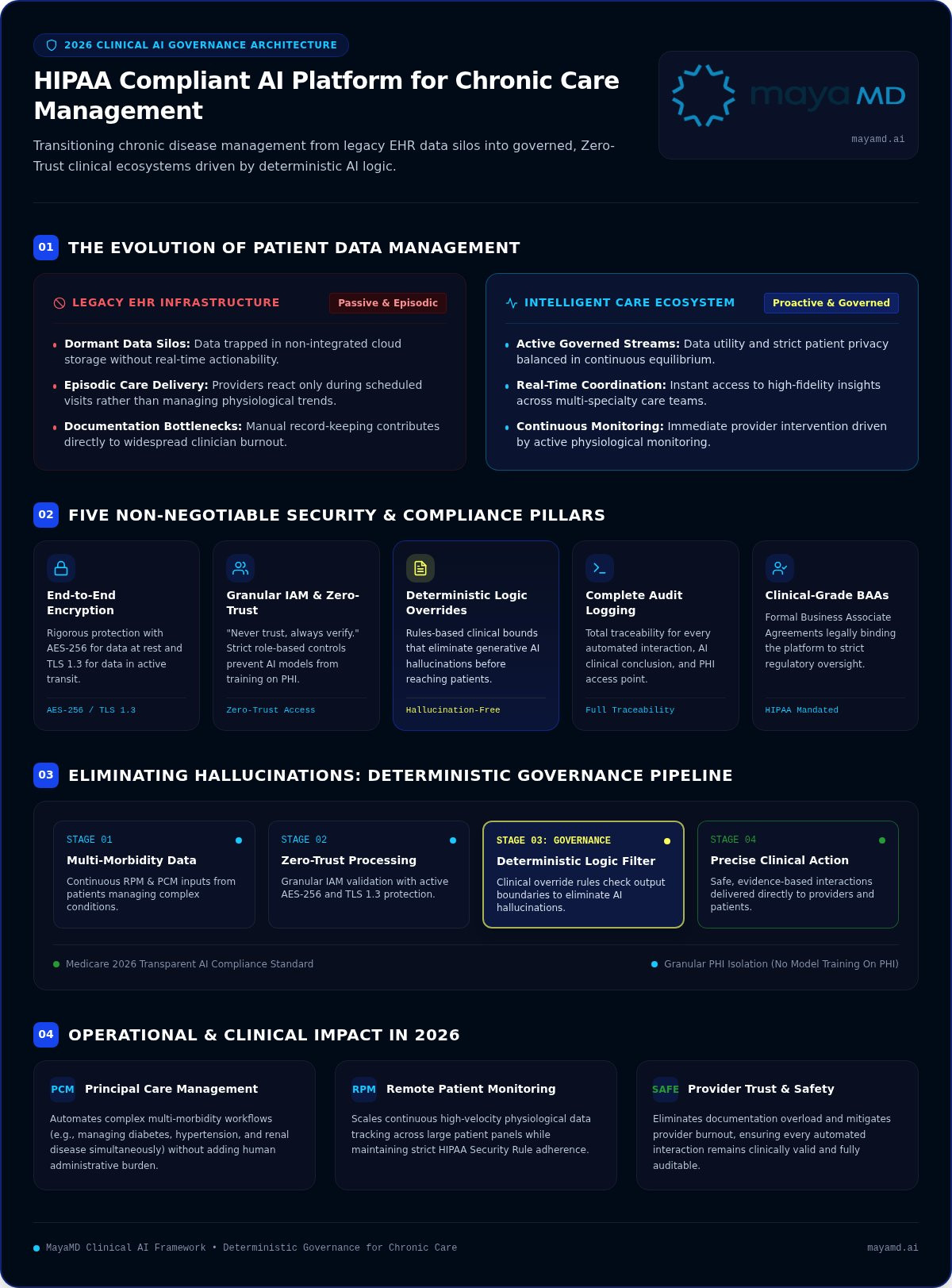
The 2026 regulatory landscape has redefined secure patient data management. It's no longer a matter of passive encryption; it's about the active, deterministic governance of information in motion. You recognize that legacy systems often treat data as a dormant record, but modern chronic care requires a more dynamic approach. A HIPAA compliant AI platform for chronic care management must transcend simple cloud storage to become a governed ecosystem where data utility and patient privacy exist in equilibrium. This shift from static repositories to intelligent, AI-driven frameworks allows providers to maintain rigorous oversight while leveraging the high-velocity data required for complex clinical decision-making. You don't need a disruptor. You need a sophisticated partner that understands the nuances of a regulated clinical workflow and treats security as a foundational logic, not an afterthought.
From Siloed EHRs to Intelligent Care Ecosystems
Traditional Electronic Health Records (EHRs) were built for documentation, not for the continuous monitoring required in chronic disease states. These siloed systems often create bottlenecks that impede the real-time data flows necessary for advanced primary care management. When patient information is trapped in non-integrated cloud storage, the care team loses the ability to act on physiological changes as they happen. An intelligent care ecosystem replaces these silos with a unified stream of governed data. This connectivity ensures that every provider in a multi-specialty environment has access to the same high-fidelity clinical insights. It's a move from episodic reactions to continuous, proactive care coordination.
Why 2026 Demands Advanced Chronic Care Infrastructure
The clinical reality of 2026 is defined by multi-morbidity. Patients aren't just managing a single condition. They're often balancing diabetes, hypertension, and renal issues simultaneously. Scaling remote patient monitoring for these populations requires a cloud-native infrastructure that can handle massive data volumes without compromising security. Specialists are increasingly turning to a Clinical AI Agent to manage Principal Care Management (PCM) workflows that would otherwise overwhelm human staff. These tools aren't just convenient; they're becoming a regulatory necessity. Anticipated shifts in 2026 Medicare guidelines emphasize the need for transparency in AI-assisted care. Providers must be able to demonstrate exactly how their platform handles Protected Health Information (PHI) and reaches clinical conclusions. Adopting a HIPAA compliant AI platform for chronic care management ensures your practice remains compliant while meeting the rising complexity of modern patient needs.
Essential Pillars of a HIPAA Compliant AI Platform
Compliance isn't a secondary administrative task; it's a structural requirement. It dictates how clinical data moves through an AI's logic. A HIPAA compliant AI platform for chronic care management must be architected to prevent data leakage at every node. This involves a rigorous adherence to HIPAA Security Rule requirements, ensuring that electronic PHI remains protected during active processing. The capability to secure data at a granular level directly leads to the outcome of sustained provider trust and patient participation in chronic care programs. Without this foundation, the most advanced clinical insights remain unusable in a regulated environment.
To ensure high-stakes reliability, a 2026 AI healthcare platform must integrate five non-negotiable security features. These include end-to-end encryption, granular Identity and Access Management (IAM), deterministic logic overrides to prevent hallucinations, comprehensive audit logging for every AI decision, and clinical-grade Business Associate Agreements (BAAs). These components work in harmony to create a governed environment where technology serves the clinical workflow without introducing unnecessary risk.
Zero-Trust Architecture and Data Encryption Standards
Zero-Trust operates on the principle of "never trust, always verify." Within a remote patient monitoring framework, this architecture requires every access request to be authenticated and authorized, regardless of its origin. The platform utilizes AES-256 encryption for data at rest and TLS 1.3 for data in transit to ensure that PHI is unreadable to unauthorized parties. These technical safeguards are essential for maintaining the integrity of chronic care data, and organizations often rely on specialized software testing from Test Triangle to validate these complex security layers. Sophisticated IAM protocols ensure that AI models don't "learn" from PHI in a way that allows for data reconstruction. This isolation is critical for maintaining regulatory boundaries while leveraging clinical insights to improve patient care.
A standard cloud BAA is often insufficient for generative AI providers. You need a specialized agreement that specifically addresses how AI models interact with your data. Legal considerations for AI model training on de-identified chronic care data are complex. All sub-processors, including third-party LLM providers, must be bound by clinical-grade BAAs that match your own security standards. This prevents your patient data from being used to train public models or being exposed through secondary vulnerabilities. Ensuring these legal protections are in place allows you to focus on clinical outcomes rather than liability. If you're looking to evaluate your current compliance framework, consulting with a technical partner can provide the necessary clarity for your organization.
Beyond Hallucinations: Governing AI with Deterministic Logic
Clinical safety is the primary metric for any technology introduced into the chronic care workflow. While generative AI has demonstrated impressive capabilities in natural language processing, its probabilistic nature introduces a significant risk: hallucinations. In a medical context, an AI that "guesses" the next word based on probability rather than clinical fact is a liability. A HIPAA compliant AI platform for chronic care management must solve this by implementing deterministic logic. This governed approach ensures that every clinical output is rooted in established medical protocols rather than statistical likelihood. By layering deterministic rules over generative models, providers can leverage the efficiency of AI without compromising the accuracy of patient documentation or care plans.
Why Clinical Safety Requires More Than Large Language Models
Large Language Models (LLMs) often operate as a "black box," making it difficult for clinicians to verify the reasoning behind a specific suggestion. This opacity is particularly dangerous when managing complex multi-morbid cases like hypertension or diabetes. Probabilistic models might misinterpret vital sign trends in remote patient monitoring, leading to incorrect alerts or clinical documentation errors. To mitigate these risks, platforms must adhere to strict HIPAA Security Rule requirements, ensuring that the data used for reasoning is both protected and processed through a Clinical AI Agent that prioritizes deterministic logic. This transition from "black box" algorithms to transparent, rule-based systems is essential for maintaining safety in high-stakes chronic care environments.
Neuro-Symbolic AI: The Standard for Chronic Care Reliability
Neuro-symbolic AI represents the gold standard for clinical safety by fusing the pattern-recognition capabilities of neural networks with the rigid, rule-based reasoning of symbolic logic. This hybrid framework allows the system to understand the nuances of human language while remaining bound by the "symbols" of medical truth. For instance, when managing automated post-discharge communication, the system can engage empathetically with a patient while ensuring that all medical advice remains 100% accurate. This dual-layered approach prevents the creative leaps common in standard GenAI, providing a stable foundation for long-term chronic care management. It creates a reliable bridge between disparate data points and actual human care, ensuring that every interaction is both clinically valid and regulatory compliant.
Implementation Framework: Evaluating Cloud Security for CCM
Implementation requires a systematic framework that prioritizes clinical validity and regulatory adherence. For healthcare executives, the selection of a HIPAA compliant AI platform for chronic care management hinges on a partner's ability to demonstrate rigorous oversight of data in motion. It's insufficient to rely on generic cloud security; the platform must be purpose-built for the nuances of clinical workflows and patient privacy. Furthermore, because continuous patient monitoring depends on high availability, healthcare SaaS vendors often utilize public status page software to provide real-time uptime transparency during unexpected service disruptions. Integrating these advanced systems into existing EHR environments requires a deliberate strategy that maintains data integrity while reducing administrative burden. You don't need a disruptive overhaul. You need a sophisticated integration that acts as a bridge between your current data points and the future of automated care.
Key Security Certifications and Audit Readiness
While SOC2 Type II confirms general operational security, it doesn't address the specific requirements of the HIPAA Security Rule for AI-driven clinical reasoning. HITRUST provides a more comprehensive, healthcare-centric certification that bridges this gap by validating the technical safeguards necessary for PHI handling. Beyond certifications, you must verify that the platform generates immutable audit logs for every clinical suggestion. This technical feature provides the outcome of total traceability, ensuring that every AI interaction is documented for clinical oversight and legal protection. When evaluating remote patient monitoring apps, audit readiness remains a non-negotiable pillar of clinical safety.
Managing Continuous Care via Secure RPM and PCM Integrations
Secure cloud platforms facilitate seamless transitions from hospital to home by maintaining a continuous data thread across the care continuum. This connectivity is vital for Principal Care Management (PCM), where specialists require real-time insights without the risk of data leakage or unauthorized access. A secure 'Digital Front Door' serves as the primary point of entry for patient triage, filtering data through deterministic logic before it enters the EHR. This systematic approach reduces security friction while ensuring that only high-fidelity, validated information reaches the provider. The MayaMD Virtual Triage platform provides a model for this secure entry, balancing clinical accessibility with rigorous data governance. By automating the initial intake and triage process, providers can focus on high-value interventions, ultimately improving patient outcomes in chronic care programs.
If you're ready to implement a governed AI framework in your practice, contact our clinical team to discuss your specific security and integration requirements.
Advancing Chronic Care with MayaMD’s Clinical AI Agent
MayaMD stands as a sophisticated partner for organizations seeking a HIPAA compliant AI platform for chronic care management. It moves beyond the experimental phase of clinical technology by integrating deterministic logic directly into the core of the Clinical AI Agent. This architecture ensures that documentation remains precise and evidence-based, effectively eliminating the risk of hallucinations while maintaining 100% HIPAA compliance. By unifying disparate data points into a governed cloud ecosystem, the platform allows providers to focus on the human impact of care rather than the mechanics of documentation. You can schedule a consultation to secure your chronic care workflows and experience this systematic approach firsthand.
Integrating APCM and RPM into a Unified Secure Workflow
Primary care physicians frequently face administrative burnout from managing fragmented data across multiple chronic care programs. MayaMD alleviates this burden by consolidating Advanced Primary Care Management (APCM) and Remote Patient Monitoring (RPM) into a single, secure interface. The Clinical AI Agent acts as a bridge, automating post-discharge monitoring and Principal Care Management (PCM) tasks with clinical-grade precision. This connectivity ensures that vital sign trends and patient feedback are captured and processed without security friction. The resulting benefit is a streamlined workflow that fosters deeper patient connection and supports better long-term outcomes.
Future-Proofing Your Practice with AI-Governed Care
The clinical standards of 2026 demand a platform that evolves alongside regulatory requirements. MayaMD’s recognition as a finalist for the 2025 Digital Health Hub Foundation Awards validates its commitment to a security-first methodology. This isn't just about meeting current benchmarks; it's about establishing a framework that remains resilient against future cyber threats and shifting compliance mandates. By adopting an AI-governed model, your practice gains a reliable, collaborative expert that understands the nuances of chronic disease management. This long-term partnership ensures that your technology remains an asset to your clinical mission, rather than a regulatory liability. To begin this transition, connect with our clinical AI experts today to evaluate your infrastructure.
Establishing the 2026 Standard for Clinical Data Integrity
The transition from static documentation to dynamic, governed intelligence is no longer optional for organizations managing complex patient populations. You've seen how the convergence of deterministic logic and cloud-native security creates a framework where clinical documentation remains precise and hallucination-free. This shift toward neuro-symbolic AI ensures that every patient interaction is both empathetic and regulatory compliant. As a 2025 Digital Health Hub Foundation Finalist, MayaMD has proven that a HIPAA compliant AI platform for chronic care management can reduce administrative burden while enhancing the human connection in RPM and PCM programs. By prioritizing stability and systematic oversight, you move beyond the risks of probabilistic models into a reliable, long-term partnership. It's time to leverage these advanced clinical agents to improve outcomes without compromising the privacy your patients deserve. Secure your practice's future with a HIPAA-compliant Clinical AI Agent; contact MayaMD today. We look forward to supporting your clinical mission with precision and care.
Frequently Asked Questions
What makes an AI platform truly HIPAA compliant for chronic care?
True compliance requires more than simple encryption; it demands a Zero-Trust architecture and clinical-grade Business Associate Agreements (BAAs). A HIPAA compliant AI platform for chronic care management must protect data both at rest and in transit using AES-256 and TLS 1.3 standards. Additionally, the system must employ deterministic governance to prevent unauthorized data usage during processing. This ensures full adherence to the HIPAA Security Rule while maintaining the high-stakes reliability required for clinical data.
How does MayaMD prevent AI hallucinations in clinical settings?
MayaMD utilizes a neuro-symbolic AI framework that integrates deterministic logic with generative capabilities. While standard generative models rely on probabilistic guesses, our Clinical AI Agent is governed by rigid medical rules and clinical protocols. This hybrid approach ensures that every suggestion or documentation entry is rooted in established medical truth rather than statistical likelihood. By layering symbolic reasoning over neural networks, the platform effectively eliminates the risk of clinical hallucinations in high-stakes environments.
Can a HIPAA compliant AI platform integrate with my existing EHR?
Yes, sophisticated platforms are designed to bridge the gap between disparate data points and existing clinical workflows. MayaMD facilitates seamless integration with major Electronic Health Record (EHR) systems through secure APIs and interoperability standards. This connectivity allows for real-time data flows between the AI-driven ecosystem and the patient's permanent record. Such integration ensures that chronic care management remains a unified process rather than a series of siloed documentation tasks, improving overall efficiency.
What is the difference between RPM and PCM in an AI-driven environment?
Remote Patient Monitoring (RPM) focuses on the continuous collection of physiological data, while Principal Care Management (PCM) targets the comprehensive management of a single, high-risk chronic condition. In an AI-driven environment, the Clinical AI Agent synthesizes data from both streams to provide a holistic view of the patient's health. This allows for automated triage and proactive interventions, ensuring that specialists and primary care providers can coordinate care with a level of precision that manual monitoring cannot match.
How does cloud-based AI improve patient engagement for chronic conditions?
Cloud-based AI fosters connection by providing patients with 24/7 access to intelligent engagement tools and automated post-discharge communication. These systems offer personalized support and education, helping patients navigate the complexities of chronic disease management from their own homes. By utilizing a HIPAA compliant AI platform for chronic care management, providers can deliver a digital front door that feels supportive while maintaining the rigorous oversight necessary for clinical safety and long-term patient outcomes.
What security certifications should I look for in a clinical AI vendor?
Beyond standard HIPAA self-attestation, you should prioritize vendors with HITRUST and SOC2 Type II certifications. HITRUST is particularly significant in healthcare because it provides a comprehensive framework for managing risk and protecting sensitive information. Additionally, look for vendors that provide immutable audit logs for all clinical suggestions. These certifications validate that the vendor has successfully navigated the complexities of a highly regulated industry and maintains a secure, national-scale infrastructure for patient data.
Is generative AI safe for managing complex patient documentation?
Generative AI is only safe when it's governed by deterministic logic and rigid clinical frameworks. MayaMD’s approach ensures that generative outputs are verified against medical protocols to prevent errors in complex hypertension or diabetes cases. This governed methodology allows providers to automate documentation without the risks associated with black box algorithms. By prioritizing safety and precision, the platform transforms generative technology into a reliable tool for high-fidelity clinical documentation and continuous patient care.
How does a Clinical AI Agent reduce physician burnout?
A Clinical AI Agent reduces burnout by automating the administrative weight of chronic care documentation and triage. It handles routine tasks such as post-discharge follow-ups and physiological data analysis, allowing physicians to focus on high-value clinical interventions. By streamlining workflows and reducing the time spent on manual data entry, the platform restores the human element of care. This systematic efficiency helps practitioners manage larger patient panels without sacrificing their well-being or the quality of patient experiences.




See The MayaMD Difference
Fill the form below
Download Our Apps
MayaMD for patients and MayaPro for physicians - available on iOS and Android.
FOR PATIENTS
MayaMD App
AI-powered symptom assessment, triage, and secure access to your care team.

FOR PHYSICIANS
MayaPro App
MayaPro brings patient vitals, RPM/PCM care plans, and clinical decision support to your pocket.