
Generative AI Risks in Clinical Settings: 2026 Guide

A fluent answer can still be clinically wrong. The risks of using generative AI in clinical settings include fabricated information, privacy exposure, biased outputs, and uncertainty about who is accountable when a system influences care. These concerns deserve attention, especially when an AI response sounds confident enough to escape careful review.
Generative AI can support patient engagement and clinical workflows, but its presence alone doesn’t make a process safer or more efficient. Risk depends on what the tool is asked to do, what information it can access, how its outputs are checked, and when a clinician must step in. Human oversight matters, but it needs clear responsibilities and a workflow that makes meaningful review possible.
This guide offers a practical framework for assessing clinical, operational, privacy, bias, and governance risks before adoption. You’ll learn what to examine in validation, escalation pathways, data handling, and ongoing monitoring, as well as how to distinguish documented safeguards from vendor assurances. The goal isn’t to treat every AI tool as equally risky, but to evaluate each use case on its own terms and set clear expectations for safe, accountable use.
Key Takeaways
• Assess the risks of using generative AI in clinical settings by considering the specific task, data, users, workflow, and potential consequences of an incorrect output.
• Separate reliability, privacy, bias, automation, and integration risks so teams can identify where safeguards are needed.
• Compare safeguards by the harm they address, the evidence supporting them, who is responsible, and what limitations remain.
• Use a staged deployment process that includes local testing, representative and edge-case scenarios, user preparation, and ongoing monitoring.
• Evaluate clinical AI for defined use cases and accountable oversight. MayaMD’s cloud-based, HIPAA-compliant platform combines deterministic logic with generative AI.
What are the risks of using generative AI in clinical settings?
Generative AI produces new text or other content in response to an instruction, drawing on patterns learned during training and the information provided at the time. In clinical settings, it might draft a patient message, summarize information, or respond to a question. Deterministic rules and conventional automation work differently: they follow predefined instructions, such as routing a response when a specific condition is met. Some systems combine both approaches, but generated language remains distinct from a rule-based result.
Model output risk is the chance that generated content is inaccurate, incomplete, or unsuitable; clinical deployment risk is the possibility that the system’s design, data, users, or workflow allows that output to influence care in a harmful way. That distinction matters. A flawed draft caught by a clinician has a different potential impact from incorrect guidance sent directly to a patient. The broader field of Artificial intelligence in healthcare includes varied uses and ethical considerations, so assess risk for the specific application rather than assigning one level of risk to AI as a whole.
Why can a plausible AI answer still be unsafe?
Fluent language can sound authoritative without being factually accurate, clinically relevant, or faithful to its sources. A model may receive an ambiguous prompt, lack a key detail, or work from an incomplete record. Its response may then fill gaps with plausible-sounding content instead of making the missing information clear. The issue isn’t that every error causes harm. It’s that a team needs to consider how an error could affect a particular task, who might rely on it, and whether review happens before action.
Which clinical workflows raise different levels of risk?
Risk varies with the intended use and the consequences of an incorrect output. Administrative drafting may have a more limited impact when qualified staff check the result before use. Patient-facing guidance or outputs that could influence a care decision call for closer scrutiny, because a patient or clinician may act on information that is incomplete or misleading.
Documentation and patient communication aren’t automatically safe just because they’re familiar tasks. A generated summary could omit a relevant detail; a patient message could be unclear or inappropriate for the person’s circumstances. Assess each workflow by asking:
• What information does the model receive, and could important context be missing?
• Who reviews the output, and can they verify it against relevant information before it’s used?
• What happens if the response is wrong, unclear, or outside the intended task?
The risks of using generative AI in clinical settings therefore depend on the task, data, users, workflow, and potential consequences. Useful assistance is possible, but controls should fit the specific use. Design human review and escalation around the decisions the output could affect.
Hallucinations, Bias, and Privacy Risks in Clinical AI
Clinical AI risk has several layers. A model may generate inaccurate content, while the system around it may expose sensitive data, produce uneven results, encourage over-reliance, or fail to route an issue to the right person. The GAO report on AI challenges in healthcare discusses concerns including false information, privacy, and bias. Clinical risk reflects both how an AI system behaves and the context in which people use its output.
What causes hallucinations and clinically misleading output?
Unreliable output can take different forms. A model might fabricate a detail that wasn’t in the source material, present an unsupported conclusion in a summary, or omit a relevant fact while accurately restating the information it retained. Each failure calls for a different check: verify factual claims, compare summaries with source records, and assess whether important context is preserved.
Responses can also change when prompts or patient information change. Test the system with realistic variations, including incomplete records and ambiguous requests, rather than relying on a single successful demonstration. No general claim that a model is free of hallucinations can replace validation for its intended use.
How can bias, privacy, and automation bias affect care?
Training data may not represent every population or clinical context equally. As a result, performance could vary across patient groups, potentially contributing to disparities. Teams should evaluate outputs across relevant subgroups and investigate differences before relying on the system in a workflow.
Generative AI may process sensitive health information, so review what data the system receives, how it is handled, who can access it, and what the vendor says about storage and use. Assess access controls and data-handling practices directly. Don’t treat a general assurance as proof that the arrangement fits your organization’s requirements.
Automation bias is another concern. A fluent response may seem dependable, leading a user to accept it without checking. Review is meaningful only when staff know what to verify, can access the relevant source information, and can question or override the output. A nominal human reviewer doesn’t provide an effective safeguard if workload or interface design makes careful scrutiny difficult.
Finally, failures can arise outside the model itself. A result might not reach the intended reviewer, an integration could pass incomplete information, or escalation responsibilities may be unclear. These are deployment failures, not necessarily model errors, but they can still shape outcomes. The risks of using generative AI in clinical settings should therefore be assessed across output reliability, privacy, bias, human reliance, and workflow connectivity.
For teams considering AI in patient engagement or care management, start by defining the intended workflow and review responsibilities. Learn more about MayaMD’s clinical AI workflows.
How should healthcare teams compare safeguards for generative AI?
Compare safeguards against the risks they’re meant to address, not by how extensive a vendor’s feature list sounds. A control matters only if it fits the intended workflow, has evidence behind it, and has a clear owner. A scoping review of generative AI challenges offers broader context on concerns such as bias, privacy, hallucinations, and compliance, but local evaluation is still necessary.
What should an AI safety and governance comparison include?
Start by defining the system’s intended and excluded uses, who may use it, and what actions it may initiate. Then ask how outputs are tested, documented, corrected, and escalated when they’re uncertain or inappropriate. Vendor demonstrations and stated capabilities are useful starting points, not proof of performance in your clinical workflow. Look for evidence from testing that reflects the intended users, data, and operating conditions.
A practical comparison connects each control to its purpose and limitations:
Human review
Which outputs require review, who performs it, and can that person inspect relevant context and override the result?
Deterministic constraints
Which steps follow fixed rules, and where does generated content still shape the response? Constraints can narrow a task, but they don’t establish that every output is correct.
Source traceability
Can reviewers identify what information supports an output? Traceability may aid verification, but it doesn’t prove the source is complete or interpreted accurately.
Access controls
Who can access the system and the information it processes? Review access permissions and data-handling practices as part of vendor assessment.
Monitoring
Who reviews incidents, output changes, and performance after deployment? Specify ownership and how findings prompt correction or escalation.
For each safeguard, record the risk addressed, evidence available, accountable owner, and residual limitation. Governance should also cover incident review and change management, including how the organization will reassess the system if its model, configuration, data, or workflow changes.
When is human review meaningful rather than symbolic?
Human oversight is credible only when reviewers have the information, time, training, and authority to question an output. Test the review process under realistic workload conditions. If staff can’t inspect relevant sources, override the system, or use a defined escalation route, the review step may provide little protection. Human review is one safeguard among several, not proof of safety by itself.
MayaMD describes its platform as combining deterministic logic with generative AI. The clinical AI agent approach is one example of a combined approach. Evaluate any proposed workflow’s specific controls and evidence independently.
This discipline helps organizations assess the risks of using generative AI in clinical settings without assuming that a safeguard works equally well across tasks or that vendor assurances replace local validation.
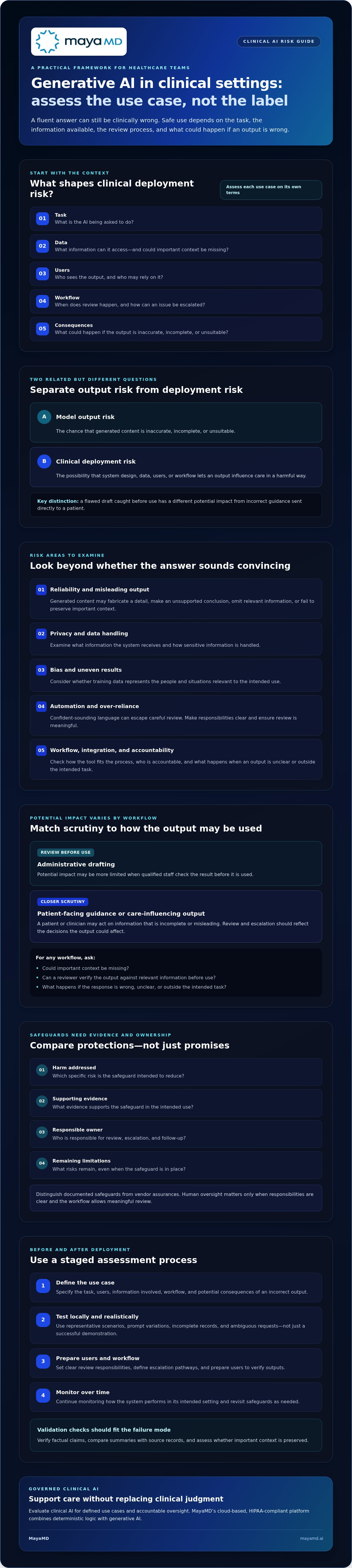
How can a clinical team assess and reduce generative AI risks before deployment?
Deployment should be a governed process, not a single approval decision. The risks of using generative AI in clinical settings are easier to manage when teams define the intended task, examine potential harms, test the workflow locally, prepare users, begin with limited use, and monitor performance after launch. Give each stage an owner and document the criteria for moving forward.
How should teams validate an AI workflow before launch?
Begin by specifying what the system is expected to do, what it must not do, who will use its output, and whether a clinician reviews it before action. Clear role boundaries help teams assess whether the tool supports a defined task or could be mistaken for making a clinical decision.
Test the proposed workflow with representative cases and challenging scenarios, using the data, users, and operating conditions expected in practice. Include incomplete information, ambiguous requests, and examples where an error or omission could have greater consequences. Clinical stakeholders should assess output quality and clinical relevance, while operational and technical reviewers examine usability, handoffs, and integration behavior. Include privacy expertise where sensitive information is involved.
Before testing, set acceptance criteria suited to the task. These might track factual errors, important omissions, subgroup performance differences, usability problems, or whether escalation occurs as intended. Document known limitations and decide what findings require correction, restricted use, additional testing, or a pause. Reassess after a material change to the model, configuration, data, or workflow.
What should ongoing monitoring and accountability cover?
Assign organizational owners for clinical review, technical operations, privacy, and incident response. Define how concerns are reported, who investigates them, and how corrections reach affected users. Verify applicable requirements for the organization and intended use rather than relying on a generic deployment checklist.
Monitoring should examine more than whether the system remains available. Track errors, user overrides, escalation patterns, feedback, and relevant performance differences. Set a review cadence and thresholds in advance, including conditions that trigger remediation, restricted use, or suspension. A limited launch can help teams observe how the system behaves in the actual workflow before considering broader deployment.
Define
Intended use, exclusions, users, and decision boundaries.
Test
Representative and edge cases with relevant clinical and operational reviewers.
Prepare
Train users on limitations, review expectations, and escalation routes.
Monitor
Assign owners, review performance, and act on incidents or meaningful changes.
Organizations evaluating a workflow-specific clinical AI approach can contact MayaMD to discuss a use case.
How can governed clinical AI support care without replacing clinical judgment?
Clinical AI is most appropriate when its task is clearly defined, its controls are validated for that use, and its place in the care workflow is understood. It can support communication and care-management processes, but it shouldn’t be treated as a substitute for professional judgment. The risks of using generative AI in clinical settings depend on how a system is configured, what information it handles, and how people respond to its output.
Where can AI-supported chronic care fit into clinical workflows?
Patient engagement, post-discharge communication, and chronic care support are potential workflow areas to evaluate. For example, a care team might assess whether AI-supported communication fits a defined follow-up process, who reviews or responds to messages, and what should happen when a patient’s needs fall outside the intended scope. In remote patient monitoring workflows, teams should also establish how AI-supported interactions connect to clinical review and escalation.
MayaMD describes its platform as cloud-based and HIPAA-compliant, combining deterministic logic with generative AI to support patients with chronic conditions. These characteristics describe the platform, not proof that a particular workflow is clinically safe or appropriate. Suitability still requires evaluation of the specific use, data, oversight responsibilities, and escalation design. HIPAA compliance alone doesn’t establish clinical safety or regulatory approval.
What should providers clarify with a potential AI partner?
Before adoption, ask for clear answers about the system’s intended uses and limits, evidence from validation relevant to the proposed workflow, and details about how information is handled. Clarify what integrations are needed, who is responsible for reviewing outputs, and how users can flag or correct a problematic response. Also discuss support processes and how performance, incidents, and material system changes will be monitored after deployment.
Connect each answer to your organization’s requirements. If the evidence doesn’t match the intended users or workflow, identify what additional testing is needed before proceeding. If escalation responsibilities are unclear, resolve them before launch. Governance should continue after deployment, with accountable owners able to review issues and adjust or restrict use when appropriate.
Careful evaluation helps teams consider potential benefits without assuming that generative AI removes uncertainty or transfers clinical accountability to a system. To assess fit, workflow needs, and oversight requirements, review your clinical AI requirements with MayaMD.
Make Clinical AI Adoption Deliberate and Governed
The risks of using generative AI in clinical settings depend on more than model output. Patient impact is shaped by the task, information available, workflow, and whether oversight is practical and accountable. Evaluate safeguards against specific risks, validate performance in the intended setting, and establish clear review, escalation, and monitoring responsibilities before deployment.
For chronic care, patient engagement, post-discharge communication, and remote patient monitoring may be useful workflows to assess, provided each use has defined boundaries and clinician-led escalation. MayaMD describes its platform as cloud-based and HIPAA-compliant, combining deterministic logic with generative AI to support chronic care workflows, including RPM, APCM, and PCM. HIPAA compliance is relevant to data handling, but it doesn’t by itself establish clinical safety or prove that a workflow is suitable.
Responsible adoption doesn’t require assuming every AI tool has the same risk profile. It requires asking for evidence, identifying limitations, and matching controls to the use case. With careful evaluation and accountable oversight, teams can consider AI support while keeping clinical judgment central. Contact MayaMD to discuss your clinical AI requirements.
Frequently Asked Questions
What are the main risks of using generative AI in clinical settings?
The main risks include inaccurate or fabricated output, missing context, bias, privacy and security concerns, automation bias, and failures in workflow integration. The risks of using generative AI in clinical settings depend on the task and the potential consequences of an error. Teams should define intended use, validate the system in that workflow, establish meaningful human oversight, and monitor performance after deployment. No single safeguard addresses every risk.
Can generative AI make clinical decisions safely?
Generative AI shouldn’t be assumed safe for independent clinical decision-making. Suitability depends on the task, relevant validation evidence, safeguards, and qualified human oversight. Before use, define what the system may support and which decisions remain with clinicians. Establish how uncertain or concerning outputs are escalated, and monitor performance in the intended workflow. A tool’s fluent response or general claims about its capabilities aren’t substitutes for this evaluation.
How can generative AI hallucinations affect patient care?
A hallucination can introduce unsupported details, misstate information, or produce a misleading summary. Its potential effect depends on how the output is used and whether someone reviews it before action. Test for these failure patterns using representative cases and realistic workflow conditions. Make review responsibilities explicit, ensure reviewers can check relevant source information, and define correction and escalation processes. Fluent wording alone doesn’t show that an answer is accurate.
Is generative AI in healthcare HIPAA compliant?
HIPAA compliance isn’t an inherent property of generative AI; it depends on the service, its configuration, data flows, contractual arrangements, and organizational practices. Review how protected health information is accessed, handled, and used, and consult qualified privacy and compliance professionals about applicable obligations. MayaMD describes its platform as HIPAA-compliant, but that designation alone doesn’t establish that a particular use is clinically safe, suitable, or approved.
How can healthcare organizations reduce generative AI risks?
Start by defining the use case and mapping foreseeable harms. Test the system with representative and challenging scenarios, establish clinical review and escalation procedures, train users, and document limitations. Assign owners for monitoring and incident response, then track errors, overrides, escalations, and user feedback after launch. Reassess controls when the model, data, or workflow changes, and verify current legal and regulatory requirements that apply to the planned use.
Does human review eliminate the risks of generative AI in clinical settings?
No. Human review can help catch errors, but it doesn’t eliminate risk. Oversight may be weakened by workload, unclear responsibilities, insufficient training, or over-reliance on plausible-sounding output. Define who reviews each type of output, provide access to relevant context, and ensure reviewers can question, override, and escalate responses. Combine review with local validation, governance, and ongoing monitoring so the safeguard works as part of a broader process.
What should providers ask before adopting a clinical generative AI tool?
Ask what the tool is designed to do, what uses are outside its scope, and what validation evidence supports the proposed workflow. Clarify data handling, integration requirements, review and escalation responsibilities, known limitations, and post-deployment monitoring. Ask how incidents are reported and addressed, and who is accountable for clinical decisions and governance. Request evidence from testing with comparable users and workflows, then identify any additional local evaluation needed before adoption.




See The MayaMD Difference
Fill the form below
Download Our Apps
MayaMD for patients and MayaPro for physicians - available on iOS and Android.
FOR PATIENTS
MayaMD App
AI-powered symptom assessment, triage, and secure access to your care team.


FOR PHYSICIANS
MayaPro App
MayaPro brings patient vitals, RPM/PCM care plans, and clinical decision support to your pocket.