
Downcoding and Denials: The Quiet Revenue Leakage in Specialty Clinics How documentation gaps silently erode financial performance

The revenue problem most chronic clinics don’t see clearly
In many specialty clinics across the US, patient volumes remain steady. Providers continue to see and treat patients, procedures are performed, and care is delivered according to clinical standards. Yet, despite this, financial performance often falls short of expectations.
This gap is rarely caused by lack of demand. More often, it is the result of small but persistent issues in the revenue cycle. Issues that accumulate quietly over time.
Downcoding, claim denials, and delayed reimbursements are among the most common contributors.
Together, they create a form of revenue leakage that is difficult to detect day to day, but the loss builds up significantly over the course of a year.
Why Specialty Chronic Care Clinics are particularly vulnerable
Specialty clinics operate in a more complex billing environment than primary care. Conditions are chronic, visits are longitudinal, and documentation must justify medical necessity across repeated encounters.In specialties such as nephrology, cardiology, pulmonology, and endocrinology, coding accuracy depends heavily on the completeness and clarity of clinical notes. Small omissions, such as missing symptom detail, unclear severity, incomplete histories, etc. can materially affect how a claim is processed.
These clinics are not undercoding because they choose to. They are undercoding because documentation often does not fully support the level of care provided.
a. Downcoding: What it looks like in practice
Downcoding occurs when a claim is reimbursed at a lower level than the care delivered would justify. In many cases, the payer does not deny the claim outright. Instead, it is quietly adjusted.
From the clinic’s perspective, this is easy to miss. The claim is paid, just not at the expected rate.
Common reasons include:
- Insufficient detail in history of present illness
- Lack of documented symptom severity
- Missing context for comorbid conditions
- Notes that do not clearly support complexity
Over time, these adjustments compound. A few dollars lost per visit can translate into substantial annual revenue impact across a busy specialty practice.
b. Claim denials: the more visible problem
Denials are more noticeable than downcoding, but they are often treated as isolated incidents rather than systemic signals.
Incomplete documentation is one of the leading causes of claim denials across outpatient specialties. When clinical notes fail to clearly support medical necessity, payers request additional information or reject claims outright.
The result is increased rework:
- Staff spend time correcting and resubmitting claims
- Providers are asked to amend notes after the fact
- Payment timelines extend
Even when claims are eventually paid, the administrative cost of recovering revenue is high.
c. The operational cost of “fixing it later”
Many clinics rely on downstream revenue cycle teams to catch and correct documentation gaps. This approach assumes that problems can be fixed after the visit.
In reality, retrospective fixes are inefficient. Providers may not recall visit details clearly, and staff may struggle to reconstruct clinical reasoning from partial notes.
This creates a cycle where:
- Notes are finalized under time pressure
- Revenue cycle teams flag issues weeks later
- Providers are pulled back into documentation tasks
- Payments are delayed or reduced
The hidden cost is not just lost revenue, but lost clinical time.
Why “Documentation Quality” is the real lever
Revenue cycle performance in specialty clinics is often discussed in terms of coding expertise or payer behavior. While those factors matter, they are secondary to documentation quality.
Coding teams can only work with what is documented. If the clinical record does not clearly reflect patient complexity, symptom burden, or medical decision-making, even the best coders are limited.
Strong documentation does not mean longer notes. It means clearer notes. Notes that capture:
- Relevant symptoms
- Severity and progression
- Clinical context
- Rationale for decisions
This level of clarity is difficult to achieve consistently during short visits, especially in chronic care settings.
The pressure of value-based care and risk adjustment
As more specialty clinics participate in value-based models, documentation becomes even more financially significant.Risk adjustment, quality reporting, and shared savings calculations all depend on accurate capture of patient conditions. Missing or under-documented diagnoses can reduce risk scores and distort performance metrics.
In this environment, documentation gaps affect not only fee-for-service revenue, but also broader financial outcomes tied to population health management.
Clinics that fail to document comprehensively may appear to manage healthier populations than they actually do - resulting in lower reimbursement and fewer resources.
Why the front end matters more than the back end
Most revenue cycle interventions focus on the back end: coding audits, denial management, payer negotiations. These are necessary, but they address symptoms rather than causes.
The root cause of many revenue issues lies at the point of information capture. If clinical data is incomplete at the start, it is difficult to correct later.
This is where specialty clinics face a structural constraint. Visit time is limited, and clinical conversations are often compressed. Important details may be discussed but not fully documented.
Improving documentation quality requires improving how information is gathered, not just how it is coded.
“Structured Intake” as a revenue protection strategy
One of the most effective ways to improve documentation is to capture structured, clinically relevant information before the visit.
Pre-visit intake allows patients to share symptoms, changes, and concerns in advance. When guided properly, this process can surface details that might otherwise be missed.
For revenue cycle performance, structured intake helps by:
- Ensuring symptom completeness
- Clarifying severity and progression
- Supporting medical necessity
- Reducing ambiguity in notes
This approach does not replace clinician judgment. It supports it by providing a more complete starting point.
Specialty Chronic Care Clinics benefit differently, but consistently
In nephrology clinics, structured intake helps capture subtle symptom changes that justify visit complexity. In cardiology, it supports documentation of risk factors and symptom burden. In pulmonology, it helps track exacerbations and functional impact.
Across specialties, the benefit is the same: clearer documentation leads to more confident coding and fewer claim issues.
Importantly, this also reduces the need for retrospective note corrections, which are time-consuming and frustrating for providers.
Where MayaMD fits into this workflow
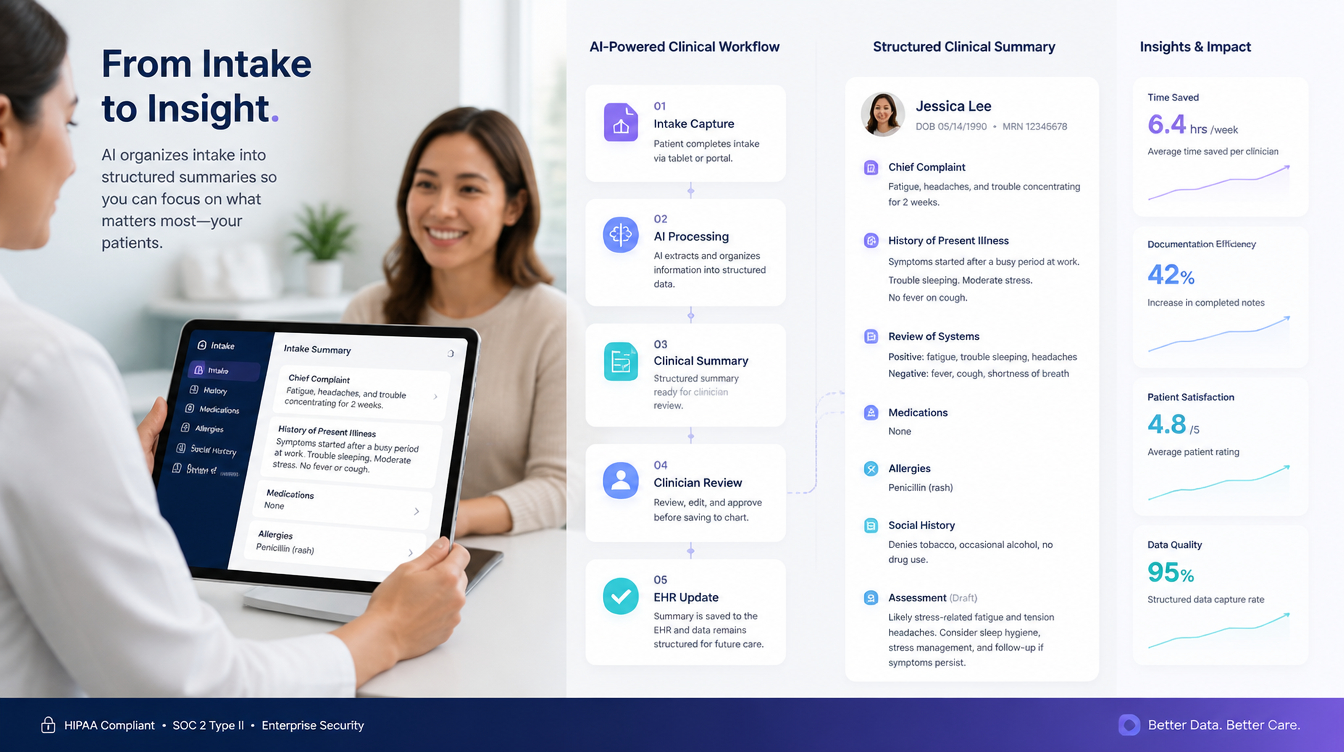
MayaMD’s Clinical AI Companion was designed to support documentation quality upstream.
The platform focuses on:
- Structured, symptom-driven intake before the visit
- Pre-visit consult note generation
- Visit-ready summaries aligned with clinical logic
- Stronger documentation that supports coding confidence
By shifting part of the documentation burden earlier, clinics can enter visits with more complete information and produce clearer notes without extending visit time.
This approach does not guarantee approval of every claim. No system can. But it reduces the likelihood that revenue is lost due to missing or unclear documentation.
Revenue protection without adding burden
One of the challenges in addressing revenue leakage is that many solutions add operational overhead. Additional staff, additional workflows, or additional review steps can improve accuracy but increase cost.
Structured intake and pre-visit intelligence work differently. They aim to improve the quality of information without increasing clinician workload during the visit.
For specialty clinics managing high patient volumes and limited staff, this distinction matters.
A quieter but more sustainable improvement
Revenue cycle improvements are often measured in large initiatives and system overhauls. Yet many of the most effective gains come from small, consistent improvements in documentation quality.
Downcoding and denials rarely result from a single failure. They result from repeated, minor gaps that go unnoticed.
By improving how information is captured at the start of the care process, clinics can reduce revenue leakage without dramatic changes to clinical practice.
Closing perspective
Specialty clinics do not lose revenue because they provide poor care. They lose revenue because the care they provide is not always fully reflected in the clinical record.
Downcoding and denials are not just revenue cycle problems. They are documentation problems.
Addressing them requires a shift in how and when clinical information is captured. Structured intake and pre-visit documentation are not administrative tools. They are foundational to sustainable clinical and financial performance.
MayaMD’s approach fits into this broader shift, supporting clinics in protecting revenue by improving documentation quality - quietly, consistently, and upstream.
Sources & References
- https://tcf.org/content/report/physician-burnout-will-burn-all-of-us/
- https://www.mgma.com/mgma-stat/detecting-and-fixing-leaks-across-the-revenue-cycle




See The MayaMD Difference
Fill the form below
Download Our Apps
MayaMD for patients and MayaPro for physicians - available on iOS and Android.
FOR PATIENTS
MayaMD App
AI-powered symptom assessment, triage, and secure access to your care team.


FOR PHYSICIANS
MayaPro App
MayaPro brings patient vitals, RPM/PCM care plans, and clinical decision support to your pocket.