
Clinical AI for Patient Adherence: Bridging the Gap in Chronic Care Management

Passive monitoring tools have reached a functional plateau; they document patient decline rather than preventing it. You've likely experienced the frustration of managing high hospital readmission rates driven by non-adherence, only to be met with fragmented data from tools that offer no actionable path forward. This cycle creates a significant burden on clinical staff, where manual outreach leads to physician burnout without moving the needle on long-term health. It's time to recognize that data without intervention is merely noise.
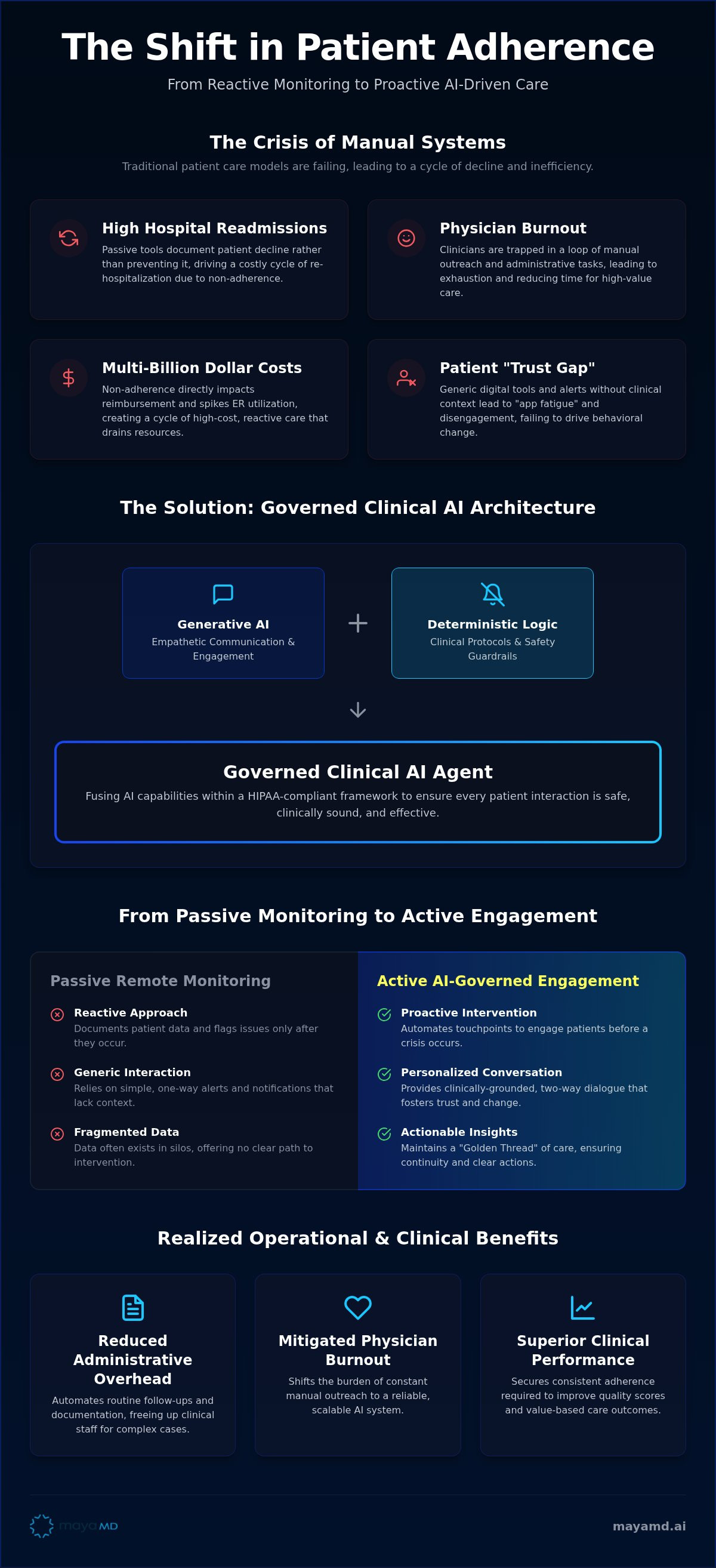
This article demonstrates how clinical AI for patient adherence is bridging this critical gap in chronic care management. You'll discover how governed clinical AI agents are transforming adherence from a passive monitoring challenge into a proactive, automated clinical outcome. We will explore a framework that integrates deterministic logic with generative capabilities to ensure HIPAA-compliant patient safety. By moving toward a systematic, AI-driven engagement model, healthcare organizations can reduce administrative overhead while securing the consistent adherence required for superior clinical performance.
Key Takeaways
• Understand why traditional manual systems fail and how clinical AI for patient adherence shifts chronic care from reactive monitoring to proactive, automated intervention.
• Explore the architecture of governed AI, which combines the empathy of large language models with deterministic logic to ensure HIPAA-compliant patient safety.
• Discover the transition from passive remote patient monitoring to active engagement agents that foster behavioral change through consistent, intelligent interaction.
• Learn a structured deployment strategy for identifying high-risk patient cohorts and configuring clinical protocols within a secure AI framework.
• Realize the operational benefits of automation, including reduced administrative overhead and the mitigation of physician burnout through streamlined documentation.
The Adherence Crisis in Chronic Care: Why Manual Systems Fail
In the landscape of 2026 value-based care, patient adherence has evolved from a simple measure of medication compliance into a foundational pillar of clinical performance. It represents the degree to which a patient's behavior coincides with agreed recommendations from a healthcare provider. When this alignment fails, the systemic consequences are profound. Traditional manual systems, which rely on periodic phone calls or generic push notifications, are struggling to keep pace with the complexities of chronic disease management. These legacy approaches often fail because they lack the clinical depth and real-time responsiveness required to address the dynamic nature of patient needs. The multi-billion dollar cost of non-adherence isn't just a statistical abstraction; it manifests as thousands of avoidable readmissions and preventable complications that strain the entire medical infrastructure. Passive reminders and alerts aren't enough for patients managing complex, multi-morbid conditions that require constant calibration.
The Economic Impact on Modern Healthcare Systems
The financial stakes of non-adherence are higher than ever for health systems. Poor adherence metrics directly impact Medicare reimbursement through penalties associated with high readmission rates and sub-optimal quality scores. When patients fail to manage chronic conditions effectively, ER utilization spikes, creating a cycle of high-cost, reactive care that drains resources. Clinicians are often trapped in an administrative loop of manual outreach, which limits their ability to provide high-value interventions. This administrative burden contributes significantly to physician burnout, as staff spend more time on documentation and "phone tag" than on actual care. Implementing clinical AI for patient adherence offers a path to automate these touchpoints. This technology ensures that interventions occur before a patient reaches a crisis state, allowing for a more sustainable allocation of human resources while protecting the bottom line. For specialized providers such as dental clinics looking to automate their own patient guidance, you can visit PractCom to explore digital instruction and consent tools.
The Psychology of the Digital Health Divide
Patients are increasingly wary of generic digital tools. This "Trust Gap" stems from a lack of clinical relevance in many consumer-grade health apps. App fatigue is a documented phenomenon where patients disengage from tools that offer buzzers without context. Effective management requires more than just alerts; it demands a sophisticated understanding of health literacy and patient psychology. In 2026, human-only follow-up models aren't scalable to meet the growing demand for chronic care. To bridge this divide, healthcare systems are utilizing clinical AI for patient adherence to provide meaningful, clinically-grounded interaction. By deploying a Clinical AI Agent, organizations can offer support that feels both authoritative and personalized. This approach moves beyond passive Remote Patient Monitoring to active, governed engagement. It addresses the root causes of disengagement by providing patients with the clinical insights they need to succeed in self-management, thereby fostering long-term behavioral change.
Governed Clinical AI: The Architecture of Reliable Adherence
Reliability in healthcare requires more than just conversational fluidity; it demands rigorous clinical grounding. Governed clinical AI for patient adherence utilizes a Neuro-Symbolic architecture, which effectively fuses the empathetic communication of large language models with the rigid precision of deterministic clinical logic. This hybrid approach ensures that every interaction remains within the boundaries of established medical protocols. Unlike standard generative models that may hallucinate or provide inconsistent advice, a Clinical AI Agent maintains a "Golden Thread" of care. This continuity bridges the transition from hospital discharge to home self-management, ensuring that patient instructions are always grounded in verified medical fact within a HIPAA-compliant, cloud-based framework.
Deterministic Logic vs. Generative Hype
In chronic disease management, "black box" AI systems present an unacceptable liability. These models often lack the transparency required for clinical oversight, making it difficult to trace the logic behind a specific patient recommendation. By implementing deterministic logic in clinical AI, providers can establish clinical guardrails that mirror physician-approved protocols. This ensures that the AI never deviates from the intended care plan. Research has already demonstrated the efficacy of targeted digital interventions; for instance, the Agency for Healthcare Research and Quality has explored how AI-adapted text messages can improve medication adherence in specific populations. A governed framework prioritizes these safety-first mechanisms to protect patient well-being.
Real-Time Clinical Insights and Documentation
Effective clinical AI for patient adherence does more than just talk to patients; it transforms unstructured conversations into actionable data. As the agent engages with a patient, it simultaneously generates structured clinical notes that integrate directly into the existing EHR workflow. This capability-to-outcome structure allows clinicians to view adherence trends without manually sorting through disparate data points. By automating the "busy work" of patient intake and follow-up, the system drastically reduces physician burnout. Providers can focus on high-acuity interventions while the AI handles routine monitoring and documentation. If you're looking to enhance your clinical workflow with these automated safeguards, you can consult with our team about your specific integration needs.
From Passive RPM to Active AI-Governed Engagement
Traditional Remote Patient Monitoring has historically functioned as a static data repository, where devices transmit physiological vitals to portals that clinicians must then manually review. This passive model often fails to drive meaningful behavioral change because it lacks a real-time feedback loop between the data point and the patient's action. By shifting to active, governed engagement, clinical AI for patient adherence transforms these isolated data points into conversational interventions. This evolution aligns with recent research into AI Solutions for Medication Adherence, which highlights how intelligent tools can address the specific educational and psychological barriers chronic patients face. Instead of a patient simply recording a high blood pressure reading, an AI agent can immediately engage them in a clinical dialogue to assess symptoms, confirm medication intake, or provide immediate dietary guidance.
APCM and PCM: Aligning Technology with Reimbursement
Implementing AI-driven adherence tools directly supports the financial and clinical viability of modern chronic care programs. For initiatives such as Principal Care Management (PCM) and Advanced Primary Care Management (APCM), continuous oversight is a regulatory and clinical necessity. Clinical AI agents help practices capture the required monthly engagement minutes for RPM billing by automating routine check-ins and educational modules. This automation ensures that complex, multi-morbid populations receive consistent attention without overwhelming the clinical staff's manual capacity. A proven application of this technology is seen in heart failure management; providing automated post-discharge education via a conversational agent helps patients recognize early warning signs, effectively bridging the critical gap between the hospital and the home environment.
The Digital Front Door: Triage and Symptom Checking
The virtual triage model acts as a sophisticated digital front door, directing patients to the appropriate level of care based on rigorous clinical logic. Governed symptom checkers provide "high probability" insights to physicians before the patient even enters the exam room, streamlining the diagnostic process. This preemptive data collection ensures that clinicians can focus on the most critical issues during the appointment. By offering 24/7 availability, a governed clinical assistant builds patient trust through consistent, reliable support that's always accessible. It prevents unnecessary ER visits by providing immediate, clinically-validated triage, ensuring that high-cost healthcare resources are reserved for those in acute need while maintaining a steady pulse on the adherence of the broader patient population.
Deployment Strategy: Integrating Clinical AI into Your Workflow
Successful implementation of clinical AI for patient adherence requires a methodical, four-step framework that prioritizes clinical safety and operational efficiency. Initially, administrators must identify high-risk patient cohorts, such as individuals with heart failure or uncontrolled diabetes, who present the greatest risk of readmission. Once these groups are defined, the next phase involves configuring clinical protocols and deterministic logic boundaries. This step is vital because it ensures the AI remains within physician-approved parameters, preventing the "hallucinations" common in ungoverned models. Following configuration, the clinical team undergoes training to transition into an AI-augmented management model. Finally, organizations must establish a rigorous feedback loop by measuring adherence KPIs and optimizing engagement scripts based on real-world performance data.
Optimizing the Post-Discharge Transition
The period immediately following a hospital stay is a high-risk window for non-adherence. By automating post-discharge communication, health systems can significantly reduce 30-day readmission rates. The AI agent bridges the gap between the acute setting and primary care follow-up by providing consistent, intelligent check-ins. This continuous interaction ensures patients understand their medication changes and lifestyle requirements at home, where instructions are often forgotten or misinterpreted. If you're ready to modernize your clinical workflow with these safeguards, contact our implementation specialists for a tailored deployment plan.
Scaling Patient Engagement Without Increasing Staff
One of the most significant benefits of clinical AI for patient adherence is the ability to scale care delivery without a linear increase in staffing costs. By automating routine check-ins and only flagging high-risk anomalies for human intervention, a single clinical coordinator can manage five times more patients than traditional manual methods allow. This shift is a core component of digital healthcare for chronic disease, where the focus moves toward continuous, AI-governed oversight. The system handles the "busy work" of data collection and documentation, which empowers clinicians to focus their expertise on patients who require immediate, complex care. This model doesn't replace staff; it augments their capability, allowing for a more sustainable and responsive chronic care management program.
MayaMD: The Future of Governed Clinical AI for Adherence
MayaMD stands at the forefront of the digital health revolution, offering a specialized framework for clinical AI for patient adherence that prioritizes safety over novelty. By utilizing a "hallucination-free" architecture, the platform ensures that every patient interaction is grounded in deterministic logic. This systematic approach eliminates the risks associated with unmonitored generative models, providing healthcare executives with the high-stakes reliability essential in chronic care. The Clinical AI Agent functions as more than a simple communication tool; it's a robust clinical engine designed to drive measurable adherence through intelligent, real-time engagement. It seamlessly integrates with existing Remote Patient Monitoring (RPM) and Advanced Primary Care Management (APCM) programs, creating a unified ecosystem for continuous patient oversight.
Award-Winning Innovation in Digital Health
MayaMD’s commitment to excellence was recently highlighted by its recognition as a finalist for the 2025 Digital Health Hub Foundation Digital Health Awards at HLTH. This accolade underscores the brand’s position as a visionary leader that has successfully navigated the complexities of a highly regulated industry. The platform's HIPAA-compliant, cloud-based architecture ensures that patient data remains secure while providing the scalability required for enterprise-level deployments. MayaMD acts as a sophisticated partner for healthcare executives by offering the intellectual depth and clinical validity necessary to transform fragmented data points into a cohesive strategy for patient support.
Transforming Patient Outcomes Today
The transition from theoretical AI to practical application is where MayaMD delivers its greatest value. By deploying clinical AI for patient adherence, providers can achieve significant improvements in chronic care management and overall patient satisfaction. The platform’s ability to automate documentation and routine follow-up allows clinicians to operate at the top of their license, focusing on complex medical decision-making rather than administrative busy work. To begin your journey toward a more proactive and automated clinical outcome, you can request a consultation to streamline your adherence workflows. Moving from passive monitoring to active, governed engagement is the definitive step toward securing the future of value-based care.
Securing the Future of Chronic Care Through Governed Innovation
The transition from passive remote monitoring to active engagement represents a fundamental shift in chronic care management. We've seen how manual outreach and fragmented data contribute to the adherence crisis; however, clinical AI for patient adherence provides a systematic solution to these persistent challenges. By replacing "app fatigue" with intelligent, clinically-grounded interactions, organizations can finally bridge the gap between the acute setting and the patient's home. This shift ensures that care is not just documented but actively delivered through every touchpoint.
MayaMD facilitates this transformation through a HIPAA-compliant, secure platform that utilizes Neuro-Symbolic AI to eliminate hallucinations. As a 2025 Digital Health Hub Foundation Award Finalist, we provide a proven framework for healthcare executives who need to scale care delivery without increasing administrative burden. Our architecture ensures that every patient interaction remains within deterministic clinical boundaries, protecting both patient safety and provider reputation. It's time to move beyond theoretical monitoring and toward measurable clinical outcomes. We invite you to contact MayaMD today to see our Clinical AI Agent in action. Empower your team and your patients with the tools required for sustainable health success.
Frequently Asked Questions
How does clinical AI differ from standard chatbots for patient adherence?
Clinical AI for patient adherence
differs from standard chatbots by utilizing a sophisticated Neuro-Symbolic architecture that combines conversational empathy with rigid, deterministic medical logic. While standard chatbots often rely on simple keyword matching or unmonitored generative models, a clinical agent remains grounded in physician-approved protocols. This ensures that every interaction is clinically valid and safe for managing complex chronic conditions rather than providing generic, non-clinical responses.
Is clinical AI for patient adherence HIPAA-compliant?
Yes, the platform is fully HIPAA-compliant and built on a secure, cloud-based architecture designed for enterprise healthcare environments. MayaMD prioritizes data integrity and patient privacy by implementing rigorous security protocols that meet federal standards. This framework allows healthcare providers to manage sensitive patient data across the continuum of care without compromising regulatory adherence or exposing the organization to unnecessary security risks.
Can clinical AI agents integrate with my existing EHR system?
Clinical AI agents are designed to integrate seamlessly with existing EHR systems to streamline clinical workflows and reduce documentation time. By transforming patient conversations into structured data, the system allows clinicians to view adherence trends directly within the patient record. This connectivity ensures that data from the home environment is immediately actionable, eliminating the need for manual data entry and reducing the risk of administrative errors.
What is the role of deterministic logic in patient safety?
Deterministic logic serves as a critical safety guardrail by ensuring that the AI agent operates within specific, pre-defined clinical boundaries. In a medical context, this logic dictates that the system follows established protocols rather than generating unpredictable responses. This approach is essential for preventing hallucinations, where an AI might otherwise provide incorrect or dangerous medical advice, thereby maintaining the highest standards of patient safety.
How does AI-driven adherence improve RPM and APCM reimbursement?
AI-driven adherence tools improve RPM and APCM reimbursement by automating the patient engagement minutes required for billing. The system consistently tracks interactions and educational touchpoints, ensuring that the necessary thresholds for monthly reimbursement are met without increasing staff workload. Utilizing clinical AI for patient adherence allows practices to maximize revenue while providing continuous, high-quality oversight for patients managing complex, multi-morbid conditions at home.
Will elderly patients with chronic conditions actually use an AI agent?
Elderly patients with chronic conditions frequently find conversational AI agents more accessible than traditional, complex health apps. Because the interface relies on natural language rather than technical navigation, it reduces the digital barrier for seniors. These agents provide consistent, empathetic support that mimics human interaction, which fosters trust and encourages long-term engagement. This ease of use is a primary driver in improving adherence rates across older demographics.
How does MayaMD prevent AI hallucinations in a medical context?
MayaMD prevents AI hallucinations by utilizing a hybrid Neuro-Symbolic AI model that tethers generative capabilities to a deterministic logic engine. This ensures that while the agent can communicate naturally, its medical output is strictly limited to verified clinical facts and physician-approved protocols. By enforcing these systematic frameworks, the platform guarantees that every response is accurate, reliable, and safe for use in high-stakes clinical environments.
What are the primary clinical outcomes of using an AI agent for post-discharge care?
The primary clinical outcomes of using an AI agent for post-discharge care include a significant reduction in 30-day readmission rates and improved patient health literacy. By providing automated, consistent education and symptom monitoring, the agent identifies potential complications before they require acute intervention. Utilizing platforms like Spacewize to transform static medical documents into interactive e-learning courses can further enhance this educational experience. Patients gain a clearer understanding of their medication schedules and lifestyle changes, which leads to more stable health outcomes and higher overall satisfaction.




See The MayaMD Difference
Fill the form below
Download Our Apps
MayaMD for patients and MayaPro for physicians - available on iOS and Android.
FOR PATIENTS
MayaMD App
AI-powered symptom assessment, triage, and secure access to your care team.


FOR PHYSICIANS
MayaPro App
MayaPro brings patient vitals, RPM/PCM care plans, and clinical decision support to your pocket.