
Clinical AI for Chronic Care Management: The 2026 Blueprint

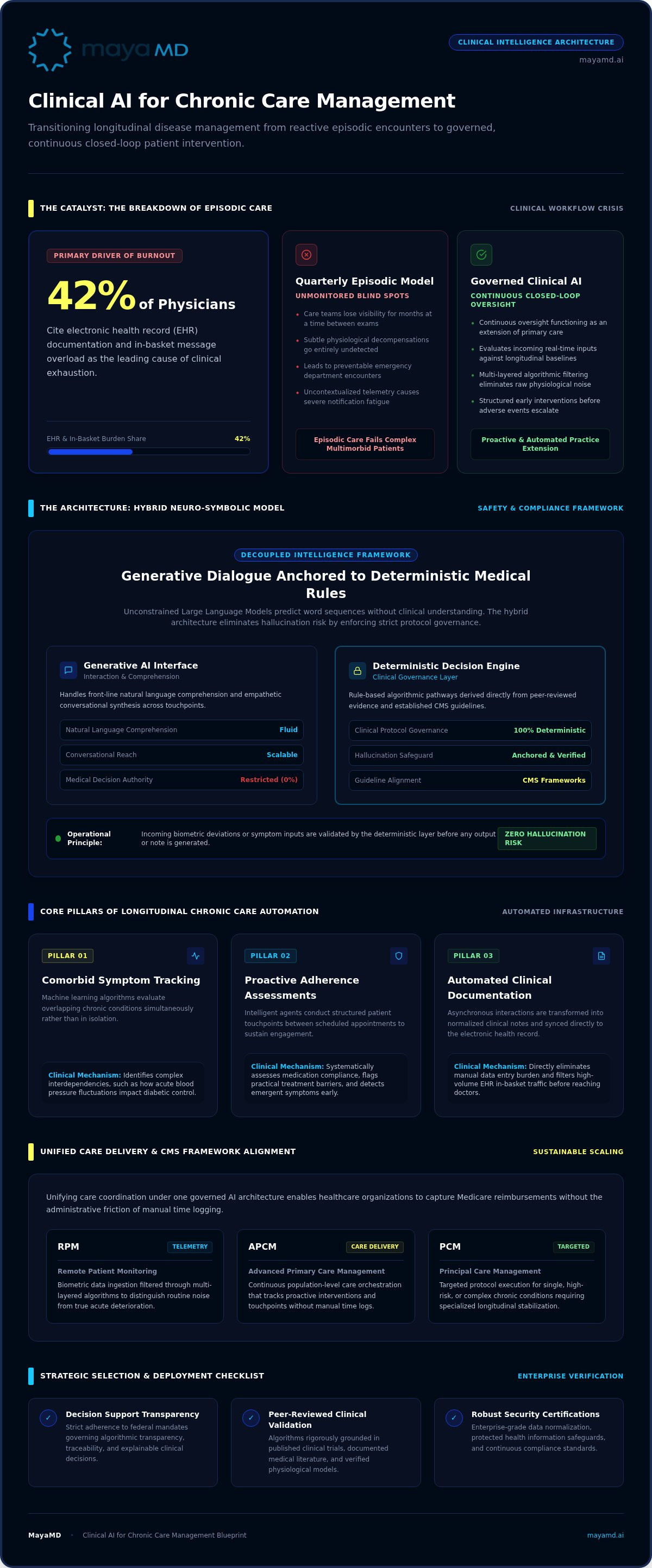
With 42% of physicians citing electronic health record documentation and in-basket message overload as their primary driver of burnout, traditional episodic care has broken down. Care teams don't have the bandwidth to monitor complex patient panels between visits, yet adopting clinical AI for chronic care management often raises valid fears regarding unvalidated generative hallucinations. You shouldn't have to compromise clinical precision just to keep providers from drowning in clerical overhead.
You already know the core operational challenge: expanding proactive touchpoints can't rely on brute-force human labor, but unconstrained algorithmic models introduce unacceptable liability. Discover how clinical AI transforms chronic care management by combining deterministic safety with automated patient monitoring and workflow orchestration. This blueprint details the governed hybrid architectures, CMS reimbursement frameworks, and proactive care pathways that protect clinical accuracy while scaling sustainable disease management in 2026.
Key Takeaways
• Deploying governed clinical AI for chronic care management establishes continuous, closed-loop oversight that shifts clinical practice from reactive episodic visits to proactive patient intervention.
• A hybrid architecture combining deterministic clinical protocols with constrained generative models eliminates hallucination risks while expanding conversational reach.
• Unifying Remote Patient Monitoring with Advanced Primary Care Management frameworks allows organizations to capture Medicare reimbursements without the administrative friction of manual time logging.
• Autonomous patient outreach and standardized data normalization directly alleviate clinician burnout by filtering high-volume EHR in-basket traffic.
• Enterprise deployment requires strict adherence to federal decision support transparency mandates, robust security certifications, and peer-reviewed clinical validation.
What Is Clinical AI for Chronic Care Management?
Quarterly clinic visits fail patients facing complex, multimorbid diseases. When individuals leave the exam room, care teams lose visibility for months at a time, allowing subtle physiological decompensation to escalate into preventable emergency department encounters. Modern clinical AI for chronic care management transforms this fragmented model into an automated, governed care coordination architecture. Rather than requiring exhausted physicians to manage continuous manual check-ins, clinical AI agents operate as vigilant extensions of the primary care practice, maintaining oversight across the entire patient journey.
Passive digital health logging merely records numbers in isolated databases without driving clinical action. By incorporating advanced frameworks of artificial intelligence in healthcare, enterprise platforms establish proactive, closed-loop coordination. They ingest real-time inputs, evaluate values against longitudinal baselines, and initiate structured interventions before adverse events occur.
The Evolution Beyond Traditional Remote Patient Monitoring
Early telemetry systems overwhelmed clinical practices with continuous alerts, triggering severe clinician notification fatigue from raw, uncontextualized biometric readings. The transition toward intelligent remote patient monitoring for chronic care management addresses this bottleneck through multi-layered algorithmic filtering. These systems distinguish routine physiological noise from true deterioration, ensuring care coordinators evaluate only high-risk deviations. By synthesizing device data with individual care plans, the platform turns isolated data points into governed clinical escalations.
Core Pillars of Longitudinal Chronic Care Automation
Scaling chronic disease programs safely requires three foundational pillars of automated clinical infrastructure:
Comorbid Symptom Tracking
Machine learning algorithms evaluate overlapping chronic conditions simultaneously, identifying how acute fluctuations in blood pressure impact diabetic control.
Proactive Adherence Assessments
Intelligent agents conduct structured patient touchpoints between scheduled appointments to assess medication compliance, address treatment barriers, and detect emergent symptoms early.
Automated Clinical Documentation
Asynchronous patient interactions are summarized into normalized clinical notes that sync directly to the electronic health record, eliminating manual data entry.
The Architecture of Clinical AI: Deterministic Logic vs. Generative Hype
Unconstrained large language models pose severe clinical liability when deployed directly in outpatient disease management. A purely probabilistic model predicts the most statistically likely sequence of words; it doesn't understand pharmacological contraindications, pathophysiology, or clinical risk. In complex chronic care, an ungrounded generative response recommending an inappropriate medication adjustment or overlooking an acute electrolyte imbalance can trigger catastrophic outcomes. Relying on generic chatbots creates unacceptable risks that healthcare executives and clinicians cannot tolerate.
Safe implementation requires a hybrid neuro-symbolic framework. In this architecture, generative artificial intelligence manages natural language comprehension and empathetic conversational synthesis, while a deterministic decision engine governs every clinical insight. Deterministic medical logic prevents hallucinations by anchoring generative dialogue to verified clinical guidelines. By decoupling conversational fluency from medical decision-making, clinical AI for chronic care management delivers natural patient interaction while guaranteeing absolute adherence to established protocols.
Eliminating Hallucinations with Governed Clinical Decision Engines
Governed clinical engines run on rule-based algorithmic pathways derived directly from peer-reviewed evidence and established CMS Care Management guidelines. When an AI system evaluates incoming patient biometric trends or symptom reports, the deterministic layer validates the findings against rigid clinical rules before generating output. If a hypertensive patient reports a blood pressure spike alongside severe headaches, the deterministic boundary engine blocks open-ended conversational drift and immediately executes a validated urgent care escalation pathway.
Deploying a Specialized Clinical AI Agent
Bridging the gap between patient communications and clinical safety demands purpose-built tooling. Deploying an enterprise-grade Clinical AI Agent allows health systems to automate longitudinal oversight without increasing physician workload. These governed agents function systematically across daily practice:
Structured Longitudinal Intake
They conduct continuous, conversational assessments between office appointments, capturing relevant subjective symptoms and social determinants of health into structured clinical datasets.
Deterministic Dynamic Triage
The agent matches patient-reported changes against deterministic clinical pathways, automatically routing low-acuity questions to digital care plans while escalating red-flag anomalies directly to nursing staff.
Pre-Visit Clinical Synthesis
By compiling longitudinal vitals, compliance gaps, and active symptom patterns into an executive summary, care teams enter patient encounters fully informed.
Healthcare networks aiming to expand chronic disease capacity safely can consult with clinical AI specialists to review governed architecture frameworks that fit their existing EHR workflows.
Unifying Care Delivery: RPM, APCM, and PCM Under One AI Framework
Healthcare organizations frequently isolate Medicare care management programs into disconnected administrative siloes. Remote patient monitoring runs on isolated vendor dashboards, chronic care documentation stays trapped in disconnected billing spreadsheets, and specialty pathways remain entirely uncoordinated. This fragmentation inflates operational costs and exacerbates clinician cognitive load. Deploying governed clinical AI for chronic care management consolidates these parallel streams into a single automated operational engine. Unified clinical AI infrastructures eliminate care silos by harmonizing continuous biometric monitoring with long-term care management plans.
Aligning multi-program workflows with broader international benchmarks, such as the WHO guidance on AI governance in healthcare, ensures these models remain transparent, clinically validated, and auditable across diverse patient panels.
Advanced Primary Care Management (APCM) Orchestration
Medicare's bundled APCM codes (G0556, G0557, and G0558) represent a permanent structural shift from tedious time-logging to population-level clinical accountability. Fulfilling APCM requirements demands 24/7 patient access and proactive risk mitigation. Through integrated advanced primary care management architectures, AI agents continuously stratify longitudinal panels. The system identifies rising-risk diabetic or hypertensive patients whose vitals or medication lapses signal impending crises, queuing automated outreach before acute decompensation requires hospitalization.
Continuous Biometric Synthesis via Remote Patient Monitoring
Raw biometric data streams are clinically useless if they paralyze care coordinators with alert volume. Robust remote patient monitoring frameworks ingest device transmissions, evaluating daily physiological data against multi-week historical baselines. Intelligent multi-tier routing ensures that expected daily fluctuations remain within automated logging registries, while statistically confirmed anomalies trigger rapid clinical notifications for nursing review.
Principal Care Management (PCM) for Complex Single-Condition Care
While primary care teams oversee systemic patient health, high-acuity chronic diseases require targeted specialist protocols. Clinical AI agents support focused endocrinology, cardiology, and pulmonology interventions by enforcing condition-specific diagnostic trees. These specialized workflows enable seamless coordination between general practitioners and subspecialists:
Targeted Condition Tracking
Autonomous agents track narrow, high-stakes metrics, such as ejection fraction symptoms in heart failure or peak flow trends in severe chronic obstructive pulmonary disease.
Cross-Specialty Data Synchronization
Objective biometrics and subjective patient check-in responses are automatically mapped into both primary care and subspecialty treatment plans.
Protocol-Driven Escalations
If high-acuity thresholds fail, the agent directs emergency-level notifications to specialty nurses while updating primary care records asynchronously.
Overcoming Clinical Workflow Obstacles and Physician Burnout
Clinicians face continuous administrative drag when managing complex disease cohorts. Between disparate device portals and fragmented chart histories, primary care practitioners spend excessive hours hunting for relevant details instead of delivering care. Successfully applying clinical AI for chronic care management resolves this friction through a structured four-stage clinical data workflow:
Normalize Ingested Data Streams
The platform extracts disjointed metrics from home monitors, patient portals, and lab feeds, structuring them into a single longitudinal patient timeline.
Automate Longitudinal Outreach
Governed conversational agents handle regular check-ins, collecting functional status, dietary compliance, and subjective symptoms without staff intervention.
Synthesize Pre-Drafted Documentation
Algorithmic engines transform multi-week biometric trends into pre-populated clinical progress notes ready for provider sign-off.
Maintain Single-Source EHR Synchronization
Bidirectional APIs push validated encounter summaries back into native medical records, preserving chart consistency across the enterprise.
Automating Ambient Clinical Documentation and Chart Summaries
Clerical overhead remains the single largest operational obstacle to sustained chronic care delivery. Instead of forcing nurses to record manual timestamps for billing compliance, clinical AI tracks qualifying remote management encounters in the background. When a clinician opens a complex chart, the system delivers an actionable thirty-second briefing detailing interval biometric shifts, reported medication side effects, and active care plan deviations. By automating clerical chart assembly, practices restore valuable face-to-face physician time and alleviate severe documentation fatigue.
Seamless Integration with Modern EHR and Triage Systems
Health systems cannot afford isolated software that creates operational friction. Modern deployment requires enterprise connectivity using Fast Healthcare Interoperability Resources (FHIR) and HL7 standards. Ingested data flows bi-directionally, ensuring documentation maps directly into native chart fields without manual copy-pasting. Incorporating MayaMD virtual triage capabilities ensures that emerging symptoms reported outside clinic hours are assessed against deterministic safety rules, categorizing acuity levels before an encounter reaches the nursing pool.
Throughout these automated workflows, final decision-making remains with the clinical provider. The AI compiles data, runs safety checks, and drafts documentation, but the licensed practitioner retains ultimate authority over care plans and medical prescriptions.
To eliminate EHR documentation bottlenecks across your clinical staff, connect with the MayaMD clinical team to review direct integration pathways.
Evaluating and Deploying Enterprise Clinical AI: The Strategic Selection Checklist
Healthcare leadership must subject algorithmic tools to the same rigorous scrutiny applied to novel pharmaceuticals. Implementing clinical AI for chronic care management without strict governance exposes health networks to severe clinical liability, diagnostic drift, and regulatory penalties. Selecting an enterprise partner requires moving past marketing presentations to evaluate underlying technical architecture, data provenance, and clinical safety controls.
Health systems evaluating infrastructure should use a structured four-part deployment roadmap:
Phase 1: Pilot Panel Selection
Identify a defined chronic cohort, such as high-risk patients with concurrent hypertension and type 2 diabetes, to benchmark baseline escalation rates.
Phase 2: Governance and Integration Validation
Audit EHR interface stability, verify bidirectional FHIR mapping, and test deterministic threshold boundaries against historical patient data.
Phase 3: Supervised Care Team Rollout
Deploy clinical agents under nurse-in-the-loop oversight, evaluating documentation accuracy, alert relevance, and time savings.
Phase 4: Enterprise Scale
Expand platform capabilities across broader primary care and subspecialty networks to capture population-level quality incentives.
Clinical Governance, Patient Safety, and Regulatory Adherence
Patient safety hinges on verifiable engineering. Enterprise clinical AI must combine HIPAA compliance with robust administrative controls, including granular role-based access, end-to-end data encryption, and immutable audit logs. Platforms must operate within transparent algorithmic frameworks that clearly disclose underlying clinical logic to practicing physicians. Recognition such as being named a Digital Health Awards Finalist signals an ongoing organizational commitment to governed, safe healthcare innovation.
Scalable Implementation with MayaMD
MayaMD delivers a unified, HIPAA-compliant clinical AI platform designed specifically to alleviate provider strain across national healthcare networks. By fusing deterministic clinical rules with conversational artificial intelligence, the architecture supports remote patient monitoring, advanced primary care management, and principal care management within a single cloud-based environment. This closed-loop approach stratifies chronic populations proactively, engages patients between office encounters, and automates administrative charting without removing the clinician from ultimate medical authority.
Healthcare organizations ready to deploy safe, enterprise-grade chronic disease infrastructure can contact MayaMD to discuss integration timelines and clinical deployment strategies.
Architecting the Next Era of Chronic Disease Delivery
Managing high-acuity patient panels no longer requires trading clinical precision for administrative exhaustion. Deploying governed clinical AI for chronic care management establishes an automated, closed-loop infrastructure that bridges episodic care gaps. By anchoring conversational interfaces to deterministic clinical safety rails, health systems eliminate hallucination liabilities while unifying remote monitoring and advanced primary care management into cohesive provider workflows.
As a Digital Health Awards Finalist at HLTH, MayaMD provides an enterprise-scale, HIPAA-compliant platform designed to relieve clinical teams from excessive documentation burdens. Our proprietary hybrid architecture pairs deterministic medical validation with conversational intelligence, giving providers the verified insights they need to intervene proactively without sacrificing face-to-face patient connection. Sustainable, proactive disease management is within reach. Partner with MayaMD to transform your chronic care management and build a scalable care foundation for your health system.
Frequently Asked Questions
How does clinical AI differ from standard remote patient monitoring software?
Standard remote patient monitoring merely records and transmits biometric figures, while clinical AI actively evaluates and contextualizes that data. Traditional RPM software triggers alerts based on static, isolated thresholds, which often inundates clinical staff with false positives. Clinical AI evaluates incoming vitals against historical baselines, longitudinal trends, and comorbid symptoms, executing closed-loop triage that filters operational noise and prioritizes genuine physiological decompensation for clinical teams.
Can clinical AI agents hallucinate false medical recommendations in chronic care?
Ungoverned, purely generative models can hallucinate, but hybrid clinical systems prevent fabricated advice by binding conversational models to deterministic decision trees. Governed architectures decouple language generation from clinical logic. The generative component only handles natural dialogue and summarization, while hardcoded, evidence-based medical rules validate every response. If a patient query falls outside established guidelines, the system halts autonomous answers and triggers nursing escalation.
How do clinical AI platforms integrate into existing hospital EHR systems?
Modern platforms connect to electronic health records using standard SMART on FHIR and HL7 bi-directional application programming interfaces. This architecture extracts longitudinal health histories, recent labs, and medication registries without requiring rip-and-replace deployments. Synthesized check-ins, remote monitoring trends, and pre-drafted encounter notes flow directly into native provider inboxes and chart fields, preserving a single source of truth across the enterprise without disrupting routine physician charting workflows.
What Medicare reimbursement codes apply to clinical AI-enabled chronic care management?
Deploying clinical AI for chronic care management supports billing across several Medicare Physician Fee Schedule pathways, including Remote Patient Monitoring (RPM), Advanced Primary Care Management (APCM), and Principal Care Management (PCM). Practices frequently bill RPM codes such as CPT 99453 and 99454 alongside clinical management codes CPT 99457 and 99458. The bundled APCM codes (HCPCS G0556 through G0558) compensate organizations for continuous care coordination without requiring minute-by-minute time logging.
Does deploying a clinical AI agent reduce clinician burnout and administrative documentation?
Yes, deploying a clinical AI agent significantly decreases clerical overhead by automating routine data gathering, in-basket sorting, and chart preparation. Documentation overload drives more than 40% of physician burnout. Clinical agents manage interval check-ins, gather patient-reported outcomes, and transform longitudinal biometric transmissions into pre-drafted clinical summaries. This reduces time spent on clerical charting, suppresses notification fatigue, and lets care teams focus on direct medical decision-making.
How do deterministic clinical algorithms safeguard patient data privacy under HIPAA?
Deterministic clinical algorithms execute within dedicated, cloud-based environments protected by end-to-end encryption, strict access controls, and comprehensive Business Associate Agreements. Unlike public generative chatbots that might retain user prompts for continuous model training, enterprise clinical AI for chronic care management processes protected health information within isolated, HIPAA-compliant boundaries. Data remains encrypted in transit and at rest, supported by granular role-based access controls and immutable audit trails.



See The MayaMD Difference
Fill the form below
Download Our Apps
MayaMD for patients and MayaPro for physicians - available on iOS and Android.
FOR PATIENTS
MayaMD App
AI-powered symptom assessment, triage, and secure access to your care team.

FOR PHYSICIANS
MayaPro App
MayaPro brings patient vitals, RPM/PCM care plans, and clinical decision support to your pocket.