
Avoiding CMS Audit Penalties for RPM Billing: The 2026 Compliance Checklist

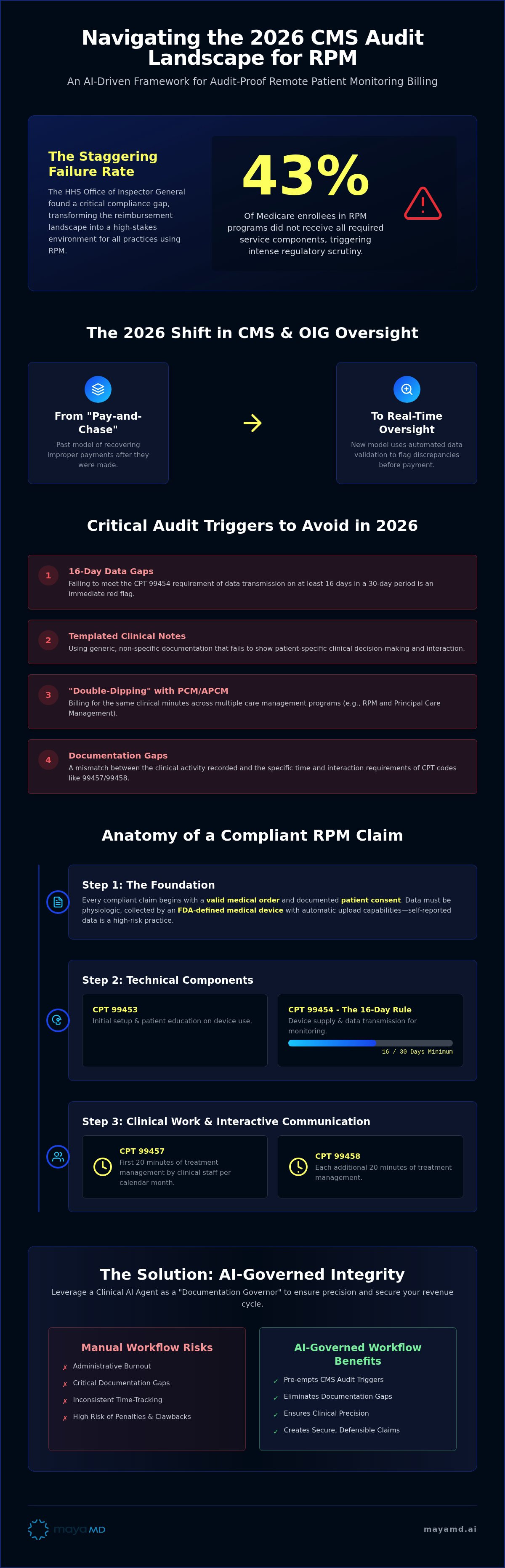
Did you know that the HHS Office of Inspector General discovered that 43% of Medicare enrollees receiving remote patient monitoring did not receive all required service components? This staggering failure rate has transformed the 2026 reimbursement landscape into a high-stakes environment where avoiding CMS audit penalties for RPM billing is no longer a peripheral concern; it is a clinical and financial imperative. You likely feel the weight of potential retroactive payment clawbacks, especially as administrative burnout from manual time-tracking continues to drain your staff's resources. To alleviate these pressures, you might explore Bookkeeper solutions that provide specialized virtual support for your billing and administrative workflows. Proving "interactive communication" for codes like CPT 99457 or 99458 shouldn't feel like a gamble against a federal auditor's scrutiny.
We recognize that the complexity of maintaining a repeatable, audit-proof workflow often conflicts with the daily reality of patient care. This guide secures your revenue cycle with a deterministic, AI-driven framework designed to eliminate documentation gaps and pre-empt CMS audit triggers. By implementing systematic oversight, you can reduce the administrative burden on clinical staff and submit RPM, PCM, and APCM claims with absolute confidence. We will examine the 2026 compliance checklist, including the nuances of new codes like 99445 and 99470, to ensure your practice remains a leader in both care quality and regulatory precision.
Key Takeaways
• Analyze the transition toward real-time oversight and how the 2026 OIG Work Plan specifically targets data validation in remote monitoring workflows.
• Master the technical nuances of CPT codes 99453, 99454, 99457, and 99458 to ensure your practice is effectively avoiding CMS audit penalties for RPM billing.
• Identify the critical risks of templated EHR documentation and the necessity of deterministic AI logic to prevent billing hallucinations and documentation gaps.
• Deploy a rigorous, two-stage audit-preemption checklist that verifies medical necessity and patient-specific device calibration before and during the billing cycle.
• Leverage a Clinical AI Agent to function as a "Documentation Governor," ensuring every patient interaction is captured with the clinical precision required for secure revenue cycles.
The 2026 CMS Audit Landscape: Why RPM Billing is Under the Microscope
CMS has fundamentally shifted its strategy from "pay-and-chase" to a model of rigorous, real-time oversight. Remote patient monitoring (RPM) programs are now subject to automated data validation that flags discrepancies before payments are finalized. This scrutiny is a direct response to historical data showing that nearly half of all RPM claims lacked at least one essential service component. In 2026, avoiding CMS audit penalties for RPM billing requires a proactive defense against these automated triggers, specifically unexplained 16-day data gaps and the use of "templated" clinical notes that fail to show patient-specific decision-making.
The Evolution of OIG Oversight in 2026
The Office of Inspector General's 2026 Work Plan emphasizes "continuous monitoring" integrity. This oversight isn't just about checking boxes; it's an analytical deep-dive into the continuity of care. Regulators now use sophisticated data analytics to identify billing outliers who report high volumes of CPT 99454 without corresponding clinical interventions. The False Claims Act is increasingly applied to documentation errors that suggest a systemic pattern of billing for services not fully rendered. It's not enough to have the data. You must prove that the data was reviewed and acted upon by clinical staff to justify the reimbursement.
Identifying High-Risk Claims in Chronic Care
Scrutiny intensifies when remote patient monitoring services overlap with Principal Care Management (PCM) or Advanced Primary Care Management (APCM). Auditors are specifically looking for "double-dipping," where the same clinical minutes are billed across multiple care management programs. Your documentation must clearly bifurcate the time spent on physiologic data review from the time spent on broader chronic care coordination. The Documentation Gap, defined as the mismatch between recorded clinical activity and the specific requirements of the CPT code, is the primary driver of audit penalties in 2026.
Beyond simple clawbacks, the financial consequences of non-compliance are severe. Practices often face per-claim fines and a permanent loss of billing privileges if a pattern of negligence is established. Avoiding CMS audit penalties for RPM billing is a matter of survival for modern practices that rely on these revenue streams to support chronic care initiatives. Maintaining clinical authority requires a workflow that prioritizes precision over convenience.
The Anatomy of a Compliant RPM Claim: 2026 Requirements
A compliant claim begins long before the first data point is transmitted. To maintain clinical integrity, you must secure a valid medical order and documented patient consent as the baseline for every enrollment. It is equally vital to distinguish between raw data and physiologic data for billing purposes. CMS only reimburses for physiologic data, which must be collected by an FDA-defined medical device that automatically uploads metrics like blood pressure, glucose levels, or weight. Relying on self-reported data is a high-risk practice that often triggers unwanted regulatory scrutiny. Adhering to these RPM documentation requirements ensures that your claims reflect actual clinical interventions rather than mere data collection.
The 16-Day Rule: Documentation vs. Reality
CPT 99453 and 99454 represent the technical foundation of your program. While 99453 ($21.71) covers the initial setup and patient education, 99454 ($52.11) requires data transmission on at least 16 days within a 30-day period. In 2026, simply reporting the presence of data is insufficient. You must document that the device was calibrated for the specific patient and that the data transmitted was used to manage their chronic condition. Avoiding CMS audit penalties for RPM billing requires an automated system that identifies patients at risk of falling below the 16-day threshold, allowing staff to intervene before the billing cycle ends.
Interactive Communication: Beyond the Phone Call
Quantifying clinical effort through CPT 99457 and 99458 is often where documentation fails. Interactive communication must be a synchronous, real-time exchange between clinical staff and the patient or caregiver. For 2026, the national average reimbursement for 99457 is approximately $51.77 for the first 20 minutes, with 99458 providing $41.42 for each additional 20-minute block. Documentation must capture the specific start and end times of these interactions and, more importantly, the clinical decision-making that occurred during that time. Every minute billed must be linked to a specific patient outcome or adjustment in the care plan.
Understanding these Remote Patient Monitoring fundamentals allows clinicians to focus on care rather than clerical defense. If your current workflow relies on manual logs or vague "templated" notes, it's time to transition to a more rigorous, governed framework. To see how a deterministic AI approach can safeguard your documentation, you can connect with our compliance experts for a detailed analysis of your current billing strategy.
Manual vs. AI-Governed Integrity: Eliminating Documentation Hallucinations
Traditional documentation methods are failing under clinical pressure. While human oversight was once the gold standard, fatigue and the reliance on "templated" EHR notes have become major audit triggers. These static templates often fail to reflect the unique clinical nuances of a patient's journey, making it difficult for providers to justify the medical necessity of their RPM claims. Relying on outdated manual processes is no longer a viable strategy for avoiding CMS audit penalties for RPM billing. Precision is now the only path to stability.
Standard Large Language Models (LLMs) introduce a new set of risks to the revenue cycle. Without a governed framework, generative AI can "hallucinate" interactions or data points that never occurred. Legal analysts highlighting the CMS Proposed Rule for RPM Billing note that the OIG is increasingly skeptical of automated notes that lack specific, verifiable clinical logic. This skepticism means that "AI-generated" is not a synonym for "compliant" unless the underlying technology is deterministic.
The Risk of Hallucinations in Clinical Documentation
LLMs aren't sufficient for high-stakes billing because they lack the deterministic logic required to match documentation with actual physiologic events. A neuro-symbolic approach bridges this gap by combining the conversational flexibility of generative AI with the rigid, rule-based logic of clinical protocols. By deploying a Clinical AI Agent, practices ensure healthcare AI functions without hallucinations. This deterministic framework ensures every billable minute is anchored in truth, not statistical probability. It creates a sober, reliable audit trail that survives federal scrutiny.
Efficiency vs. Compliance: The False Trade-off
Many providers fear that rigorous compliance must come at the cost of clinical efficiency. However, implementing a sophisticated remote patient monitoring solution streamlines the transition from raw data to billable outcomes. Transitioning from manual time-tracking to automated "capability-to-outcome" reporting allows clinical staff to focus on patient care while the system maintains the integrity of the billing chain. This automated oversight ensures a HIPAA-compliant flow of data between the patient and the billing office, effectively avoiding CMS audit penalties for RPM billing through consistent, high-fidelity reporting that reduces physician burnout.
The Ultimate RPM Audit-Preemption Checklist for 2026
Legal warnings alone cannot protect a practice from the financial repercussions of a federal review. Transitioning from abstract compliance to a rigorous, daily application of OIG standards is the only sustainable method for avoiding CMS audit penalties for RPM billing. This checklist serves as a bridge between high-level regulatory requirements and the granular reality of clinical AI integration, ensuring every claim is backed by a centralized, HIPAA-compliant repository of physiologic data.
Step 1: Establishing the Clinical Foundation
The integrity of an RPM program is determined during the initial enrollment phase. Documentation must confirm that the patient has a chronic condition meeting specific RPM or PCM criteria, supported by a valid medical order. If the patient is new to the practice or hasn't been seen within the previous calendar year, you must document an initiating face-to-face visit to establish the care plan. Crucially, the RPM device must be "digitally uploaded," meaning it automatically transmits data without manual entry by the patient. Self-reported logs are a primary target for auditors and don't meet the technical requirements for CPT 99454.
Step 2: Monthly Oversight and Validation
Verification must occur in real-time to prevent billing errors before they reach the claim submission stage. Clinical staff should monitor the 16-day transmission threshold throughout the month, ensuring that physiologic data points are captured and reviewed for clinical significance. When documenting interactive communication for CPT 99457, the notes must reflect performative clinical decision-making rather than administrative tasks like appointment scheduling or technical troubleshooting. The Final Review protocol requires a clinical supervisor to verify that physiologic data trends were actively reviewed and that any interactive communication surpassed the threshold of administrative scheduling before the monthly claim is finalized.
Step 3: Continuous Workflow Governance
Maintaining an audit-proof system requires a broader view of the patient's care journey. Integrating Advanced Primary Care Management (APCM) provides the necessary clinical context to justify prolonged monitoring and frequent interventions. We recommend performing quarterly "mock audits" using AI-driven analytics to identify documentation gaps or billing outliers that could trigger a CMS inquiry. This proactive oversight creates a culture of accountability and ensures that your practice remains an authoritative leader in remote care delivery. Need an audit-proof system? Contact our compliance specialists at MayaMD today to secure your clinical workflow against future scrutiny.
MayaMD: AI-Governed Integrity for Secure RPM and APCM
MayaMD represents the next evolution in clinical oversight. Our platform functions as a "Documentation Governor," ensuring every billable interaction is clinically justified and accurately recorded. As a finalist for the 2025 Digital Health Hub Foundation Digital Health Awards, MayaMD has established institutional trust by prioritizing safety and precision over experimental hype. By utilizing deterministic logic, the platform pre-empts the most common CMS audit triggers that typically compromise revenue cycles. This rigorous approach is essential for avoiding CMS audit penalties for RPM billing, especially as regulators shift toward real-time data validation in 2026.
The transition from hospital discharge to home is a period of heightened risk for both patients and providers. MayaMD bridges this gap by providing continuous monitoring that captures physiologic shifts before they escalate into readmissions. This connectivity ensures that the clinical team remains informed while the system generates the necessary documentation to support high-fidelity billing. It is not merely about data collection; it is about establishing a bridge between disparate data points and human care.
The Clinical AI Agent as a Documentation Partner
Capturing interactive communication minutes often creates significant administrative friction. The Clinical AI Agent automates post-discharge communication, engaging patients in meaningful dialogue that captures billable interactive minutes without exhausting clinical staff. Through Mayared, the system provides a comprehensive engagement ecosystem where data is actively governed. This ensures every entry in the medical record adheres to the highest regulatory standards, effectively eliminating the documentation gaps that lead to retroactive payment clawbacks.
Future-Proofing Your Revenue with MayaMD
Scaling a remote monitoring program shouldn't require a proportional increase in administrative headcount. MayaMD allows practices to expand their RPM and Advanced Primary Care Management (APCM) programs through intelligent automation. This efficiency doesn't sacrifice compliance. Instead, it strengthens it by applying the cold logic of data science to every patient interaction. By achieving measurable clinical outcomes, providers can justify their reimbursements and secure their long-term financial health. Secure your 2026 RPM revenue cycle; schedule a consultation with MayaMD.
Securing Your Clinical Revenue Cycle for 2026 and Beyond
The 2026 regulatory environment demands more than just diligence; it requires a systematic integration of clinical authority and advanced data science. You've learned that the Office of Inspector General's focus on real-time oversight makes the precision of your documentation the primary safeguard for your practice's financial health. By utilizing a HIPAA-compliant AI architecture rooted in deterministic logic, you can eliminate the documentation hallucinations that frequently trigger federal scrutiny. MayaMD, recognized as a finalist for the 2025 Digital Health Hub Foundation Awards, offers the "Documentation Governor" necessary for avoiding CMS audit penalties for RPM billing while simultaneously reducing clinical staff burnout. This approach ensures that your RPM, PCM, and APCM claims are as reliable as the care you provide. You have the tools to transform compliance from a source of anxiety into a foundation for scalable, high-quality chronic care management. Your practice is ready to lead with confidence in this new era of governed digital health.
Request a demo to audit-proof your RPM billing
Frequently Asked Questions
What are the most common reasons for an RPM audit in 2026?
Common triggers include unexplained 16-day data gaps and the use of "templated" clinical notes that lack patient-specific decision-making. Auditors also scrutinize claims where physiologic data is collected but no corresponding clinical action is documented. Ensuring that every billable minute is clinically justified is the most effective method for avoiding CMS audit penalties for RPM billing in 2026. Data outliers, such as high-volume billing for CPT 99454 without interactive communication, often spark immediate federal reviews.
Can I bill for RPM and PCM for the same patient in the same month?
Yes, you can bill for both Remote Patient Monitoring (RPM) and Principal Care Management (PCM) for the same patient in a single month, provided the services are distinct and not overlapping. Documentation must clearly bifurcate the time spent on physiologic data review from the time spent on PCM care coordination. CMS prohibits "double-dipping," so every clinical minute must be attributed to only one program. Maintaining a rigorous, governed workflow ensures that each claim remains audit-proof and clinically valid.
How does the 16-day rule work for CPT 99454?
CPT 99454 requires that physiologic data be transmitted on at least 16 days within a 30-day period to qualify for the monthly reimbursement of approximately $52.11. This rule applies to the device supply and data transmission components of the service. It's essential that the data is uploaded automatically from an FDA-defined medical device rather than being self-reported by the patient. Automated monitoring helps ensure that patients remain compliant with this threshold throughout the billing cycle.
What qualifies as "interactive communication" for CPT 99457?
Interactive communication for CPT 99457 is defined as a synchronous, real-time exchange between clinical staff and the patient or their caregiver. This interaction must involve clinical decision-making, such as adjusting a care plan or reviewing physiologic trends, rather than simple administrative tasks like scheduling. Documentation must capture the specific start and end times of these interactions. High-fidelity clinical summaries ensure that the first 20 minutes of care are clearly justified for the 2026 reimbursement rate of $51.77.
Does CMS allow AI to generate RPM documentation?
CMS allows the use of AI to facilitate clinical documentation, but the final medical record must reflect the provider's actual oversight and clinical judgment. Standard generative AI often risks "hallucinations" that can compromise billing integrity. To ensure safety and regulatory adherence, practices should use deterministic logic to verify that AI-generated summaries match actual physiologic events. This governed approach provides a reliable audit trail that supports the clinical validity of every claim submitted for remote monitoring.
What happens if a patient fails to transmit data for the full 16 days?
If a patient transmits data for fewer than 16 days, you cannot bill for CPT 99454. However, the 2026 Physician Fee Schedule introduced CPT 99445, which covers device supply and data transmission for 2 to 15 days in a calendar month at a similar reimbursement rate of approximately $52.11. This new flexibility allows practices to maintain revenue continuity even when patient compliance fluctuates. You must still document that the data received was reviewed and used to manage the patient's chronic condition.
How can I prove that the RPM device used is FDA-cleared?
Proving a device is FDA-cleared requires maintaining a centralized repository of manufacturer documentation and the specific FDA registration or 510(k) numbers. CMS mandates that RPM devices must meet the FDA's definition of a medical device and must automatically upload physiologic data. Self-reported logs or consumer-grade gadgets that don't meet these technical standards are ineligible for reimbursement. Verification should be performed during the initial setup phase and documented as part of the CPT 99453 setup service.
Is a new patient consent required every year for RPM billing?
CMS doesn't require a new patient consent every year, but a valid consent must be documented in the medical record before the first RPM service is billed. This consent can be obtained verbally or in writing and must include information about any co-payments that may apply. If there is a significant change in the care plan or the primary provider, it's a best practice to refresh the consent to ensure the patient remains fully informed. Continuous engagement helps maintain this clinical relationship.




See The MayaMD Difference
Fill the form below
Download Our Apps
MayaMD for patients and MayaPro for physicians - available on iOS and Android.
FOR PATIENTS
MayaMD App
AI-powered symptom assessment, triage, and secure access to your care team.

FOR PHYSICIANS
MayaPro App
MayaPro brings patient vitals, RPM/PCM care plans, and clinical decision support to your pocket.