
Automated Post-Discharge Communication: 2026 AI Guide

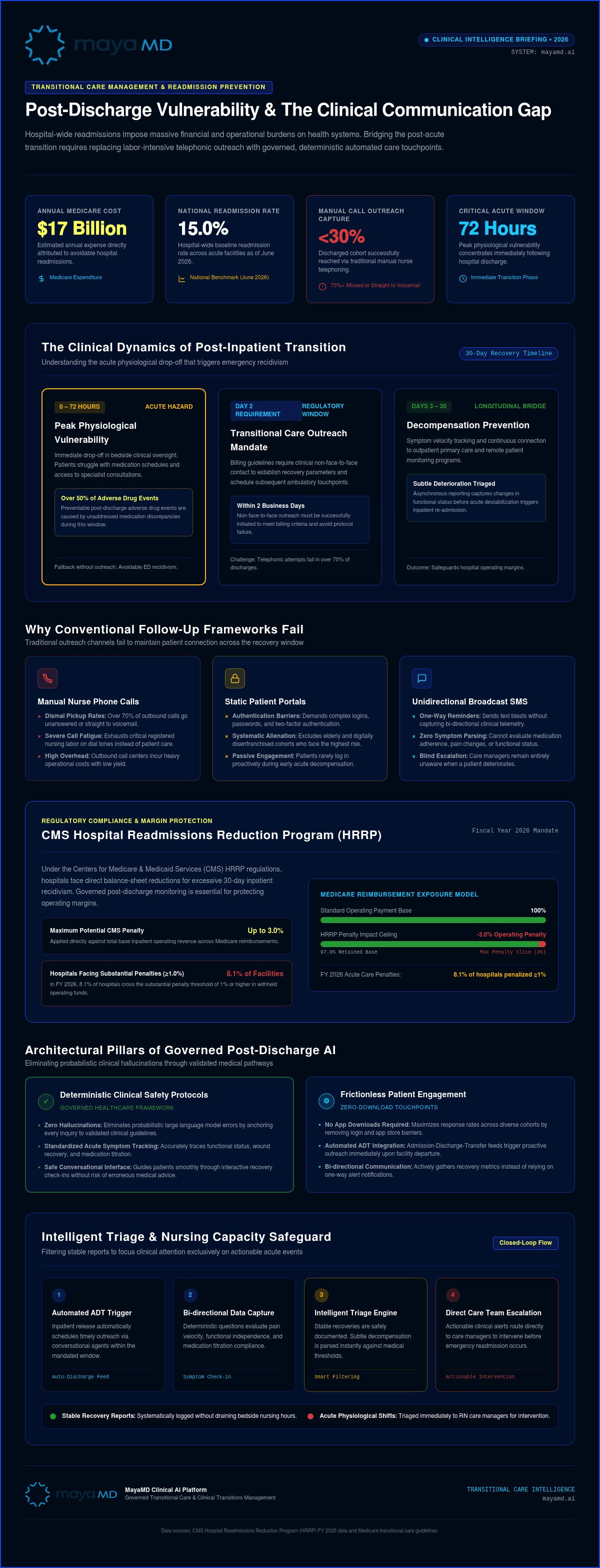
Avoidable hospital readmissions cost Medicare an estimated $17 billion annually, yet hospital teams still spend hours dialing phone numbers that go straight to voicemail. With the national hospital-wide readmission rate sitting at 15% as of June 2026, standard post-discharge protocols simply aren't protecting patients or operating margins. You already know the underlying friction: exhausted nurses facing relentless call fatigue, fragmented transitions to outpatient primary care, and a valid hesitation around unmonitored AI providing erroneous medical guidance. High-performance automated post discharge communication solutions address these vulnerabilities by transforming routine follow-ups into safe, governed clinical touchpoints.
Discover how automated post-discharge communication platforms reduce readmission rates, prevent care gaps, and automate clinical transitions of care. Grounded in deterministic safety protocols rather than unpredictable models, these systems actively identify early decompensation and triage actionable escalations directly to your care team. This 2026 guide examines the operational frameworks, regulatory requirements, and closed-loop workflows essential for safeguarding patients while protecting critical nursing capacity.
Key Takeaways
• Deploying governed automated post discharge communication solutions bridges vulnerable care gaps and mitigates readmission penalties by replacing manual call lists with intelligent, closed-loop interactions.
• Uniting conversational interfaces with deterministic clinical logic eliminates dangerous hallucinations, ensuring that acute symptom tracking strictly follows validated medical protocols.
• Frictionless patient touchpoints that require no app downloads maximize response rates while automated admission-discharge-transfer data feeds initiate timely outreach upon departure.
• Intelligent triage workflows protect nursing capacity by filtering stable recovery reports and escalating only acute, clinically actionable events to care teams.
• Continuous transitional engagement creates an operational bridge between inpatient discharge, outpatient follow-up, and longitudinal remote patient monitoring programs.
Deconstructing Post-Discharge Vulnerability and the Communication Gap
Automated systems orchestrating intelligent follow-up interactions across the post-inpatient transition represent a structural shift in how health systems manage care continuity. Inpatient discharge is notoriously fragile. The immediate drop-off in active clinical oversight exposes patients to acute risks, turning what should be recovery into emergency recidivism. Communication gaps cause preventable hospital readmissions by severing clinical observation at the precise moment post-acute complications begin to manifest. Conventional manual telephonic follow-ups capture under 30% of discharged cohorts, squandering scarce nursing labor on unanswered rings. Enterprise-grade automated post discharge communication solutions provide continuous, asynchronous clinical touchpoints that maintain patient connection during this critical recovery window.
The Clinical Dynamics of the 30-Day Transition Window
Peak physiological vulnerability concentrates heavily within the initial 72 hours following inpatient release. During this brief timeframe, unaddressed medication discrepancies account for over 50% of preventable post-discharge adverse drug events. When patients struggle to access timely specialist consultations or fail to comprehend complex medication titration schedules, their underlying pathology deteriorates rapidly. Without structured guidance, avoidable emergency department visits become the default fallback for unmanaged symptoms.
Why Conventional Call Centers and Static Portals Fail
Traditional outreach frameworks cannot keep pace with dynamic post-acute needs:
Manual Call Outreach
Staffing outbound call centers incurs massive operational overhead while yielding dismal pickup rates, pulling registered nurses away from top-of-license bedside duties.
Static Patient Portals
Portals demand complex login credentials and two-factor authentication, systematically alienating elderly and digitally disenfranchised demographics who face the highest clinical risk.
Unidirectional SMS Reminders
Broadcast text alerts deliver static information without capturing bi-directional clinical data, failing to detect subtle physiological decompensation.
The Regulatory Imperative: HRRP Penalties and Value-Based Care
Under the Hospital Readmissions Reduction Program (HRRP), the Centers for Medicare & Medicaid Services penalizes health systems up to 3% of total base inpatient operating payments for excessive 30-day readmissions. For FY 2026, 8.1% of hospitals face substantial penalties of 1% or higher, turning clinical coordination into an immediate balance-sheet priority. Effective transitional care management also dictates strict adherence to billing requirements, which mandate non-face-to-face clinical outreach within two business days of discharge. Managing these shared-risk thresholds requires deploying automated post discharge communication solutions that continuously gather, parse, and escalate patient-reported recovery metrics directly to care managers before acute destabilization requires emergency inpatient re-admission.
Architectural Pillars of Intelligent Post-Discharge Communication Platforms
Intelligent care continuity requires balancing natural language comprehension with strict clinical governance. While retrospective surveys evaluate satisfaction weeks after the fact, prospective management demands real-time physiological tracking. Modern automated post discharge communication solutions address the common challenges surrounding the discharge process by utilizing bidirectional conversational agents. Rather than sending static notices, these systems actively capture changes in functional status, symptom velocity, and medication adherence directly from recovering individuals.
Deterministic Logic Versus Generative Conversational Models
Deploying pure generative large language models directly into post-acute environments introduces severe clinical risks. Free-form probabilistic outputs can generate hallucinations, offering inaccurate reassurance or flawed dosage directions to vulnerable patients. To solve this, sophisticated platforms deploy hybrid architectures. Natural language processing handles conversational inputs empathetically, while underlying deterministic algorithms dictate all clinical triage pathways. Clinicians can review validated clinical frameworks, such as how conversational agent technology delivers heart failure education, to understand how rigid rule sets prevent unsafe medical drift.
Multichannel Outreach and Adaptive Cadence Modeling
Patient compliance collapses when systems force users through complex portal logins and forgotten passwords. Effective platforms eliminate these authentication barriers through zero-friction engagement pathways:
Adaptive Cadence
Dynamic protocols scale interaction frequency up or down based on patient-reported severity, surgical recovery curves, and diagnostic acuity.
Universal Channels
Multimodal outreach delivers interactive SMS, conversational interactive voice response (IVR), and lightweight web sessions directly to consumer devices.
Accessibility Compliance
Dynamic interfaces meet WCAG accessibility standards and dynamically adapt reading levels across diverse languages to ensure health equity.
Closed-Loop Escalation and Real-Time EHR Interoperability
Asynchronous data collection is clinically useless if findings remain trapped in isolated communication silos. High-performing architectures leverage HL7 FHIR application programming interfaces to ingest inpatient summaries at the moment of discharge. When patients report red-flag symptoms, deterministic safety engines instantly bypass routine queues to alert on-call clinicians with actionable context. Structured documentation writes back directly into the electronic health record, creating closed-loop audit trails without manual nurse data entry. Healthcare leaders looking to modernize transitional infrastructure can connect with clinical integration specialists to evaluate EHR-native workflow designs.
Evaluating Post-Discharge Communication Solutions: Core Selection Criteria
Healthcare procurement teams often struggle to differentiate between basic notification utilities and comprehensive clinical communication platforms. Simple messaging tools send static appointment reminders, but they cannot assess clinical trajectory or capture progressive deterioration. Evaluating enterprise-grade automated post discharge communication solutions requires examining three critical dimensions: clinical safety governance, technical interoperability, and low-barrier engagement. Platforms must also uphold rigorous enterprise safeguards, including SOC 2 Type II compliance, continuous data encryption, and strict HIPAA adherence.
Clinical Triage Precision and Symptom Check Depth
Static surveys fail because patient recovery is inherently fluid. Procurement committees must confirm that a platform incorporates dynamic, disease-specific clinical protocols for high-risk cohorts such as heart failure, COPD, pneumonia, and post-surgical cases. Rather than offering basic questionnaires, advanced architectures integrate intelligent logic to determine symptom acuity. Health systems frequently evaluate how virtual triage and digital front door solutions assess high-probability conditions, ensuring conversational check-ins systematically identify decompensation before an adverse event occurs.
EHR Interoperability and Workflow Friction Reduction
A solution that operates outside established clinical operations creates administrative friction and clinical blind spots. Much like specialized departmental platforms—such as the radiology management software from SMAART Medical Systems, Inc.—transitional care systems must be built on standards-based HL7 FHIR APIs capable of ingesting clinical variables directly from existing electronic health records without custom development delays. The provider dashboard must feature intelligent filtering so care teams only receive acute, actionable alerts rather than endless notifications. Platforms that automatically compile structured post-encounter notes back into the chart protect valuable staff hours while documenting compliance for transitional care management billing.
Engagement Optimization, Health Literacy, and Empathy Calibration
Even the most sophisticated clinical software fails if patients refuse to interact with it. Digital disenfranchisement remains a substantial barrier for older demographics, making zero-friction deployment non-negotiable. Platforms should never require app installations, complex registrations, or forgotten account credentials to begin an interaction.
Conversational design must mirror validated frameworks, such as the Agency for Healthcare Research and Quality's post-discharge follow-up call guide, translating complex instructions into sixth-grade reading proficiencies. Real-time language translation, compassionate phrasing, and adaptive multi-channel outreach ensure high interaction completion across diverse socioeconomic populations.
Strategic Implementation: Deploying Automated Transition Workflows
Successful enterprise deployment requires moving beyond ad-hoc software pilots toward an integrated clinical change management methodology. Implementing automated post discharge communication solutions relies on a disciplined four-phase deployment blueprint:
Phase 1: Ingest ADT Feeds.
Admission, Discharge, and Transfer (ADT) data streams automatically trigger protocol enrollment at the exact moment of patient departure without manual staff intervention.
Phase 2: Map Clinical Pathways.
Condition-specific conversational modules align directly to primary ICD-10 discharge diagnoses and surgical procedures.
Phase 3: Establish Escalation Rules.
Closed-loop triage workflows route acute patient responses to active care management queues.
Phase 4: Optimize Protocol Performance.
Care teams review longitudinal engagement and clinical metrics to continuously refine outreach frequency and conversational logic.
Cohort Stratification and Automated Protocol Assignment
Effective post-acute outreach avoids one-size-fits-all messaging cadences. The platform parses clinical variables within the electronic health record, stratifying patients by clinical acuity to assign intensive high-touch pathways or standard low-touch check-ins. When the EHR records an inpatient discharge event, protocol enrollment activates immediately. Clinical teams can review research on re-engineering the hospital discharge to improve patient transitions home to optimize these underlying enrollment triggers.
Designing Interactive Medication Verification Pathways
Adverse drug events cause extensive post-discharge readmissions, making immediate pharmaceutical confirmation vital. Automated verification check-ins initiate within 48 hours of a patient returning home. The conversational agent confirms whether new prescriptions were picked up from retail pharmacies, surfaces financial or transportation barriers, and delivers clear, conversational instructions to resolve confusion and reinforce adherence.
Operationalizing Care Team Triage and Closing the Loop
Alert fatigue quickly undermines clinical efficiency if notifications aren't properly governed. Care teams must establish clear, deterministic parameters that distinguish benign post-operative recovery symptoms from dangerous physiological deterioration. Urgent alerts bypass stand-alone dashboards, delivering notifications directly into existing clinical communication devices and EHR inboxes. Once staff members intervene, structured resolution notes sync back to the medical chart, completing the loop and creating an audit-ready clinical trail. To design and deploy custom escalation protocols tailored to your clinical units, schedule a consultation with MayaMD's workflow engineering team.
Transforming Transitional Care with the MayaMD Clinical AI Platform
Health systems require unified enterprise infrastructure rather than isolated point solutions that fragment clinical oversight. The MayaMD platform delivers a comprehensive clinical AI ecosystem, integrating conversational outreach, intelligent triage, and longitudinal physiological tracking. Recognized as a finalist for the 2025 Digital Health Hub Foundation Digital Health Awards at HLTH, the platform equips health networks nationwide with robust automated post discharge communication solutions that protect patients while eliminating manual outreach overhead.
The MayaMD Clinical AI Agent: Precision Post-Discharge Dialogue
Post-inpatient follow-up demands conversational sophistication backed by absolute clinical safety. The MayaMD Clinical AI Agent operates as a tireless care team extender, conducting multi-turn check-ins customized to each patient's discharge plan. By pairing natural language processing with deterministic medical logic, the agent prevents conversational hallucinations during triage. Patients discuss recovery symptoms, surgical wound healing, or prescription regimens in plain language, while the underlying clinical algorithms evaluate risk factors with diagnostic rigor.
Bridging Post-Discharge Outreach into Continuous Remote Monitoring
Transitional care shouldn't terminate abruptly at day 30. High-risk cardiovascular and pulmonary cohorts frequently require continuous physiological surveillance to prevent acute re-hospitalization. MayaMD bridges transitional communication directly into remote patient monitoring for chronic care management. Care managers view cellular biometric device data and conversational recovery updates side-by-side within a single pane of glass, creating an unbroken operational continuum between inpatient discharge and outpatient care.
Measurable Impact on Hospital Readmissions and Clinical Operations
Automating transitional outreach yields immediate operational and financial returns across acute networks:
Mitigating Penalties
Proactive identification of early decompensation curbs avoidable emergency visits, directly shielding health systems from severe readmission payment reductions.
Reclaiming Nursing Hours
Automated check-ins resolve routine status confirmations autonomously, liberating registered nurses to focus their expertise on high-acuity, deteriorating patients.
Longitudinal Care Coordination
Patient touchpoints bridge smoothly into Advanced Primary Care Management programs, securing ongoing primary care follow-ups and closing care gaps.
Health systems ready to modernize transition workflows and deploy an enterprise automated post discharge solution can connect directly with MayaMD's clinical team.
Modernizing Transitional Care with Governed Clinical Intelligence
Safe post-acute recovery requires moving past unanswered outbound calls and passive patient portals. Governed automated post discharge communication solutions bridge the precarious gap between inpatient discharge and home recovery by pairing conversational clarity with deterministic clinical logic that guarantees zero hallucinated medical guidance during patient triage. This disciplined framework shields health systems from severe readmission penalties while identifying acute physiological decompensation before it requires emergency re-hospitalization.
Recognized as a finalist for the 2025 Digital Health Hub Foundation Digital Health Awards at HLTH and supported by published clinical evidence delivering conversational discharge education in complex cohorts, MayaMD transforms post-acute transitions into structured, closed-loop clinical encounters. Your care teams don't have to sacrifice valuable nursing hours to maintain continuous, vigilant patient oversight.
Empower your clinical staff with proactive, intelligent tools that safeguard patients when they are most vulnerable. Request a clinical demonstration of MayaMD post-discharge solutions to evaluate enterprise integration and elevate care transitions across your network today.
Frequently Asked Questions
What are automated post discharge communication solutions and how do they function?
Governed automated post discharge communication solutions are enterprise digital health systems that orchestrate bidirectional check-ins with patients following hospital departure. Rather than relying on manual telephone calls, these platforms trigger automated SMS, interactive voice, or web sessions. They capture recovery progress, verify medication regimens, assess clinical symptoms against structured protocols, and immediately alert clinical care teams if red-flag signs of deterioration emerge.
How do automated post-discharge platforms prevent 30-day hospital readmissions?
These platforms identify subtle physiological decline during the critical 72-hour window after inpatient discharge. By checking symptom severity, confirming prescription fulfillment, and verifying scheduled primary care follow-up visits, the system detects complications before they escalate into acute emergencies. Care teams receive real-time, triaged alerts, allowing nurses to intervene with timely outpatient adjustments rather than managing an uncoordinated emergency room readmission.
Can conversational AI safely assess post-acute patients without hallucinating medical advice?
Yes, provided the system deploys a hybrid architecture pairing conversational natural language processing with deterministic clinical algorithms. Pure generative models risk unmonitored hallucinations, which are dangerous in post-acute triage. Governed platforms use generative processing solely to understand patient dialogue empathetically, while clinical logic strictly bounds all medical triage, risk assessments, and escalation paths according to validated protocols.
How do automated communication systems integrate with existing hospital EHR platforms?
Enterprise platforms integrate through standardized HL7 FHIR application programming interfaces to ingest admission, discharge, and transfer feeds in real time. This automated connection instantly launches condition-specific conversational modules when a patient leaves the hospital. Following each interaction, structured summaries and clinical flags write directly back into medical records, eliminating redundant manual documentation for nursing staff.
What is the difference between automated communication and remote patient monitoring?
Automated communication solutions deliver episodic, asynchronous conversational check-ins that evaluate qualitative symptoms, medication adherence, and transitional milestones over the post-discharge period. Remote patient monitoring tracks continuous, quantitative biometric data like blood pressure, blood glucose, and weight using cellular medical devices. Platforms like MayaMD unify both capabilities, allowing qualitative conversational triage and quantitative biometric streams to coexist in a single interface.
How do automated systems handle complex, elderly, or digitally illiterate patient populations?
Successful platforms eliminate friction by removing app downloads, user accounts, and password requirements entirely. Patients interact through standard text messages or automated conversational voice calls on their existing mobile devices or landlines. Conversational interfaces adapt to appropriate reading levels, incorporate multiple language translations, and permit designated family caregivers to participate in follow-up exchanges on the patient's behalf.
Can post-discharge communication solutions support Transition of Care Management billing?
Yes, modern automated post discharge communication solutions systematically document timely non-face-to-face clinical outreach within the mandated two business days post-discharge. By capturing patient-reported recovery status, identifying medication reconciliation issues, and filing time-stamped encounter summaries into the electronic health record, the platform establishes the verified audit trail required to support Transition of Care Management reimbursement coding.




See The MayaMD Difference
Fill the form below
Download Our Apps
MayaMD for patients and MayaPro for physicians - available on iOS and Android.
FOR PATIENTS
MayaMD App
AI-powered symptom assessment, triage, and secure access to your care team.

FOR PHYSICIANS
MayaPro App
MayaPro brings patient vitals, RPM/PCM care plans, and clinical decision support to your pocket.