
AI Remote Patient Monitoring Best Practices: A Guide to Clinical Governance in 2026

The 16-day monitoring rule, once a formidable barrier to digital health adoption, has officially been retired as of January 2026, marking a new era where clinical efficacy finally outweighs arbitrary compliance hurdles. While this regulatory shift opens doors for broader access, it also mandates a more disciplined approach to AI remote patient monitoring best practices to prevent alert fatigue from compromising provider well-being. You likely feel the weight of inaccurate documentation and the persistent anxiety that AI hallucinations could undermine patient safety. It is a valid concern in an industry where precision remains the only acceptable standard.
Mastering the integration of clinical AI is no longer about testing experimental software; it's about implementing a governed, neuro-symbolic framework that prioritizes safety and professional reliability. This guide provides a sophisticated roadmap to utilizing clinical AI agents that eliminate documentation errors and automate chronic care management at scale. We will examine how to leverage new CPT codes like 99445 and 99470 while maintaining HIPAA-compliant data governance. You'll learn to bridge the gap between disparate data points and human-centered care, ensuring your RPM program is both financially viable and clinically superior in this new regulatory landscape.
Key Takeaways
• Transition from passive data monitoring to a proactive, governed ecosystem that transforms raw metrics into actionable clinical interventions.
• Implement deterministic logic frameworks to ensure clinical safety and eliminate the risk of AI hallucinations in patient care settings.
• Streamline provider workflows by leveraging automated documentation tools that reduce administrative fatigue while maintaining high-stakes reliability.
• Master AI remote patient monitoring best practices to enhance patient enrollment and long-term adherence through structured engagement strategies.
• Scale chronic care management effectively by deploying a Clinical AI Agent that aligns complex data points with rigorous clinical governance.
The Evolution of AI-Enabled Remote Patient Monitoring
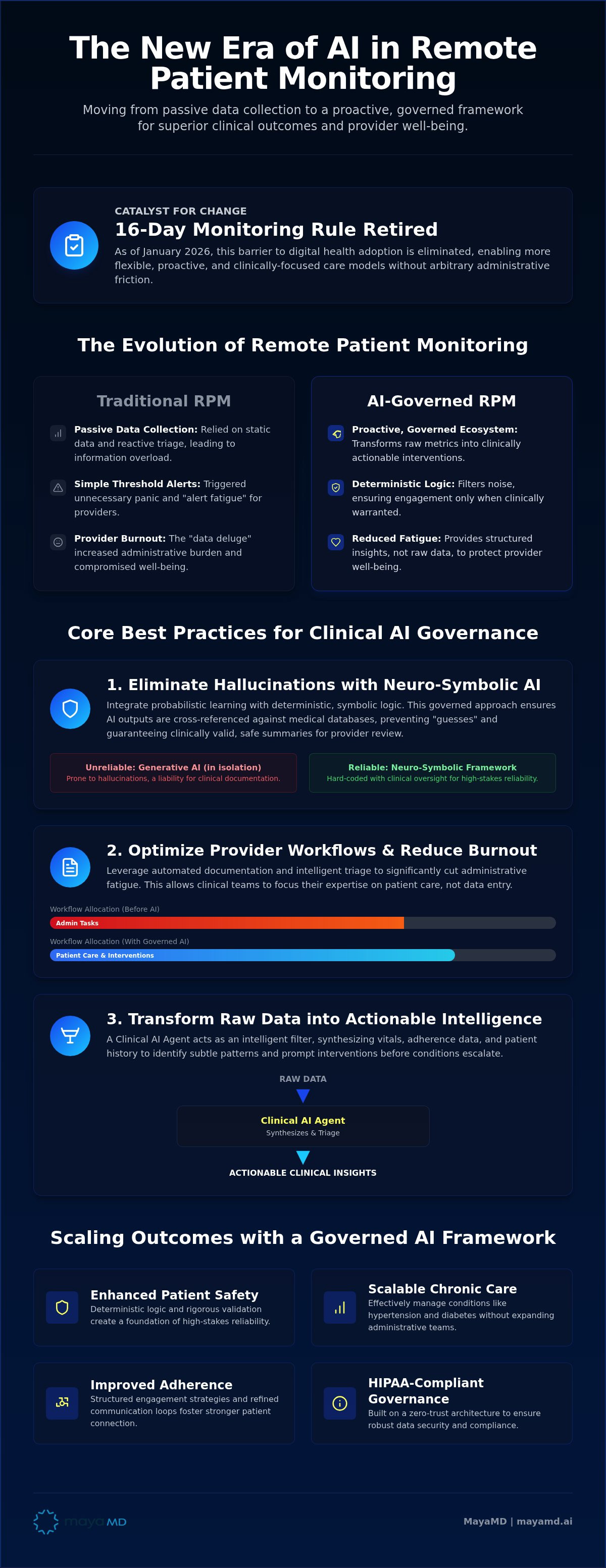
The traditional model of Remote patient monitoring (RPM) has historically relied on static data collection and reactive triage. By 2026, this approach is insufficient for modern healthcare systems. Standards now require an integrated, governed ecosystem where raw metrics are synthesized through deterministic logic rather than simple threshold alerts. Implementing AI remote patient monitoring best practices means moving beyond the noise that often triggers unnecessary panic or provider burnout. Instead, clinicians utilize specialized agents to filter the "data deluge," ensuring that engagement occurs only when interventions are truly warranted. This transition is supported by the 2026 elimination of the 16-day rule, allowing for more flexible, proactive care models that adapt to a patient's immediate clinical needs without administrative friction.
From Passive Data to Actionable Intelligence
Intelligence begins when raw vitals undergo clinical synthesis. In a governed AI environment, a sudden spike in blood glucose isn't just a data point; it's a prompt for a Clinical AI Agent to assess the patient's recent dietary adherence or medication schedule. This real-time triage significantly reduces hospitalizations by addressing physiological deviations before they escalate into emergencies. These refined communication loops foster a deeper connection between the patient and the care team. Patients feel supported rather than monitored. Providers receive structured insights instead of raw data. The resulting capability-to-outcome flow ensures that every technological feature serves a specific, measurable clinical benefit, enhancing the overall quality of care through rigorous oversight.
The Role of AI in Chronic Condition Management
Chronic conditions like hypertension and diabetes require continuous, nuanced oversight that traditional office visits can't provide. AI platforms now manage these complexities by identifying subtle patterns in blood pressure and glycemic trends that human eyes might miss. This level of precision is particularly vital when utilizing Principal Care Management Tools for specialist-led interventions. By integrating specialized PCM workflows, practices can scale their chronic care programs without expanding their administrative headcount. Following AI remote patient monitoring best practices ensures that every data point serves a clinical purpose, reinforcing the stability and security required for long-term patient health outcomes. This systematic framework allows providers to bridge the gap between disparate data points and human-centered care, fostering a sustainable ecosystem for chronic disease management.
Best Practices for Clinical AI Governance and Safety
Eliminating Hallucinations with Deterministic Logic
Generative AI has revolutionized natural language processing, but its inherent tendency toward hallucinations makes it a liability when used in isolation for clinical documentation. Neuro-symbolic AI serves as the essential solution. It integrates probabilistic learning with deterministic, symbolic logic to create a system that can't "guess" a patient's vitals or history. Validating AI-generated summaries requires a framework where the AI's output is cross-referenced against structured medical databases in real time. This rigorous validation process is essential for meeting current standards for FDA regulation of AI medical devices. It ensures that summaries aren't just readable, but clinically valid and safe for immediate provider review.
Data Security and HIPAA Compliance Standards
Security protocols for 2026 emphasize zero-trust architecture within cloud-based AI platforms. Encryption standards have moved beyond traditional methods to include homomorphic encryption, allowing AI to process sensitive metrics without ever fully decrypting the patient's identity. This protects privacy during continuous monitoring sessions. Secure data sharing between disparate EHR systems relies on FHIR protocols integrated with blockchain-based audit trails to provide an immutable record of every data access point. These frameworks ensure that AI remote patient monitoring best practices are maintained across the entire care continuum, shielding both the patient and the organization from digital vulnerabilities.
Regular auditing of clinical decision support systems is the final pillar of safety. This involves periodic "stress tests" where AI logic is challenged with edge-case clinical scenarios to ensure consistent performance. Adopting a Clinical AI Agent that utilizes these deterministic safeguards allows practices to scale care without compromising the rigorous standards required in modern medicine. This systematic approach transforms clinical risk into a manageable, transparent component of the digital health workflow.
Optimizing Provider Workflows and Reducing Burnout
Physicians often view remote patient monitoring as a source of "alert fatigue" rather than a clinical asset. By 2026, the volume of data generated by wearable sensors can overwhelm even the most efficient practices. Implementing AI remote patient monitoring best practices involves deploying automated triage systems that filter non-critical metrics. This ensures that clinicians only engage when physiological data deviates from established baseline parameters. Integrating this intelligence directly into the Electronic Health Record (EHR) eliminates the need for manual data entry, allowing the care team to focus on intervention rather than administration. It's a move from reactive data management to a governed, proactive clinical workflow.
Automated Clinical Documentation and Reporting
Summarizing patient vitals for clinical reviews is a high-burden task that traditionally steals hours from direct patient care. Clinical AI agents now function as sophisticated digital scribes, distilling weeks of monitoring data into concise, structured consult notes. This capability directly supports Advanced Primary Care Management (APCM) billing requirements by providing the necessary documentation for time-based care management. It's a bridge between high-volume data and the specific requirements of 2026 reimbursement codes. By automating post-discharge care summaries, practices ensure that documentation is both accurate and billing-aligned, reducing the risk of audit failures while reclaiming provider time for high-stakes decision-making.
Streamlining Chronic Care Management Workflows
Seamless integration into daily clinical rounds is the goal of a mature RPM program. Robotic Process Automation in Healthcare handles the repetitive tasks of scheduling follow-up appointments or triggering automated post-discharge communication solutions. This allows the clinical staff to operate at the top of their license, focusing only on patients who require human empathy and complex clinical judgment. To optimize your daily operations, consider this workflow integration checklist:
Threshold Verification
Validate automated triage thresholds before starting clinical rounds to ensure alert accuracy.
Summary Review
Review AI-generated summaries for at-risk patients to identify physiological trends early.
EHR Synchronization
Confirm that monitoring metrics have been successfully pushed to the patient's permanent record.
Automated Coordination
Execute RPA-driven care coordination tasks for stable patients who don't require immediate intervention.
By following these AI remote patient monitoring best practices, organizations transform a potentially chaotic data stream into a methodical, predictable process. This systematic approach mirrors a clinical process, building trust through transparency and measurable performance. The result is a comprehensive ecosystem where technology and human care work in harmony to improve chronic condition outcomes without sacrificing provider well-being.
Strategic Implementation: Enrollment and Patient Engagement
Successful enrollment is the pivot point where technological potential meets clinical reality. Without a disciplined onboarding process, even the most advanced AI remote patient monitoring best practices will fail to produce measurable outcomes. A systematic 5-step enrollment strategy ensures that the patient remains the focus of the digital ecosystem. First, use clinical risk stratification to identify high-risk candidates. Second, present the value of the "clinical safety net" to the patient. Third, manage technical provisioning by ensuring hardware is paired and functional. Fourth, verify the first HIPAA-compliant data transmission. Finally, activate the Clinical AI Agent to begin the engagement cycle. This methodical approach transforms a technical setup into a reliable care connection.
Driving Patient Adherence Through AI Interaction
Connectivity breeds confidence. When patients realize that a Clinical AI Agent is monitoring their physiological trends 24/7, their adherence to the care plan increases significantly. This continuous connectivity provides a psychological safety net that traditional episodic care cannot replicate. Automated post-discharge communication solutions play a vital role here; they bridge the dangerous gap between hospital release and the first follow-up appointment. By delivering structured, logic-based check-ins, these solutions identify early signs of decompensation. This proactive engagement reduces readmissions by addressing patient concerns in real time, ensuring that the patient feels supported throughout their recovery journey.
Local Deployment and Support Considerations
National strategies often falter when they ignore regional nuances. In high-density healthcare markets like Las Vegas and Houston, local support networks are essential for managing the high prevalence of chronic conditions. Regional implementation teams in cities such as Indianapolis and Chicago provide the necessary boots-on-the-ground support to navigate specific payer environments and local clinical workflows. Hardware logistics also require localized precision; for instance, Phoenix-based providers must account for extreme temperature impacts on device storage and delivery schedules. Understanding these local regulatory and environmental nuances is a hallmark of sophisticated AI remote patient monitoring best practices.
Educating patients on device usage remains a cornerstone of long-term success. Best practices include providing simplified, multi-modal instructions and conducting a supervised "first use" session to build patient self-efficacy. By combining high-level data science with empathetic, local support, organizations create a sustainable model for remote care. To see how these engagement strategies function in a live clinical environment, explore the capabilities of the MayaMD Clinical AI Agent. This platform acts as a bridge between complex data points and human care, ensuring that every patient interaction is governed by clinical logic and professional precision.
Scaling Outcomes with MayaMD’s Clinical AI Agent
The implementation of AI remote patient monitoring best practices culminates in the deployment of a system that is as rigorous as it is scalable. MayaMD’s Clinical AI Agent serves as this logical conclusion, providing a governed ecosystem where clinical safety and technological ambition coexist. While previous sections detailed the necessity of deterministic logic and optimized workflows, our platform synthesizes these elements into a single, cohesive interface. It's designed for healthcare leaders who have moved past experimental phases and require a proven application that fosters genuine connection between disparate data points and human care. This systematic approach ensures that your organization doesn't just collect data, but transforms it into measurable clinical performance.
The MayaMD Difference: Safety-First AI
The core of the platform is its unique neuro-symbolic architecture. This framework ensures that while the system utilizes generative capabilities for natural engagement, every clinical decision is anchored in deterministic logic. This approach eliminates the risk of hallucinations, providing a level of reliability that matches high-stakes medical standards. By prioritizing systematic frameworks, the Clinical AI Agent delivers a measurable reduction in documentation time for primary care providers. Clinicians find that structured consult notes and automated reporting allow them to focus on the human impact of their work rather than administrative mechanics. It's a capability-to-outcome structure that produces immediate benefits for the provider and the patient alike.
Clinical validity is the non-negotiable foundation of our technology. Every interaction is governed by rigorous oversight, ensuring that patient safety remains the primary metric of success. The platform’s scalability makes it a sophisticated partner for multi-city hospital systems, allowing for a standardized level of care across diverse geographic markets. Whether you're managing hardware logistics in Phoenix or navigating payer nuances in Chicago, the platform maintains a consistent level of professional gravity and performance. This reliability allows for the expansion of chronic care management without the proportional increase in administrative overhead that typically stalls growth.
Next Steps for Implementation
Evaluating your current RPM governance against MayaMD standards is the first step toward a more sustainable clinical future. We invite healthcare executives and practitioners to request a comprehensive clinical workflow audit to identify specific areas where automation can alleviate administrative burden. Our onboarding process is methodical and thorough, mirroring the clinical processes your team performs daily. This transparency builds trust and ensures that the integration of our Clinical AI Agent is seamless, effective, and aligned with 2026 regulatory requirements. We provide the bridge between high-level artificial intelligence and the daily reality of patient management.
It's time to move beyond threshold-based alerts and embrace a proactive, governed care model that prioritizes precision and safety. Transform your RPM program with MayaMD’s Clinical AI Agent and experience the intersection of advanced data science and compassionate patient support.
Advancing the Standard of Governed Remote Care
The regulatory shifts of 2026 provide a rare opportunity to rebuild remote care around clinical precision rather than administrative compliance. Adopting AI remote patient monitoring best practices requires a move away from the noise of threshold-based alerts toward a governed ecosystem of proactive intervention. By integrating deterministic logic into your workflow, you ensure that every automated summary and patient interaction remains safe, valid, and reliable. This systematic approach doesn't just reduce provider burnout; it restores the human connection at the heart of medicine.
MayaMD provides the infrastructure for this evolution through a HIPAA-compliant, cloud-based framework designed specifically for specialized APCM and PCM workflow support. Our platform uses deterministic logic to maintain clinical safety while automating the documentation that previously burdened your staff. It's time to transition from experimental data collection to a proven, scalable model of chronic care management. Request a Demo of MayaMD’s Clinical AI Agent to evaluate how our governed AI can transform your practice's outcomes. We look forward to partnering with you on this journey toward a more connected and efficient healthcare future.
Frequently Asked Questions
What are the primary benefits of using AI in remote patient monitoring?
AI in RPM provides real-time triage and automated data synthesis to transform raw physiological metrics into actionable clinical insights. These tools allow providers to move from reactive models to proactive interventions, significantly reducing hospital readmissions. By filtering non-critical data, AI ensures that clinical teams focus their attention on the patients who need it most. This enhances the overall efficiency of chronic care management programs while maintaining high-stakes reliability for the provider.
How does MayaMD ensure AI clinical documentation is accurate and hallucination-free?
MayaMD ensures documentation accuracy by utilizing a neuro-symbolic architecture that integrates deterministic logic with generative capabilities. This hybrid approach prevents AI hallucinations by anchoring every clinical summary in structured, rule-based medical protocols. The system doesn't guess or improvise patient data; instead, it synthesizes verified metrics into precise consult notes. This commitment to clinical validity provides a stable framework for providers who require rigorous oversight and precision in their digital workflows.
Is AI-enabled remote patient monitoring HIPAA compliant?
Yes, MayaMD's platform is a fully HIPAA-compliant, cloud-based framework designed for secure clinical data exchange. It employs zero-trust architecture and advanced encryption standards to protect sensitive patient metrics during continuous monitoring. This security extends to every data access point, providing an immutable audit trail for healthcare organizations. Maintaining these high standards is a core component of AI remote patient monitoring best practices, ensuring that patient privacy remains foundational to the care model.
How does AI-RPM integrate with Advanced Primary Care Management (APCM)?
AI-RPM integrates with APCM by providing the automated documentation and time-based tracking required for 2026 reimbursement codes. The platform distills monitoring data into structured summaries that align with APCM billing requirements, reducing the administrative burden on primary care teams. This connectivity allows practices to scale their management of complex chronic conditions while ensuring that every clinical interaction is captured accurately for both care coordination and financial compliance across the entire care continuum.
Can AI help reduce physician burnout in chronic care management?
AI reduces physician burnout by automating the "data deluge" and eliminating the administrative fatigue associated with manual documentation. Automated triage filters non-essential alerts, allowing clinicians to escape the cycle of alert fatigue. By handling repetitive tasks through robotic process automation, the system frees providers to operate at the top of their license. This refocuses the clinical effort on human care and high-stakes decision-making rather than the exhausting mechanics of data entry.
What is the difference between deterministic logic and generative AI in healthcare?
Generative AI focuses on probabilistic language patterns, which can lead to unpredictable results in clinical settings. In contrast, deterministic logic follows hard-coded, symbolic rules to ensure predictable, safe outcomes. MayaMD combines these approaches, using generative AI for natural patient engagement and deterministic logic for clinical decision support. This distinction is critical for AI remote patient monitoring best practices, as it prevents the safety risks often associated with unmonitored, black-box artificial intelligence systems.
How do you improve patient adherence in an RPM program?
Adherence is improved through continuous connectivity and automated post-discharge communication solutions that provide patients with a 24/7 clinical safety net. When patients feel supported by a Clinical AI Agent, their engagement with the care plan increases. The system provides structured check-ins and immediate support for technical or clinical questions. This high-level engagement fosters a sense of security and accountability, which is essential for successful long-term management of complex chronic conditions.
What cities does MayaMD support for RPM implementation?
MayaMD provides local implementation support in several major US healthcare markets, including Las Vegas, Indianapolis, Chicago, Phoenix, and Houston. These regional teams understand the specific payer environments and clinical workflows unique to each city. By offering localized deployment and hardware logistics support, we ensure that healthcare partners can navigate regional regulatory nuances effectively. This boots-on-the-ground presence is vital for scaling outcomes and maintaining professional gravity in multi-city hospital systems across the country.




See The MayaMD Difference
Fill the form below
Download Our Apps
MayaMD for patients and MayaPro for physicians - available on iOS and Android.
FOR PATIENTS
MayaMD App
AI-powered symptom assessment, triage, and secure access to your care team.
FOR PHYSICIANS
MayaPro App
MayaPro brings patient vitals, RPM/PCM care plans, and clinical decision support to your pocket.