
AI for Chronic Disease Management: Governing the 2026 Clinical Paradigm

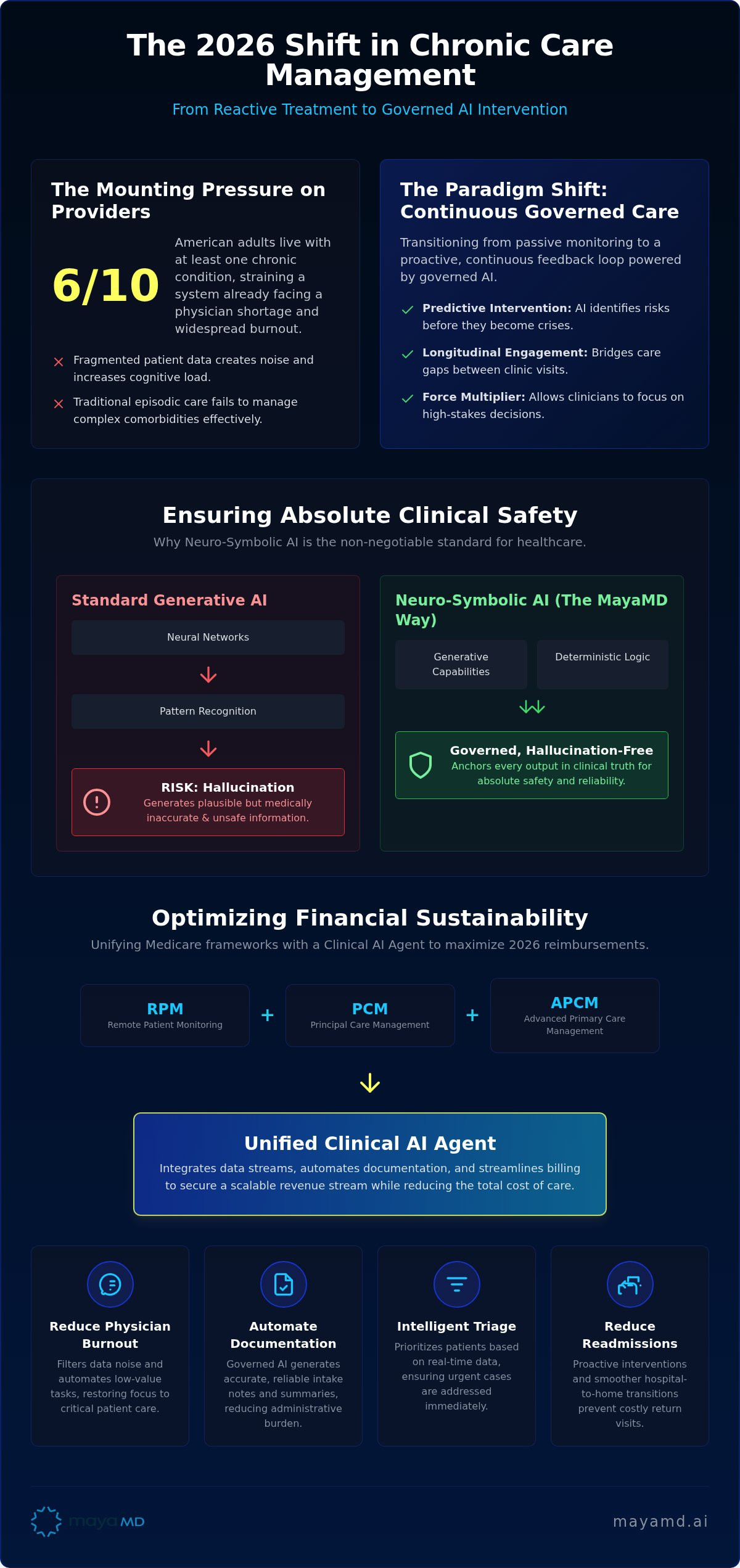
In 2026, the era of experimental AI in healthcare has ended, replaced by a mandate for absolute clinical governance. For providers managing the six in ten American adults living with chronic conditions, the potential of AI for chronic disease management has often been overshadowed by fragmented data and the persistent threat of model hallucinations. You've likely experienced the mounting pressure of physician burnout as documentation requirements grow alongside the noise of disconnected remote patient monitoring alerts. It's a frustrating reality where technology often adds to the workload rather than subtracting from it.
We recognize that clinical safety cannot be sacrificed for the sake of automation. This article demonstrates how neuro-symbolic AI and clinical agents are transforming chronic care from passive oversight into a governed, hallucination-free proactive intervention system. We'll explore the 2026 Medicare Physician Fee Schedule updates, including new codes for Advanced Primary Care Management; we'll also detail how integrating deterministic logic with generative capabilities reduces hospital readmissions and secures sustainable revenue. By moving beyond simple pattern recognition, you can finally achieve a scalable clinical workflow that prioritizes both precision and the human connection.
Key Takeaways
• Transition from episodic interventions to a continuous, governed feedback loop by implementing advanced AI for chronic disease management.
• Mitigate the risk of clinical hallucinations by utilizing neuro-symbolic AI, which combines generative capabilities with deterministic clinical logic for absolute safety.
• Optimize financial sustainability by strategically aligning RPM, PCM, and APCM frameworks under a unified Clinical AI Agent to maximize 2026 Medicare reimbursements.
• Reduce physician burnout through automated documentation and intelligent triage systems designed to streamline the complex hospital-to-home transition.
• Discover how the Mayared ecosystem provides a scalable, HIPAA-compliant architecture that prioritizes both rigorous clinical oversight and patient engagement.
The Evolution of Digital Healthcare for Chronic Disease in 2026
Clinical standards in 2026 have undergone a fundamental shift. The traditional model of episodic care, characterized by quarterly check-ins and reactive treatments, is no longer sufficient for a population where six in ten adults live with at least one chronic condition. Instead, we've entered an era where AI for chronic disease management functions as a continuous, governed feedback loop. This paradigm shift ensures that patient data isn't just stored but is actively utilized to maintain a steady state of health. It's a move toward longitudinal engagement that bridges the dangerous gaps between physical clinic visits.
The 2026 physician shortage has made this evolution a necessity rather than a luxury. Clinicians are facing unprecedented burnout levels driven by the cognitive load of managing fragmented data from disparate sources. Governed AI systems act as a critical force multiplier. They filter the noise of raw data, allowing practitioners to focus their expertise on high-stakes clinical decisions rather than administrative sorting. This technology doesn't replace the physician; it restores their ability to practice at the top of their license.
From Passive Monitoring to Predictive Intervention
Passive remote monitoring is a relic of the early 2020s. In the current clinical landscape, active agents identify subtle physiological shifts before they manifest as acute crises. For example, a slight trend in nocturnal respiratory rates or minor fluctuations in weight can trigger a governed intervention long before a patient requires an emergency room visit. This transition from data collection to actionable clinical insights is vital. It provides patients with a profound sense of emotional stability. They're no longer "monitoring" their illness alone; they're supported by a system that understands their baseline and acts when deviations occur. This constant connectivity significantly improves medication adherence and lifestyle compliance. Providers looking to extend this oversight into clinical nutrition can learn more about TeleDIETS to see how AI-driven software supports specialized dietary management.
The 2026 Economic Reality of Chronic Care
Managing complex comorbidities in an aging population presents a staggering financial challenge. The economic sustainability of healthcare now depends on the successful implementation of value-based care models. Strategic adoption of digital healthcare for chronic disease reduces the total cost of care by preventing high-cost events like hospital readmissions and prolonged stays. As the industry moves away from fee-for-service, the focus has shifted to measurable performance and patient outcomes. A broad overview of AI in healthcare confirms that data-driven efficiency is the primary driver of fiscal health for modern practices. By automating the triage process and streamlining documentation, organizations can achieve a scalable revenue stream that remains resilient even as patient complexity increases.
Beyond Hallucinations: How Neuro-Symbolic AI Ensures Clinical Safety
The critical flaw of standard generative models in clinical settings is their propensity for hallucinations, where the system produces plausible sounding but medically inaccurate information. This risk is fundamentally incompatible with the high stakes of AI for chronic disease management. When managing patients with complex comorbidities, a single erroneous recommendation can lead to catastrophic outcomes. 2026 marks the definitive move toward neuro-symbolic AI, a hybrid architecture that combines the pattern-recognition capabilities of neural networks with the rigid reasoning of symbolic logic. This ensures that every output is both contextually relevant and clinically sound.
MayaMD has pioneered this governed approach to ensure that every patient interaction and documentation entry is anchored in clinical truth. By integrating deterministic logic, the system functions as a Clinical AI Agent that cannot deviate from established medical guidelines. This framework provides a hallucination-free environment where providers can trust the accuracy of automated triage and intake notes. This reliability is essential for scaling care without increasing the cognitive burden on physicians. It transforms the AI from a simple chatbot into a sophisticated clinical tool that maintains the highest standards of evidence-based medicine.
Deterministic Logic in Chronic Care Workflows
Deterministic logic is the bedrock of clinical safety because it provides a verifiable logic trail for every AI-generated insight. By mapping responses to validated protocols, deterministic logic in clinical AI ensures that recommendations remain within safe parameters. As noted in AI in Chronic Disease Self-Management, effective digital interventions must align with rigorous standards to achieve meaningful outcomes. This transparency allows clinicians to audit the AI's reasoning, fostering trust in automated systems that manage longitudinal care journeys.
HIPAA Compliance and Data Governance
Managing sensitive data in 2026 requires more than basic encryption; it demands a comprehensive governance framework. MayaMD’s HIPAA-compliant, cloud-based architecture is backed by SOC 2 Type 2 certification, ensuring that patient privacy is maintained at scale. This rigorous oversight allows healthcare organizations to deploy advanced engagement tools without compromising data integrity. If you're ready to implement a secure, governed framework, reach out to our clinical experts for a detailed consultation on our safety protocols and technical architecture.
Strategic Frameworks: Integrating RPM, PCM, and APCM
The fragmented application of Remote Patient Monitoring (RPM), Principal Care Management (PCM), and Advanced Primary Care Management (APCM) has historically limited the efficacy of AI for chronic disease management. In 2026, these programs aren't isolated billing opportunities; they're integrated components of a single clinical ecosystem. Data silos fail. A Clinical AI Agent acts as the vital connective tissue, synthesizing data from diverse sources—including diagnostic imaging from providers like One Health Connect—into a unified patient profile. This integration ensures that a patient's journey remains consistent across different care levels, preventing the data gaps that often lead to clinical errors.
Effective management requires more than hardware. It demands the strategic application of remote patient monitoring software that aligns with specific chronic care pathways. By automating patient engagement and enrollment, organizations maintain higher retention rates without increasing staff workload. This system doesn't just collect data; it interprets it within the context of the patient's overall management plan. It ensures every alert is actionable and every intervention is timely.
The 2026 Medicare Physician Fee Schedule has solidified APCM as a cornerstone of value-based care. This model replaces the labor-intensive task of tracking minutes with a bundled monthly payment, simplifying the financial landscape for practices. Implementing this at scale requires a robust digital infrastructure to manage large patient populations efficiently. Practitioners should consult the Advanced Primary Care Management definitive guide to understand the specific requirements for codes like G0568 and G0570. AI-driven systems facilitate this transition by automating the longitudinal tracking and behavioral health integrations required for success in this bundled model.
Principal Care Management (PCM) for High-Risk Populations
For patients with single, high-complexity chronic conditions, PCM provides the specialized focus necessary to prevent acute exacerbations. AI agents are uniquely suited to coordinate care between specialists and primary care providers by maintaining a synchronized documentation trail. This coordination reduces the administrative friction that typically plagues complex care transitions. By utilizing specialized principal care management tools, clinics ensure that specialists have immediate access to governed clinical insights. This level of integration is essential for managing high-risk populations where timing and precision determine clinical outcomes.
Workflow Transformation: Automating Clinical Documentation and Triage
The administrative burden on clinicians has reached a critical breaking point. In 2026, the clinical objective is a documentation-free environment where AI for chronic disease management captures and structures patient data automatically. We're moving away from the era where physicians spend more time with digital interfaces than with the patients themselves. This transformation begins by reengineering the hospital discharge process. It turns what was once a stack of static, often ignored papers into an active, governed AI agent that follows the patient home to ensure continuity of care.
By automating the intake and triage phases, healthcare organizations can effectively manage the "digital front door." This ensures that every patient interaction is captured with clinical precision, creating a seamless data flow that informs subsequent interventions. It's a fundamental shift that prioritizes the human connection while the technology handles the rigorous demands of documentation and data synthesis. If you're ready to modernize your clinical operations, contact our team to discuss workflow automation.
Automated Post-Discharge Communication
The first 30 days following a hospital stay are historically the most volatile for patients with chronic conditions. Conversational agents provide the necessary oversight by monitoring recovery progress and reinforcing complex care plans. By implementing hospital discharge education specifically tailored for heart failure protocols, healthcare systems can significantly lower preventable readmission rates. These agents don't just provide information; they conduct intelligent follow-ups that identify rising risks before they escalate into crises. This proactive approach is a core element of reengineering the hospital discharge to ensure a safe transition from the acute setting to the home environment.
Virtual Triage and Digital Front Door Solutions
Modern triage serves as the primary filter for efficient healthcare delivery. By utilizing AI symptom checkers, organizations can guide patients to the most appropriate level of care before they reach the emergency department. This isn't just about convenience; it's about clinical resource optimization. Systems like MayaMD Virtual Triage provide clinicians with a list of high-probability conditions for immediate review, streamlining the intake process. This allows the medical team to focus their expertise on high-acuity cases while the AI manages the routine data gathering and initial triage logic, ensuring that AI for chronic disease management remains both scalable and precise.
MayaMD: The Definitive Clinical AI Agent for Governance and Care
MayaMD represents the shift from experimental technology to a proven, governed ecosystem. The Mayared platform isn't just a software layer; it's a sophisticated integration of deterministic logic and clinical empathy. While standard patient portals act as passive repositories for lab results, a Clinical AI Agent actively steers the patient journey. It uses neuro-symbolic frameworks to ensure that every interaction remains within the guardrails of evidence-based medicine. This approach eliminates the variability and risks associated with unmanaged generative models, providing a stable foundation for AI for chronic disease management.
Standard care models often struggle with the "last mile" of patient engagement. MayaMD solves this by delivering measurable clinical outcomes. For example, in a case study at Seguros Bolivar, the platform achieved a 45% reduction in end-to-end call times and a 96% triage accuracy rate. These aren't just efficiency metrics; they're indicators of a system that provides high-stakes reliability. By reducing documentation time and improving the precision of initial assessments, the platform allows clinical teams to focus their resources where they're most needed: on complex patient care.
The Clinical AI Agent as a Partner, Not a Tool
Building long-term patient trust requires more than a digital interface; it requires consistent, high-quality interaction. The Clinical AI Agent functions as a tireless partner that supports the human side of primary care by removing administrative noise. It manages the routine data gathering and symptom checking that often leads to physician fatigue. This commitment to clinical excellence and safety is why MayaMD was recognized as a finalist for the 2025 Digital Health Awards. By positioning the AI as a bridge between patient and provider, we ensure that technology fosters connection rather than creating a barrier to care.
Future-Proofing Your Practice for 2026 and Beyond
Managing thousands of patients with chronic conditions requires a level of scalability that human-only teams cannot achieve. Clinical leaders in 2026 must adopt systems that offer seamless interoperability with the evolving EMR landscape and the latest Medicare reimbursement frameworks. AI for chronic disease management must be agile enough to adapt to new CPT codes and regulatory requirements without disrupting existing workflows. MayaMD’s HIPAA-compliant, cloud-based architecture is designed for this high-stakes environment, offering the stability and security required for long-term clinical partnerships. To see how these governed frameworks can transform your specific workflow, contact MayaMD for a customized clinical AI demonstration and discover the future of proactive care management.
Governing the Future of Longitudinal Care
The clinical landscape of 2026 demands a transition from fragmented data collection to a governed, continuous feedback loop. By implementing advanced AI for chronic disease management, practices can finally bridge the gap between acute interventions and long-term wellness. We've explored how neuro-symbolic frameworks eliminate the risk of hallucinations, while the strategic integration of RPM and APCM protocols creates a sustainable, scalable revenue model. As a 2025 Digital Health Hub Foundation Finalist, MayaMD provides the HIPAA-compliant and SOC 2 certified architecture necessary for this high-stakes evolution. Our deterministic logic ensures that every clinical insight is verifiable and safe for your most complex patient populations.
You don't have to navigate this technological shift alone. We're here to help you restore the human connection to primary care by removing the administrative noise that hinders your practice. Request a Demo of the MayaMD Clinical AI Agent to see our governed framework in action. The path to a more efficient, patient-centered future is ready for your leadership.
Frequently Asked Questions
How does AI for chronic disease management reduce physician burnout?
AI for chronic disease management reduces physician burnout by automating the cognitive load associated with documentation and data synthesis. Instead of manually reviewing thousands of data points from remote devices, clinicians receive prioritized, actionable insights. This shift allows physicians to focus on high-stakes clinical decision-making rather than administrative overhead. By streamlining the intake process and pre-structuring clinical notes, the system restores time for direct patient interaction, which is the core of modern primary care.
Can AI really eliminate hallucinations in clinical documentation?
Purely generative models are prone to hallucinations, but neuro-symbolic AI effectively eliminates this risk by integrating deterministic clinical logic. This hybrid architecture ensures that every AI-generated insight is anchored in validated medical protocols and pathways. By applying rigid reasoning to probabilistic data, the system creates a verifiable logic trail. This governed approach ensures that clinical documentation remains accurate, reliable, and compliant with evidence-based standards, providing a level of safety that standard chatbots cannot achieve.
What is the difference between Remote Patient Monitoring and Principal Care Management?
Remote Patient Monitoring (RPM) focuses on the continuous collection and transmission of physiological data, such as blood pressure or glucose levels, to monitor a patient's status. In contrast, Principal Care Management (PCM) is designed for patients with a single, high-complexity chronic condition that requires specialized coordination. While RPM provides the data stream, PCM provides the management framework for high-risk individuals. Both programs work in tandem to ensure longitudinal oversight and prevent acute clinical exacerbations.
Is MayaMD's Clinical AI platform HIPAA compliant?
Yes, the MayaMD platform is a fully HIPAA-compliant, cloud-based architecture designed for the secure management of sensitive patient data. The system is also SOC 2 Type 2 certified, ensuring that all data governance practices meet the highest industry standards for security and privacy. This rigorous oversight allows healthcare organizations to scale their digital engagement solutions with confidence. The platform prioritizes data integrity and regulatory adherence, maintaining patient trust while facilitating advanced clinical workflows across the national landscape.
How does the Clinical AI Agent improve hospital-to-home transitions?
The Clinical AI Agent improves hospital-to-home transitions by serving as an active bridge during the critical 30-day post-discharge period. It provides automated post-discharge communication that monitors recovery progress and reinforces complex education protocols. By identifying subtle physiological shifts or gaps in adherence early, the agent allows for timely interventions. This proactive oversight reduces preventable readmission rates and ensures that patients feel supported and informed as they move from acute clinical settings to home environments.
What are the reimbursement requirements for APCM in 2026?
Under the 2026 Medicare Physician Fee Schedule, Advanced Primary Care Management (APCM) requirements focus on a bundled monthly payment model rather than time-based tracking. Practices must utilize codes like G0568, G0569, or G0570 to manage patient populations comprehensively. Requirements include the integration of behavioral health services and the use of a certified digital infrastructure for longitudinal care. This model simplifies billing by providing a stable revenue stream for practices that demonstrate continuous, high-quality management of chronic patient populations.
How does deterministic logic improve patient safety in AI healthcare?
Deterministic logic improves patient safety by ensuring that AI responses are predictable and strictly aligned with established clinical guidelines. Unlike standard generative models that may produce variable outputs, a deterministic framework operates within defined safety guardrails. This means every recommendation or triage insight is mapped to a validated clinical protocol. This transparency allows for a verifiable logic trail, enabling clinicians to audit the AI's reasoning and ensuring that patient care never deviates from evidence-based medical standards.
Can AI symptom checkers be used for virtual triage in primary care?
Yes, AI symptom checkers are essential for virtual triage as they function as a digital front door for primary care practices. These tools guide patients to the appropriate level of care by gathering initial data and generating a list of high-probability conditions for clinical review. This process optimizes resource allocation by filtering low-acuity cases. By streamlining the intake phase, symptom checkers ensure that AI for chronic disease management remains both scalable and precise for clinical teams.




See The MayaMD Difference
Fill the form below
Download Our Apps
MayaMD for patients and MayaPro for physicians - available on iOS and Android.
FOR PATIENTS
MayaMD App
AI-powered symptom assessment, triage, and secure access to your care team.
FOR PHYSICIANS
MayaPro App
MayaPro brings patient vitals, RPM/PCM care plans, and clinical decision support to your pocket.