
Advanced Primary Care Management (APCM): The 2026 Clinical AI Framework

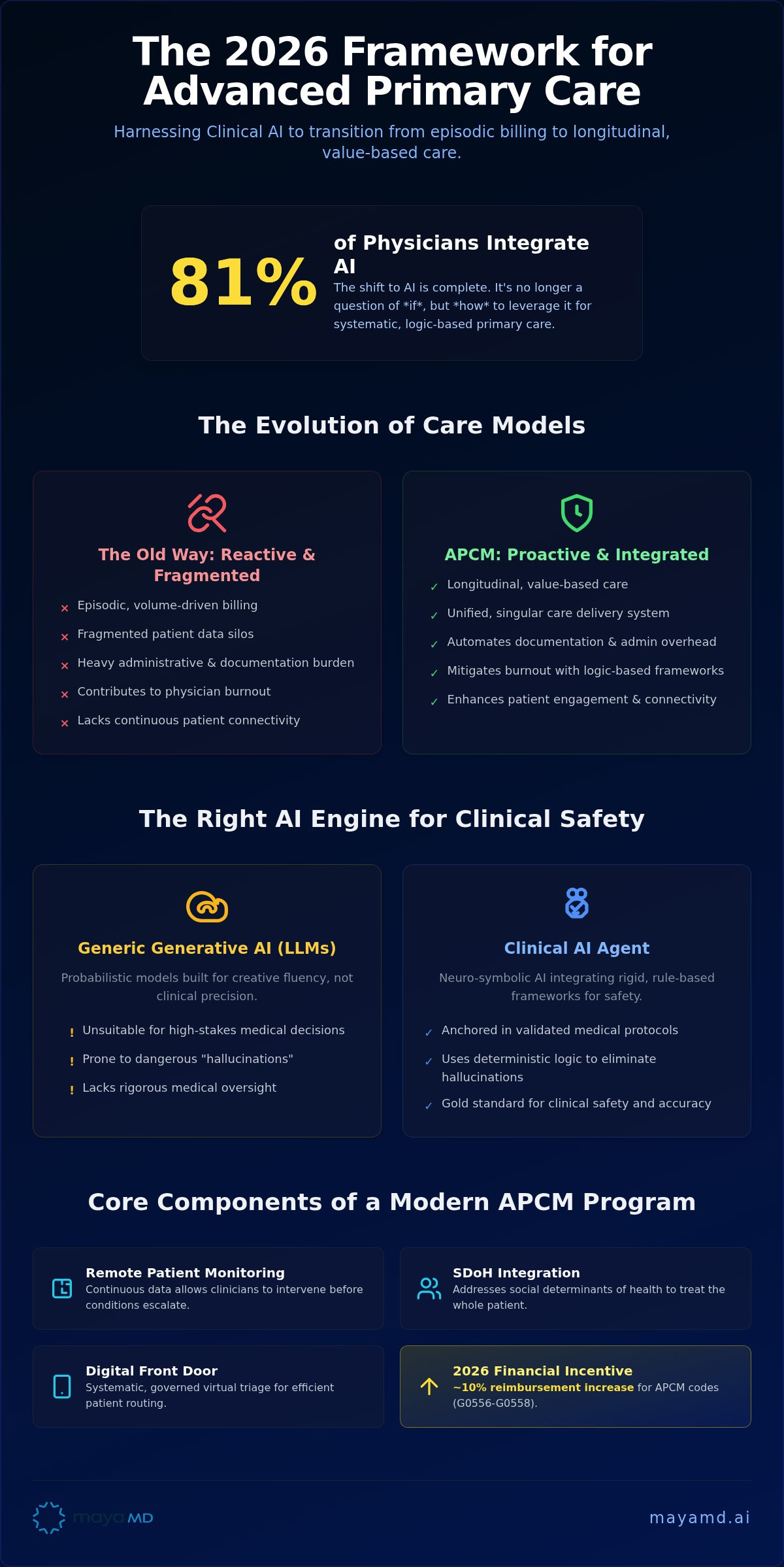
With 81% of physicians now integrating artificial intelligence into their professional workflows, the shift from experimental technology to essential clinical infrastructure is complete. For many practices, the challenge isn't whether to adopt AI, but how to harness it to meet the rigorous demands of the Advanced Primary Care Management (apcm) program. CMS has structured the 2026 reimbursement rates, such as the G0558 code for high-complexity cases, to reward longitudinal care that traditional fee-for-service models often overlook. However, the administrative burden of managing multiple chronic conditions can quickly lead to physician burnout if not governed by a systematic, logic-based framework.
Key Takeaways
• Understand the 2026 transition from episodic billing to longitudinal care within the evolving value-based framework.
• Differentiate between generic language models and Clinical AI Agents that utilize deterministic logic to ensure rigorous medical oversight.
• Identify specific methodologies to mitigate provider burnout by automating complex apcm documentation and Medicare reimbursement requirements.
• Execute a phased implementation strategy that integrates HIPAA-compliant engagement tools seamlessly into existing clinical workflows.
• Leverage automated post-discharge communication and remote monitoring to enhance long-term chronic care outcomes and patient stability.
What is Advanced Primary Care Management (APCM) in 2026?
Advanced Primary Care Management (APCM) represents a fundamental departure from the episodic, volume-driven models of the past. By 2026, the program has matured into a sophisticated framework that synthesizes the objectives of Chronic Care Management (CCM) and Principal Care Management (PCM) into a singular, longitudinal care delivery system. Traditional primary care often struggles with the complexity demands of 2026. Fragmented patient data and documentation burdens stifle clinical efficiency. APCM solves this. It prioritizes relationship-based care coordination that scales through advanced integration rather than manual labor. This evolution is rooted in the principles of Primary Care Case Management (PCCM), yet it leverages modern automation to ensure that high-touch patient engagement reduces hospital readmissions.
The shift toward value-based, longitudinal models is no longer a theoretical goal but an operational reality. In 2026, clinicians face an aging population with multiple comorbidities that require constant oversight rather than quarterly check-ins. Traditional models fail because they lack the connectivity required to bridge the gap between the clinic and the home. By focusing on the transition from hospital to home, APCM creates a safety net that captures patient needs in real-time. This approach addresses the human impact of technology, fostering a sense of support that empowers patients to manage their health more effectively. It transforms the practice from a cost center into a high-performance clinical engine.
The Regulatory Landscape: From Volume to Value
The 2026 Medicare Physician Fee Schedule has solidified apcm as the cornerstone of value-based care. CMS updated reimbursement rates for codes G0556, G0557, and G0558, reflecting an approximate 10% increase for 2026. This framework incentivizes the quality of the patient-provider connection over time-based tracking. Maintaining a HIPAA-compliant cloud platform is now a regulatory necessity for managing the rigorous documentation and behavioral health add-on codes that define the program.
Key Components of a Modern APCM Program
Successful advanced primary care management requires a shift toward proactive monitoring. Continuous data from remote patient monitoring allows clinicians to intervene before chronic conditions escalate. Modern programs integrate social determinants of health (SDoH) data to address environmental factors. Establishing a digital front door for virtual triage ensures that patient concerns are addressed through a governed, systematic process. This creates a comprehensive ecosystem that supports both provider and patient.
The Role of Clinical AI Agents in APCM Delivery
Precision defines the new era of care. While generic Large Language Models (LLMs) have captured public attention, their probabilistic nature makes them unsuitable for high-stakes clinical decision-making. In the context of Advanced Primary Care Management services, clinicians require a Clinical AI Agent that prioritizes safety over creative fluency. These agents function as a bridge between raw patient data and actionable clinical insights. By shifting from reactive responses to governed interactions, practices can manage the complexities of apcm without compromising the integrity of the medical record or the safety of the patient.
Deterministic Logic vs. Generative AI
Neuro-symbolic AI has emerged as the gold standard for clinical safety in 2026. This architecture integrates the pattern recognition of neural networks with the rigid, rule-based frameworks of deterministic logic. It's a system designed to eliminate the hallucinations common in standard generative AI models. When a patient uses an AI symptom checker, the logic must be anchored in validated medical protocols. This ensures that triage recommendations are both accurate and clinically valid. You can explore more about this in our sibling article on Deterministic Logic in Clinical AI for Care Safety. This governed approach transforms raw input into structured data, allowing the care team to focus on high-acuity interventions rather than data entry.
Scaling Expertise Without Increasing Headcount
Staffing shortages remain a persistent challenge for modern practices trying to meet the demands of apcm. A Clinical AI Agent is a governed extension of the care team that operates within predefined medical protocols to ensure patient safety. By handling routine patient inquiries and automated post-discharge follow-ups, these agents allow clinicians to focus on the most complex cases. This capability supports specialists in providing Principal Care Management (PCM) by maintaining continuous engagement without increasing administrative headcount. The system captures patient symptoms and history, then translates that information into structured clinical documentation. This direct automation reduces the administrative overhead that often leads to physician burnout and "pajama time." This capability-to-outcome flow ensures that AI-driven triage leads directly to faster clinical intervention, creating a more responsive care environment. By automating the digital front door, your practice can maintain a high standard of care while scaling operations efficiently. If you're ready to modernize your workflow, connect with our clinical experts today to see how these agents integrate into your existing systems.
APCM vs. Traditional Care Management: A Comparative Analysis
Traditional care management models often struggle under the weight of manual documentation and episodic patient interactions. These legacy systems depend on human-intensive outreach, which inherently limits scalability and leads to clinical blind spots. In contrast, the 2026 apcm framework utilizes robotic process automation (RPA) to handle the administrative complexities of longitudinal care. By following the CMS Advanced Primary Care Management Services standards, practices can move away from reactive, time-based billing toward a more sustainable, outcome-oriented model. This shift replaces siloed data with integrated, HIPAA-compliant ecosystems that provide a comprehensive view of the patient’s health status in real-time.
Cost-efficiency is achieved by reducing the reliance on manual tracking for chronic care conditions. While human-only teams face inevitable fatigue and oversight errors, AI-automated workflows maintain a consistent level of clinical rigor. This systematic approach ensures that every patient interaction is captured and documented according to federal requirements, effectively lowering the administrative overhead that typically erodes practice margins. Proactive monitoring replaces the "wait-and-see" approach of traditional care, allowing for early intervention before a condition requires emergency services. It's a transition that doesn't just save money; it saves clinical capacity.
The Efficiency Gap in Primary Care
Data from early 2026 indicates that AI scribe and ambient listening tools have reached 29% adoption among physicians, a significant rise from 20% just ten months prior. This technical feature directly translates to a reduced administrative burden, allowing clinicians to reclaim hours previously lost to documentation. Implementing Advanced Primary Care Management through an AI-governed framework improves the ROI of value-based care contracts by ensuring all billable care coordination activities are recorded without manual intervention. This level of precision is essential for meeting the 2026 Medicare Physician Fee Schedule requirements.
Patient Engagement and Retention
Patient satisfaction scores are heavily influenced by accessibility and the continuity of support. A 24/7 Clinical AI Agent provides immediate triage and symptom checking, which reduces patient anxiety and prevents network leakage. When chronic patients feel supported within their primary care network, they don't seek fragmented care from outside providers. For example, specific studies on conversational agents have demonstrated their efficacy in heart failure management, as detailed in our overview on Improving Patient Outcomes with AI. This high-touch engagement model ensures that the patient remains the center of the clinical ecosystem while improving long-term retention.
Implementing APCM: A Strategic Roadmap for 2026
Successful implementation of an apcm program requires more than just updated billing software. It demands a systematic re-engineering of clinical workflows to ensure that technology supports, rather than hinders, the provider-patient connection. Leaders must move beyond the experimental phase into a proven, governed application of Clinical AI to meet the complexity demands of 2026. This roadmap outlines the five essential steps for a safe and scalable transition.
Step 1: Conduct a Clinical Workflow Audit.
Identify where documentation bottlenecks occur, particularly during the transition from hospital to home. This audit reveals the specific administrative burdens that lead to physician burnout.
Step 2: Deploy a HIPAA-compliant Clinical AI Agent.
This tool manages the digital front door, handling virtual triage and patient engagement with deterministic logic to ensure clinical validity.
Step 3: Integrate Remote Patient Monitoring.
Continuous data streams feed the logic engine, allowing for real-time adjustments to care plans. Note that practices signing agreements for Remote Patient Monitoring or PCM on or before August 31, 2026, may qualify for temporary software fee waivers.
Step 4: Establish Automated Post-Discharge Protocols.
Re-engineering the discharge process ensures that high-risk patients receive immediate follow-up, which is a core requirement for high-complexity APCM billing.
Step 5: Monitor Performance Metrics.
Use AI-driven insights to refine care plans based on measurable patient outcomes and reimbursement accuracy.
Integrating RPM and PCM into APCM
APCM acts as a central hub for data continuity across the care continuum. While regulations prohibit billing apcm concurrently with Chronic Care Management (CCM) or Principal Care Management (PCM) for the same patient in the same month, it is designed to work alongside RPM. The logic engine processes remote data to identify high-risk alerts, which are then routed to the appropriate specialist. This creates a unified ecosystem that prevents data fragmentation and ensures that specialists are informed of primary care interventions in real-time.
Overcoming Implementation Barriers
Resistance to AI often stems from concerns over clinical safety and regulatory compliance. Practice leaders must adopt the role of an "Authoritative Pioneer," demonstrating how a governed framework reduces documentation fatigue while adhering to new state-level regulations. For example, Alabama’s SB 63 now requires clear disclosure when AI is used in medical decision-making. Maintaining HIPAA compliance during cloud-based data integration is non-negotiable. It requires a platform that prioritizes security and rigorous medical oversight. If you're ready to identify your practice's specific documentation challenges, contact us for a clinical workflow assessment to begin your transformation.
MayaMD: The Engine for Advanced Primary Care Management
MayaMD provides the necessary infrastructure to scale longitudinal care without sacrificing clinical precision. Our Clinical AI Agent serves as a purpose-built apcm tool, integrating deterministic logic with generative capabilities to eliminate the risks of hallucination. This governed approach ensures that every patient interaction remains within validated medical protocols, providing a sense of high-stakes reliability for both providers and patients. Our platform's recognition as a finalist for the 2025 Digital Health Hub Foundation Awards underscores our commitment to proven application over experimental hype. We speak as an established leader that has moved past the trial phase into rigorous, real-world deployment.
A critical focus of our technology is reengineering the hospital discharge process to stabilize the transition from hospital to home. By automating post-discharge communication, the platform identifies potential complications before they escalate into costly readmissions. This capability-to-outcome flow directly supports the high-complexity requirements of the apcm framework, allowing practices to capture the full value of 2026 reimbursement codes. It's a systematic approach that prioritizes safety while fostering the human connection essential for chronic care success.
Sophisticated AI for Sophisticated Providers
The Mayared framework establishes a rigorous standard for data governance and clinical safety. Within this ecosystem, Virtual Triage acts as a digital front door, capturing patient history and symptoms with academic precision. MayaMD functions as the essential bridge between disparate data points and compassionate human care. This integration allows practitioners to maintain clinical authority while leveraging the cold, hard logic of advanced data science. The result is a more connected care team that can respond to patient needs with unprecedented speed and accuracy.
Your Partner in Value-Based Care
Stability and regulatory adherence are the hallmarks of our partnership. We offer scalable solutions designed for national healthcare systems that require measurable performance and long-term clinical validity. Our platform isn't just a software solution; it's a collaborative expert that understands the nuances of primary care workflows. By prioritizing safety and precision, we help you navigate the complexities of 2026 reimbursement codes with calm confidence. We value long-term partnerships over fleeting trends, ensuring that your practice remains at the forefront of the value-based care movement. Schedule a consultation to master APCM with MayaMD and transform your chronic care management delivery today.
Advancing the Standard of Longitudinal Care
The 2026 landscape for primary care has shifted from episodic billing to a model of continuous, governed oversight. This transition requires more than just administrative compliance; it demands a technical framework that prioritizes clinical safety and operational scalability. By adopting a system rooted in deterministic logic, your practice can effectively manage the complexities of apcm while reclaiming significant clinical capacity. This approach ensures that documentation is precise and that patient engagement remains high-touch, particularly during the critical transition from hospital to home.
MayaMD stands as a reliable, collaborative partner in this evolution. As a finalist for the 2025 Digital Health Hub Foundation Awards, we provide a HIPAA-compliant Clinical AI Agent designed to foster human connection through the logic of data science. Our deterministic logic safety framework eliminates the risks of generative hallucinations, ensuring that your patient interactions are both safe and accurate. You don't have to navigate the complexities of value-based care alone. Request a Demo of MayaMD's APCM Solutions to see how our platform can transform your clinical workflows. Together, we can build a more resilient and responsive primary care ecosystem.
Frequently Asked Questions
What is the difference between CCM and APCM in 2026?
APCM (Advanced Primary Care Management) represents an evolution from the time-based Chronic Care Management (CCM) model. While CCM requires clinicians to track specific 20-minute intervals for reimbursement, APCM utilizes a bundled monthly payment structure that prioritizes longitudinal care coordination over stopwatch tracking. This shift allows practices to focus on the quality of the patient-provider connection and relationship-based oversight. It integrates CCM and Principal Care Management (PCM) objectives into a singular, high-performance clinical workflow.
Is APCM reimbursement available for all primary care practices?
Eligibility for apcm reimbursement is available to primary care clinicians who can meet Medicare’s specific requirements for continuous, longitudinal care. The program is designed for practices managing patients with multiple chronic conditions who require steady oversight. By 2026, CMS has finalized reimbursement through codes G0556, G0557, and G0558. Practices must demonstrate they have the necessary digital infrastructure to provide high-touch patient engagement and virtual triage to qualify for these payments.
How does a Clinical AI Agent improve APCM documentation?
A Clinical AI Agent automates the conversion of patient interactions into structured, billable documentation. By utilizing deterministic logic, the system captures symptoms and histories with academic precision, which eliminates the risk of generative hallucinations. This technical feature ensures that every patient interaction is recorded in real-time, satisfying Medicare's rigorous documentation requirements without requiring manual data entry. This creates a more accurate medical record while ensuring that the practice remains compliant with federal standards.
Can APCM help reduce physician burnout?
Yes, the bundled payment model of APCM reduces the administrative friction that typically leads to provider fatigue. When integrated with a Clinical AI Agent, the platform handles routine follow-ups, triage, and documentation, reclaiming hours of "pajama time" for the clinician. This capability-to-outcome flow allows providers to focus on high-acuity medical decision-making rather than repetitive data entry. By automating administrative overhead, practices can maintain a sustainable pace while improving long-term chronic care outcomes.
Is MayaMD's AI platform HIPAA compliant?
MayaMD operates a cloud-based, HIPAA-compliant platform designed to meet the security demands of the modern healthcare industry. The architecture integrates deterministic logic with generative AI to ensure that patient data is handled with rigorous oversight and clinical validity. As a finalist for the 2025 Digital Health Hub Foundation Awards, the platform is recognized for its commitment to safety and precision. It provides a secure bridge between disparate data points and compassionate human care.
What is the role of Remote Patient Monitoring in APCM?
Remote Patient Monitoring (RPM) serves as the essential data source for a proactive APCM program. While clinicians cannot bill apcm concurrently with CCM or PCM for the same patient, the program is designed to function alongside RPM. Continuous data from home-based monitoring devices feeds the logic engine, allowing the Clinical AI Agent to identify high-risk alerts. This integration ensures that care is proactive rather than reactive, stabilizing chronic patients between office visits and reducing hospital readmissions.
How do I start an APCM program in my clinic?
Starting an APCM program begins with a clinical workflow audit to identify existing documentation bottlenecks. Once these are identified, practices should deploy a HIPAA-compliant Clinical AI Agent to manage the digital front door and virtual triage. The next steps include:
• Integrating remote monitoring tools for continuous patient data.
• Establishing automated post-discharge communication protocols.
• Monitoring performance metrics via AI-driven insights to refine care plans.
This systematic approach ensures a safe and scalable transition to value-based care.What are the core requirements for APCM billing under Medicare in 2026?
Core requirements for APCM billing in 2026 include providing 24/7 access to care, establishing personalized care plans, and maintaining longitudinal coordination. Clinicians must use specific codes: G0556 for low complexity, G0557 for moderate complexity, and G0558 for high-complexity cases. There is a strong regulatory focus on relationship-based management and documented engagement. Utilizing a governed AI framework ensures these requirements are consistently met through automated documentation and rigorous clinical oversight, protecting the practice's reimbursement integrity.




See The MayaMD Difference
Fill the form below
Download Our Apps
MayaMD for patients and MayaPro for physicians - available on iOS and Android.
FOR PATIENTS
MayaMD App
AI-powered symptom assessment, triage, and secure access to your care team.


FOR PHYSICIANS
MayaPro App
MayaPro brings patient vitals, RPM/PCM care plans, and clinical decision support to your pocket.