
Workflow for Reviewing Remote Patient Data: How RPM Works

A remote reading is only useful when it leads to an appropriate next step. A workflow for reviewing remote patient data defines how measurements and patient concerns are received, reviewed in context, documented, and escalated when needed. The Centers for Medicare & Medicaid Services describes the provider’s role as reviewing the data, making treatment decisions, and communicating with the patient.
It’s understandable to focus on devices and readings, but reliable remote patient monitoring also depends on clear ownership: who reviews incoming information, what triggers escalation, and how the care team follows up. Without that structure, data can arrive without becoming part of a managed care process.
This article explains how remote patient monitoring (RPM) data moves from collection and review to clinical escalation. You’ll learn how teams define the information they collect, assign review responsibilities, interpret alerts in context, and document the next step in care.
The result is a practical guide to the workflow’s decision points and human oversight, so you can see how connected monitoring links patient readings with clinical care.
Key Takeaways
• Define which patients the program is designed to support, what information it collects, and who is responsible for reviewing it.
• Set clear alert thresholds and escalation paths so concerning readings reach the appropriate provider for clinical review.
• Connect monitoring tasks with existing communication, documentation, and follow-up processes to support continuity of care.
• Keep human oversight central: readings and patient concerns need context, documentation, and an appropriate next step.
• Use a pilot to identify gaps in data transmission, alert review, and workflow ownership before expanding the program.
Defining the patient population, collected signals, decision points, and response workflow
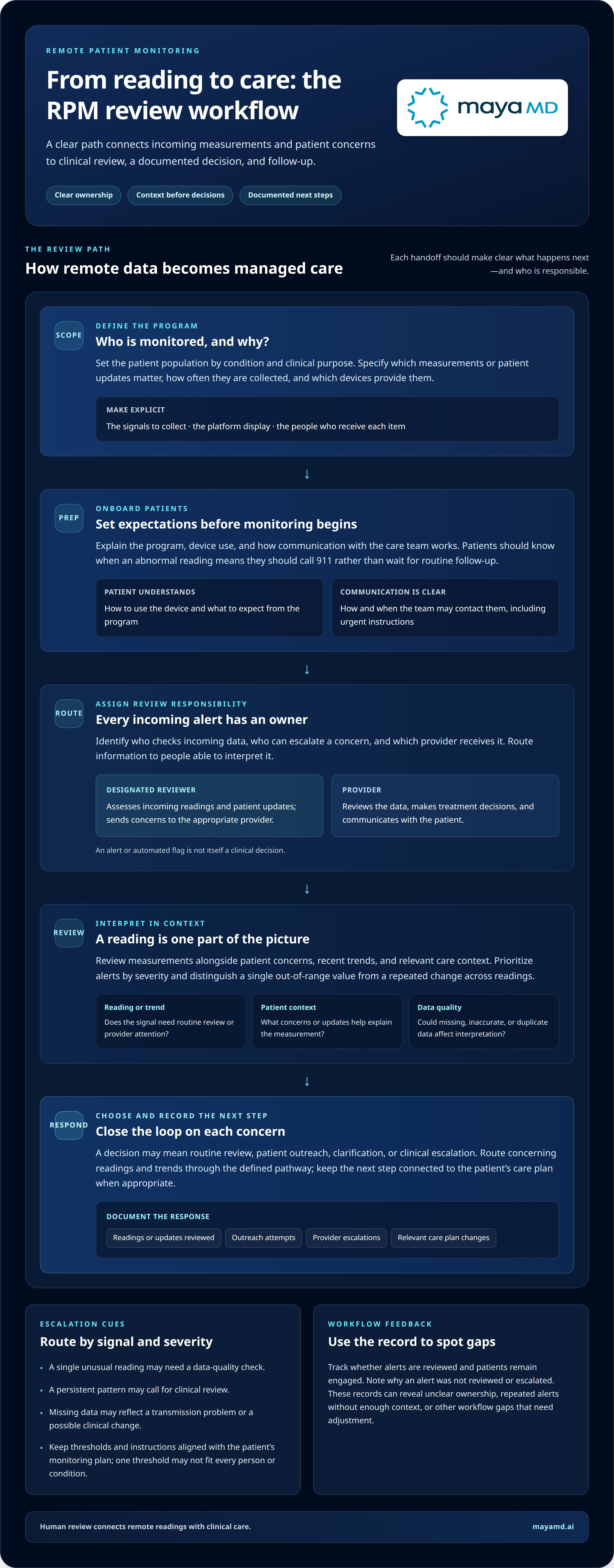
A dependable RPM workflow starts by defining who the program serves, what it monitors, and how the team responds. Platforms can differ in how they display readings, route alerts, support documentation, and identify the next reviewer.
Defining Patients and Collected Signals
Define the patient population by the condition being monitored and the clinical purpose of collecting remote measurements. For example, a chronic care program can identify eligible patients, relevant readings, and the care team responsible for review. This scope helps distinguish useful signals from information that does not inform the intended care process.
Specify which measurements or patient updates are collected, how often they are collected, and which devices provide them. A program might track blood pressure readings and patient-reported concerns, routing each to its designated reviewer. Decide what the platform displays and who receives the information, so it reaches people able to interpret it.
Patient onboarding should explain the program, device use, and communication expectations before monitoring begins. Patients also need to know when an abnormal reading means they should call 911 rather than wait for routine follow-up. Clear expectations make the monitoring process understandable to patients and staff.
Setting Decision Points and Response Steps
Decision points define what happens after a reading arrives: routine review, patient outreach, or clinical escalation. Teams should identify which readings or trends need provider attention and prioritize alerts by severity. A single out-of-range measurement may call for a different response than a repeated change across several readings.
Review readings alongside patient concerns and relevant care context before deciding on follow-up. For example, a reviewer can determine whether an unexpected value needs clarification, outreach, or provider review. Make the next step clear: document the interpretation, record any outreach attempt, and connect the result to the patient’s care plan when appropriate.
Patients should understand how and when the care team may contact them. A clear communication pathway helps distinguish expected follow-up from urgent instructions and supports continuity when readings raise concerns. It also helps the team identify missed signals, false alerts, or data that needs more context before it can be interpreted.
Assigning Clinical Review and Escalation Roles
Assign a specific role to review each patient’s alerts, with a clear route for escalating critical cases. State who checks incoming data, who can escalate a concern, and which provider receives it. According to the Centers for Medicare & Medicaid Services, the provider reviews data, makes treatment decisions, and communicates with the patient.
Clinical ownership must remain clear when several staff members support monitoring. A designated reviewer can assess incoming information and send concerns to the appropriate provider, who makes treatment decisions. This division clarifies responsibility without treating an alert or automated flag as a clinical decision.
Documentation can capture which readings or patient updates were reviewed, outreach attempts, provider escalations, and relevant care plan changes. Teams can also track whether alerts are reviewed and patients remain engaged with monitoring. These records can reveal where the response workflow needs adjustment, such as unclear ownership or repeated alerts without enough context.
Escalating readings and trends to providers
Escalation plans define how a concerning reading or patient concern reaches clinical review. For missing or inaccurate readings, distinguish transmission problems from possible clinical changes. Prioritize abnormal values and trends by severity before assigning follow-up.
Planning Escalation for Concerning Readings
An escalation plan maps each concerning signal to a review role, priority, and response pathway. This helps an organization avoid treating every device alert as equally urgent. Define which readings or trends warrant provider review, who receives each alert, and who can escalate it further.
For example, a single unusual reading may need a data-quality check, while a persistent pattern may call for clinical review. Account for missing data, duplicate alerts, and signals arriving outside the team’s coverage. Record why an alert was not reviewed or escalated so operational gaps can be identified.
Keep clinical thresholds and escalation instructions aligned with the patient’s monitoring plan. Don’t assume one threshold fits every person or condition. Clear routing helps staff distinguish a technical issue from a potential change that needs provider attention, while preserving an auditable record for care coordination and reimbursement documentation.
Following Up on Abnormal Readings
Clinical follow-up connects an abnormal reading with an appropriate next step instead of leaving the alert as an unresolved system event. Before deciding whether outreach or provider escalation is appropriate, a reviewer can assess the reading alongside recent trends, patient updates, and possible transmission issues.
If a device reading appears inaccurate, start by checking whether the data arrived correctly and seeking clarification through the established patient communication pathway. If readings remain concerning, route them to the designated provider rather than relying on an automated flag alone. Document the review, outreach attempts, and resulting care plan update when appropriate.
Follow-up should also make clear what the patient can expect next. Staff can explain whether the team needs more information or a provider will review the concern. This closes the loop between the monitoring system and the patient, while giving the organization a record of response activity and unresolved issues.
Escalating Patient Concerns to Physicians
Patient concerns need a defined route to a physician when they require clinical judgment. The reviewer should record the concern, connect it with relevant readings or trends, and forward it through the organization’s escalation pathway. This gives the physician context to decide on an appropriate response.
Keep patient-reported symptoms distinct from device-generated alerts, but consider both during review. For example, a patient who reports feeling worse may need escalation even when a device reading appears unchanged. Document the concern, the clinician receiving it, and any resulting communication or care plan change.
Teams can assess whether escalation works by reviewing unresolved alerts, follow-up completion, and reasons for delayed review. These measures help reveal whether role assignments or communication pathways need adjustment. For teams refining these processes, discuss clinical monitoring workflows as part of operational planning.
Workflow, staffing, and system integration
RPM works best when monitoring tasks connect with existing care team processes. Before expanding enrollment, establish how data, staffing, documentation, and billing-related records move through the practice.
Integrating RPM Into Care Team Workflows
Integrating RPM means placing data review, patient communication, and follow-up within the care team’s existing processes. This helps reduce disconnected tasks and clarifies how monitoring supports ongoing care. For example, an incoming reading can enter a review queue, then move to patient outreach or provider review through established communication channels.
Test the workflow with a small patient cohort before a full rollout. During the pilot, track whether intended users complete enrollment, data arrives as expected, and technical issues require staff attention. Brief review meetings can help teams spot handoff problems early and adjust the process before it becomes routine.
Staffing plans should account for alert review and patient follow-up, not just device setup. One toolkit describes an RPM registered nurse reviewing alerts received during the business day within four hours. This example sets an operational expectation; each program still needs clearly assigned responsibilities and a workable coverage process.
Defining Workflow Roles
Workflow roles identify who handles each task, from checking incoming data to documenting follow-up. Clear assignments matter because shared responsibility can leave alerts or patient messages without an owner. For example, a designated reviewer can sort routine readings from issues needing provider attention, while the provider retains treatment decisions.
Define how staff communicate during handoffs and what information the next person needs. Document transmission days, management time, and interactive communication as the work occurs. These records support operational oversight and make relevant billing documentation easier to maintain within the workflow.
Staffing needs can change as enrollment grows. A process that works for 25 patients may need adjustment when a program reaches 250. Teams can review alert volume, unreviewed signals, and workload distribution to identify where responsibilities or procedures need revision.
Connecting Remote Data With the EHR
EHR integration connects remote readings and review activity with the practice’s existing documentation and follow-up processes. The goal is a coherent view of relevant information, rather than separate, disconnected workflows for staff to manage.
Establish what information enters the clinical record, who can access it, and how the team records review outcomes. For example, document a reviewed reading and resulting outreach alongside relevant care updates. Clear connectivity supports continuity when another team member needs to understand the patient’s monitoring history.
Define how the team responds to missing data or technical problems. During a pilot, record whether data arrives as expected and which issues need staff attention. Review the findings before scaling, then update workflow templates, documentation practices, and escalation paths to match a process the care team can operate reliably.
How should clinical scope and human oversight be assessed?
Assess the program’s scope by defining which patients need monitoring, which decisions require human review, and how treatment management is documented. Time tracking and clear clinical ownership connect review activity with patient care.
Assessing Patient Eligibility and Clinical Need
Patient eligibility starts with whether continuous physiological monitoring is expected to improve management of the patient’s condition. This clinical purpose helps distinguish patients who could benefit from ongoing readings from those for whom monitoring would not meaningfully inform care.
During implementation, define the population in scope, relevant conditions, and any exclusions. For a chronic condition program, specify which readings relate to management goals and how clinicians will use them. In specialized fields like gut health, teams such as IBS Clinics show how remote care and symptom tracking can be structured around personalized chronic management. Enrollment decisions should also consider whether the patient can participate in monitoring and whether the care team can review the incoming information.
Evaluate a platform in context: identify the task it was evaluated to perform and what fell outside that evaluation. Also assess which populations, devices, and care settings were represented, and whether performance varies across groups or sites. These distinctions help teams judge how well the evaluation applies to their intended patient population.
Defining Clinical Scope and Human Oversight
Clinical scope defines which monitoring signals inform care and which decisions remain with qualified clinicians. This distinction matters because an alert or platform output can support review, but it does not replace clinical judgment or establish a treatment decision.
Specify who reviews incoming data, how often review occurs, and which practitioner owns treatment decisions. Medicare RPM can be billed only by physicians and nonphysician practitioners eligible to furnish evaluation and management services. Auxiliary personnel may furnish Medicare RPM services under the billing practitioner’s general supervision.
Human oversight includes reviewing patient context and documenting the clinical response. For example, a provider may consider a reading alongside the patient’s reported condition before deciding whether care should change. Set procedures for unavailable data and missed signals, then assess whether the designated reviewer can act within the agreed process.
Planning Clinical Review and Treatment Time
Treatment management time refers to time spent reviewing and managing RPM data, including required interactive communication. Recording that work as it happens helps the care team distinguish data transmission from clinical management and supports accurate operational documentation.
For Medicare RPM, code 99457 covers the first 20 minutes of treatment management in a calendar month, including required interactive communication. Code 99458 covers each additional 20 minutes of treatment management when reported with the primary treatment-management service, when applicable. Code 99470 covers the first 10 minutes for a shorter period of clinical staff time.
Medicare RPM codes 99470 and 99457 cannot both be reported in the same calendar month. A platform with time-tracking features can help teams record work, but the clinical workflow still needs to connect that time with actual review, communication, and management. Align implementation and documentation with current CMS guidance, payer requirements, internal policies, and applicable laws.
Remote patient data transmission and review
Remote patient monitoring depends on more than a reading reaching a platform; teams need a process for interpreting, recording, and acting on that data. In 2026, Medicare RPM billing codes distinguish device setup, data transmission, and treatment management.
Transmitting Remote Patient Data
Data transmission moves readings from a patient’s device into a system where the care team can review them. Define which measurements are expected, how often they should arrive, and what happens when a transmission is absent or incomplete.
For Medicare, CPT 99454 covers device supply with daily recordings or programmed alert transmissions for 16 to 30 days in a 30-day period. Code 99445 covers the device-supply service when 2-15 days of transmitted data are recorded within 30 days. These thresholds differ, so one code should not be treated as interchangeable with the other.
Medicare codes 99445 and 99454 describe the same device-supply service at different data thresholds and cannot both be reported for the same 30-day period. A reliable record should show whether data arrived, which days were represented, and whether gaps arose from a device or transmission issue.
Reviewing Data Through a Step-by-Step Workflow
A review workflow links incoming data to a documented clinical response. This sequence helps staff distinguish a technical gap from a reading that may need clinical attention.
• Receive the transmission and record whether the expected data arrived.
• Check readings for missing, duplicate, or potentially inaccurate information.
• Review available readings and patient updates in their clinical context.
• Route concerning values or trends to the designated provider for review.
• Document the review, communication, and next step in the patient’s care.
Each handoff needs an owner. If a transmission is missing, record the issue and follow the program’s process for resolving it. If a reading raises concern, route it for clinical review. This creates a traceable record instead of leaving an alert without a disposition.
For Medicare reimbursement, code 99453 covers initial device setup and patient education. Code 99457 covers the first 20 minutes of treatment management in a calendar month, including required interactive communication; 99458 covers each additional 20 minutes when reported with the primary treatment-management service, when applicable. Code 99470 covers the first 10 minutes of treatment management for a shorter period of clinical staff time. Medicare added codes 99445 and 99470, effective January 1, 2026.
These are toolkit averages, not a substitute for documenting the applicable service and its requirements. Medicare RPM services require patient consent, and the workflow should record that consent alongside setup and review activity.
For teams aligning transmission records with clinical review, discuss an RPM workflow that connects data, documentation, and follow-up.
MayaMD: remote patient monitoring for chronic care management
MayaMD provides remote patient monitoring for chronic care management, helping care teams connect ongoing monitoring with clinical follow-up. Its Clinical AI Agent and AI patient engagement solutions can support communication within broader digital care workflows. These offerings can help healthcare organizations structure chronic care monitoring, with patient engagement complementing data review and clinician oversight.
Remote readings still require defined review responsibilities, clinical judgment, and documented next steps. Technology can support the workflow, while providers remain responsible for treatment decisions and patient communication.
Contact MayaMD to discuss remote patient monitoring for chronic care management.
Build the Next Stage of Connected Care
A durable workflow for reviewing remote patient data should evolve with patient needs, care team capacity, and program goals. Treat operational learning as part of implementation: review where handoffs slow down, where patients need clearer communication, and how the process can better support continuity of care.
Technology can support this work when it complements clinical judgment and fits the way a care team communicates. MayaMD offers a Clinical AI Agent, AI patient engagement solutions, and automated post-discharge communication solutions. These capabilities support different points in the care journey, from ongoing engagement to communication after discharge, while providers retain clinical decision-making.
If your organization is planning or refining remote patient monitoring for chronic care management, consider how the workflow should connect data review with patient communication and follow-up. Contact MayaMD to discuss RPM and explore a thoughtful next step for your care model.
Frequently Asked Questions
How does RPM work?
Remote patient monitoring uses connected devices to collect health readings outside in-person visits, then makes them available for the care team to review. For example, a patient’s home measurement can be transmitted to a monitoring platform, where a reviewer considers it alongside patient updates and the care plan. The team can then decide whether routine follow-up or clinical attention is appropriate.
How should privacy, security, and governance be reviewed?
Assess what patient information the system handles, who can access it, and how the organization oversees its use. For example, map access by role, clarify how staff document reviews, and define how data is managed when a patient leaves the program. Include vendor responsibilities and escalation procedures in governance discussions. These checks help teams assess whether the process fits organizational privacy and security policies.
What data should clinicians review in remote patient monitoring?
Clinicians should review measurements relevant to the patient’s monitoring purpose, along with patient-reported updates and information needed to interpret the readings. For example, an isolated measurement may mean something different from a developing trend or a reading accompanied by a new concern. The review should also account for missing or potentially inaccurate data, so technical gaps aren’t mistaken for clinical change.
How often should remote patient monitoring data be reviewed?
Set review frequency according to the program’s clinical purpose, the data collected, and its response plan. The care team can distinguish routine from alert-driven review and assign an owner to each. For example, a concerning alert may need attention through the escalation pathway as it arrives, while other readings follow the planned review cadence. Patients should understand how follow-up communication works.
What thresholds trigger alerts or clinical escalation in remote patient monitoring?
Alert thresholds should reflect the patient’s monitoring plan and identify readings or trends that need review. A program can prioritize alerts by severity, distinguishing a value needing routine assessment from a pattern requiring provider attention. Avoid using one universal threshold for every patient and condition. Specify who receives each alert, how staff assess context, and how they record the outcome.
Who is responsible for reviewing and responding to remote patient data?
A designated reviewer should monitor incoming information and route concerns through the agreed clinical pathway. According to the Centers for Medicare & Medicaid Services, the provider reviews data, makes treatment decisions, and communicates with the patient. A sound workflow for reviewing remote patient data therefore names the reviewer and escalation recipient while keeping clinical decision-making with the provider. Teams should also define how coverage handoffs work.
What documentation is required for remote patient monitoring reviews?
Documentation should create a clear record of the work performed and its outcome. Depending on the review, it may include the data considered, the reviewer’s disposition, outreach attempts, provider escalation, and relevant care plan changes. For example, if an alert is closed after clarification, record the reason and follow-up. Consistent records help the care team understand prior actions and identify unresolved items during later reviews.
What HIPAA and privacy rules apply to remote patient data review in the United States?
Remote patient data review should follow applicable HIPAA obligations, organizational privacy policies, payer requirements, and relevant state and federal laws. The precise obligations depend on the organization’s role and the information it handles. For practical governance, document who may access patient information, how review activity is managed, and how privacy responsibilities are addressed with technology partners. MayaMD describes its clinical AI platform as HIPAA-compliant.




See The MayaMD Difference
Fill the form below
Download Our Apps
MayaMD for patients and MayaPro for physicians - available on iOS and Android.
FOR PATIENTS
MayaMD App
AI-powered symptom assessment, triage, and secure access to your care team.

FOR PHYSICIANS
MayaPro App
MayaPro brings patient vitals, RPM/PCM care plans, and clinical decision support to your pocket.