
Improve Care for People with Multiple Chronic Conditions

Three in four American adults have at least one chronic condition, and over half have two or more, according to the Centers for Disease Control and Prevention. For people managing several conditions, care improves when providers coordinate treatment, review medications together, and keep the patient’s goals in view. A practical approach to how to improve care for patients with multiple chronic conditions also includes using population health reports to identify care gaps and remote monitoring to follow health changes between visits.
Coordinated support matters because a change in one condition or treatment can affect a patient’s entire care plan. This article explains how medication support, population health reports, whole-person care, and remote patient monitoring can help teams respond consistently and stay connected with patients beyond the clinic. You’ll learn how these approaches work together, from identifying patients who may need outreach to using home readings and reported symptoms to guide ongoing care.
Key Takeaways
• Coordinate care across providers so treatment decisions account for how a patient’s conditions and care plans interact.
• Review medications together to identify potential interactions, side effects, and adherence barriers.
• Use population health reports to surface care gaps and identify patients who may need timely outreach.
• Build whole-person care plans around each patient’s health needs, preferences, and goals.
• Connect remote monitoring with clinical follow-up to help care teams respond to health changes between visits.
1. What Are the Most Effective Ways to Manage Chronic Health Conditions?
Effective chronic care starts with one coordinated plan, not separate decisions for each diagnosis. In the United States, 90% of annual healthcare expenditures is attributed to caring for patients with chronic and mental health conditions, according to the Centers for Disease Control and Prevention. That scale makes reliable coordination important for patients, families, and care providers. Teams assessing how to improve care for patients with multiple chronic conditions can begin by clarifying who connects each part of treatment.
Primary care teams can improve communication by naming a lead coordinator, recording decisions in a shared care plan, and sending updates to involved specialists. A morning huddle can surface coordination needs, quality gaps, and concerns about treatment or patient education. Providers should share care-plan changes and signs of progress or decline so everyone works from current information. A predictable check-in also gives team members a chance to raise issues before they become disconnected tasks.
For people with multiple conditions, the goal is to align treatment while protecting safety, function, and quality of life. A care plan should capture the patient’s priorities, current treatments, and potential conflicts between recommendations. When a specialist proposes a change, the primary care team can consider how it fits with the patient’s other conditions before updating the overall plan. This avoids treating each diagnosis in isolation and keeps decisions connected to the patient’s goals.
Coordination also faces practical barriers. Specialists may use different records, terminology, or referral processes, and recommendations may arrive at different times. A clear handoff should include the reason for referral, relevant history, current medications, pending tests, and follow-up responsibilities. After a consultation, add the specialist’s findings and next steps to the primary care record. This shared reference helps the team track decisions and spot unresolved questions.
Coordinating care across conditions means reviewing the full treatment picture before adding or changing care. The team can compare recommendations, clarify conflicting instructions, and assign follow-up tasks. Patients and family members should take part in decisions because they can describe daily routines, treatment burdens, and personal goals. A practical answer to how to improve care for patients with multiple chronic conditions is to make sure the plan reflects these perspectives, not just clinical measures.
Evidence supports integrated coordination as a way to strengthen care. The Agency for Healthcare Research and Quality says effective care coordination improves safety, continuity of care, and outcomes for people with chronic conditions. Teams can put this into practice by sharing timely updates between primary care and specialists, maintaining a current record, and assigning clear follow-up responsibilities. These processes help providers work toward shared outcomes rather than isolated condition targets.
2. Medication management and adherence
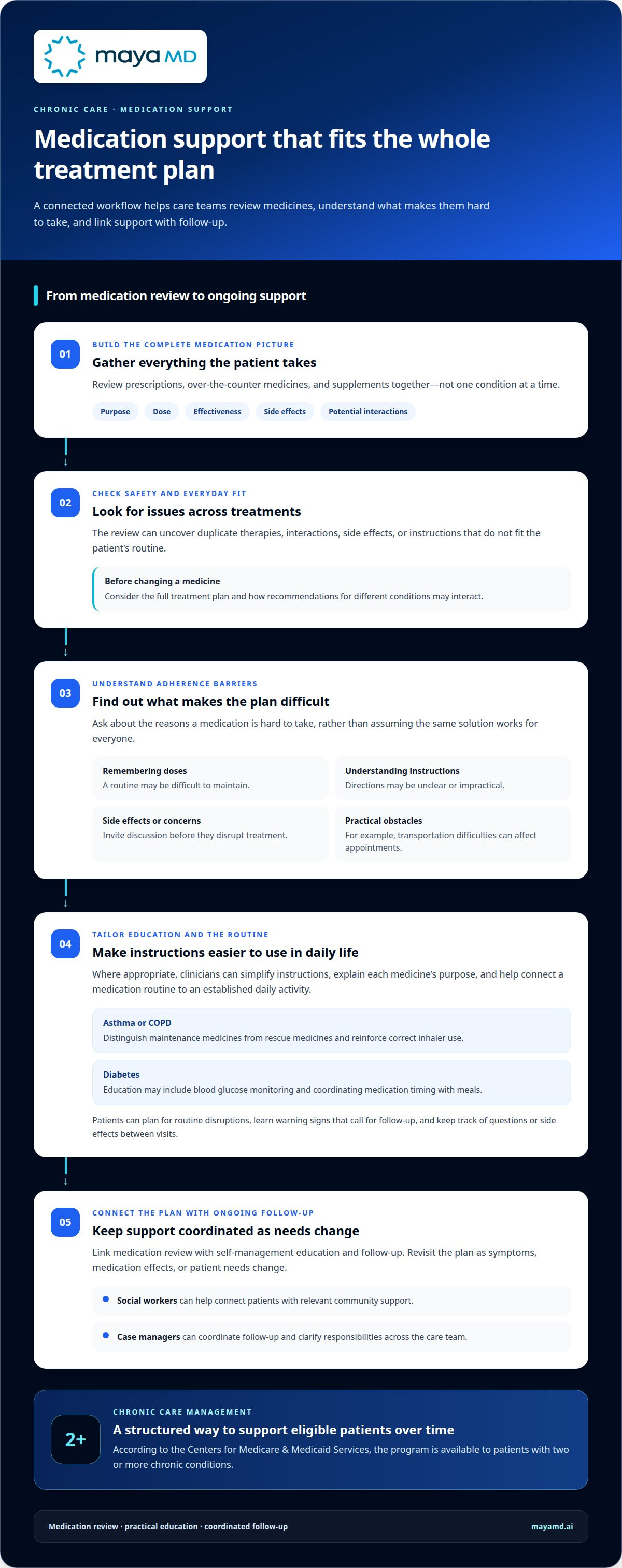
Medication management starts with a complete review of prescriptions, over-the-counter medicines, and supplements. The care team checks each medication’s purpose, dose, effectiveness, and possible side effects, along with potential interactions across treatments for different conditions. The review may uncover duplicate therapies or impractical instructions, such as taking medicines around meals when that conflicts with a patient’s routine. Any proposed adjustment should account for the full treatment plan, not just one disease.
Adherence support works best when it addresses why a medication is difficult to take. A patient may forget doses, misunderstand instructions, experience side effects, or struggle to maintain a routine. Where appropriate, the clinician can simplify instructions, explain the purpose of each medicine, and discuss concerns before they disrupt treatment. For asthma or COPD, education can distinguish maintenance medicines from rescue medicines and reinforce correct inhaler use. Patients also benefit from knowing which warning signs call for follow-up.
Chronic Care Management offers a structured way to support eligible patients over time. According to the Centers for Medicare & Medicaid Services, the program is available to patients with two or more chronic conditions. A care plan can connect medication review with self-management education and follow-up, so treatment tasks don’t remain disconnected instructions. The team can revisit the plan as symptoms, medication effects, or patient needs change.
Social workers and case managers can address barriers that a clinical medication review alone may not resolve. For example, a patient who has trouble arranging transportation may miss appointments needed to assess treatment effectiveness. A social worker can help connect the patient with relevant community support, while a case manager can coordinate follow-up and clarify responsibilities across the care team. These roles complement primary care by linking clinical recommendations with practical support.
Self-management education should turn clinical instructions into steps that fit everyday life. The care team can help a patient connect a medication routine to an established daily activity, plan for disruptions, and recognize early warning signs. For diabetes, education may include monitoring blood glucose and coordinating medication timing with meals. Patients can also track questions or side effects between visits, giving clinicians useful context for treatment discussions.
Technology can reinforce support when it helps patients stay connected to care. AI patient engagement solutions can support communication and education, while remote patient monitoring for chronic care management can help teams follow relevant health measures between visits. Digital tools should complement clinical judgment: readings, symptoms, and patient questions need a clear route into care workflows. This helps teams respond to meaningful information instead of relying on isolated reminders.
For care teams building medication support into ongoing chronic care, discuss a coordinated patient engagement approach that connects education, follow-up, and clinical care.
3. Identifying patients at risk through population health reports
Population health reports help healthcare providers identify patients whose care may need attention. A useful starting point is a report showing which patients have not seen primary care in a year. Teams can review missed follow-ups, open care gaps, and recent changes in documented health information. For example, a patient with several chronic conditions and no recent primary care visit may need outreach to reconnect with the care team.
Reports are useful when they prompt a defined action. An organization can assign a staff member to review flagged records, determine the reason for outreach, and document the next step. Physicians can prioritize cases using clinical context, such as an unresolved test result or a care plan that needs follow-up. Population reports support this workflow, but they don’t replace a clinician’s assessment of an individual patient’s needs.
Information sharing makes those flags actionable. Primary care teams, specialists, and other healthcare providers need relevant updates, including treatment changes and follow-up plans. A consistent process can specify who records an update, where it goes, and who receives it. After a specialist visit, for instance, the practice can route the note to the primary care team and track any recommended follow-up.
For Medicare beneficiaries, an overwhelming majority of hospital readmissions occur among patients living with multiple chronic conditions. Reports can help practices identify care transitions that warrant review, such as a recent discharge without a documented follow-up plan. Staff can coordinate outreach and share relevant information with the responsible clinicians. This gives the practice a repeatable way to address potential gaps instead of relying only on individual memory.
Population reporting can also help practices understand administrative strain. When records are incomplete or updates arrive through disconnected channels, staff may spend time locating information and clarifying responsibilities. A shared review process can establish consistent workflows: assign report reviews, record outreach attempts, and close the loop when follow-up occurs. These steps make coordination visible and help leaders identify where processes stall.
The case illustrates how organized remote care can be evaluated alongside operational outcomes, though one program’s result does not establish the same result for every practice. Healthcare organizations can track their own measures, such as completed follow-ups and unresolved care gaps, and use the findings to refine workflows. Regular review helps physicians and administrators connect population-level patterns with practical changes in patient care.
4. Whole-person care for patients with complex conditions
A Patient-Centered Medical Home model puts patients and families at the center of decisions. For complex conditions, an interdisciplinary team can connect primary care, specialists, and patient priorities through one evolving care plan.
Personalized planning starts by asking what matters most to the patient, then aligning clinical goals with daily life. One person may prioritize staying mobile, while another may focus on managing symptoms that disrupt sleep. The team records these preferences alongside condition-specific medications, monitoring schedules, lifestyle changes, and measures of progress. This gives each specialist context for recommendations and helps prevent treatment goals from competing.
A useful care plan assigns each action to a responsible person and identifies when the team will review it. It might specify who reviews a home blood pressure record, who follows up on laboratory results, and how a medication change affects other conditions. Patients can track symptoms, questions, and concerns between visits, then prioritize topics for their next appointment. This makes clinical discussions more responsive to changes outside the clinic.
Regular monitoring should reflect the patient’s conditions and the information needed to guide decisions. A team may combine office visits, laboratory tests, home blood pressure or blood sugar checks, pulmonary function tests, and reported symptoms. For some patients with multiple chronic conditions, visits every month or two may support ongoing evaluation. The timing and measures should match care needs, treatment changes, and progress toward personal goals.
Whole-person care considers emotional and functional changes as well as disease measurements. If discomfort with a treatment affects a patient’s willingness to continue, the care team should explore the concern and adapt the plan where clinically appropriate. Changes in mobility or mood can also affect daily routines. Recording these changes alongside clinical measures gives the interdisciplinary team a broader view of progress.
Personalized plans should include preventive care as well as management of existing conditions. The team can review immunizations, cancer screenings on recommended schedules, and assessments for other health risks. These needs can be overlooked when visits focus only on current symptoms. Including them in the care plan gives primary care and specialists a shared reference for ongoing follow-up.
Plans need regular revision as conditions, preferences, and treatment effects change. At each review, the team can ask whether goals remain meaningful, monitoring is producing useful information, and responsibilities are clear. Patients and families should take part in these decisions. This process keeps the plan individualized, actionable, and connected to the person’s health and daily priorities.
5. Continuous monitoring and remote patient monitoring
Appointments offer important snapshots, but chronic conditions can change between visits. Remote patient monitoring (RPM) extends observation into a patient’s home by transmitting readings such as blood pressure, weight, or glucose to care providers. These measurements add context to symptoms and scheduled tests. For adults managing several conditions, the key question is how each reading relates to the overall care plan.
Useful monitoring starts with a defined clinical purpose. The care team identifies which measure matters, how the patient will collect it, and who reviews incoming information. A weight trend, for example, may be relevant to a heart failure plan, while glucose readings may inform diabetes follow-up. Providers interpret readings alongside symptoms, medications, and other clinical information rather than treating an isolated number as a diagnosis.
Data need a reliable route into care workflows. A practice can assign responsibility for reviewing submitted readings, documenting relevant changes, and deciding when clinical follow-up is appropriate. The team should also define how to handle missing or unexpected information. If a patient reports a new symptom, the team can consider it alongside transmitted measurements and the existing care plan. Clear responsibilities help prevent data from arriving without a clinical response.
Patient participation is essential to RPM. Instructions should explain how and when to take readings, where to submit them, and how to report symptoms that readings cannot capture. A measurement taken after unusual activity may need different interpretation from one recorded during a usual routine. Follow-up conversations can clarify context and help the team adapt monitoring instructions when a patient’s circumstances change.
RPM can support continuity after hospital care, when providers need relevant information about a patient’s condition at home. The transition works best when the responsible team knows which measures to review and how they relate to follow-up appointments. Monitoring does not replace examinations, laboratory tests, or direct communication. It adds information between those points, helping providers assess changes and coordinate the next appropriate step.
To evaluate a monitoring workflow, healthcare practices can track whether readings reach the right team member, follow-up is documented, and patients can complete the process. These operational measures show where instructions or handoffs need adjustment. The key point is that remote monitoring is more than data collection: its clinical value depends on purposeful measures, review, and a defined response within ongoing care.
Discuss remote monitoring for chronic care management to explore how connected readings can fit into your care workflows.
MayaMD: remote patient monitoring for chronic care management
MayaMD provides remote patient monitoring for chronic care management to help care teams follow patients between appointments. Its platform can complement a coordinated care plan and help maintain connection beyond in-person visits. AI patient engagement solutions and the Clinical AI Agent can also support communication within chronic care workflows. For patient triage, an AI symptom checker can provide clinical insight and a list of high-probability conditions for care teams to consider.
These tools can be relevant when a healthcare organization is working to connect ongoing monitoring, patient engagement, and clinical workflows. They support care teams, rather than replace clinical judgment or individualized treatment planning. If you’re exploring ways to strengthen chronic care management, contact MayaMD to discuss your needs.
Build the next step into the care pathway
Lasting progress depends on turning a care approach into a workflow teams can sustain. Start with a practical priority, such as strengthening follow-up after discharge or connecting ongoing patient communication with clinical review. Then define how information reaches the responsible care team and informs the next decision. This makes it easier to assess whether the workflow fits existing practice and patient needs.
For organizations considering how to improve care for patients with multiple chronic conditions, technology should support clinical relationships, not displace them. MayaMD offers a Clinical AI Agent, AI patient engagement solutions, and automated post-discharge communication solutions to support connected care workflows. The next step is a focused conversation about your care priorities, current processes, and where additional support could fit.
Contact MayaMD about care to discuss your needs and identify a thoughtful path forward.
Frequently Asked Questions
What Are the Most Effective Ways to Manage Chronic Health Conditions?
Effective care connects treatment decisions to the person’s full health picture and daily priorities. A care team can review whether a treatment schedule leaves room for meals, work, and rest, and set a clear point of contact for questions between appointments. These practical details help turn clinical recommendations into routines patients can follow and discuss with their providers.
How can clinicians coordinate care across specialists for patients with multiple chronic conditions?
Clinicians can coordinate specialist care by making referrals specific and closing the communication loop afterward. A referral should describe the clinical question and relevant history, while the specialist’s response should clarify recommendations and follow-up ownership. If a specialist suggests a new test, for example, the teams can agree who will order it and review the result. This reduces ambiguity for patients and clinicians.
How can medication reviews reduce polypharmacy risks in patients with multiple chronic conditions?
Medication reviews help clinicians identify treatments that may overlap, conflict, or no longer fit a patient’s needs. Patients can bring medication containers or an up-to-date list, including supplements and nonprescription products. The clinician can clarify which medicines are active, why each is used, and whether side effects or practical barriers affect use. Patients shouldn’t stop or change prescribed medication without discussing it with their care team.
How can patients and caregivers be involved in managing multiple chronic conditions?
Patients and caregivers can shape decisions by sharing what daily care involves, which symptoms interfere most, and what goals matter to the patient. With the patient’s agreement, a caregiver might help organize appointment questions or record changes noticed at home. The care team can clarify what information is useful and how to communicate concerns. This participation keeps care planning connected to the patient’s preferences and lived experience.
What role do social determinants of health play in care for patients with multiple chronic conditions?
Social conditions can affect a patient’s ability to follow a care plan. Transportation challenges may make clinic visits difficult, while food access, housing instability, language barriers, or limited support can complicate daily self-care. Asking respectfully about these circumstances helps clinicians understand obstacles behind missed appointments or interrupted routines. A social worker or case manager can help connect patients with relevant community resources and include practical needs in follow-up planning.
How can telehealth and remote monitoring support patients with multiple chronic conditions?
Telehealth can make follow-up possible when an in-person visit is difficult, while remote monitoring can give clinicians information collected at home. A care team might review submitted blood pressure readings alongside reported dizziness and decide whether a follow-up discussion is needed. Monitoring works best when patients know how to submit information, providers know who reviews it, and the care plan explains how findings inform next steps.




See The MayaMD Difference
Fill the form below
Download Our Apps
MayaMD for patients and MayaPro for physicians - available on iOS and Android.
FOR PATIENTS
MayaMD App
AI-powered symptom assessment, triage, and secure access to your care team.

FOR PHYSICIANS
MayaPro App
MayaPro brings patient vitals, RPM/PCM care plans, and clinical decision support to your pocket.