
Value-Based Care Technology Solutions for Connected Care

When healthcare leaders search for value-based care technology solutions, they may be comparing analytics, care management, and patient engagement tools. The practical question is which capabilities help teams stay connected with patients after discharge while keeping clinical judgment with clinicians.
This guide offers a framework for evaluating technology against value-based care priorities. It covers protocol-driven communication, remote monitoring, and patient engagement from hospital discharge through the months at home, along with practical ways to assess workflow fit and clinical oversight.
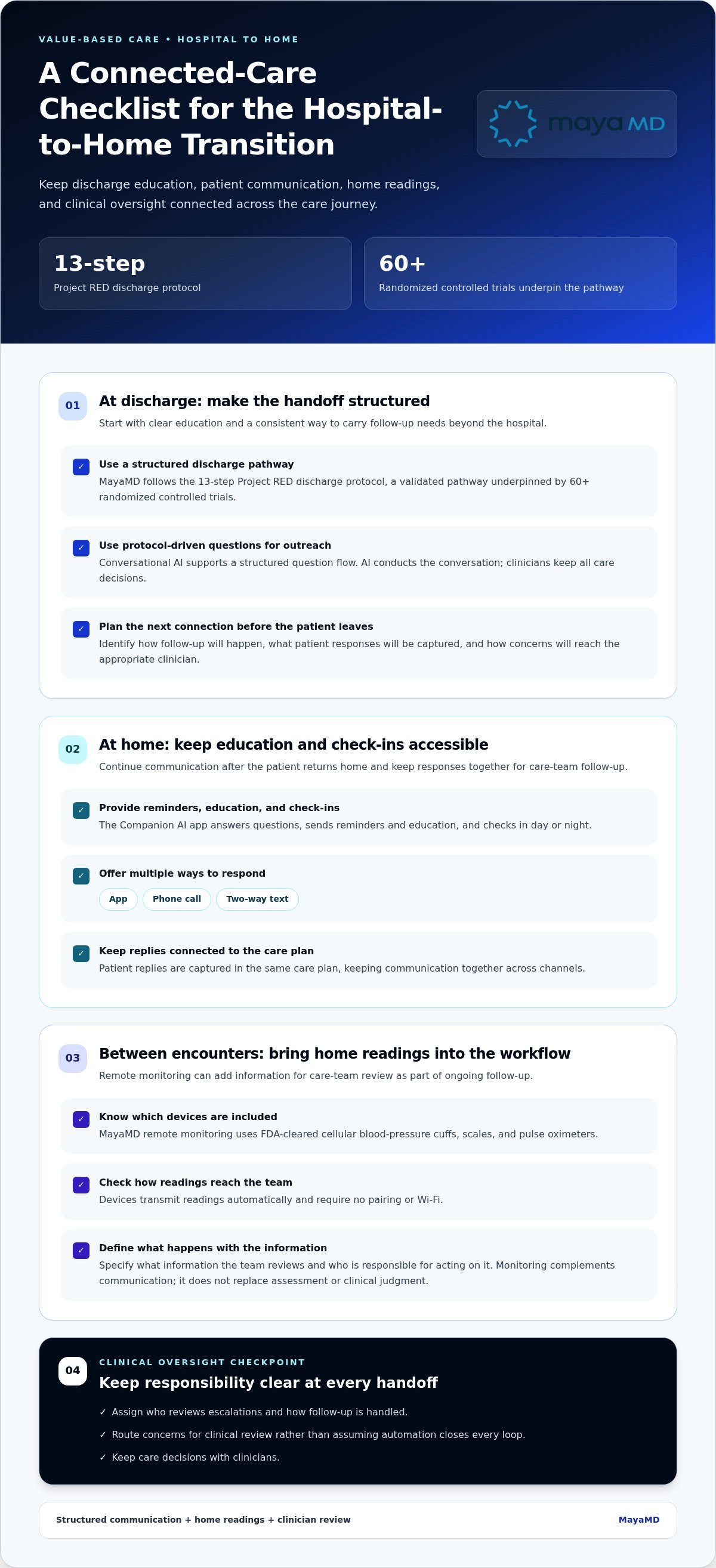
MayaMD is a nationally recognized platform that supports hospital-to-home transitions. Its 13-step Project RED discharge protocol is underpinned by 60+ randomized controlled trials. Conversational AI supports structured outreach, while clinicians retain all care decisions. When evaluating a solution, consider how it handles patient access, escalations, and implementation readiness.
Key Takeaways
• Separate value-based payment models from the technology capabilities that support quality, coordination, patient experience, and accountable workflows.
• Use the hospital-to-home journey to assess how discharge education, follow-up, and remote monitoring can work together, with clinicians retaining care decisions.
• Compare analytics, patient engagement, remote monitoring, and workflow support by who uses them, what information they return, and how that information informs care.
• Evaluate value-based care technology solutions against a defined care gap, workflow, oversight model, and rollout scope.
• Build a practical implementation plan: define the care gap, map the workflow, assign oversight, then start with one unit and go live in 4-6 weeks.
What Value-Based Care Technology Solutions Need to Support
Value-based care technology includes digital tools and connected workflows that help care teams support quality, coordination, patient experience, and accountability across a defined care journey. The technology is not the payment model itself. It should help teams carry out the work the model prioritizes, share useful information with those responsible for care, and preserve clear clinical oversight.
Value-based care organizes care around patient outcomes and quality rather than the volume of services delivered, as in a traditional fee-for-service model. Contract and program details vary, so distinguish payment terms and performance measures from the operational tools used to support care delivery. For foundational context, see this overview of value-based health care models.
How value-based care changes technology priorities
Technology priorities should reflect the care gaps an organization is addressing. If patients need support after leaving the hospital, teams need a consistent way to provide discharge education, conduct follow-up, capture patient responses, and route concerns for review. For people managing chronic conditions at home, remote monitoring can add information for care-team review between encounters.
These capabilities support clinical work; they do not replace clinical judgment. Protocol-driven communication can standardize questions and outreach, while clinicians review escalations and make care decisions. See this example of heart-failure discharge education, which connects discharge instructions with follow-up at home.
Care-delivery technology also serves a different purpose from financial, claims, and population analytics. Analytics can help leaders examine performance patterns, utilization, or attributed populations. Patient-facing care-delivery tools support communication, follow-up, monitoring, and routing information for review. Some organizations use both, but they serve different users and decisions. A dashboard alone, for example, does not complete a follow-up workflow.
Which outcomes and workflows should technology support?
Start with a priority, then connect it to an observable workflow. For continuity after discharge, identify who provides education, how follow-up occurs, what patient responses are captured, and how concerns reach the appropriate clinician. For chronic-condition support at home, specify what information the team reviews and who is responsible for acting on it. This makes evaluation concrete without assuming a particular clinical or financial result.
A practical test is whether each capability has a defined user, place in the care journey, information flow, and oversight role. Patient engagement can support education and check-ins; remote monitoring can provide readings for clinician review; workflow tools can organize outreach and escalations. Not every organization needs every capability in one platform. Prioritize the configuration that addresses a defined care gap and fits existing responsibilities, systems, and processes.
How Value-Based Care Technology Supports the Hospital-to-Home Transition
Discharge is a handoff, not the end of a care episode. Patients leave with instructions and follow-up needs, then manage those next steps at home. A connected transition workflow can carry education and communication forward: provide discharge guidance, check in after the patient returns home, capture questions or responses, and make relevant information available to the care team. Remote monitoring can complement outreach by bringing home readings into the care pathway for clinician review.
MayaMD follows the 13-step Project RED discharge protocol, a validated pathway underpinned by 60+ randomized controlled trials. This gives discharge education and follow-up a structured foundation instead of treating outreach as an isolated message. Learn more about the Project RED discharge pathway and how it informs support from hospital to home. Federal initiatives also connect inpatient and outpatient care; the CMS value-based programs overview describes programs tied to quality and hospital performance.
From discharge education to ongoing patient engagement
At discharge, Conversational AI uses a protocol-driven question flow. AI does the talking; it does not make clinical decisions. At home, the Companion AI app answers questions, sends reminders and education, and checks in day or night. Patients can respond through the app, a phone call, or two-way text. Replies are captured in the same care plan, keeping communication together across channels.
Structured outreach connects patient responses with clinician follow-up by bringing communication into a shared care plan and routing escalations for clinical review. A patient response can inform the next step, but clinicians retain all care decisions. Define who reviews escalations and how follow-up is handled rather than assuming automation closes every loop.
How remote monitoring connects home readings with care teams
MayaMD’s remote monitoring uses FDA-cleared cellular blood-pressure cuffs, scales, and pulse oximeters. The devices transmit readings automatically and require no pairing or Wi-Fi. This reduces technical steps for patients and provides readings for the care team to review as part of follow-up. Monitoring complements transition communication; it does not replace assessment or clinical judgment.
Through the clinician portal, clinicians receive escalations and structured notes, then decide what action is appropriate. When evaluating value-based care technology solutions in Phoenix, consider whether patient communication and home readings reach the right care-team workflow with clear oversight. To discuss how this hospital-to-home pathway could fit your team’s priorities, Book a 20-minute intro, call +1 (888) 629-2631, or email info@mayamd.ai.
How to Compare Value-Based Care Technology by Capability and Clinical Role
Technology categories can overlap in a product demonstration, but they answer different operational questions. Compare each capability by its users, place in the workflow, information returned, and relationship to clinical decisions. This makes gaps visible: a performance dashboard can inform leaders, but it does not contact a patient or organize follow-up after discharge.
Performance analytics show how care is tracking; patient-facing care-support technology helps carry out communication and follow-up. Both can contribute to a value-based care strategy, but they are not interchangeable. MayaMD supports hospital-to-home transition care and remote monitoring. Evaluate analytics, claims, financial reporting, or coding requirements as distinct needs in the broader technology environment.
Analytics
Leaders and analysts use measurement and reporting capabilities to examine performance and identify patterns. The information may include measures or trends, depending on the system. Analytics informs organizational review; it does not itself deliver patient outreach or make clinical decisions.
Patient engagement
Patients interact through an app, voice, or two-way text. In MayaMD’s hospital-to-home workflow, these channels support education, check-ins, and responses captured in the same care plan. Clinicians retain decisions about care and follow-up.
Remote monitoring
Patients use FDA-cleared cellular blood-pressure cuffs, scales, and pulse oximeters to provide readings from home. The devices transmit readings automatically without pairing or Wi-Fi. Clinicians review relevant information and escalations; readings do not make decisions on their behalf. Learn more about remote patient monitoring software.
Clinical workflow support
Clinical staff and clinicians use structured outreach, escalations, notes, and portal visibility to support follow-up. The MayaMD clinician portal provides escalations and structured notes for review, while care decisions remain with clinicians. Assess whether responsibilities for outreach, review, and action are clearly assigned.
Assess governance, integration, and patient access
Evaluate how information moves, not just what a feature is called. Can patient replies and monitoring information reach the appropriate care-team workflow? Are staff responsibilities for outreach and follow-up clear? Do clinicians receive structured information they can review while retaining authority over decisions? These questions help reveal workflow gaps before implementation.
Patient access matters, too. Some patients may prefer an app, while others may be more comfortable responding by phone or text. Multi-channel communication gives patients options without requiring everyone to use the same method. For data exchange across care settings, review the role of health IT interoperability standards and assess how a solution fits existing information flows.
For a useful comparison, document each capability’s user, trigger, information returned, escalation path, and decision owner. Then identify which gaps call for analytics, patient-facing support, or clinical workflow redesign. This prevents one platform from being treated as a substitute for every technology or operational requirement.
A Practical Readiness Plan for Value-Based Care Technology
A sound rollout begins with the care pathway, not the software configuration. For hospital-to-home support, define the patient group, identify where continuity breaks down, and agree on how staff will respond before introducing communication or monitoring workflows. A focused plan helps the care team assess fit and refine operations without assuming results in advance.
Define the care gap.
Identify the discharge-to-home population and the specific need the program will address, such as consistent education, follow-up communication, or home monitoring. Set a clear scope so the team can distinguish the intended workflow from adjacent needs.
Map the workflow.
Trace the process from enrollment and discharge education through patient outreach, responses, follow-up calls, and EHR documentation. Note where information is created, who needs to see it, and how it moves to the next step.
Assign oversight.
Define clinical staff responsibilities for enrollment, outreach, follow-up calls, and EHR documentation. Establish who reviews escalations and how they reach clinicians. Conversational AI asks protocol-driven questions; clinicians retain all care decisions.
Establish rollout scope.
Choose one unit, identify the team involved, and agree on what will be reviewed during implementation. MayaMD’s approach is to start with one unit and go live in 4-6 weeks.
Define the workflow and ownership before rollout
Make the operating model explicit. For each transition step, record the responsible role, expected information, and follow-up path. Clarify how clinical staff coordinate enrollment and communication, how patients can respond, and how clinicians receive escalations for review. This shared map helps prevent unclear handoffs and keeps automated communication within defined clinical oversight.
Start with a focused, measurable deployment
A first-unit rollout helps the team assess workflow adoption, patient responses, and escalation handling in a defined setting. Review these observations with staff and clinicians, then identify adjustments before considering a broader scope. Where the care pathway intersects with advanced primary care management, clarify how transition support relates to existing responsibilities and processes.
Keep the review practical: Are outreach tasks being completed as intended? Can the team find and interpret patient responses? Are escalations reaching the right clinicians, with clear ownership for follow-up? These checks help leaders assess operational readiness without treating early activity as proof of clinical or financial impact.
For a focused discussion about planning a hospital-to-home workflow and rollout scope, Book a 20-minute intro.
How MayaMD Supports Value-Based Care from Hospital to Home
MayaMD is a nationally recognized platform that guides patients from hospital discharge through the critical months at home. It connects discharge education, ongoing patient communication, and remote monitoring in a single care pathway. The platform follows the 13-step Project RED discharge protocol, a validated pathway underpinned by 60+ randomized controlled trials, making it an essential component of value-based care technology solutions in Phoenix.
What the MayaMD care pathway brings together
Protocol-driven Conversational AI asks patients structured questions. AI does the talking, while clinicians retain every care decision. The Companion AI app provides education, answers questions, sends reminders, and checks in. Patients can respond through the app, voice, or two-way text, with communication captured in the same care plan. Clinical staff support enrollment, outreach, follow-up calls, and EHR documentation.
For remote monitoring, the pathway includes FDA-cleared cellular blood-pressure cuffs, scales, and pulse oximeters. Readings transmit automatically without pairing or Wi-Fi. The clinician portal provides escalations and structured notes for review, giving clinicians information to assess while preserving their authority to determine appropriate care. Together, these components connect patient contact and home readings within hospital-to-home transition care and remote monitoring.
The platform supports care pathways including APCM, RPM, PCM, and BHI, without guaranteeing reimbursement or financial results. Organizations deploying value-based care technology solutions in Phoenix can consider how transition support and monitoring fit their program design and clinical workflows. For an adjacent view of digital healthcare for chronic disease, consider how communication and home readings can complement ongoing care-team oversight.
Evidence, patient experience, and next steps
MayaMD has reached 300,000+ patients through partner practices. 100% of surveyed patients preferred MayaMD for discharge education. At Spring Valley Hospital, the care pathway demonstrated 30%+ fewer 30-day heart-failure readmissions. These figures describe specific adoption, survey, and hospital experience; they are not a guarantee of results for another organization.
The platform’s recognition includes CB Insights Digital Health 150, LG NOVA Selected 20, and winner of the Renault-Nissan Open Innovation Challenge. For leaders evaluating value-based care technology solutions in Phoenix, consider whether a defined discharge-to-home workflow, patient communication, and remote monitoring align with care-team responsibilities and oversight.
To discuss how MayaMD’s hospital-to-home pathway may fit your organization, call +1 (888) 629-2631 or email info@mayamd.ai. Book a 20-minute intro.
Turn Your Care Priorities Into a Governed Next Step
The next step is not adding technology for its own sake. Choose a care transition where better continuity matters, then align the workflow, team responsibilities, and clinical oversight around that need. For leaders evaluating value-based care technology solutions in Phoenix, a focused discussion can turn broad priorities into a practical question: what should patients and care teams be able to do more reliably after discharge?
Bring your current transition workflow and the questions your team needs answered. Explore how connected outreach and remote monitoring may fit into the work, while keeping care decisions with clinicians and setting a realistic evaluation scope. Progress starts with a clear, shared plan, not a promise of predetermined results.
Book a 20-minute intro to discuss a next step for your organization. With thoughtful governance and a defined care gap, your team can plan more connected support at home.
Frequently Asked Questions
What is value-based care technology?
Value-based care technology is a set of digital tools that helps organizations deliver and evaluate care focused on quality, coordination, and patient needs. It is not the payment model itself. A contract may set a quality priority, while separate tools help a care team organize follow-up or help leaders review performance. Defining the goal first makes it easier to identify the relevant technology.
How can technology support patients after hospital discharge?
Technology can keep discharge instructions and follow-up needs visible after a patient returns home. For example, a patient may respond to a check-in with a question or report difficulty following instructions. That response can be documented and routed for care-team review. Define who reviews responses and handles follow-up so communication supports a clear workflow instead of creating another unattended inbox.
Can patients use MayaMD without Wi-Fi?
MayaMD’s cellular monitoring devices do not require Wi-Fi or device pairing to transmit readings. The devices are FDA-cleared cellular blood-pressure cuffs, scales, and pulse oximeters. This applies to readings from those connected devices, not necessarily every communication channel or app function. Patients may also interact through the app, a phone call, or two-way text as part of the hospital-to-home care plan.
How does AI maintain clinician oversight in care management?
MayaMD’s Conversational AI follows a protocol-driven question flow and asks the questions; it does not make care decisions. Patient responses and escalations are made available to the clinical team through the care pathway, and clinicians decide what action is appropriate. Define who reviews escalations, how follow-up is assigned, and how decisions are documented. Clear roles keep automation in a support function.
How long does it take to launch MayaMD?
A team can start with one unit and go live in 4-6 weeks. Before launch, clarify the patient group, outreach workflow, staff responsibilities, clinician escalation process, and EHR documentation approach. These preparations help the team assess implementation in a defined setting. To discuss rollout planning, call +1 (888) 629-2631 or email info@mayamd.ai, or Book a 20-minute intro.
Does value-based care technology only mean analytics software?
No. Analytics can help leaders measure performance, while other technology supports patient communication, follow-up, remote monitoring, and clinical workflows. These capabilities serve different users and tasks, so identify the care gap before choosing a tool. Measurement can flag a trend, for example, while a separate patient-support workflow helps teams follow up with individuals.




See The MayaMD Difference
Fill the form below
Download Our Apps
MayaMD for patients and MayaPro for physicians - available on iOS and Android.
FOR PATIENTS
MayaMD App
AI-powered symptom assessment, triage, and secure access to your care team.
FOR PHYSICIANS
MayaPro App
MayaPro brings patient vitals, RPM/PCM care plans, and clinical decision support to your pocket.