
The Future of AI in Primary Care 2026: From Generative Hype to Clinical Governance

What if the solution to physician burnout isn't more automation, but more governance? The future of AI in primary care 2026 has moved past the era of unpredictable generative experiments into a phase defined by rigorous clinical oversight and deterministic logic. You've likely seen the limitations of standard large language models, specifically when hallucinations threaten patient safety or administrative documentation still feels like a second full-time job. It's a frustrating reality where fragmented care for chronic conditions like hypertension and diabetes persists despite the technological noise.
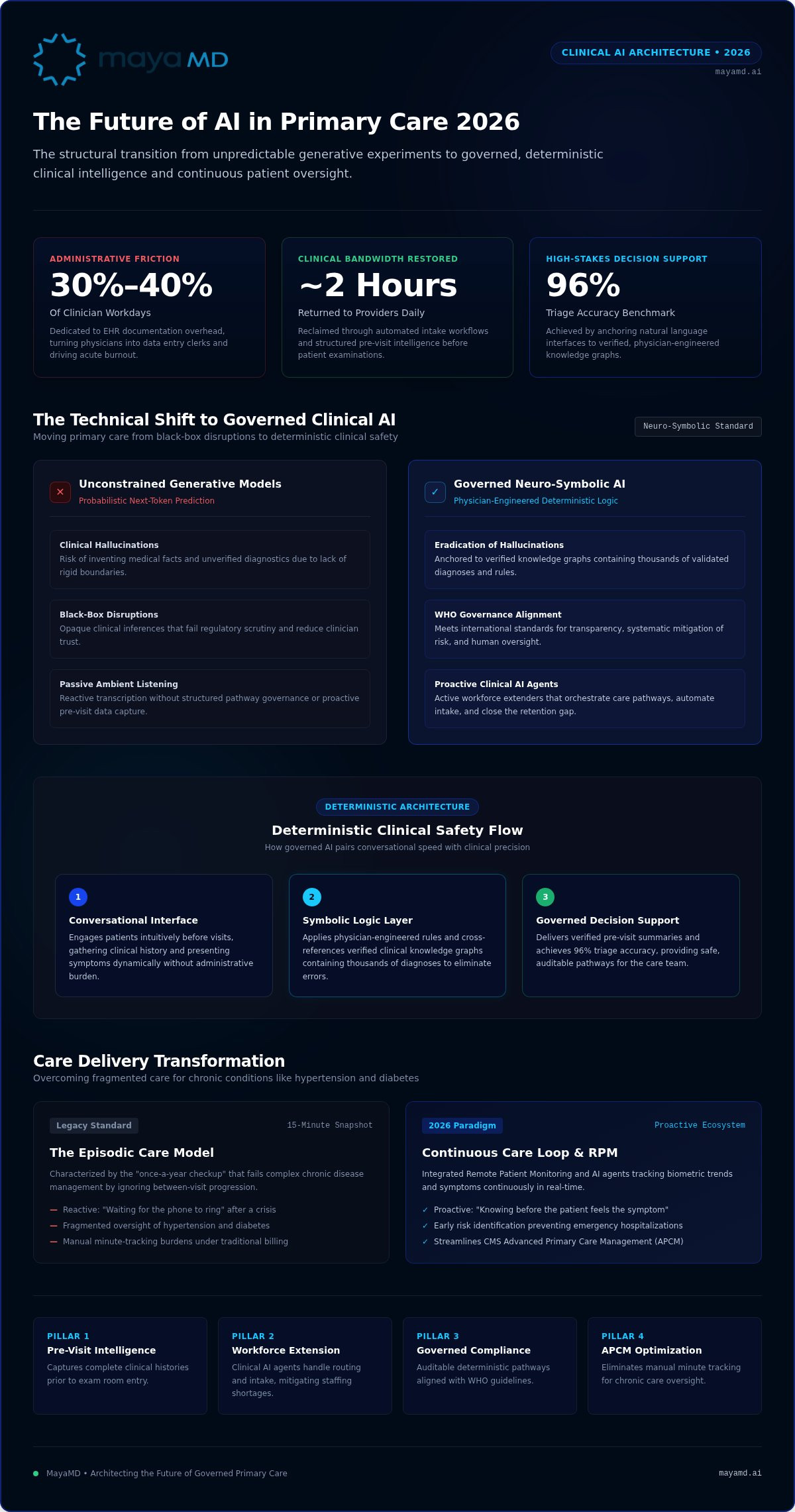
We're entering a period where sophisticated clinical AI agents act as reliable partners rather than black-box disruptions. Discover how the integration of deterministic logic and governed AI is revolutionizing primary care workflows, chronic disease management, and physician retention in 2026. This shift ensures predictable insights that reduce administrative burdens while improving patient engagement between visits. By pairing conversational interfaces with physician-engineered knowledge graphs, practices can achieve the 96% triage accuracy required for high-stakes decision support. We'll explore the transition from passive ambient listening to proactive pre-visit intelligence, the impact of new CMS Advanced Primary Care Management codes, and the way integrated Remote Patient Monitoring creates a safer, more connected ecosystem for both provider and patient.
Key Takeaways
• Understand why the future of AI in primary care 2026 mandates a shift from unconstrained generative models to deterministic, physician-engineered logic.
• Discover how Clinical AI Agents act as sophisticated workforce extenders by automating administrative intake and reducing provider documentation fatigue.
• Learn to leverage AI-driven platforms to streamline Advanced Primary Care Management (APCM) and chronic disease oversight without the burden of manual minute-tracking.
• Explore the technical transition to neuro-symbolic AI, the emerging gold standard for clinical safety that eliminates hallucinations while maintaining intuitive patient engagement.
• Identify a structured framework for deploying governed AI that prioritizes transparency, regulatory compliance, and seamless integration into existing clinical workflows.
The Evolution of Primary Care: Why 2026 is the Turning Point for AI
2026 marks a definitive pivot in healthcare. The industry has moved beyond the unconstrained experimentation of early generative models, landing firmly in a landscape of clinical accountability and rigorous oversight. This shift from reactive, symptom-based medicine to proactive, AI-governed population health management is no longer a luxury; it's a structural necessity. With the physician shortage reaching critical levels this year, the future of AI in primary care 2026 centers on workforce extension. We're seeing a rapid transition from basic "Digital Front Doors" that simply route traffic to sophisticated Clinical AI Agents that actively manage care pathways. By reducing administrative friction, these systems are finally closing the "retention gap" that has plagued the profession for a decade.
The Productivity vs. Burnout Paradox
Traditional EHR systems were designed for billing rather than the fluid reality of patient care. They inadvertently turned highly trained clinicians into data entry clerks, leading to widespread burnout. In 2026, the focus has shifted toward workflow orchestration through automated clinical documentation and pre-visit intelligence. By capturing a structured clinical history before the patient even enters the exam room, AI returns roughly two hours of clinical bandwidth to the provider every day. In 2026, the administrative burden is defined as the systemic inefficiency that forces clinicians to dedicate 30% to 40% of their workday to EHR documentation overhead, effectively draining billions from the healthcare system in lost clinical capacity. Adopting robust clinical governance frameworks ensures these automated processes remain safe, transparent, and auditable for every stakeholder.
From Episodic Care to Continuous Engagement
The episodic care model, characterized by the "once-a-year checkup," has failed patients with chronic conditions like diabetes and hypertension. These complex cases require more than a fifteen-minute snapshot every twelve months to achieve optimal outcomes. The future of AI in primary care 2026 relies on a continuous care loop where the provider and patient stay connected through intelligent, governed oversight. This is where Remote Patient Monitoring becomes the backbone of modern practice. Instead of waiting for a crisis to trigger an urgent hospital visit, AI agents monitor biometric trends and symptoms in real-time. This proactive engagement identifies risks early, allowing for minor adjustments that prevent major complications. It's a move from "waiting for the phone to ring" to "knowing before the patient feels the symptom." This model fosters a deeper sense of support, proving that technology, when governed correctly, actually enhances the human connection in medicine.
Eliminating Hallucinations: The Technical Shift to Governed Clinical AI
The future of AI in primary care 2026 hinges on a critical technical transition: the eradication of clinical hallucinations. While standard generative models rely on probabilistic next-token prediction, medical practice demands deterministic accuracy. We've moved past the "black-box" era into a period where neuro-symbolic AI serves as the gold standard for clinical safety. This architecture pairs the sophisticated natural language capabilities of large language models with the rigid, physician-engineered rules of symbolic logic. By anchoring conversational outputs to a verified knowledge graph containing thousands of diagnoses and clinical inferences, systems can enforce strict protocols that prevent the invention of medical facts. This structural oversight aligns with the latest WHO guidance on health AI governance, which emphasizes transparency, human oversight, and the systematic mitigation of algorithmic risk.
Deterministic Logic: The Clinical Safety Net
Deterministic logic acts as an immutable layer of verification within the clinical workflow. When a patient describes complex symptoms through a conversational interface, the generative engine parses the language, but the Deterministic Logic in Clinical AI for Care Safety framework validates every inference against established medical guidelines. This dual-layered process ensures that virtual triage and symptom checking results are not just linguistically plausible, but clinically valid. In real-world enterprise deployments, this hybrid approach has demonstrated a 96% concordance with primary care physician assessments, effectively eliminating the liability associated with "creative" medical advice. It replaces the uncertainty of pure machine learning with a stable, auditable decision-support engine that clinicians can trust at the point of care.
Building HIPAA-Compliant Clinical Agents
Security and privacy are the non-negotiable foundations of any clinical deployment. A robust, cloud-based architecture must protect sensitive data across the entire spectrum of care, from Remote Patient Monitoring (RPM) to Principal Care Management (PCM) tools. In 2026, HIPAA compliance is the baseline for entry into the market, not the ceiling of excellence for patient data protection. Modern Clinical AI Agents utilize multi-layered encryption, strict identity management, and automated audit logs to ensure data integrity remains uncompromised throughout the patient journey. This methodical approach to security builds the deep trust necessary for long-term partnerships between technology providers and healthcare systems. If you're ready to explore how governed AI can secure your clinical workflows and protect patient privacy, connect with our team for a detailed consultation.
AI’s Role in Advanced Primary Care Management (APCM) and PCM
The future of AI in primary care 2026 is defined by a shift from granular time-tracking to bundled, longitudinal management. CMS has fundamentally altered the landscape by establishing CMS Advanced Primary Care Management services, which prioritize proactive care over the traditional 20-minute monthly documentation threshold. This regulatory pivot allows practices to deploy AI agents that manage continuous panel communication and risk stratification without the administrative friction of manual stopwatches. By 2026, the integration of AI within Advanced Primary Care Management (APCM) frameworks has become the operational backbone for independent and small-group practices aiming to meet complex attestation benchmarks.
APCM Implementation in 2026
AI-driven platforms handle the rigorous documentation requirements of APCM by automating population health outreach and care transitions. These systems coordinate care teams through automated task assignment, ensuring that 24/7 access to urgent needs is met through governed clinical triage. Instead of hiring massive shifts of after-hours nursing staff, practices use Clinical AI Agents to perform essential functions:
• Conducting proactive risk stratification across the entire patient panel.
• Monitoring MIPS screenings for depression and social determinants of health.
• Synchronizing consult notes before appointments begin to ensure continuity of care.
This systematic approach ensures that every patient interaction is captured and categorized, allowing providers to focus on clinical decision-making rather than data entry.
Enhancing the Hospital-to-Home Transition
The transition from inpatient care to domestic recovery remains a high-risk window for readmission. AI plays a pivotal role in Reengineering The Hospital Discharge by delivering structured education and monitoring medication adherence. For heart failure patients, automated post-discharge communication has proven to cut 30-day readmission rates by identifying early signs of fluid overload or medication non-compliance. These governed agents convert free-form patient concerns into structured clinical insights, allowing the primary care team to intervene before a crisis occurs. By stacking longitudinal APCM with Remote Patient Monitoring (RPM), providers capture both chronic disease oversight and real-world biometric data, creating a seamless safety net that extends far beyond the clinic walls. This connectivity ensures that patients feel supported during their most vulnerable recovery phases, reinforcing the human connection through technological reliability.
A Framework for Deployment: Building Trust as a Clinical Outcome
Deploying advanced technology within a clinical environment requires a systematic, risk-mitigated approach. To establish baseline credibility, healthcare organizations must first ensure complete transparency in algorithmic decision-making processes, fulfilling the 31 source attribute disclosures mandated by current ASTP/ONC HTI-1 regulations. The future of AI in primary care 2026 depends on integrating these systems into existing EHR workflows without disrupting daily operations. This seamless introduction allows care teams to adapt naturally, turning a potential technological hurdle into a standard protocol for clinical efficiency.
Scaling governed platforms across multi-site primary care organizations requires a structured, five-step framework:
Step 1
Establish absolute transparency by publishing auditable data validation and risk frameworks.
Step 2
Embed the software directly into legacy workflows to prevent interface fragmentation and tool fatigue.
Step 3
Train clinical staff to act as the mandatory human-in-the-loop for all generated insights.
Step 4
Measure patient engagement and longitudinal clinical outcomes as primary trust metrics.
Step 5
Standardize these deployment protocols across all regional clinics to ensure unified care quality.
The Human-in-the-Loop Necessity
Autonomous diagnosis remains outside the boundaries of safe medical practice. Neither regulatory bodies nor clinical risk officers permit an AI to operate without licensed oversight; therefore, technology must support, not replace, the primary care physician. By positioning a Clinical AI Agent as an assistive decision-support tool, practices create a collaborative environment where nursing staff and physicians validate every recommendation. This structure preserves the physician's medico-legal responsibility while leveraging data science to optimize panel management and patient outreach.
Measuring Success Beyond ROI
Evaluating an AI deployment solely on financial return overlooks the primary objective of healthcare delivery. Modern organizations track patient satisfaction, medication adherence, and longitudinal touchpoints through integrated digital tools to assess true efficacy. Increased touchpoints correlate directly with reduced hospital readmissions and stabilized biometric trends in chronic care panels. As we evaluate the future of AI in primary care 2026, success cannot be judged by financial metrics alone. In 2026, trust is defined as a quantifiable clinical metric measured by the percentage of patients who consistently engage with AI-driven protocols and the rate of clinician adherence to validated decision-support insights.
To implement a governed, compliant framework that transforms trust into a measurable asset for your medical group, contact our clinical transformation team today.
MayaMD: Architecting the Future of Governed Primary Care
MayaMD represents the convergence of clinical expertise and advanced data science. As a finalist for the 2025 Digital Health Hub Foundation Awards, the organization has demonstrated that the future of AI in primary care 2026 lies in governed, auditable systems rather than unconstrained generative models. By bridging the gap between disparate data points and human-centered care, the platform provides a stable framework for modern medical groups. The commitment to HIPAA-compliant, deterministic logic ensures that every clinical inference is grounded in peer-reviewed protocols, protecting both the patient and the provider from the risks of algorithmic error. This methodical approach to technology transforms raw data into a reliable clinical asset, allowing practices to scale their impact without compromising the quality of care.
The MayaMD Clinical AI Agent
The Clinical AI Agent functions as a sophisticated digital front door, orchestrating the transition from initial patient symptom capture to structured clinical insight. It utilizes a hybrid engine that pairs conversational parsing with a physician-engineered knowledge graph containing over 7,000 diagnoses and 40,000 clinical inferences. This capability results in a list of high-probability conditions and clinical insights delivered to the physician before the encounter begins. By automating the intake process, the system significantly reduces administrative friction, converting free-form patient descriptions into actionable, billable data. This structured approach allows clinicians to maintain high-stakes reliability while managing larger patient panels with increased precision and reduced documentation fatigue.
Partnering for the Future of Healthcare
Primary care practices face the dual challenge of rising chronic disease prevalence and a shrinking workforce. MayaMD addresses these systemic pressures by providing integrated solutions for Advanced Primary Care Management (APCM) and Remote Patient Monitoring (RPM). These tools empower providers to move away from episodic checkups toward a model of continuous, governed engagement. By monitoring biometric trends and symptom progression in real-time, the platform identifies high-risk deviations before they escalate into acute crises. This systematic oversight fosters a deeper sense of connection between the patient and the care team, ensuring that support is constant rather than occasional.
Joining the shift toward AI-governed continuous care allows practices to future-proof their operations while prioritizing clinical safety and physician retention. The future of AI in primary care 2026 is not about replacing the human element, but about providing the technological scaffolding necessary for clinicians to thrive in a complex regulatory environment. To begin reengineering your clinical workflows for the next era of medicine, contact MayaMD to transform your primary care workflow today.
Navigating the New Standard of Governed Primary Care
The transition from experimental automation to rigorous clinical governance is now complete. We've established that the future of AI in primary care 2026 belongs to systems that prioritize safety through deterministic logic and HIPAA-compliant frameworks. By moving beyond the unconstrained outputs of early generative models, practices are now realizing a proven reduction in administrative documentation time, returning vital clinical bandwidth to overextended providers. This systematic shift ensures that technology serves as a reliable partner in the exam room rather than a source of liability.
As a 2025 Digital Health Hub Foundation Award Finalist, MayaMD continues to architect the connectivity required for Advanced Primary Care Management and longitudinal patient engagement. This evolution toward proactive, governed oversight fosters deeper patient trust through predictable, safe insights. It's an era where clinical authority and data science work in harmony to stabilize the healthcare workforce and improve chronic disease outcomes. The path forward is clear: integrating sophisticated AI agents that respect the human-in-the-loop necessity while optimizing every facet of the clinical workflow.
Take the first step toward a more efficient, governed practice. Request a Demo of MayaMD’s Clinical AI Agent and discover how we can support your clinical mission today. We're ready to help you build a more resilient future for your patients and your staff.
Frequently Asked Questions
How will AI reduce physician burnout in primary care by 2026?
AI reduces burnout by automating administrative intake and clinical documentation. It captures structured patient histories before the visit, reducing EHR overhead by 30% to 40%. By 2026, clinical AI agents act as workforce extenders, returning roughly two hours of clinical bandwidth daily. This allows providers to focus on complex decision-making rather than data entry, effectively closing the retention gap caused by systemic inefficiency and documentation fatigue.
What is the difference between generative AI and deterministic logic in healthcare?
Generative AI uses probabilistic modeling to predict sequences, which can lead to unpredictable clinical hallucinations. In contrast, deterministic logic follows a rigid, physician-engineered rules engine based on verified medical protocols. The future of AI in primary care 2026 relies on neuro-symbolic systems that pair these two. This hybrid approach ensures conversational natural language processing remains anchored to stable, auditable clinical inferences for patient safety.
Can clinical AI agents be HIPAA-compliant?
Yes, clinical AI agents must be HIPAA-compliant to operate within the U.S. healthcare system. Platforms like MayaMD utilize cloud-based architectures with multi-layered encryption, strict identity management, and automated audit logs. In 2026, compliance is the baseline for entry rather than the ceiling of excellence. These secure systems protect sensitive data across remote monitoring and care management tools, ensuring that patient privacy remains uncompromised throughout the entire digital journey.
How does AI improve Remote Patient Monitoring (RPM) for chronic diseases?
AI enhances RPM by providing continuous, governed oversight of biometric data for conditions like hypertension and heart failure. Instead of relying on passive data collection, AI agents analyze real-time trends to identify high-risk deviations before they escalate. This proactive engagement allows for immediate clinical intervention, reducing hospital readmissions. It transforms raw sensor data into actionable clinical insights, ensuring that patients with chronic conditions receive constant support between office visits.
What role does AI play in Advanced Primary Care Management (APCM)?
AI serves as the operational backbone for APCM by automating population health outreach and risk stratification. Since CMS established bundled payments for APCM, AI platforms help practices meet rigorous attestation benchmarks without hiring additional staff. These systems manage continuous panel communication and coordinate care transitions through automated task assignment. This ensures that independent practices can deliver 24/7 access to urgent care needs while maintaining a high standard of longitudinal management.
Will AI replace primary care doctors in the future?
AI is designed to support, not replace, the primary care physician. Regulatory bodies and clinical governance frameworks mandate a human-in-the-loop for all diagnostic and treatment decisions. In the future of AI in primary care 2026, technology functions as a sophisticated assistant that handles administrative friction and data synthesis. The licensed clinician retains full medico-legal responsibility, using AI-generated insights to enhance the quality and speed of human-centered care delivery.
How can AI help with hospital discharge and readmission rates?
AI reduces readmission rates by automating post-discharge communication and education. For heart failure patients, clinical agents monitor medication adherence and early symptom changes during the high-risk 30-day window. By converting free-form patient concerns into structured clinical insights, the primary care team can intervene early. This reengineering of the hospital-to-home transition ensures continuity of care, providing patients with a reliable safety net that extends well beyond the physical clinic.
What are the risks of using AI for clinical documentation?
The primary risk involves black-box generative models producing inaccurate medical facts or hallucinations. Without deterministic guardrails, AI might misinterpret clinical nuances, leading to documentation that doesn't reflect the patient's true status. To mitigate these risks, systems must implement auditable risk frameworks and maintain transparent model attributes. Ensuring a physician reviews every AI-generated note remains critical to maintaining data integrity and fulfilling legal requirements for clinical accuracy and patient safety.




See The MayaMD Difference
Fill the form below
Download Our Apps
MayaMD for patients and MayaPro for physicians - available on iOS and Android.
FOR PATIENTS
MayaMD App
AI-powered symptom assessment, triage, and secure access to your care team.


FOR PHYSICIANS
MayaPro App
MayaPro brings patient vitals, RPM/PCM care plans, and clinical decision support to your pocket.