
The Evolution of the AI Patient Engagement Platform in 2026

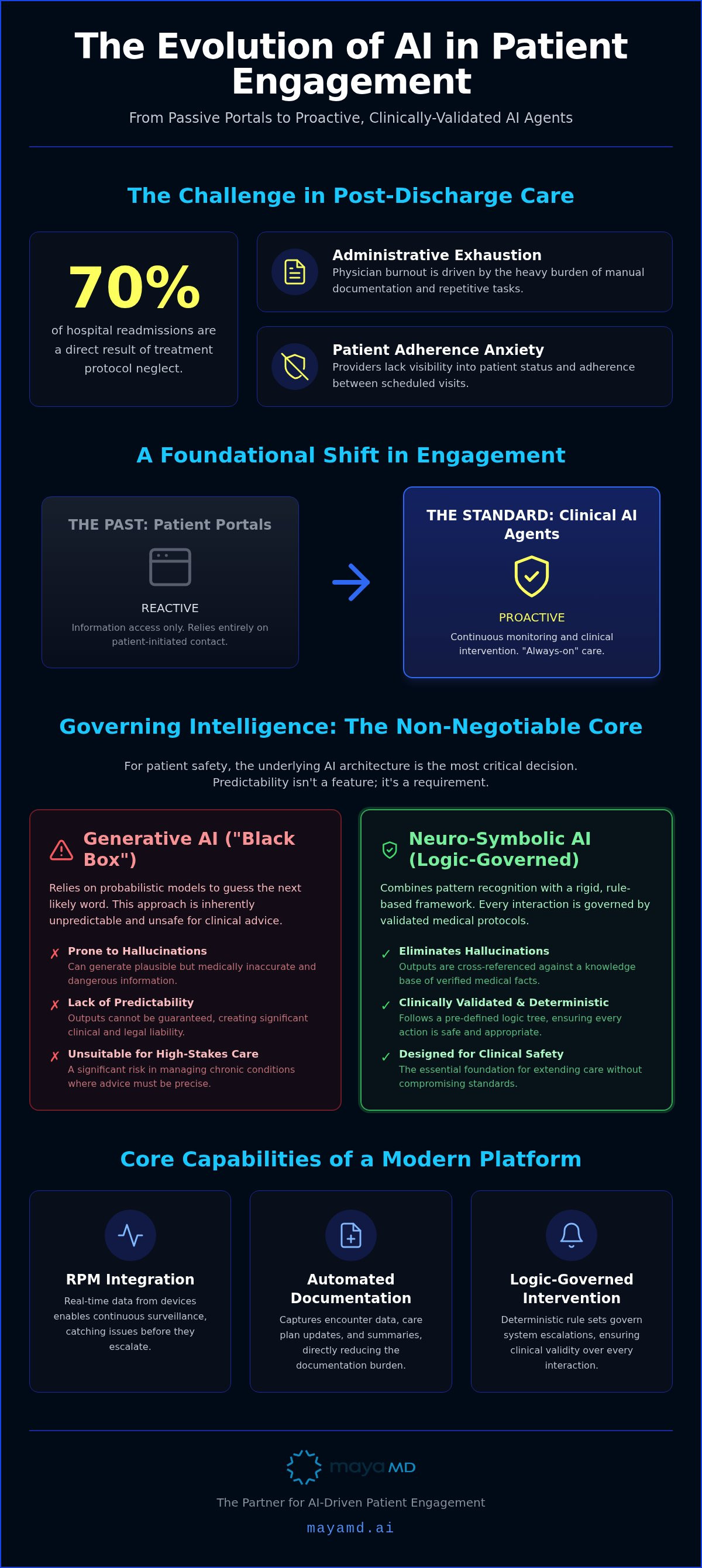
Clinical oversight often ends the moment a patient exits the facility, yet data indicates that 70% of hospital readmissions are the direct result of treatment protocol neglect. You're likely familiar with the administrative exhaustion of manual documentation and the persistent anxiety surrounding patient adherence between scheduled visits. While the industry promises relief through a modern AI patient engagement platform, the valid fear of AI hallucinations in clinical advice has kept many providers from fully embracing a digital shift.
Trust is the foundation of care; therefore, the industry has transitioned from simple chatbots to logic-governed Clinical AI Agents. You'll discover how these neuro-symbolic systems maintain rigorous safety standards while significantly reducing physician burnout and capturing new revenue through RPM and APCM. We'll preview the 2026 HIPAA updates and the technical frameworks that allow for continuous, safe patient monitoring without increasing your team's workload. This evolution represents a shift toward a more proactive, data-driven ecosystem that prioritizes clinical validity over conversational novelty.
Key Takeaways
• Discover why neuro-symbolic AI and deterministic logic are now essential to eliminate clinical hallucinations and ensure patient safety.
• Understand the transition of the modern AI patient engagement platform from a reactive portal to a proactive system for clinical intervention.
• Learn how to optimize CMS reimbursement through integrated Remote Patient Monitoring (RPM) and Advanced Primary Care Management (APCM) frameworks.
• Explore specialized deployment strategies for integrating clinical AI agents into the complex workflows of major urban healthcare hubs like Phoenix and Las Vegas.
• Identify the specific ways logic-governed systems reduce administrative documentation while strengthening the connection between providers and chronic care patients.
What is an AI Patient Engagement Platform in 2026?
The definition has fundamentally changed. What once described a web portal where patients could view lab results and request prescription refills now represents a sophisticated, logic-governed clinical ecosystem capable of continuous intervention, real-time physiological monitoring, and automated care coordination. An AI patient engagement platform in 2026 is not a communication tool; it's a clinical infrastructure layer that operates between scheduled visits, where the majority of patient health decisions actually occur.
This distinction matters enormously for chronic care. A patient managing Type 2 diabetes or congestive heart failure doesn't need a better messaging interface. They need a system that detects a deteriorating trend in their biometric data on a Tuesday evening and triggers a structured clinical response before Wednesday's crisis becomes Friday's readmission. That capability requires a fundamentally different architecture than a portal ever provided.
The Shift from Portals to Clinical AI Agents
Traditional patient portals reached their functional ceiling years ago. They were built for information access, not clinical action, and they depend entirely on the patient initiating contact. Clinical AI Agents invert this model entirely. Operating continuously within a HIPAA-compliant cloud infrastructure, these agents monitor patient-reported data and RPM device inputs, apply deterministic clinical logic, and surface prioritized alerts to care teams without requiring any staff to actively watch a dashboard. For patients with complex, multi-morbid conditions, this "always-on" model of care isn't a convenience; it's a clinical necessity.
Core Capabilities for Modern Healthcare Systems
The modern platform integrates several capabilities that function as a unified clinical workflow rather than isolated features:
RPM integration
Real-time data streams from connected devices flow directly into the clinical decision layer, enabling continuous physiological surveillance between office visits.
Automated clinical documentation
AI-driven automated medical scribes capture encounter data, care plan updates, and monitoring summaries, directly reducing the documentation burden that contributes to physician burnout.
Logic-governed intervention protocols
Deterministic rule sets govern when and how the system escalates a concern, ensuring clinical validity over every patient interaction.
The Clinical AI Agent functions as the critical bridge between raw patient data and meaningful provider action, translating continuous data streams into structured, actionable clinical intelligence. This is the standard that separates a genuine AI patient engagement platform from a digitized waiting room.
Governing the Intelligence: Deterministic Logic vs. Generative AI
The rapid adoption of artificial intelligence in healthcare has introduced a critical tension between the conversational fluidity of generative models and the rigorous safety requirements of clinical practice. While standard "black box" AI systems can process massive datasets, their probabilistic nature makes them prone to hallucinations, a phenomenon where the system generates plausible but medically inaccurate information. For an AI patient engagement platform operating in 2026, this lack of predictability is a significant liability. True clinical intelligence requires a neuro-symbolic approach, which integrates the pattern recognition of neural networks with the rigid, rule-based frameworks of symbolic logic.
Deterministic logic ensures that every patient interaction follows validated medical protocols. Unlike standard consumer chatbots that guess the next word in a sequence, a governed Clinical AI Agent operates within a predefined logic tree. This systematic oversight is non-negotiable for patient safety, especially when managing high-stakes chronic conditions where a single piece of incorrect advice could lead to a preventable emergency room visit. By anchoring AI behavior to established clinical pathways, providers can extend their reach without compromising the standard of care.
Eliminating Hallucinations in Clinical Settings
Neuro-symbolic AI functions as the primary defense against clinical inaccuracies. By layering symbolic reasoning over natural language processing, MayaMD ensures that the system's outputs are always cross-referenced against a knowledge base of verified medical facts. This technical mechanism prevents the AI from "inventing" symptoms or suggesting unverified treatments. For a deeper dive into these safety protocols, read our technical analysis on Healthcare AI Without Hallucinations: A Technical View.
The Role of Clinical Logic in Documentation
Governed AI transforms the administrative burden of chronic care management into a streamlined, automated workflow. The Role of Natural Language Processing in Patient Care has become increasingly vital as systems must now interpret complex patient narratives while maintaining 100% adherence to clinical guidelines. While standard Large Language Models (LLMs) often struggle with clinical precision, neuro-symbolic systems achieve a triage accuracy rate of 96% by anchoring conversational outputs to validated medical protocols. This high level of accuracy ensures that post-discharge summaries and chronic care notes are reliable enough for immediate physician review.
Implementing these logic-governed frameworks allows your practice to automate routine monitoring, which directly results in lower administrative overhead and more consistent patient adherence. If you're ready to move past experimental tools and adopt a proven solution, consider how a governed clinical AI agent can stabilize your practice's workflow. This capability-to-outcome structure provides the stability required to meet the 2026 HIPAA security updates while fostering deeper patient connectivity.
Solving the Adherence Crisis in Chronic Care Management
Patient non-adherence remains one of the most significant barriers to clinical success, with up to 70% of hospital readmissions directly attributed to patients neglecting their treatment protocols. This isn't just a clinical failure; it's a massive financial burden. Data indicates that engaged patients typically experience 8% to 21% lower healthcare costs compared to those who are disconnected from their care plans. A modern AI patient engagement platform addresses this gap by replacing intermittent, manual follow-ups with a continuous, logic-governed surveillance model.
Traditional follow-up methods rely on reactive outreach, such as a nurse calling a patient days after a missed medication dose or a blood pressure spike. This model is inherently flawed because it depends on human bandwidth that doesn't exist in modern practice. This systematic friction is a primary driver behind the Digital Transformation in Patient Engagement, where the industry has moved toward automated care paths that respond to real-time patient data. By shifting the burden of monitoring to a Clinical AI Agent, providers ensure that no patient falls through the cracks between office visits.
RPM and PCM: A Unified Engagement Strategy
Specialists managing complex, single-organ diseases through Principal Care Management (PCM) require a high level of granular data to make informed adjustments to treatment plans. Integrating Remote Patient Monitoring (RPM) with an AI patient engagement platform allows for the continuous flow of physiological data directly into the specialist’s workflow. This connectivity ensures that specialists can manage high-risk patients with precision, intervening only when the data indicates a clinical necessity. For a comprehensive look at these workflows, see our guide on Principal Care Management Tools: A Guide to AI-Driven Specialist Care in 2026.
Improving Clinical Outcomes with APCM
For primary care providers, the transition to Advanced Primary Care Management (APCM) represents a shift toward value-based outcomes and care continuity. Clinics in healthcare hubs like Phoenix and Indianapolis are increasingly deploying AI-driven APCM to stabilize their chronic care populations. These systems automate the "documentation tax" by capturing monitoring data and patient interactions, allowing physicians to focus on high-level clinical decision-making. The result is a measurable improvement in performance metrics and a significant reduction in the administrative overhead that typically stifles primary care expansion. This structured approach ensures that care remains proactive, safe, and fully aligned with 2026 reimbursement requirements.
Implementing AI Patient Engagement in Major US Healthcare Hubs
Deploying a sophisticated AI patient engagement platform within complex urban healthcare systems requires a nuanced understanding of local clinical ecosystems. In metropolitan areas like Chicago and Houston, the sheer volume of patients often overwhelms traditional care models, leading to significant delays in follow-up care. By integrating Clinical AI Agents into these high-density environments, providers can scale their outreach without the unsustainable costs associated with hiring additional administrative staff. This systematic approach ensures that every patient, regardless of the size of the healthcare network, receives consistent and proactive clinical attention.
The physician shortage in Indianapolis and Houston has reached a critical point, forcing many practices to limit their intake of complex chronic care cases. Implementing a robust AI patient engagement platform in these markets addresses the documentation tax and ensures that care remains proactive. These systems act as a force multiplier, automating preliminary triage and data collection so that practitioners can focus their limited time on high-level clinical decision-making. Scaling in these markets isn't just about volume; it's about maintaining the quality of care through rigorous, logic-governed automation.
Local Market Dynamics and Care Coordination
Customizing AI workflows for Chicago’s diverse patient populations involves more than simple translation; it requires a platform capable of navigating varied health literacy levels and cultural nuances. Similarly, Houston’s medical districts face unique challenges in managing chronic care across disparate specialist networks. Phoenix clinics have successfully utilized these agents to manage geriatric patient engagement, where persistent and low-friction monitoring is essential for seniors managing multiple comorbidities. These local applications demonstrate how a centralized technology can be adapted to meet specific demographic needs without compromising clinical standards.
Regulatory and Compliance Readiness
The 2026 HIPAA Security Rule update has introduced mandatory encryption for electronic Protected Health Information (ePHI) both at rest and in transit. This regulatory shift removes the previous "addressable" flexibility, making technical compliance a non-negotiable requirement for providers in Las Vegas and beyond. Modern platforms must also support Multi-Factor Authentication (MFA) for all systems accessing ePHI and adhere to a defined testing schedule that includes vulnerability scans every six months. A 24-hour notification is now required upon activation of a contingency plan, highlighting the need for systems with high reliability. If you're ready to scale your urban practice while ensuring total compliance, explore how to implement a Clinical AI Agent to stabilize your patient outreach.
Why MayaMD is the Partner for AI-Driven Patient Engagement
Selecting a partner for digital transformation requires more than just choosing a software vendor. MayaMD operates as an Authoritative Pioneer in the field, providing a logic-governed AI patient engagement platform that has moved past the experimental phase into proven clinical application. By combining neuro-symbolic AI with specialized frameworks for RPM, APCM, and PCM, we provide the stability and precision required for high-stakes chronic care management. This isn't a disruptive experiment; it's a sophisticated bridge between raw data and human care.
The financial impact of this technology is measurable and immediate. Our platform has been shown to reduce end-to-end call times by 45%, allowing clinical staff to focus on higher-acuity patient needs rather than administrative triage. By automating the capture of monitoring data and patient interactions, providers can maximize CMS reimbursement through RPM and APCM codes while simultaneously lowering the administrative overhead that typically consumes 25% to 34% of total healthcare costs. Efficiency and clinical validity work in harmony to stabilize your practice's bottom line.
The MayaMD Clinical AI Agent Advantage
Our Clinical AI Agent provides a continuous layer of support for patients transitioning from acute care to the home environment. By applying deterministic logic to post-discharge protocols, the system identifies potential complications before they require readmission, addressing the root cause of the 70% of readmissions triggered by treatment neglect. This methodology has already stabilized care coordination in major hubs like Las Vegas and Indianapolis, where clinics utilize our platform to maintain engagement across diverse patient populations. For a more detailed analysis of these reimbursement and management frameworks, consult our Advanced Primary Care Management (APCM): The 2026 Definitive Guide.
The system's 96% triage accuracy rate ensures that clinicians receive reliable, actionable data. It's a level of precision that standard generative models simply cannot match, providing the safety net necessary for patients managing complex, multi-morbid conditions. This reliability fosters a deeper sense of trust between the patient and the provider, as the technology remains a supportive extension of the clinical team.
Getting Started: Implementation and Next Steps
Transitioning to an AI-driven model doesn't require a total overhaul of your existing infrastructure. MayaMD utilizes a modular approach to deployment, allowing your facility to integrate Clinical AI Agents into specific workflows, such as chronic care monitoring or post-surgical follow-up, before scaling across the entire network. This phased implementation minimizes friction and allows your clinical team to adapt to new automated protocols at a manageable pace. It's a deliberate, methodical process designed to ensure long-term success.
Healthcare executives ready to modernize their engagement strategy can request a comprehensive clinical workflow audit. This assessment identifies specific areas where an AI patient engagement platform can reduce documentation burden and improve patient adherence. Contact our team today to begin your transition toward a more connected, data-driven clinical ecosystem that prioritizes patient safety and provider well-being.
Stabilizing the Future of Clinical Connectivity
The transition from reactive patient portals to a logic-governed AI patient engagement platform is no longer a visionary concept; it's a clinical necessity for modern providers. By anchoring engagement in neuro-symbolic AI, your facility can ensure hallucination-free documentation while maintaining the rigorous safety standards required for high-stakes chronic care management. This systematic approach stabilizes patient adherence and secures practice revenue through specialized RPM and APCM support, allowing your team to focus on high-level clinical decision-making rather than administrative triage.
As the 2026 HIPAA updates mandate stricter cybersecurity and mandatory encryption, the need for a HIPAA-compliant cloud architecture has become paramount for every urban healthcare hub. MayaMD provides the established framework necessary to bridge the gap between continuous physiological data and human care, fostering deeper connections without increasing staff hours. We invite you to schedule a demo of MayaMD’s Clinical AI Agent to see how we can eliminate documentation friction and improve your clinical outcomes. The future of healthcare is proactive, governed, and remarkably precise.
Frequently Asked Questions
How does an AI patient engagement platform differ from a standard patient portal?
Standard patient portals function as reactive repositories for lab results and scheduling. In contrast, a modern AI patient engagement platform operates as a proactive clinical layer that monitors patient data in real-time. While portals require the patient to initiate contact, these AI-driven systems use deterministic logic to identify clinical risks and trigger interventions before a crisis occurs. This shift moves healthcare from passive information access to active, continuous care coordination between visits.
Is AI patient engagement HIPAA-compliant?
Yes, clinical AI platforms are designed to meet the 2026 HIPAA Security Rule updates. These regulations now mandate encryption for ePHI at rest and in transit, alongside multi-factor authentication for all system access. MayaMD’s architecture includes these safeguards, including vulnerability scans every six months and a 24-hour notification protocol for contingency plans. This ensures that patient data stays secure within a governed framework, protecting providers from the increasing risks of the modern digital landscape.
Can AI patient engagement platforms really reduce physician burnout?
AI platforms significantly reduce burnout by automating the "documentation tax" that consumes hours of a physician's day. By utilizing automated medical scribes and preliminary triage agents, the system handles routine data entry and administrative follow-ups. This allows practitioners to focus on high-level clinical decision-making rather than manual charting. Reducing these repetitive tasks helps restore the provider's focus to direct patient care, which is the primary driver of professional satisfaction in medicine.
How does MayaMD ensure its AI does not provide incorrect medical advice?
MayaMD eliminates the risk of clinical hallucinations by utilizing neuro-symbolic AI. This approach combines the conversational flexibility of natural language processing with a rigid, deterministic logic layer. Every system output is cross-referenced against a knowledge base of verified medical protocols. By anchoring the AI to these rule-based frameworks, we ensure that the advice provided is always clinically valid and never probabilistic, providing a level of safety that standard generative AI cannot achieve.
What is the role of Remote Patient Monitoring (RPM) in patient engagement?
Remote Patient Monitoring (RPM) provides the continuous physiological data stream that fuels the AI’s decision-making engine. While the AI platform manages the interaction, RPM devices provide the objective biometrics, such as blood pressure or glucose levels, needed for accurate surveillance. This connectivity allows the system to detect subtle health shifts that would otherwise go unnoticed between office visits. It transforms patient engagement from a series of conversations into a data-driven clinical intervention strategy.
How does an AI platform support Advanced Primary Care Management (APCM)?
The platform supports Advanced Primary Care Management (APCM) by automating the continuous engagement required for value-based care. It tracks patient adherence to chronic care plans and captures the necessary documentation for CMS reimbursement. By maintaining a steady flow of communication and monitoring, the AI ensures that primary care teams can manage large patient populations without increasing their administrative workload. This structured approach helps clinics meet performance metrics while providing more consistent support to chronic care patients.
Will patients actually use an AI Clinical Agent for their care?
Patients value systems that provide a direct bridge to their clinical team and immediate answers. While trust in autonomous AI is only 19%, patients trust their doctors four times more; therefore, the AI must act as a provider-led tool. Conversational AI has already reduced no-show rates by 30%, proving its utility. When patients realize the AI provides a faster path to clinical oversight and better health outcomes, they adopt the technology as a reliable resource.
What are the reimbursement opportunities for AI-driven patient engagement in 2026?
Providers can capture substantial revenue through several CMS frameworks in 2026. These include Remote Patient Monitoring (RPM), Principal Care Management (PCM), and the Advanced Primary Care Management (APCM) codes. An AI patient engagement platform automates the time-tracking and documentation required to meet these billing requirements. This ensures that practices get compensated for the intensive, between-visit management of chronic care populations without adding manual administrative tasks to their staff's workload.




See The MayaMD Difference
Fill the form below
Download Our Apps
MayaMD for patients and MayaPro for physicians - available on iOS and Android.
FOR PATIENTS
MayaMD App
AI-powered symptom assessment, triage, and secure access to your care team.

FOR PHYSICIANS
MayaPro App
MayaPro brings patient vitals, RPM/PCM care plans, and clinical decision support to your pocket.