
The Evolution of AI for Virtual Patient Triage: From Chatbots to Clinical AI Agents in 2026

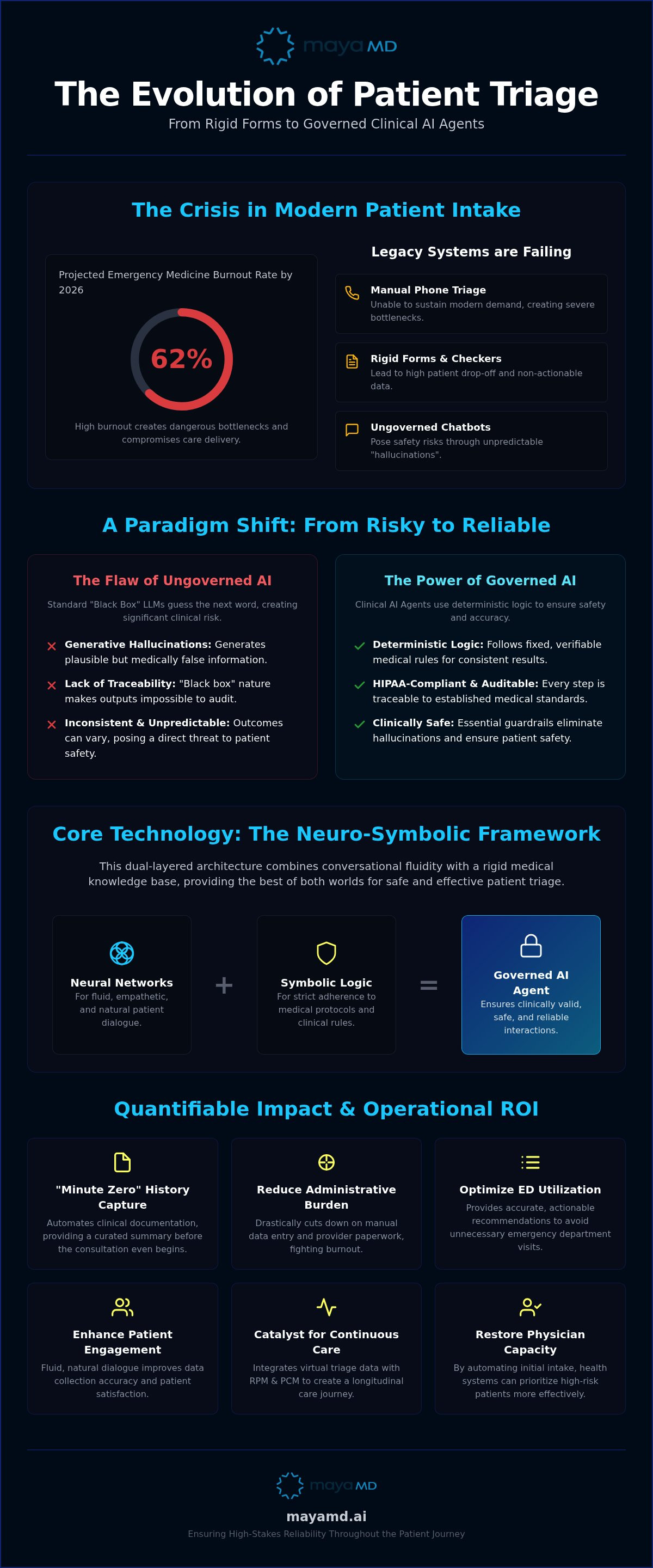
With emergency medicine burnout rates reaching 62% in 2026, the traditional digital front door of rigid, form-based intake is no longer just a patient inconvenience; it's a systemic liability. You've likely witnessed the friction caused by ungoverned chatbots that fail to understand clinical nuance or, even worse, pose safety risks through unpredictable generative hallucinations. It's clear that the industry requires a more robust, governed approach. Modern AI for virtual patient triage must move beyond these brittle scripts toward sophisticated Clinical AI Agents that bridge the gap between advanced data science and human care.
You'll discover how the integration of deterministic logic and neuro-symbolic frameworks is transforming patient navigation by providing the necessary guardrails for generative interaction. This article details the shift toward HIPAA-compliant, auditable triage logic that reduces emergency department over-utilization while significantly lowering administrative burdens. We'll explore how these governed systems foster deeper patient connection through natural, precise dialogue. By the end, you'll understand how a Clinical AI Agent can restore physician capacity and ensure high-stakes reliability throughout the entire patient journey.
Key Takeaways
• Transition from rigid, form-based intake to fluid Clinical AI Agents that enhance patient engagement through natural, governed dialogue.
• Understand how deterministic logic provides the essential guardrails for AI for virtual patient triage, ensuring clinical safety by eliminating the risk of generative hallucinations.
• Explore the strategic synergy between virtual triage data and continuous care models such as Remote Patient Monitoring (RPM) and Principal Care Management (PCM).
• Quantify the operational ROI of "Minute Zero" history capture, which automates clinical documentation to drastically reduce provider administrative burdens.
• Follow a rigorous implementation framework to ensure your AI deployment maintains HIPAA compliance while optimizing digital front door bottlenecks.
The Paradigm Shift in Patient Navigation: Beyond Basic Chatbots
The 2026 healthcare ecosystem has moved past the era of experimental digital tools into a phase of rigorous application. AI for virtual patient triage has evolved from a peripheral convenience into a critical infrastructure component for health systems managing unprecedented patient volumes. This shift represents a transition from rigid, decision-tree forms that often frustrate users toward fluid, conversational agents capable of sophisticated interaction. The Digital Front Door is no longer a luxury. It's a clinical necessity that reduces initial patient friction while simultaneously improving the accuracy of initial data collection. By deploying these advanced systems, organizations capture high-fidelity patient data that was previously lost to manual errors or incomplete intake forms.
The Limitations of Legacy Triage Systems
Traditional phone-based nurse triage lines are increasingly unable to sustain modern demand. With emergency medicine burnout reaching 62% in 2026, relying on manual triage creates dangerous bottlenecks that compromise care delivery. Legacy symptom checkers often fail because they provide non-actionable data or overly cautious recommendations that drive emergency department over-utilization. These static, non-conversational interfaces lead to significant patient drop-off and dissatisfaction. Patients now expect a dialogue that feels clinically informed, not a repetitive digital interrogation that lacks medical context and fails to provide a clear path forward.
The Rise of the Clinical AI Agent
The emergence of the clinical AI agent marks a departure from simple if-then logic. These agents function as a sophisticated Clinical Decision Support System, bridging the gap between raw patient symptoms and structured provider workflows. Unlike standard LLMs that may hallucinate, a governed agent utilizes deterministic clinical reasoning to ensure safety and precision. This transition allows for a Minute Zero history capture, ensuring that providers receive a curated clinical summary before the consultation begins. The MayaMD Clinical AI Agent serves as a primary care support tool that integrates seamlessly into existing clinical workflows. This capability transforms the triage event from a standalone interaction into the first step of a longitudinal care journey. By automating this initial clinical insight, health systems can prioritize high-risk patients more effectively and ensure every interaction is grounded in stability and regulatory adherence.
Governing Intelligence: The Role of Deterministic Logic in Clinical Safety
Clinical safety in 2026 demands a departure from the "black box" nature of standard Large Language Models (LLMs). While generative AI excels at natural language processing, it lacks the inherent clinical guardrails required to manage patient risk safely. AI for virtual patient triage must operate within a governed framework where every output is traceable to established medical standards. This is where deterministic logic becomes essential. Unlike probabilistic models that guess the next word in a sequence, deterministic systems follow fixed, verifiable rules to ensure that triage outcomes are consistent, safe, and medically sound. It's this transition from guessing to knowing that defines the next generation of clinical-grade technology.
Eliminating Hallucinations in Virtual Triage
The primary risk of ungoverned AI in a medical context is the phenomenon of hallucinations, where the system generates plausible but medically inaccurate information. To mitigate this, advanced platforms utilize a dual-layered architecture that combines conversational fluidity with a rigid medical knowledge base. Neuro-symbolic AI is the synthesis of symbolic logic and neural networks for clinical validity. This approach allows the system to engage in fluid, empathetic dialogue through its neural component while its symbolic component enforces strict adherence to medical protocols. MayaMD utilizes this neuro-symbolic framework to eliminate the unpredictability of pure generative models, ensuring that every patient interaction remains within the bounds of clinical safety.
Deterministic Logic vs. Black-Box Models
Healthcare providers require absolute transparency to trust AI-driven decisions. If an AI recommends a specific level of care, clinicians must be able to audit the reasoning behind that choice. Deterministic logic provides this audit trail, transforming the "black box" into an open book. This transparency is vital for maintaining HIPAA compliance and meeting the rigorous data security standards of a cloud-based architecture. A system that cannot explain its logic is a liability in a clinical environment. By prioritizing auditability, health systems can ensure that their digital front door remains a secure and reliable entry point for patient care. You can learn more about how these systems function in our detailed guide on the Clinical AI Agent.
If you're ready to evaluate how governed intelligence can secure your patient navigation workflows, we invite you to speak with our clinical team. Integrating a system that prioritizes safety over hype is the first step toward reducing physician burnout and improving the overall patient experience.
Virtual Triage as a Catalyst for Continuous Care and RPM
Effective patient navigation in 2026 transcends the initial point of contact. While legacy systems treated symptom checking as an isolated event, modern AI for virtual patient triage serves as the primary engine for longitudinal care. The data captured during a triage encounter provides a high-resolution snapshot of a patient's clinical status, allowing for the immediate identification of risks that necessitate higher levels of oversight. This connectivity ensures that acute symptoms are not merely resolved but are instead used to inform broader care strategies, such as Advanced Primary Care Management (APCM) or Principal Care Management (PCM).
By leveraging sophisticated data points, clinical agents identify patients who qualify for specialized chronic care programs. This proactive approach transforms the digital front door into a strategic entry point for continuous monitoring. When a patient presents with symptoms indicative of a worsening chronic condition, the system doesn't just provide a triage score. It initiates a clinical pathway that integrates with the provider's existing workflows, ensuring that no high-risk individual falls through the cracks of a fragmented healthcare system. This cause-and-effect flow ensures that every interaction adds measurable value to the patient's long-term health record.
From Acute Triage to Chronic Management
A single triage encounter can now serve as the trigger for automated enrollment in Remote Patient Monitoring (RPM) programs. This seamless transition is particularly critical for patients recently discharged from inpatient settings. Continuous monitoring significantly reduces post-discharge readmission rates by identifying physiological deviations before they escalate into emergencies. For a deeper analysis of this transition, you can explore our research on reengineering the hospital discharge. This integration allows health systems to maintain a stable connection with patients during their most vulnerable recovery phases, fostering long-term stability and clinical reliability.
Streamlining Specialist Referrals
AI-driven triage ensures that patients reach the correct specialist on the first attempt, bypassing the traditional delays of generalist gatekeeping. By analyzing specific symptom clusters with deterministic logic, the system identifies the need for specialized intervention early in the dialogue. This precision reduces the administrative burden of unnecessary primary care visits for issues that require a specialist's expertise. Improving the efficiency of these pathways optimizes the digital front door, allowing primary care providers to focus on complex management while patients receive targeted care more rapidly. The result is a more cohesive ecosystem where data flows from the initial triage event to the specialist's office, reinforcing the role of AI as a bridge between disparate data points and human care.
Quantifying ROI: Reducing Physician Burnout and Administrative Load
The financial and psychological toll of administrative friction has reached a breaking point. In 2026, with physician burnout rates exceeding 50% across most specialties, the implementation of AI for virtual patient triage is no longer just a technological upgrade; it's a survival strategy for overextended health systems. Administrative costs currently account for up to 31% of total healthcare spending in the U.S. By offloading the burden of initial patient assessment to a Clinical AI Agent, organizations can systematically reduce these overheads while simultaneously addressing the primary drivers of clinician exhaustion. For clinics looking to further streamline their administrative infrastructure, you can learn more about MediCloud.me.
The transition from conversational dialogue to structured clinical notes is a cornerstone of modern triage. During an AI-governed session, the agent captures nuanced patient data and formats it into an auditable summary that integrates directly into the EHR. This seamless continuity eliminates the need for manual data entry and ensures that the triage record remains a living part of the patient's longitudinal history. For example, MayaMD simplifies Advanced Primary Care Management through automated data capture, allowing providers to meet rigorous documentation requirements without increasing their daily workload. This systematic approach ensures that every data point is useful, accurate, and immediately accessible.
Optimizing Resource Allocation
Strategic patient routing is essential for managing high-volume surges without necessitating additional staffing. By utilizing deterministic logic to assess acuity, AI-driven triage directs patients to the most appropriate care setting, whether that's a pharmacy, urgent care, or the emergency department. This filtering mechanism is particularly effective in reducing ED over-utilization, where burnout rates currently sit at 62%. The resulting cost-to-savings ratio is profound; healthcare AI investments now report an average ROI of 3.2:1. By guiding patients toward lower-cost care settings when appropriate, health systems protect their most expensive resources for the cases that truly require them.
If your organization is ready to quantify the impact of governed AI on your clinical workflows, connect with our specialists to explore a tailored implementation strategy that prioritizes both provider well-being and operational efficiency.
Strategic Implementation: Deploying a Safe AI Triage Solution
Deploying AI for virtual patient triage requires a methodical, multi-phase approach that prioritizes stability over speed. The process begins with a thorough audit of existing clinical workflows to identify "digital front door" bottlenecks where patient friction is highest. By pinpointing these specific inefficiencies, health systems can tailor the Clinical AI Agent’s conversational parameters to address real-world throughput challenges. This initial phase isn't just about software; it's about understanding the human movement through the care continuum and ensuring the technology serves as a bridge, not a barrier.
Once the foundation is secure, the next step involves integrating the system with existing Remote Patient Monitoring (RPM) and Electronic Health Record (EHR) systems. This connectivity allows for a seamless flow of data, ensuring that triage insights are immediately actionable within the provider's primary interface. Implementation concludes with a cycle of continuous improvement. By monitoring clinical outcomes and refining triage logic based on direct provider feedback, health systems ensure the AI evolves alongside their specific clinical needs. This cause-and-effect flow ensures that every technological feature results in a measurable benefit for both the provider and the patient.
Compliance and Data Governance Standards
Security is the bedrock of clinical adoption. A HIPAA-compliant cloud infrastructure is mandatory for processing sensitive patient data during virtual triage. Organizations must also ensure adherence to the HHS Section 1557 rule, which requires the identification and mitigation of risks regarding algorithmic discrimination in decision support tools. Establishing a clinical oversight committee provides a necessary human-in-the-loop framework to review AI performance and ensure the system meets 2026 regulatory requirements for clinical decision support. This governed approach guarantees that technological ambition never outpaces patient safety or legal adherence, fostering long-term trust between the institution and its patients. To understand how to protect these digital interfaces from client-side script attacks and fraud, read more.
The Path Forward with MayaMD
Choosing a partner that understands the nuances of clinical governance is vital for long-term success. MayaMD was recognized as a finalist for the 2025 Digital Health Hub Foundation Digital Health Awards, a distinction that reflects our commitment to rigorous oversight and technological precision. We specialize in customizing MayaMD Virtual Triage for specific clinical populations, ensuring the logic aligns with your unique specialty requirements. This bespoke approach allows for measurable performance improvements without disrupting established workflows. If you're prepared to secure your digital front door and reduce physician burnout, we invite you to Contact Us to begin your AI integration journey.
Securing the Future of Clinical Navigation
The evolution of AI for virtual patient triage has reached a critical maturity point. We've moved beyond the era of experimental chatbots into a landscape defined by Clinical AI Agents that prioritize safety through neuro-symbolic architectures. By integrating deterministic logic with fluid dialogue, health systems can finally eliminate the risk of hallucinations while capturing precise, actionable data. This shift doesn't just improve the patient experience; it fundamentally addresses the administrative burdens that drive physician burnout.
As a 2025 Digital Health Hub Foundation Finalist, MayaMD provides a HIPAA-compliant and SOC 2 ready platform designed for high-stakes reliability and rigorous oversight. Our architecture ensures that your digital front door remains a secure, auditable gateway to continuous care models like RPM and APCM. The path toward a more efficient, connected, and empathetic healthcare ecosystem is now a reality. We invite you to discover how the MayaMD Clinical AI Agent revolutionizes patient navigation and begin your strategic implementation today. We look forward to partnering with you to restore clinical capacity and enhance the quality of care for every patient you serve.
Frequently Asked Questions
Is AI for virtual patient triage safe for diagnosing conditions?
AI for virtual patient triage is designed to route patients to the appropriate level of care rather than provide a definitive medical diagnosis. MayaMD specifically focuses on providing high-probability conditions and clinical insights to support provider decision-making. By utilizing neuro-symbolic AI, the system ensures that patient interactions remain within governed clinical boundaries. This approach prioritizes safety by eliminating hallucinations and ensuring that final diagnostic responsibility always rests with a licensed clinician.
Can virtual triage AI integrate with my existing EHR system?
Seamless integration with Electronic Health Record (EHR) systems is a fundamental capability of clinical-grade AI agents. MayaMD utilizes a cloud-based architecture to ensure that triage data and structured clinical summaries flow directly into the patient's record. This connectivity eliminates the need for manual data entry and ensures that providers have immediate access to the patient's history. Such integration is essential for maintaining workflow efficiency and ensuring continuity of care across different clinical settings.
How does virtual triage reduce emergency department over-utilization?
Virtual triage reduces emergency department over-utilization by accurately assessing patient acuity and directing low-risk cases to more appropriate care settings. Many patients visit the ED for issues that could be managed via primary care, urgent care, or pharmacy-level intervention. By providing clear, evidence-based guidance, the AI agent filters these low-acuity cases out of the emergency workflow. This optimization protects high-cost hospital resources for true emergencies while simultaneously addressing the high rates of clinician burnout.
What is the difference between a symptom checker and a Clinical AI Agent?
A traditional symptom checker typically relies on static, decision-tree logic that can feel rigid and non-conversational to the patient. In contrast, a Clinical AI Agent utilizes advanced conversational intelligence to conduct fluid, empathetic dialogues while maintaining strict clinical guardrails. These agents don't just collect data; they analyze it in real-time to inform longitudinal care journeys. While symptom checkers provide a list of possibilities, a Clinical AI Agent integrates directly into provider workflows to automate documentation.
Is virtual triage software HIPAA-compliant?
Regulatory adherence is a non-negotiable requirement for any AI deployed in a clinical environment. MayaMD utilizes a HIPAA-compliant, cloud-based architecture designed to protect sensitive patient information at every stage of the triage process. The platform is also SOC 2 ready, ensuring that data processing meets the highest industry standards for security and privacy. This rigorous oversight provides healthcare executives with the confidence that their digital front door meets all federal and state-level data governance requirements.
How does AI-driven triage improve the patient experience?
AI-driven triage improves the patient experience by replacing frustrating, form-based intake with natural, conversational dialogue. Patients receive immediate attention and clear guidance, which significantly reduces the anxiety often associated with navigating complex healthcare systems. This responsive interaction fosters a deeper sense of connection and support. By streamlining the path to care, the technology ensures that patients feel heard while receiving the most efficient routing to the medical services they require.
Can AI triage help manage patients with chronic conditions like heart failure?
AI for virtual patient triage is a powerful tool for managing chronic conditions such as heart failure by acting as a bridge to Remote Patient Monitoring (RPM). When a patient presents with escalating symptoms, the AI agent can trigger automated enrollment in specialized care management programs like PCM or APCM. This proactive monitoring allows for early intervention before a chronic issue requires hospitalization. The resulting synergy between triage and continuous care ensures a more stable longitudinal patient journey.
What is deterministic logic in the context of healthcare AI?
Deterministic logic refers to a systematic framework where the AI follows fixed, verifiable rules based on established medical knowledge. Unlike purely generative "black-box" models that predict the next word in a sequence, deterministic systems ensure that triage outcomes are predictable and auditable. In healthcare, this logic provides the necessary clinical guardrails to eliminate hallucinations and maintain safety. It allows clinicians to trace the AI’s reasoning back to recognized medical standards, ensuring high-stakes reliability.




See The MayaMD Difference
Fill the form below
Download Our Apps
MayaMD for patients and MayaPro for physicians - available on iOS and Android.
FOR PATIENTS
MayaMD App
AI-powered symptom assessment, triage, and secure access to your care team.


FOR PHYSICIANS
MayaPro App
MayaPro brings patient vitals, RPM/PCM care plans, and clinical decision support to your pocket.