
Staff Training for Chronic Care Management and Care Planning

A staff training guide for chronic care management should prepare teams to coordinate consistent, patient-centered support, not just complete administrative tasks. Medicare CCM serves patients with two or more chronic conditions expected to last at least 12 months or until the patient’s death, and clinical staff engage enrolled patients for at least 20 minutes per month. That work connects the patient’s care team, care plan, and ongoing health needs.
It’s understandable to start by asking what chronic care management (CCM) involves and who may qualify. But a program’s day-to-day effectiveness also depends on whether staff can explain enrollment, coordinate care for older adults with multiple conditions, and use evidence-based planning and health coaching in patient conversations. This guide covers CCM fundamentals, enrollment, and care coordination, then shows how structured staff training can support consistent workflows and meaningful patient engagement. It also explains how digital tools can help maintain communication and continuity beyond the clinic.
Key Takeaways
• Train staff to explain enrollment clearly, document consent, and help patients understand their role in managing ongoing care.
• Coordinate senior care around the patient’s full set of conditions, connecting clinical team members and aligning follow-up across care settings.
• Use patient data to shape evidence-based care plans, then reinforce them with practical health coaching and collaborative team discussions.
• Build staff readiness through case studies, simulations, and training in communication skills such as motivational interviewing.
• Use digital engagement and post-discharge communication tools to support continuity between clinical encounters and keep care teams connected with patients.
How do patients enroll in CCM?
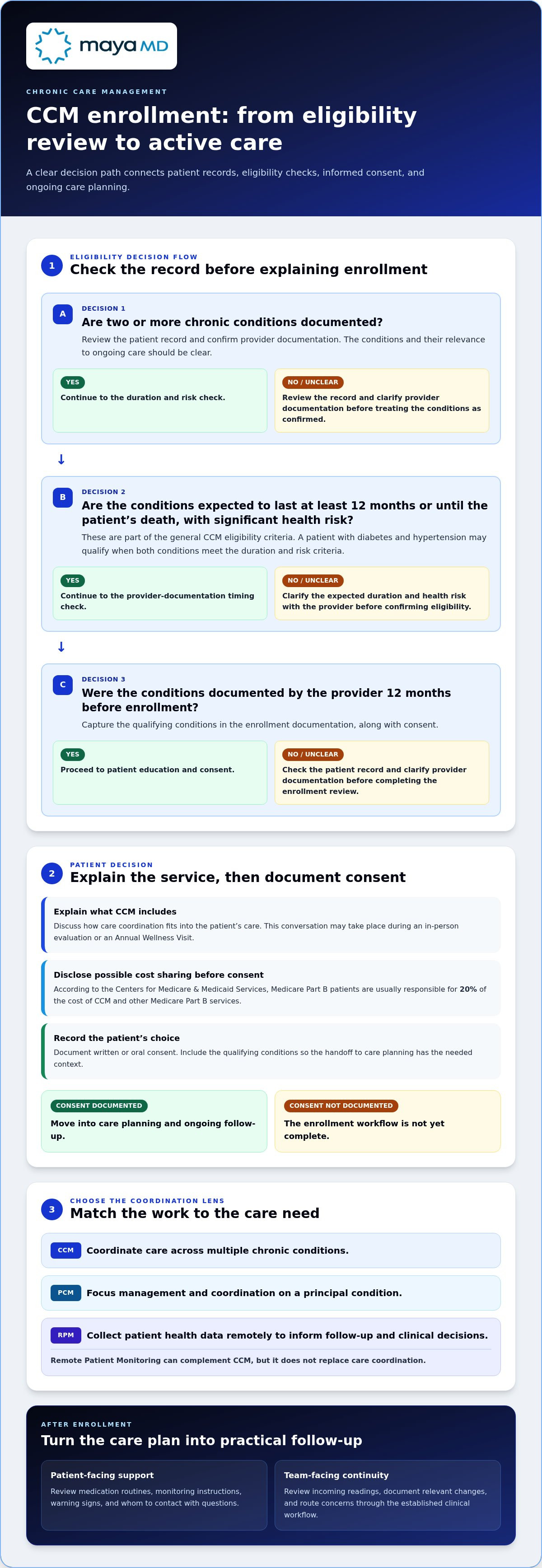
Enrollment starts by identifying patients who meet CCM criteria, explaining the service, and documenting consent. A reliable workflow connects eligibility review, patient education, care planning, and ongoing follow-up.
Patient eligibility and qualifying conditions
CCM eligibility generally requires two or more chronic conditions expected to last at least 12 months or until the patient’s death, with significant health risk. The conditions should be documented in the patient’s record, including their expected duration and relevance to ongoing care. This review helps staff identify appropriate patients and prepare a clear explanation of the support CCM can provide.
For example, a patient with diabetes and hypertension may qualify if both conditions meet the duration and risk criteria. Staff should relate those diagnoses to the patient’s everyday needs, rather than treating eligibility as a coding exercise alone.
Patient identification and enrollment workflows
A consistent workflow begins with reviewing patient records for qualifying conditions and confirming provider documentation. Staff can then discuss CCM during an in-person evaluation or Annual Wellness Visit, explain the service, and document written or oral consent. A clear process helps prevent missed steps and gives patients a chance to understand how care coordination will fit into their care.
Enrollment documentation should capture the qualifying conditions and consent. Staff should also note that the conditions must have been documented by the provider 12 months before enrollment. This information supports a reliable handoff from enrollment to ongoing care planning.
CCM coordinates care across a patient’s multiple chronic conditions. Principal Care Management focuses on management and coordination for a principal condition. Remote Patient Monitoring collects patient health data remotely to inform follow-up and clinical decisions. It can complement CCM, but does not replace care coordination.
Before consent, staff should explain what CCM includes and disclose possible cost sharing. According to the Centers for Medicare & Medicaid Services, Medicare Part B patients are usually responsible for 20% of the cost of CCM and other Medicare Part B services. Clear education helps patients make an informed enrollment decision and understand what ongoing participation involves.
After enrollment, patient education should turn the care plan into practical steps patients can follow between visits. Staff can review medication routines, monitoring instructions, warning signs, and whom to contact with questions. For example, with a patient who has heart disease and diabetes, a coach can connect daily self-management goals to the care team’s priorities and document barriers raised during follow-up.
CCM and remote monitoring work best when their information flows into a coordinated process. Staff can review incoming readings, document relevant changes, and route concerns through the established clinical workflow. Advanced Primary Care Management is another care model that practices may consider alongside chronic care services, based on their program design and patient needs.
Care coordination for seniors with multiple conditions
For older adults, care coordination connects clinicians, care settings, and patient priorities through one shared plan. The challenge is keeping recommendations aligned when several conditions and providers shape daily care.
Comprehensive care plans
A comprehensive care plan brings a patient’s conditions, goals, treatments, and follow-up needs together in one working document. This gives clinicians a shared set of priorities instead of leaving them to manage each diagnosis in isolation.
For an older adult with diabetes, hypertension, and heart disease, the plan can identify relevant providers, medication considerations, monitoring needs, and responsibility for follow-up. Staff should update it when needs change, such as after a new treatment or a change in mobility. Clear ownership keeps the plan useful between visits.
Coordination across providers and settings
Care coordination connects providers across primary care, specialty care, hospitals, and community services. A shared process helps prevent gaps when a patient moves between settings or receives recommendations from several providers.
For example, after a hospital discharge, staff can reconcile the discharge instructions with the existing care plan, identify follow-up responsibilities, and communicate changes to the patient’s other providers. At routine visits, the team can review unresolved referrals and confirm which clinician is responsible for each next step. This approach is especially relevant as nearly half of the U.S. population over 75 years of age has three or more chronic conditions.
Care coordination goals and challenges
CCM coordination keeps care aligned with a patient’s needs and supports continuity across providers. A practical goal might be making sure a patient with heart failure understands the follow-up plan after discharge and knows which care team member to contact.
Common obstacles include incomplete information, conflicting recommendations, and unclear responsibility for follow-up. One in four heart failure patients is reported to be readmitted within 30 days of discharge, making reliable transitions particularly important. Teams can address handoff gaps by recording action owners, sharing plan updates, and tracking whether follow-up occurred.
Coordination also depends on understanding the scale of multiple conditions. Many adults manage more than one chronic condition. Staff can use a case review to map each patient’s providers, active care priorities, and outstanding tasks. This makes duplicated work or missed follow-up easier to identify.
Reported outcomes offer context, not a substitute for individual care planning: one accountable care organization reported a 20% decrease in hospital admissions and a 13% decrease in emergency room visits for patients enrolled in CCM. Practices developing connected workflows can discuss care coordination needs and how digital support may fit their existing processes.
Evidence-based care planning and health coaching
Effective programs bring together patient information, coordinated care plans, and coaching that supports active self-management. Training helps staff connect these elements for patients with multiple chronic conditions.
Evidence-based care planning
Evidence-based care planning uses patient information and clinical priorities to shape practical goals and follow-up. The plan should reflect the patient’s actual needs, not simply copy a generic program template.
Staff can review available patient information, identify barriers, and involve case managers in planning. For a patient with COPD and diabetes, the team can connect condition-specific goals to daily routines and track progress through follow-up. Case studies and interdisciplinary workshops let nurses, doctors, and case managers practice aligning recommendations.
Health coaching skills
Health coaching helps patients identify achievable behavior changes and address barriers to self-management. Clear, respectful conversations make care goals more relevant to a patient’s life.
Staff can practice motivational interviewing by asking open questions, listening for patient priorities, and agreeing on a manageable next step. For example, a health coach might first explore what makes a medication routine difficult, then discuss a practical reminder strategy. Rural programs can train community health workers and other staff through Project ECHO and reinforce coaching skills in team discussions.
Care teams may include program managers, pharmacists, care coordinators, health coaches, community health workers, and specialty care providers. Training should make each role’s contribution clear. A pharmacist may help identify medication questions, while a community health worker can surface practical barriers to participation. Shared case reviews help team members coordinate their observations.
Facilities and mobile health units can extend access to coaching and other chronic disease services. Rural programs may use mobile units to connect patients with health coaches, specialists, or pharmacists. When teams work across locations, they need a clear process for recording patient goals and sharing relevant updates with the care team.
Frederick Health reported that hospital readmissions among telehealth patients were reduced by 83% over a six-month period, alongside a 50% reduction in emergency department visits. These reported outcomes illustrate why programs track care processes and patient outcomes together. They don’t establish that every program will achieve the same results, but they show the value of monitoring progress over time.
To keep care plans actionable, teams can review each patient’s progress, barriers, and next steps during routine case discussions. For a patient with multiple chronic conditions, changing one goal may affect other priorities. Recording the reason for each adjustment supports continuity and gives the next team member a clear basis for follow-up.
What is Chronic Care Management?
Chronic Care Management (CCM) coordinates continuing care for people with chronic diseases, connecting clinical follow-up with patient needs. Staff training must cover clinical workflows, time records, and billing documentation.
Medicare CCM billing uses CPT 99490 for 20 minutes of clinical staff time for non-complex CCM, and CPT 99491 for 30 minutes of physician- or qualified-professional time. Complex CCM uses CPT 99487 for 60 minutes; additional time may be billed with the applicable add-on codes. Documentation must support the service and include two ICD-10 codes.
State-specific staff requirements depend on the duties performed and applicable scope-of-practice rules. Training should distinguish Medicare billing criteria from role-specific responsibilities and align workflows with each staff member’s permitted duties.
RVU-based conversions vary by clinical specialty and facility location.
Training should cover privacy, secure handling of patient information, accurate documentation, and clinical escalation. Staff need clear procedures for routing concerning symptoms or remote patient monitoring data to the appropriate clinician.
Monthly clinical time and documentation
Monthly time documentation records the clinical work performed for each patient and supports accurate billing. For non-complex CCM, CPT 99490 represents 20 minutes of clinical staff time per month.
Staff should record the date, time spent, care activity, and relevant outcome in the patient record. For example, a follow-up about diabetes medication barriers should capture the patient’s concern and the care team’s response. Consistent entries help distinguish billable care coordination from unrelated administrative work.
Clinical and operational benefits
CCM supports ongoing coordination for patients whose needs extend beyond individual visits, with a defined workflow for clinical staff. This helps teams track care-plan actions and identify follow-up needs across chronic conditions.
Interviews with 71 healthcare professionals identified decreased hospitalizations and emergency department visits as positive CCM outcomes. Practices can use case reviews to examine whether communication, documentation, and follow-up processes support their own care goals.
Hands-on training turns policy into practice. Staff can shadow experienced professionals, join care-team meetings, and take part in patient simulations. A simulation involving a patient with diabetes can test documentation, communication, and escalation steps without interrupting live care.
Operational design also affects patient access. Rural chronic disease programs may offer evening hours for working-age patients and daytime programs for older adults. Practices can consider patient needs and staffing capacity when setting clinic hours, then document how remote patient monitoring fits into follow-up.
Provider and practice staff engagement and training
CCM training works best when physicians, primary care teams, and operational staff have clear responsibilities. A staff training guide for chronic care management should connect patient engagement, clinical judgment, and documentation to everyday workflows.
Build training around real workflows
Online chronic care management courses may combine virtual sessions, recorded materials, and discussion boards. Hybrid courses add live, in-person training so staff can apply concepts with colleagues. Practices can use these formats to cover enrollment conversations, care-plan monitoring, communication, and effective use of available services and resources.
Case managers need preparation tailored to their roles. Training can cover monitoring care plans, communicating between patients and care teams, and helping patients use available services. A practical case might follow a patient with multiple chronic conditions from a primary care visit through a referral and follow-up call. Staff can identify handoff gaps and clarify ownership of each next step.
Engage the whole practice
Provider engagement starts with shared expectations. Physicians set clinical priorities, while nurses, care coordinators, and administrative staff support the related workflows. A team discussion can map the patient journey, show where consent and care-plan information are recorded, and establish how urgent concerns reach the appropriate clinician.
Training should reflect the population served. For a practice caring for older adults with several chronic conditions, a simulated case can test how staff communicate a care-plan update and document the next follow-up. Interdisciplinary workshops give nurses, doctors, and case managers the chance to examine the same scenario from their roles.
Develop communication skills and measure readiness
Motivational interviewing helps staff support behavior change through patient-centered conversation. Staff can practice asking open questions, listening without judgment, and helping patients choose a realistic next step. If a patient says an exercise goal feels difficult, for example, the coach can explore the barrier before discussing alternatives with the care team.
Online learning may include discussion boards where staff compare approaches to challenging cases. Practices can reinforce it with shadowing, team meetings, and patient simulations. A simulation can test whether a staff member recognizes a concern, documents it clearly, and follows the practice’s escalation workflow.
Professional learning options include Chronic Care Professional (CCP), Clinical Disease Management (CDM), and Medicare CCM Certification programs. Practices can match course content to each role and use case reviews to identify where additional coaching would help. This staff training guide for chronic care management can keep learning focused on consistent performance, not just course completion.
To strengthen staff engagement and training workflows, discuss your practice’s care coordination needs.
MayaMD: Clinical AI Agent
MayaMD’s Clinical AI Agent can support patient engagement within chronic care programs. For practices seeking more consistent communication between visits, its AI patient engagement solutions help maintain connections with patients, while automated post-discharge communication supports continuity as patients return home.
These capabilities are most useful when a care team wants to strengthen communication within existing clinical workflows, not replace staff or clinical judgment. Practices can incorporate them into a broader approach to outreach, follow-up, and coordinated care planning.
To discuss how these capabilities may fit your practice, contact MayaMD.
Turn training into a durable care workflow
The next step is to turn training into routines your team can use and refine. Identify where communication or handoffs create friction, then assign responsibility for improving the workflow. A staff training guide for chronic care management can serve as a shared reference, while staff feedback keeps it grounded in daily practice.
Digital support can complement this work when communication needs to continue between encounters. MayaMD offers a Clinical AI Agent, AI patient engagement solutions, and automated post-discharge communication solutions. These tools support patient engagement and continuity within a care model guided by your clinical team.
Consider which workflow would benefit most from stronger connectivity, then explore how a digital approach could fit your practice’s priorities. Contact MayaMD to discuss CCM support and the needs of your care team.
With clear ownership and thoughtful implementation, your team can keep improving how chronic care connects with patients’ everyday lives.
Frequently Asked Questions
What Diagnoses Qualify for CCM?
CCM can cover a broad range of chronic diagnoses, including diabetes, hypertension, and heart disease, when patients meet program eligibility criteria. No short diagnosis list can replace reviewing the patient’s conditions, expected duration, and health risk. For example, staff can flag a patient with diabetes and hypertension for provider review, then document how those conditions affect ongoing care needs.
Who Is Eligible for CCM?
Patients generally qualify when they have two or more chronic conditions expected to last at least 12 months or until the end of life, and those conditions place them at significant health risk. Eligibility also depends on provider documentation and the patient’s decision to enroll. For example, a patient with heart disease and COPD may be considered when both conditions meet the criteria and need ongoing coordination.
What is chronic care management and which patients qualify?
Chronic Care Management is coordinated support for patients managing multiple ongoing health conditions. CMS describes CCM eligibility as two or more chronic conditions expected to last at least 12 months or until the patient’s death, with significant health risk. A practical distinction is that CCM addresses ongoing coordination across conditions, while a single appointment usually focuses on immediate clinical needs or a specific concern.
What staff roles are involved in chronic care management?
A CCM team may include physicians, nurses, case managers, care coordinators, pharmacists, health coaches, community health workers, and specialty care providers. The mix depends on the practice’s workflow and patient needs. A pharmacist might help clarify medication questions, while a care coordinator tracks referrals and follow-up. Defining responsibility for each task helps prevent unclear handoffs between primary care and specialists.
What training should chronic care management staff receive?
Training should prepare staff for care-plan monitoring, communication across the care team, patient engagement, and appropriate use of services. Case studies and simulations let staff practice realistic scenarios, while motivational interviewing can help them support patient behavior change. Online or hybrid courses may complement team learning. MayaMD can discuss clinical AI support for patient engagement; call +1 (888) 629-2631 or email info@mayamd.ai.
What are the steps for enrolling a patient in chronic care management?
Review the patient record for qualifying chronic conditions and provider documentation. Explain the service, its ongoing coordination role, and potential cost sharing in clear language. Enrollment can take place during an in-person evaluation or Annual Wellness Visit; document the patient’s written or oral consent. Then record the qualifying conditions and establish care-plan follow-up so the patient knows what communication to expect.
What must a chronic care management care plan include?
A useful care plan connects the patient’s conditions with individualized goals, planned services, and follow-up responsibilities. It should give the care team a practical reference for coordinating work, not just list diagnoses. For a patient with diabetes and heart disease, staff might organize relevant care priorities, assign follow-up responsibility, and note patient-reported barriers to address in the next discussion.
How should staff document and track chronic care management services?
Staff should maintain a clear record of time spent, care activities performed, and relevant follow-up for each patient. Medicare CCM billing also requires two ICD-10 codes to be presented for chronic care services. A useful workflow links each time entry to its corresponding activity, such as a care-plan review or patient communication, then records resulting actions. This makes the service record easier to interpret during internal review.




See The MayaMD Difference
Fill the form below
Download Our Apps
MayaMD for patients and MayaPro for physicians - available on iOS and Android.
FOR PATIENTS
MayaMD App
AI-powered symptom assessment, triage, and secure access to your care team.

FOR PHYSICIANS
MayaPro App
MayaPro brings patient vitals, RPM/PCM care plans, and clinical decision support to your pocket.