
Software for Tracking Patient Outcomes in Clinical Workflows

Outcome tracking doesn’t have to create a parallel clinical process. Software for tracking patient outcomes can collect patient-reported survey responses and clinical measures, connect them to care workflows, and turn the resulting data into reports on progress, trends, and benchmarks. Implementation is easiest when collection points, staff responsibilities, and reporting needs are defined before the system is introduced.
It’s reasonable to worry that another platform could add work for clinicians or leave patient responses disconnected from care. A well-designed workflow makes clear when information is collected, where it goes, and how teams use it to guide follow-up. This article explains how outcome data is gathered and analyzed, how surveys and reports fit into routine care, and what to consider when assessing implementation, integration, and trend reporting.
Key Takeaways
• Map where patient-reported and clinical data enter care so teams can see how information moves from collection to follow-up.
• Plan implementation around existing responsibilities and workflows to make outcome tracking usable in routine care.
• Structure surveys and reports around the measures clinicians need to interpret patient progress and response patterns.
• Use trend views to identify recurring gaps in engagement or care, then connect those findings to appropriate follow-up.
• Assess software by its reporting capabilities, workflow fit, and ability to support meaningful outcome review.
Real-time patient data collection and analysis
Useful outcome tracking connects patient responses and clinical measures to timely review. It depends on reliable data collection, clear interpretation, and a defined response when results change.
Automated Outcome Data Collection
Automated collection can gather patient-reported outcomes through digital questionnaires and capture clinical measures from connected systems. For example, a workflow might send a symptom survey after a visit and route the response to the appropriate care team. Assess which data sources connect, how missing responses are shown, and whether staff can trace each result to its collection point.
For real-time analysis, updates should arrive within seconds or minutes of patient interactions. That timing can help a team respond to a new symptom report while the information remains relevant. For example, a submitted response can trigger review according to the clinic’s established process, rather than waiting for a later manual data entry task.
AI and machine learning can help organize large datasets, identify patterns, and surface changes for clinical review. Their outputs depend on the quality and consistency of the collected information. Keep a clinician involved in decisions: software may flag a change in reported symptoms, but the care team interprets it in the context of the patient’s health.
Actionable Quality Improvement Data
Collected data supports quality improvement when teams connect measures to a defined question. A clinic could review whether patients report improved mobility after a care plan, then compare results by visit type or time period. Software for tracking patient outcomes should make these comparisons easy to interpret, with clear measure definitions and a way to distinguish missing responses from unchanged results.
Use a repeatable review cycle: identify a measure, examine the pattern, choose an operational response, and assess later results. If survey completion drops after a particular care transition, for example, the team can review the timing and delivery method. This evidence helps target workflow changes instead of relying on anecdotal impressions.
Security is part of the data workflow. In the United States, HIPAA compliance is a cornerstone for real-time analytics platforms, and SOC 2 is a framework organizations can ask vendors about. Also consider where patient data is stored and processed, who can access it, and how those controls align with applicable local regulations.
Software Options and Limitations
Available options include survey platforms, electronic health record modules, remote monitoring systems, and analytics tools that combine data sources. The right category depends on whether a team needs patient-reported measures, clinical data, or both. Evaluate how information moves from collection to reporting and review, rather than judging a platform by its dashboards alone.
How much does patient outcomes tracking software cost in the United States? The price depends on the project and is provided after a quote request; scope, integrations, data volume, and implementation needs shape the cost. Risks include incomplete responses, inconsistent data, and patterns that are hard to interpret. BMJ warns that poor information quality in eHealth software may compromise patient safety, so clinical review remains essential.
Implementation and workflow customization
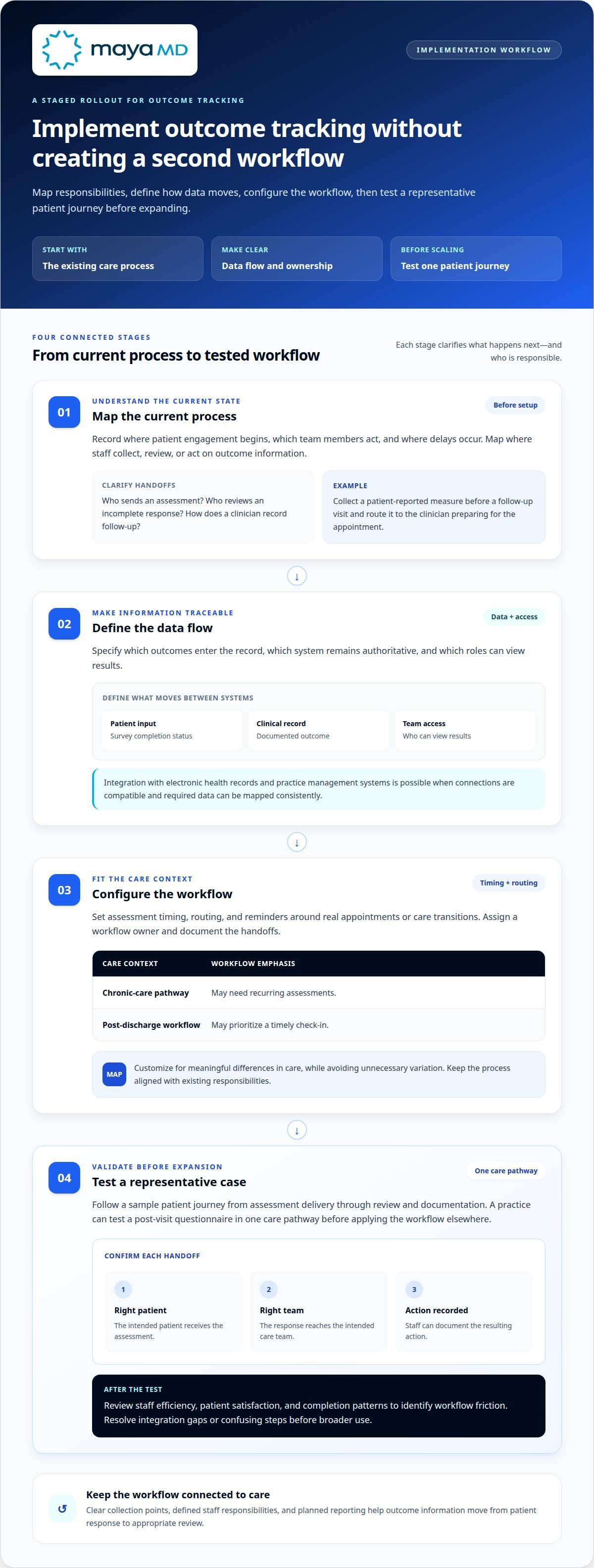
Implementation works best when software follows an existing care process instead of creating a second one. Start by mapping where staff collect, review, or act on outcome information. For example, a clinic might collect a patient-reported measure before a follow-up visit and route it to the clinician preparing for the appointment.
Can patient outcomes software integrate with electronic health records and practice management systems? Yes, integration is possible when systems support compatible connections and the required data can be mapped consistently. Define what information should move between systems, such as survey completion status or a documented outcome, and where staff should review it.
Organizations can make implementation more manageable by assigning a workflow owner and documenting handoffs. A practice manager, for instance, can map who sends an assessment, who reviews an incomplete response, and how a clinician records follow-up. Clarifying these responsibilities before introducing automated tasks helps preserve continuity in care.
Use a staged implementation instead of activating every feature at once. A practical sequence is:
Map the current process.
Record where patient engagement begins, which team members act, and where delays occur.
Define the data flow.
Specify which outcomes enter the record, which system remains authoritative, and which roles can view results.
Configure the workflow.
Set assessment timing, routing, and reminders around real appointments or care transitions.
Test a representative case.
Follow a sample patient journey from assessment delivery through review and documentation.
For example, a practice could test a post-visit questionnaire in one care pathway before applying the workflow elsewhere. Confirm that the right patient receives the assessment, the response reaches the intended team, and staff can document the resulting action. This can reveal integration gaps and confusing steps before they affect a broader workflow.
Customization should address meaningful differences in care without creating unnecessary variation. A chronic-care pathway may need recurring assessments, while a post-discharge workflow may prioritize a timely check-in. Configure each process around its clinical purpose, then review staff efficiency, patient satisfaction, and completion patterns to identify friction.
When workflow mapping reveals complex handoffs or disconnected communication, discuss your clinical workflow needs as a next step toward defining a suitable implementation approach.
Patient surveys and reporting
Patient outcome platforms collect responses through digital questionnaires delivered before or after care encounters. They organize submitted answers alongside clinical measures, then report patterns through dashboards, summaries, or patient-level views. Kyruus Health’s 2024 benchmark found that 92% of consumers want to complete pre-visit questionnaires online, reinforcing the value of accessible survey collection.
Patient-reported outcome measures capture a person’s account of their health and daily function. A questionnaire might ask about pain, disrupted sleep, mobility, or whether symptoms interfere with routine activities. Clinical outcome measures use information such as blood pressure, laboratory results, or documented encounters. Platforms can report both categories, depending on the measures selected and the data available to the care team.
Survey design affects how well teams can interpret results. Choose questions that match a defined care objective, use consistent response options, and specify when the information will be collected. Asking about mobility before and after a rehabilitation plan, for example, creates a more useful comparison than changing the question between assessments. Concise surveys can also reduce unnecessary burden and support patient satisfaction.
Reminder timing is another practical consideration. A digital reminder can prompt a patient who hasn’t completed a planned assessment, while a clear explanation helps show why the response matters. Keep the message connected to the relevant visit or care transition. For example, a follow-up survey can ask about current symptoms and whether the patient needs assistance, creating a direct route from patient experience to review.
Reports should help clinicians interpret results, not simply display response totals. A useful analytics view can group results by measure, care pathway, and collection period. Teams can then distinguish an improving score from an unanswered survey or a measure collected at a different stage. Software for tracking patient outcomes becomes more useful when each chart has a clear definition and supports a specific review decision.
For a practical reporting workflow, connect each survey to a question the team needs to answer:
Set the purpose.
Identify whether the survey assesses symptoms, function, or experience.
Choose the measure.
Match question wording and response options to that purpose.
Set collection points.
Define when patients receive the survey, such as before a visit or after a care transition.
Review the report.
Examine completion, changes, and unanswered items together.
If a report shows worsening patient-reported pain alongside unchanged clinical measures, for example, the care team can review both perspectives. That combined view can strengthen patient engagement by making concerns visible during follow-up. A consistent reporting method also helps organizations compare patient satisfaction and outcomes across care processes without conflating different measures.
Remote monitoring can extend survey reporting beyond a visit by pairing patient updates with measures collected at home. UCLA Health reported a 75% reduction in emergency department visits and readmissions for patients with postpartum hypertension after starting its blood-pressure monitoring program. Reports can make those measures easier to review by showing trends alongside patient-reported symptoms and flagging responses that need follow-up. Teams should define who reviews incoming information and how concerns are routed, so reporting supports timely action as well as evaluation of care.
Identifying trends and problem areas
A clinical outcomes platform can reveal patterns that individual appointment notes may not show. Teams can examine changes across visits, care pathways, and patient groups, then investigate where follow-up or access may be breaking down. The value lies in connecting a visible pattern to a specific operational question, not treating every variation as a clinical signal.
No-shows offer one example. About one in four US medical groups told MGMA that no-shows rose in 2025; about one in three reported increases in 2026. These findings make appointment attendance a useful operational measure to monitor. A practice can segment missed visits by care pathway or appointment type, then examine scheduling and reminder workflows for possible friction.
Access problems can appear before a visit is booked. Patient Prism’s analysis of 8,280 dental locations found that 31% of patient calls never reached a person. A hospital or clinic reviewing call outcomes alongside appointment completion can investigate whether patients encounter barriers before entering care. The platform should make these measures visible together, while preserving the distinction between a missed call and a missed visit.
Use a consistent review sequence to move from trend to action:
Define the signal.
Select a measure, such as missed appointments, incomplete assessments, or delayed follow-up.
Set the comparison.
Compare equivalent care pathways and time periods, rather than mixing different patient groups.
Locate the point of friction.
Trace the process from initial contact through appointment delivery and follow-up.
Assign a response.
Identify the team responsible for reviewing the pattern and testing a workflow change.
Reassess the measure.
Review later results using the same definition and comparison method.
For example, a clinic may notice fewer completed follow-up visits in one pathway. Staff can examine whether patients received appointment information, whether calls connected, and whether follow-up was recorded. This stepwise review helps distinguish a workflow gap from a change in patient outcomes and directs attention to a specific point in care delivery.
Interpretation also requires context. A change in reported symptoms may reflect the patient’s experience, the timing of collection, or differences in who responded. Reviewing response completeness alongside clinical measures helps teams avoid mistaking incomplete data for improvement. A unified view of appointment, contact, and outcome information can help clinicians decide which patterns need investigation, while the care team retains responsibility for clinical decisions.
Trend analysis is useful when each finding leads to a defined review, an accountable owner, and a consistent measure. After changing how follow-up calls are routed, for instance, a hospital team can review the same access and attendance indicators again. This turns a dashboard pattern into a focused quality-improvement cycle.
What software is available for tracking patient outcomes?
Organizations can choose from several software categories, each supporting a different part of outcome measurement. Electronic health record modules can place assessment results beside clinical documentation. Patient-reported outcome platforms focus on questionnaires and score comparisons. Remote monitoring systems collect ongoing information, while analytics tools combine data for broader service-level review. When selecting software for tracking patient outcomes, start with the decisions your teams need to make.
An EHR-based option can suit teams that want outcome information close to the patient record. A clinician reviewing a follow-up visit, for example, may see a completed symptom assessment alongside documented care. A dedicated survey platform may offer more flexibility in questionnaire delivery and reporting. Its value depends on whether results can enter the clinical workflow without creating separate review tasks.
Remote patient monitoring software serves a different purpose. It supports ongoing observation of health measures between in-person visits, especially when care teams need to review recurring patient information. Population health and analytics platforms help leaders examine patterns across care pathways. They can answer questions such as whether reported outcomes differ by pathway or collection point.
Common software categories include:
EHR modules
Keep assessment results within clinical documentation and patient records.
Survey platforms
Deliver patient questionnaires and organize responses for review.
Remote monitoring systems
Support ongoing collection of patient information between visits.
Analytics tools
Combine outcome data for comparisons across programs or populations.
These categories can overlap. A platform may collect survey responses and connect them with clinical record information, while another may focus mainly on reporting. Map the intended process first: who receives the data, where it appears, and what action follows. For example, a care team tracking patient function may need a questionnaire before follow-up and a view of the results at the next appointment.
Selection should also account for measure definitions, data completeness, reporting access, and workflow fit. Ask how the system distinguishes a missing response from a completed assessment and whether reports can separate care pathways. A clear demonstration should follow a representative patient journey from data collection through staff review and documentation. This can reveal practical gaps that a feature list may not show.
Choose software according to the population, measures, and decisions involved, rather than assuming one category covers every use case. Discuss your clinical workflow needs to identify an appropriate path for connecting patient engagement and outcome review.
MayaMD
MayaMD is a natural next step when outcome tracking depends on consistent patient communication and follow-up. Its AI patient engagement and automated post-discharge communication solutions help keep patients connected to care. These capabilities can complement an organization’s outcome-tracking approach, while clinical teams decide which measures to collect and how to act on results.
Consider this support when patients need clear communication after discharge or when engagement between care encounters is part of the workflow. A defined follow-up process can help teams gather patient feedback and maintain continuity, giving clinicians relevant information to review alongside other outcome measures.
Contact MayaMD to discuss your patient engagement and follow-up needs.
Make outcome insight part of the next care decision
The next step is to define how outcome information will inform care, not simply where it will be stored. Assign clear ownership for reviewing results, decide how patient concerns enter follow-up, and establish a consistent process for bringing information into clinical discussions. This gives teams a practical foundation for using software for tracking patient outcomes within the care they already deliver.
MayaMD offers a Clinical AI Agent, AI patient engagement solutions, and automated post-discharge communication solutions. These capabilities support patient communication and continuity around an outcome-tracking workflow, while clinical teams interpret information and determine care. The right fit depends on the role patient engagement and follow-up play in your organization’s approach.
Contact MayaMD about outcome tracking to discuss how these capabilities may fit your clinical workflows. A thoughtful next step can help your team make patient information more useful in care.
Frequently Asked Questions
What features should healthcare providers look for in patient outcomes software?
Choose features that support the measures and decisions central to your care program. A cardiology team, for example, may need to review patient-reported symptoms alongside clinical data, while a rehabilitation service may prioritize functional assessments. Look for clear measure definitions, useful patient-level and group reporting, and ways to distinguish incomplete responses from recorded results. Confirm that reports support the decisions clinicians actually make.
What HIPAA, privacy, and security requirements apply to patient outcomes software?
In the United States, HIPAA compliance is a cornerstone for real-time analytics platforms handling patient information. Privacy and security review should also cover who can access data, how information is protected during transfer, and where it is stored and processed. SOC 2 is another framework organizations can ask vendors about, but it is distinct from HIPAA. Consider how the platform’s controls align with applicable local regulations.
How do clinics and hospitals implement patient outcomes tracking software?
Clinics and hospitals can implement tracking by choosing one care pathway, assigning an operational owner, and mapping how information will reach the staff who use it. A hospital could pilot an outcomes workflow for one discharge pathway, then trace a sample case from patient enrollment to clinician review. Use the pilot to clarify responsibilities, resolve handoff issues, and document how teams will maintain the process before expanding it.
How do leading patient outcomes tracking platforms compare?
Platforms vary in whether they collect patient-reported measures, clinical data, or both. Compare reporting capabilities, workflow fit, integrations, and how clearly each platform connects data collection with clinical review and follow-up.




See The MayaMD Difference
Fill the form below
Download Our Apps
MayaMD for patients and MayaPro for physicians - available on iOS and Android.
FOR PATIENTS
MayaMD App
AI-powered symptom assessment, triage, and secure access to your care team.


FOR PHYSICIANS
MayaPro App
MayaPro brings patient vitals, RPM/PCM care plans, and clinical decision support to your pocket.