
Scalable RPM Platforms for Hospitals: 2026 Evaluation Guide

An RPM program can collect more data as it grows without making care more coordinated. A scalable RPM platform for hospitals needs to support the clinical workflows, oversight, and patient relationships that turn monitoring data into appropriate follow-up. Otherwise, expansion can add alerts and administrative work without improving how care teams respond.
That’s a familiar concern for hospital leaders evaluating platforms across patient populations, service lines, and care teams. The challenge isn’t simply finding technology that can accommodate more participants. It’s determining whether the platform fits existing workflows, connects with the organization’s systems, and makes responsibilities for review and escalation clear.
This guide offers a practical framework for assessing interoperability, access and oversight, patient engagement, operational support, and program expansion. It includes questions to ask vendors and steps for defining a focused starting point, so teams can assess workflow fit before scaling. MayaMD is one option to evaluate: its cloud-based, HIPAA-compliant clinical AI platform combines deterministic logic with generative AI and supports RPM and chronic-care workflows. Compare its capabilities with your organization’s clinical and technical requirements.
Key Takeaways
• Assess scalability as both technical capacity and the ability to sustain clear staffing, patient support, and escalation processes.
• Map how monitoring information moves from collection to review, documentation, and follow-up, with accountable clinical ownership at each step.
• Use consistent criteria to evaluate workflow fit, interoperability, oversight, patient engagement, and reporting when comparing RPM platforms.
• Define program goals, eligible populations, team responsibilities, escalation pathways, and evaluation measures before expanding beyond an initial pilot.
• Evaluate MayaMD’s cloud-based, HIPAA-compliant clinical AI platform against organizational requirements, including how its deterministic logic and generative AI may support RPM and chronic-care workflows.
What makes an RPM platform scalable for hospitals?
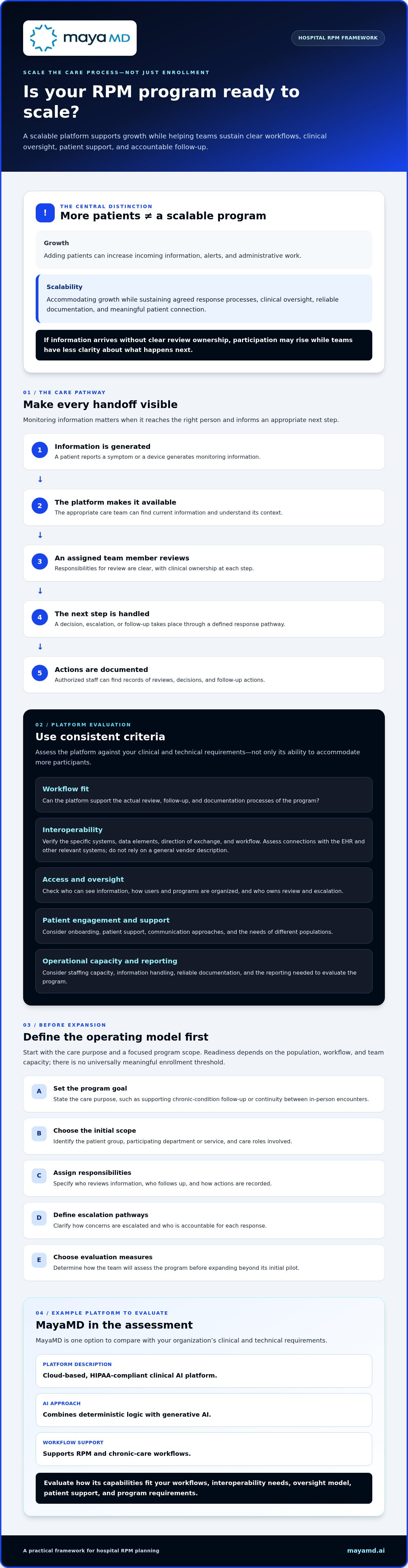
A hospital can enroll more patients without creating a scalable program. A scalable RPM platform for hospitals supports growth in monitored care while preserving safe, workable clinical processes, clear accountability, and meaningful patient connection. Enrollment volume is only one measure. Teams must also be able to review incoming information, identify when follow-up is needed, and document actions reliably as the program expands.
The technical layer matters: hospitals may need to organize users and programs across departments, manage role-based access, and accommodate different care settings. Operational scale matters just as much. Staffing capacity, escalation ownership, patient onboarding and support, and processes for handling monitoring information all affect whether expansion is sustainable. An overview of Remote patient monitoring (RPM) provides context for its applications, while hospital evaluation must account for local clinical processes.
Which hospital needs should an RPM platform serve?
Start with the care purpose, not a hospital-wide enrollment target. RPM may support follow-up for people managing chronic conditions and help care teams maintain continuity between in-person encounters. A goal such as coordinating monitoring across programs is different from the workflow of any single program. Patient populations, information to review, responsible teams, and follow-up processes may all vary.
Define the initial scope precisely. Identify the patient group, participating department or service, and care roles involved. Specify who reviews information, who follows up, and how actions are recorded. This gives teams a practical basis for assessing fit before adding populations or care transitions, such as support after discharge.
How is growth different from true scalability?
Growth means adding patients. Scalability means accommodating that growth while sustaining agreed response processes, clinical oversight, and reliable documentation. If enrollment adds information without clear review ownership, participation may increase while teams face more work and less clarity about next steps.
Patient engagement and data handling can also change as a program broadens. Different groups may need different onboarding or communication approaches, while care teams need usable processes for reviewing and documenting incoming information. There is no universally meaningful enrollment threshold. Readiness depends on the population, workflow, and team capacity, so assess the operating model alongside the platform’s technical capabilities.
How do data, workflows, and clinical oversight enable RPM at scale?
Monitoring information is useful only when it reaches the right person and informs an appropriate next step. A defined clinical response pathway should make clear who reviews information, how concerns are escalated, and where follow-up is documented. Without one, new data sources can create fragmented queues instead of continuity of care.
Map the full journey: a patient reports a symptom or a device generates information; the platform makes it available for review; an assigned care team member assesses it; and any decision, escalation, or follow-up is recorded. The RPM implementation playbook from the American Medical Association can help teams structure program planning around clinical and operational workflows.
What should hospitals examine in RPM data flows?
Document where information originates, which team members can see it, and how actions are captured. Then assess whether the platform can connect with the hospital’s EHR and other relevant systems. Don’t assume interoperability based on a general vendor description. Verify the specific systems, data elements, direction of exchange, and workflow involved. Standards such as HL7 FHIR may be relevant, but confirm their use and implementation for the proposed environment.
Visibility
Can the appropriate care team find current monitoring information and understand its context?
Documentation
How are reviews, decisions, and follow-up actions recorded, and where can authorized staff find them?
Access
Can the hospital confirm which roles can view or act on information, and whether access matches their responsibilities?
How should clinical oversight and AI fit together?
Define which tasks require professional judgment and what kinds of assistance are appropriate. A platform may organize information or support documentation, but hospitals should establish who validates relevant information, makes clinical decisions, and takes responsibility for escalation. Ask vendors how automated functions are configured, monitored, and reviewed, including how deterministic logic and generative AI are governed. AI should support the care process, not replace clinical judgment.
MayaMD describes its cloud-based, HIPAA-compliant clinical AI platform as combining deterministic logic with generative AI to support RPM and chronic-care workflows. Hospitals can review the stated capabilities of its Clinical AI Agent against their oversight, documentation, and data-flow requirements. Confirm the specific fit rather than assuming a particular EHR integration or deployment configuration.
Map a representative patient journey, then compare it with the platform’s documented capabilities. Hospital teams can find contact information on MayaMD’s contact page when they are ready to discuss organizational requirements.
How can hospitals compare RPM platforms without overlooking operational risk?
A vendor demonstration can show what a platform does. A structured scorecard helps reveal what the hospital must still configure, connect, or staff. Compare each option against the same criteria and record the evidence behind every rating. This helps distinguish verified capabilities from assumptions and highlights dependencies that could affect implementation.
Enrollment growth can increase workload if responsibilities and escalation paths aren’t designed in advance. A platform may provide data visibility or communication tools, but the hospital still needs to establish who reviews information, who follows up, and how work is documented. Evaluate these operational requirements alongside technical features. Avoid ranking vendors or assuming better outcomes without comparable, verifiable evidence.
Which criteria belong in a hospital RPM scorecard?
Use the same questions for each platform. Tailor the evidence requested to the populations and care teams in scope, and note what the vendor provides versus what the hospital must supply or configure.
| Criterion | What to assess | Evidence and open questions |
|---|---|---|
| Workflow fit | Can the platform support program-specific review, follow-up, and documentation processes? | Record workflow demonstrations, configuration needs, and staff responsibilities. |
| Interoperability | Which EHRs or other systems can exchange the required information, and how? | Verify supported connections, data elements, exchange direction, and implementation dependencies. |
| Oversight and access | How are user roles, information visibility, and review responsibilities handled? | Request documentation of relevant controls and clarify which oversight processes the hospital must define. |
| Patient engagement | Do communication and onboarding processes suit the intended population and support continued participation? | Review available communication options and identify accessibility or support needs to address. |
| Reporting | Can teams review program activity and document the measures they need to evaluate? | Confirm available reports, definitions, and any configuration or manual work required. |
For each criterion, capture the vendor’s evidence, unresolved questions, and dependencies, such as hospital staffing, workflow decisions, or technical review. The resulting record can guide procurement discussions and help teams identify what needs to be resolved before implementation.
How can teams evaluate governance and compliance claims?
Ask vendors to explain the security, privacy, access, and oversight controls relevant to the proposed use. Have the organization’s qualified compliance and security stakeholders assess those claims against current HIPAA and other applicable requirements. A vendor statement alone doesn’t establish fit for every hospital environment. MayaMD describes its offering as a cloud-based, HIPAA-compliant platform. Teams can review its remote patient monitoring information and verify specific requirements during evaluation.
A useful scorecard doesn’t assume a platform will solve operational risk by itself. It shows which capabilities are evidenced, which workflows require hospital decisions, and what must be confirmed before expansion.
What steps should hospitals take before expanding an RPM program?
Expansion should follow evidence from a defined use case, not an assumption that an initial enrollment will translate automatically to other populations. Before adding programs, establish who owns clinical decisions, what operational capacity is available, and how the patient experience will be evaluated. This readiness work helps teams determine whether a scalable RPM platform for hospitals can support their intended model and what the organization must configure or provide.
What should an RPM readiness assessment include?
Bring executive sponsors, clinical owners, operational leads, technical teams, and compliance stakeholders into planning early. Document the current workflow, capacity constraints, and intended patient experience, then agree on evaluation measures before expansion. A practical readiness sequence is:
Define the goal and use case.
Specify the clinical objective and the population the program is designed to serve.
Assign ownership.
Identify executive sponsorship, clinical decision-makers, operational leads, and compliance contacts.
Document the operating model.
Record patient eligibility criteria, onboarding steps, team responsibilities, review processes, and escalation pathways.
Plan implementation workstreams.
Assess integration requirements, staff training, patient communication and onboarding, and the operational support the program will need.
Set evaluation measures.
Choose indicators for workflow fit, patient engagement, documentation, and operational feedback before the evaluation begins.
Review pilot evidence.
Compare observed performance and staff and patient feedback with the agreed measures. Resolve gaps before deciding whether, where, or how to expand.
How should hospitals structure a phased evaluation?
Begin with a defined clinical use case and a scope the participating teams can evaluate responsibly. For example, a hospital might assess a chronic-care workflow within one service before considering additional departments. Keep the evaluation focused enough to identify where processes work, where staff capacity is constrained, and what patient support needs adjustment.
At review, look beyond enrollment. Assess whether onboarding is understandable, relevant information reaches the intended team, documentation fits the workflow, and staff feedback points to manageable next steps. If the evaluation surfaces gaps, revise responsibilities, training, or implementation plans before broadening the program. MayaMD’s remote patient monitoring information provides an overview of its stated offering.
Use readiness findings to decide what requirements a platform must meet and which questions still need vendor validation. MayaMD’s contact page is available for hospitals assessing their RPM requirements and platform fit.
How can MayaMD fit into a hospital RPM platform evaluation?
MayaMD can be considered as one candidate against the clinical, operational, and technical requirements a hospital has already defined. The company describes its platform as cloud-based and HIPAA-compliant, with support for remote patient monitoring (RPM) and chronic-care workflows. Its stated combination of deterministic logic and generative AI is a capability to examine, not evidence that the system makes clinical decisions autonomously or will fit every hospital environment.
Which MayaMD capabilities are relevant to RPM evaluation?
MayaMD describes its Clinical AI Agent and patient engagement capabilities in the context of supporting patients with chronic conditions. Clinical documentation support may also be relevant when teams assess how information and follow-up fit existing work. Hospitals should verify intended workflows and human review responsibilities directly. MayaMD lists RPM, Principal Care Management (PCM), and Advanced Primary Care Management (APCM) as distinct offerings. Assess each program’s scope and requirements separately.
For an overview of the stated RPM offering, review MayaMD’s remote patient monitoring information. Use it as a starting point for vendor questions, then confirm technical details and operational fit.
What should hospital teams confirm with a vendor?
Use the discussion to test requirements identified in the hospital’s evaluation, rather than presume suitability. Request specific evidence and clarify what the vendor provides, what the hospital must configure, and what requires internal staffing or governance.
Integrations
Which systems and data flows are supported for the hospital’s intended use case? Confirm technical details rather than relying on broad interoperability claims.
Governance
How are deterministic logic and generative AI used, reviewed, and monitored? What remains the responsibility of a qualified care team?
Implementation
Which tasks belong to the vendor and which to hospital teams, including configuration, training, and workflow design?
Patient communication
What engagement processes are available, and how can the hospital assess whether they fit the target population?
Documentation
How does documentation support fit the intended workflow, and where must staff review or record actions?
Then define a scoped evaluation with a specific population, workflow, responsible team, and measures for reviewing fit. A scalable RPM platform for hospitals must meet organizational requirements in practice, not just in a product description. Keep unresolved questions visible and avoid assuming outcomes before evidence is available.
Discuss whether MayaMD fits your RPM program by sharing the clinical, technical, and operational requirements your hospital needs to assess.
Build a Stronger Foundation for RPM Expansion
A scalable RPM platform for hospitals is only part of a sustainable program. Expansion also depends on defined clinical ownership, workable data flows, clear escalation pathways, and patient engagement that fits the populations served. Evaluate vendors against documented requirements, then use a focused pilot to assess workflow fit, integration needs, documentation, and operational feedback before broadening scope.
MayaMD describes its platform as cloud-based and HIPAA-compliant, combining deterministic logic with generative AI. Its offerings include remote patient monitoring and chronic-care support. These capabilities may be relevant to your evaluation, but confirm fit, integrations, governance, and implementation responsibilities against your organization’s needs.
Take the next step with a clear set of clinical and technical questions. Discuss your hospital RPM requirements with MayaMD to explore whether its stated capabilities align with your program. A deliberate evaluation keeps oversight and patient connection in view as teams consider expansion.
Frequently Asked Questions
What makes an RPM platform scalable for a hospital?
A scalable RPM platform supports growth in monitored care while preserving workable clinical processes, oversight, and patient support. Technical capacity is only one part of the assessment. Hospitals should also examine whether teams can review incoming information, document actions, manage escalation, and maintain appropriate patient communication as programs expand. Enrollment volume alone doesn’t show whether a platform fits defined populations and workflows.
How do hospitals choose a remote patient monitoring platform?
Hospitals should compare documented platform capabilities with defined clinical, operational, and technical requirements. Assess workflow fit, interoperability, access controls, clinical oversight, patient engagement, documentation, and reporting. Ask vendors to distinguish what their platform provides from what the hospital must configure, staff, or govern. A focused evaluation using a defined population and use case can identify dependencies before broader expansion.
Can RPM platforms integrate with a hospital EHR?
Some RPM platforms may support EHR connectivity, but hospitals should verify the specific integration rather than assume it is available or suitable. Confirm which systems and data elements are supported, whether information flows into or out of the EHR, and how review and documentation fit the workflow. Ask about implementation responsibilities and validate technical requirements with internal IT and clinical stakeholders. Standards such as HL7 FHIR may be relevant, depending on the systems and use case.
How can hospitals prevent RPM alerts from overwhelming clinical teams?
Hospitals can reduce the risk of alert overload by defining review ownership, triage criteria, escalation pathways, and documentation expectations before enrollment grows. Determine which team receives each type of information, what requires follow-up, and how actions are recorded. Evaluate alert configuration and workflow fit for the intended population. During a pilot, gather staff feedback and review workload patterns so teams can refine processes before expanding the program.
Is a cloud-based RPM platform suitable for hospital use?
A cloud-based RPM platform may be suitable for hospital use if its capabilities and controls align with the organization’s security, privacy, technical, and clinical requirements. Hospitals should review vendor documentation with qualified compliance, security, IT, and clinical stakeholders. Assess data handling, access, governance, integration needs, and implementation responsibilities for the intended use. Cloud hosting alone doesn’t establish suitability, so verify vendor claims against organizational requirements.
What should hospitals measure when evaluating an RPM program?
Hospitals should select measures before an evaluation begins and connect them to the program’s clinical and operational goals. Areas to assess include workflow fit, patient onboarding and engagement, data review and follow-up, documentation, escalation processes, and staff feedback. Define how each measure will be collected and who will review it. Use pilot findings to identify implementation gaps and inform whether the program is ready for carefully scoped expansion.
How does AI support remote patient monitoring for chronic care?
AI may support RPM workflows by helping organize information, facilitate patient engagement, or assist with documentation, depending on the platform’s capabilities. It should operate within defined governance and human-review processes, not replace clinical judgment. MayaMD describes its cloud-based, HIPAA-compliant clinical AI platform as combining deterministic logic with generative AI and supporting RPM and chronic-care workflows. Hospitals should verify intended functions, oversight boundaries, and fit with their own processes.




See The MayaMD Difference
Fill the form below
Download Our Apps
MayaMD for patients and MayaPro for physicians - available on iOS and Android.
FOR PATIENTS
MayaMD App
AI-powered symptom assessment, triage, and secure access to your care team.


FOR PHYSICIANS
MayaPro App
MayaPro brings patient vitals, RPM/PCM care plans, and clinical decision support to your pocket.