
Reducing Physician Burnout with AI Tools in Houston

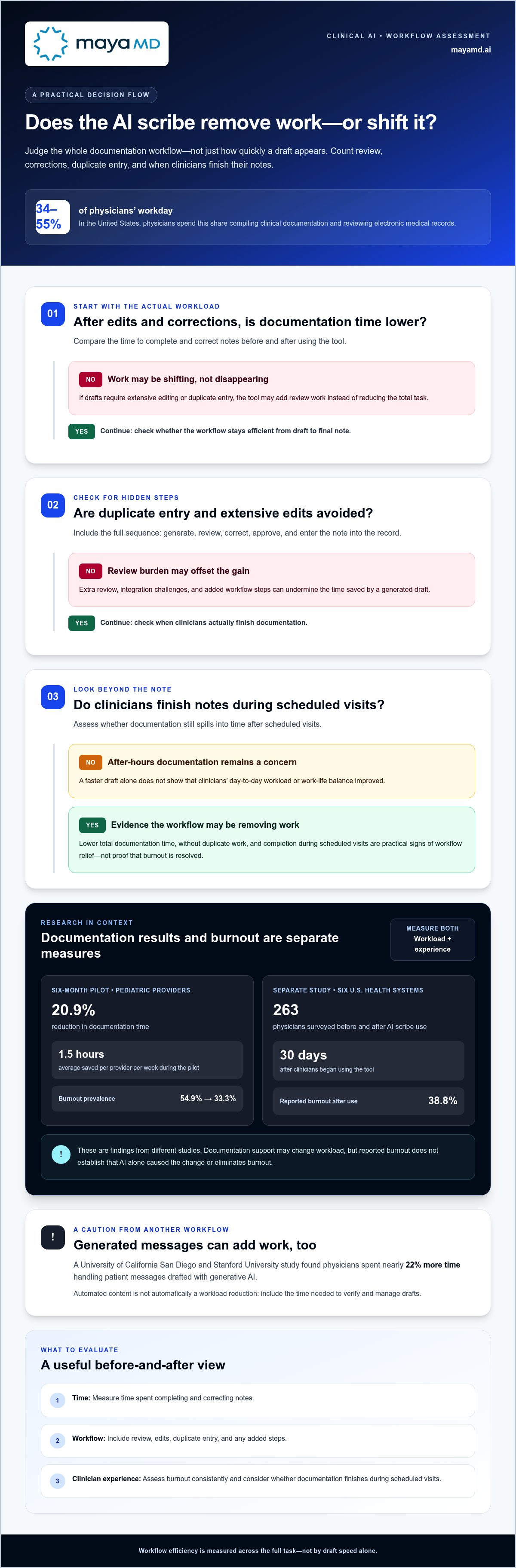
After using an AI scribe, 38.8% of surveyed physicians still reported burnout. That finding gives a measured answer for health systems considering reducing physician burnout with AI tools: documentation support may ease part of the workload, but it doesn’t eliminate burnout or prove that every tool improves clinicians’ experience.
The pressure is familiar: time spent in electronic health records and on paperwork competes with patient care and personal time. MayaMD recognizes that AI may help when it removes documentation tasks from the workflow, but extra review, integration challenges, or added steps can undermine that benefit.
This article explains what research shows about AI scribes and burnout, where workflow efficiency and work-life balance may improve, and why clinical oversight remains essential. It also considers how these findings apply to modern care settings, helping clinicians and healthcare leaders weigh potential benefits against practical limits.
Key Takeaways
• Assess AI scribes by whether they reduce documentation work in the existing clinical workflow, not simply by how quickly they generate notes.
• Interpret burnout findings in context: changes in reported symptoms can inform adoption decisions, but they don’t establish that AI alone resolves burnout.
• Keep clinicians responsible for reviewing AI-generated documentation and making clinical decisions, with clear oversight built into the workflow.
• Consider how implementation affects after-hours charting, workload distribution, and clinicians’ ability to maintain work-life balance.
• Explore how patient engagement and post-discharge communication tools can support continuity of care while reducing administrative friction.
AI scribes and automated clinical documentation
AI scribes convert spoken visits into draft clinical notes, offering another way to manage electronic medical record documentation. In the United States, physicians spend between 34 and 55 percent of their workday compiling clinical documentation and reviewing electronic medical records. Paperwork also takes double-digit hours each week, creating administrative work alongside patient care.
Ambient AI scribes listen during an encounter and prepare a draft, reducing the need for physicians to dictate every note afterward. A generated note may organize a visit into history of present illness, review of systems, examination, assessment, and plan. Physicians review the output, correct inaccuracies, and decide what belongs in the patient’s record.
How do AI medical scribes compare with human scribes and standard dictation? A human scribe documents the encounter, while standard dictation captures the physician’s speech for later transcription or entry. An AI scribe transcribes and summarizes the patient conversation into a structured draft for the clinician to review and edit.
What HIPAA, Texas privacy, and patient-consent rules apply to AI clinical tools? Organizations should account for HIPAA and applicable Texas privacy requirements in their workflows, including how encounter audio and generated notes are accessed, stored, and disclosed. They should establish patient notice and consent practices suited to the specific workflow and applicable law.
One six-month pilot of a generative AI digital scribe among pediatric providers found a 20.9% reduction in documentation time. Providers saved an average of 1.5 hours per provider per week during the pilot. Burnout prevalence among those providers decreased from 54.9% to 33.3%, showing how documentation results and clinician-reported outcomes can be evaluated together.
A separate study surveyed 263 physicians at six U.S. health systems before and after AI scribe use. Researchers surveyed physicians 30 days after they began using the tool; 38.8% reported burnout after use. These findings offer a measured view: documentation support may change workload, but burnout outcomes need to be considered separately.
Which health systems use AI scribes or clinical workflow tools? The study covered physicians at six U.S. health systems, but it doesn’t establish which systems adopted AI scribes. A system’s own public announcement is needed to identify a specific adopter; participation in a multi-system study alone doesn’t establish implementation.
For healthcare organizations, the practical test is whether a tool removes work from the existing workflow. Track time spent completing and correcting notes, then assess whether clinicians still finish documentation after scheduled visits. If generated drafts lead to duplicate entry or extensive editing, the system may shift administrative work rather than reduce it.
How is AI adoption shown to affect physician burnout levels?
AI adoption may reduce burnout when it removes administrative work, but new review tasks can offset those gains. Research findings support measuring physician experience alongside workload.
Administrative Burden and Burnout
Administrative burden is the documentation and bureaucratic work that competes with clinical responsibilities. It matters because time spent on these tasks can limit physicians’ capacity for patient care and recovery.
At the start of the study, 51.9% of surveyed physicians reported burnout, according to The study authors. In the 2023 Medscape survey, 61% of physicians identified administrative and bureaucratic tasks as a cause of burnout. Together, these findings make administrative workload an important part of understanding burnout, rather than treating it only as an individual resilience issue.
Organizations can identify the specific work creating friction in each department. Documentation, patient messages, and repetitive administrative steps affect teams differently, so match each tool to the task it is intended to address.
Administrative and Cognitive Workload
Administrative workload includes tasks such as documentation and message handling. Cognitive workload also includes reviewing outputs and resolving errors. AI can streamline repetitive work, but poor implementation may introduce integration challenges, bias concerns, or added oversight.
A University of California San Diego and Stanford University study found physicians spent nearly 22% more time handling patient messages drafted with generative AI. This example shows why automated content isn’t automatically a workload reduction. If clinicians spend extra time verifying and managing drafts, the system may shift effort rather than remove it.
Evaluate the full task sequence. For a generated message, include the time needed to review, correct, approve, and follow up. For documentation support, account for edits and duplicate entry. Comparing these steps reveals whether adoption streamlines work or adds cognitive demands.
Measuring Workload and Care Outcomes
Measurement compares clinician experience, workload, and care processes before and after adoption. It matters because faster output alone doesn’t show whether burnout or patient care has improved.
How can practices measure whether AI tools improve burnout, workload, and patient care? Use a consistent burnout assessment and track measures relevant to the tool, such as documentation time, message handling, and correction work. Pair these with suitable care-quality indicators and patient feedback.
Review results by role and workflow, then discuss whether saved time changed clinicians’ day-to-day experience. The National Academy of Medicine identifies workload and administrative burden as system-level drivers that require organizational and policy interventions. Technology evaluation is most useful when it informs those broader decisions. Discuss clinical AI workflow evaluation when planning an implementation.
Physician oversight and clinical accuracy
AI can support clinical workflows, but physicians must retain responsibility for patient care decisions. Oversight should cover generated records, clinical alerts, and any evidence used to guide care.
Reviewing AI outputs
An AI-generated note or recommendation is an input for clinician review, not a substitute for clinical judgment. During a patient visit, a physician can compare a suggested assessment with reported symptoms, examination findings, and the existing record.
Review clinically consequential details: medication names, doses, allergies, dates, and whether the documented plan reflects the conversation. A missed negation, such as “no chest pain,” can change a note’s meaning. Clear correction and approval steps keep accountability with the treating clinician.
Evidence matters, too. AI tools that summarize literature can help clinicians identify relevant findings, but physicians still need to assess the source, population, and applicability to the patient. When using AI clinical guidance alongside references such as UpToDate, teams should distinguish generated summaries from verified clinical recommendations.
Training and change management
Training should use realistic cases from the clinic’s workflow, not generic software demonstrations. Staff can practice correcting a draft note, handling an incomplete medication history, and escalating an alert that conflicts with the patient record.
Change management also requires defined roles. A clinic should specify who reviews generated documentation, who resolves integration errors, and how clinicians report unsafe or inaccurate outputs. These steps help teams identify when a tool adds cognitive work instead of allowing workloads to shift unnoticed.
During implementation, leaders can gather clinician feedback and review corrected outputs. This makes recurring problems visible, such as missing context in follow-up visits or alerts that don’t fit local care pathways.
Alerts and care coordination
Clinical alerts are useful when they connect relevant patient information to a clear next action. An alert about worsening heart-failure symptoms, for example, should reach the appropriate care team with enough context to support follow-up, rather than simply adding another notification.
AI-triggered coordination and monitoring are associated with heart-failure readmission reductions on the order of 26-34%. That finding supports examining how alerts connect to timely care, while preserving clinician review of patient-specific decisions.
For Houston practices, clinical accuracy depends on usable records, workflow integration, and trained users. Assess whether the system presents its basis clearly, supports correction, and routes alerts appropriately. A tool that produces fluent text but obscures its source or creates unreviewed tasks can complicate care instead of supporting it.
Workflow efficiency and work-life balance
AI workflow tools can support efficiency when they remove steps or improve task routing. Their value depends on whether redesigned workflows give clinicians time back instead of shifting administrative work elsewhere.
There is no single standard cost for AI scribes or physician workflow tools. Pricing depends on factors such as tool scope, integration needs, implementation, and ongoing support.
Task Reallocation and Workflow Redesign
Task reallocation assigns work to the team member or system best suited to complete it. This matters because physicians can spend less time on work that doesn’t require their clinical expertise.
One workflow redesign removed a handwritten discharge form from physicians’ responsibilities and reassigned tasks to appropriate team members. The change reduced perceived workload. A similar review can map each step, identify duplicate entry, and clarify who handles follow-up, documentation, and patient communication.
Efficiency depends on the whole process. If an AI tool generates a summary but clinicians still have to copy it into several records, the workflow retains avoidable steps.
AI Tools Across Physician Workflows
AI tools can support different workflow stages, from triage and documentation to imaging review and routing. A tool’s usefulness depends on its fit with the specific setting and the work it is meant to streamline.
In radiology, for example, an AI workflow tool may help organize imaging queues or flag studies for review. Radiologists still interpret images and determine clinical significance. The operational question is whether routing supports timely review without adding unnecessary alerts.
A scoping review synthesized 20 academic and grey-literature studies on AI-driven workflow optimization and healthcare worker mental health. That range of settings makes local measurement important: insights from one workflow may not predict outcomes in another.
Work-life balance involves more than faster task completion. In a Sermo physician survey, 37% said they struggled to achieve work-life balance, while 67% felt their clinics could do more to support it. AI adoption should therefore be evaluated alongside schedules, workload distribution, and after-hours tasks.
The 2023 Medscape survey found 44% of physicians said a more manageable work schedule would help reduce burnout; 37% identified too many work hours as a contributor. Another 33% said lighter patient loads would help. These findings point to organizational factors that software alone cannot change.
For healthcare leaders, compare workflows before and after implementation: time spent on tasks, work completed after clinic hours, and clinician feedback. If a tool saves time but that capacity becomes additional appointments, efficiency may improve without improving work-life balance. Outcomes depend on how the organization uses the time returned.
Physician burnout outcomes
Burnout outcomes matter beyond an efficiency metric: they affect physicians, patients, and healthcare organizations. Artificial intelligence is a potential solution for specific workflow pressures, but meaningful evaluation considers whether doctors’ reported symptoms, work conditions, and care experiences change together.
Interpreting burnout measures
A burnout score describes reported symptoms; its meaning depends on the scale’s definitions. In the study’s five-point assessment, a score of 3 indicated one or more burnout symptoms, while a score of 4 meant symptoms would not go away. A score of 5 represented complete burnout. These distinctions help organizations interpret movement in scores without treating every symptom level as equivalent.
For example, a change from persistent symptoms to occasional symptoms differs from a change to no reported symptoms. Practices should examine the distribution of scores and physicians’ reported experiences, not rely on a single average. This context helps leaders understand whether an intervention is associated with meaningful change in doctors’ day-to-day experience.
Why outcomes matter to organizations
Burnout can influence whether physicians remain in practice. This organizational impact makes retention a relevant outcome alongside documentation time, patient engagement, and clinical workflow performance.
Specialty context also matters. In the 2022 survey findings, emergency medicine, internal medicine, and pediatrics were the specialties most impacted by physician burnout. A system evaluating an AI intervention should examine results by specialty and workflow, since pressures in emergency care may differ from those in a pediatric clinic.
In 2021, 33% of U.S. medical practices reported losing at least one doctor to burnout. This finding highlights why leaders should consider workforce outcomes, not just whether software completes a task. Tracking retention alongside physician feedback gives organizations a fuller view of whether changes support a sustainable practice environment.
Set outcome measures that reflect real work
A practical evaluation pairs a consistent burnout assessment with measures tied to the tool’s purpose. For an administrative tool, this could include after-hours work and time spent on routine tasks; for a patient communication tool, it could include follow-up completion and patient feedback. Compare the same measures over time and review results by role or specialty.
Survey findings also point to issues technology cannot resolve alone. In the 2023 Medscape survey, 45% of physicians said increased compensation would help reduce burnout, while 31% identified lack of control and autonomy as a contributor. AI adoption should therefore sit within broader organizational learning and engagement efforts, not replace attention to workplace conditions.
Houston healthcare leaders evaluating AI outcomes can discuss AI-supported care workflows in relation to their organization’s priorities.
MayaMD: Clinical AI Agent
MayaMD’s Clinical AI Agent supports patient engagement and post-discharge communication, helping care teams manage interactions beyond the visit. For Houston organizations exploring ways to reduce administrative friction, these tools can complement workflow improvements by supporting follow-up and continuity of care. They aren’t AI scribes and don’t replace physician judgment or clinical oversight.
Consider these solutions when patient communication or discharge follow-up creates pressure in your care process. Assessing where messages, follow-up tasks, and clinical review fit in the workflow can help determine whether these capabilities suit your needs.
Contact MayaMD to discuss your organization’s care workflow.
Build a More Sustainable Path for Care Teams
For Houston organizations, reducing physician burnout with AI tools starts with a focused decision: which part of the care experience should become easier for clinicians and patients? Set that priority with frontline teams, then define how the change should affect daily work, continuity, and patient engagement. A shared objective keeps technology adoption connected to the work it is meant to support.
MayaMD offers a Clinical AI Agent, AI patient engagement solutions, and automated post-discharge communication solutions. These capabilities support organizations seeking to strengthen patient communication and follow-up as part of a broader workflow strategy. The next step is a practical discussion about your care pathways, implementation priorities, and how to evaluate fit within your organization.
Contact MayaMD to discuss AI solutions for your care workflows. Thoughtful planning can help Houston care teams move toward more connected, sustainable care.
Frequently Asked Questions
What Are AI Tools For Physicians?
AI tools for physicians are software that assists with clinical or administrative tasks. Examples include applications that draft visit notes, sort incoming patient questions, or organize follow-up information. Each tool has a defined function: a documentation assistant prepares text, while a triage system can structure symptoms for review. For teams evaluating reducing physician burnout with AI tools in Houston, identify the specific task creating friction before considering a tool.
Can AI make burnout worse?
Yes, AI can increase workload if it adds review, correction, or duplicate entry. For example, a clinician may spend more time editing an inaccurate patient message than writing one directly. Integration problems can also make relevant information harder to find. Evaluate the full workflow, including preparation, oversight, and follow-up, to see whether the technology removes work or simply transfers it to another step.
Does AI turn physicians from writers to editors?
AI can shift some documentation work toward editing, but the extent depends on draft quality and workflow design. A physician may review a generated note, confirm that it accurately reflects the visit, and correct missing context before signing. If the draft misrepresents the patient’s account, substantial rewriting may still be necessary. Clinicians retain responsibility for the final record and should be able to amend or reject generated content.
How could doctors use AI?
Doctors can use AI to organize information for clinical review, prepare draft documentation, or support patient communication. For instance, a symptom checker can structure a patient’s reported concerns and present possible conditions for clinician consideration. A care team might also use automated communication to support routine follow-up. These tools need a clear role in the workflow and should not make care decisions independently of clinicians.
How do AI solutions improve care coordination and workflow efficiency?
AI solutions can help organize patient information and direct communication to the appropriate care process. For example, a post-discharge communication tool can support follow-up after a patient returns home, while remote monitoring can make readings available for care-team review. Coordination improves when assigned staff can access the information, understand the next action, and document what happened. Clear task ownership helps prevent messages from becoming untracked work.
How much can AI reduce documentation time?
Reported reductions vary across tools and clinical workflows. Research summaries describe automated documentation cuts of 65-75%, while AI scribes and generative assistants are reported to reduce charting time by up to 75%. These figures describe reported potential, not a guaranteed result for each practice. Actual time savings depend on note complexity, system integration, clinician review, and whether information must be entered into separate records.
What Does the Research Say?
Research shows potential efficiency benefits alongside implementation challenges. In a Sermo physician survey, 78% of respondents were optimistic that AI could improve clinic efficiency by reducing documentation and non-clinical duties. In that survey, 74% believed autonomous AI could feasibly be integrated into their practices. These findings describe physicians’ views about feasibility and potential, rather than proving that adoption reduces burnout in every setting.
What AI tools are available to reduce physician burnout in hospitals and clinics?
For organizations considering reducing physician burnout with AI tools in Houston, relevant categories include AI patient engagement, virtual triage, remote patient monitoring, and automated post-discharge communication. MayaMD offers these solutions, including a Clinical AI Agent. The appropriate option depends on the workflow and patient population involved. Teams can discuss how these capabilities relate to care coordination and follow-up by contacting MayaMD at +1 (888) 629-2631 or info@mayamd.ai.




See The MayaMD Difference
Fill the form below
Download Our Apps
MayaMD for patients and MayaPro for physicians - available on iOS and Android.
FOR PATIENTS
MayaMD App
AI-powered symptom assessment, triage, and secure access to your care team.

FOR PHYSICIANS
MayaPro App
MayaPro brings patient vitals, RPM/PCM care plans, and clinical decision support to your pocket.