
Reducing EHR Data Entry Burden With Automated Progress Notes

Automated progress notes can reduce repetitive EHR entry, but they still need clinical context. Reducing the burden of EHR data entry means using relevant information efficiently while preserving a clear account of care. The Centers for Medicare & Medicaid Services says that when auto-populated text is used, enough free text should describe the patient’s treatment and orders without over-documenting.
The balance matters: documentation should support continuity of care and reimbursement without turning a visit into a data-entry exercise. This article explains how automated progress notes can streamline documentation, where physician paperwork creates friction, and what safeguards help keep notes accurate and useful. It also covers how documentation quality relates to reimbursement and what to consider when introducing automation into clinical workflows.
Key Takeaways
• Identify which documentation tasks create friction, from repetitive note entry to navigating between EHR screens.
• Use automation to reduce repetitive text work while keeping the clinical details that explain treatment and orders.
• Align documentation workflows with how care is delivered so notes support continuity rather than add unnecessary steps.
• Keep reimbursement in view by ensuring documentation accurately reflects the services provided and the relevant clinical context.
• Consider how patient engagement and post-discharge communication solutions can complement efforts to streamline documentation workflows.
Paperwork and physician burnout
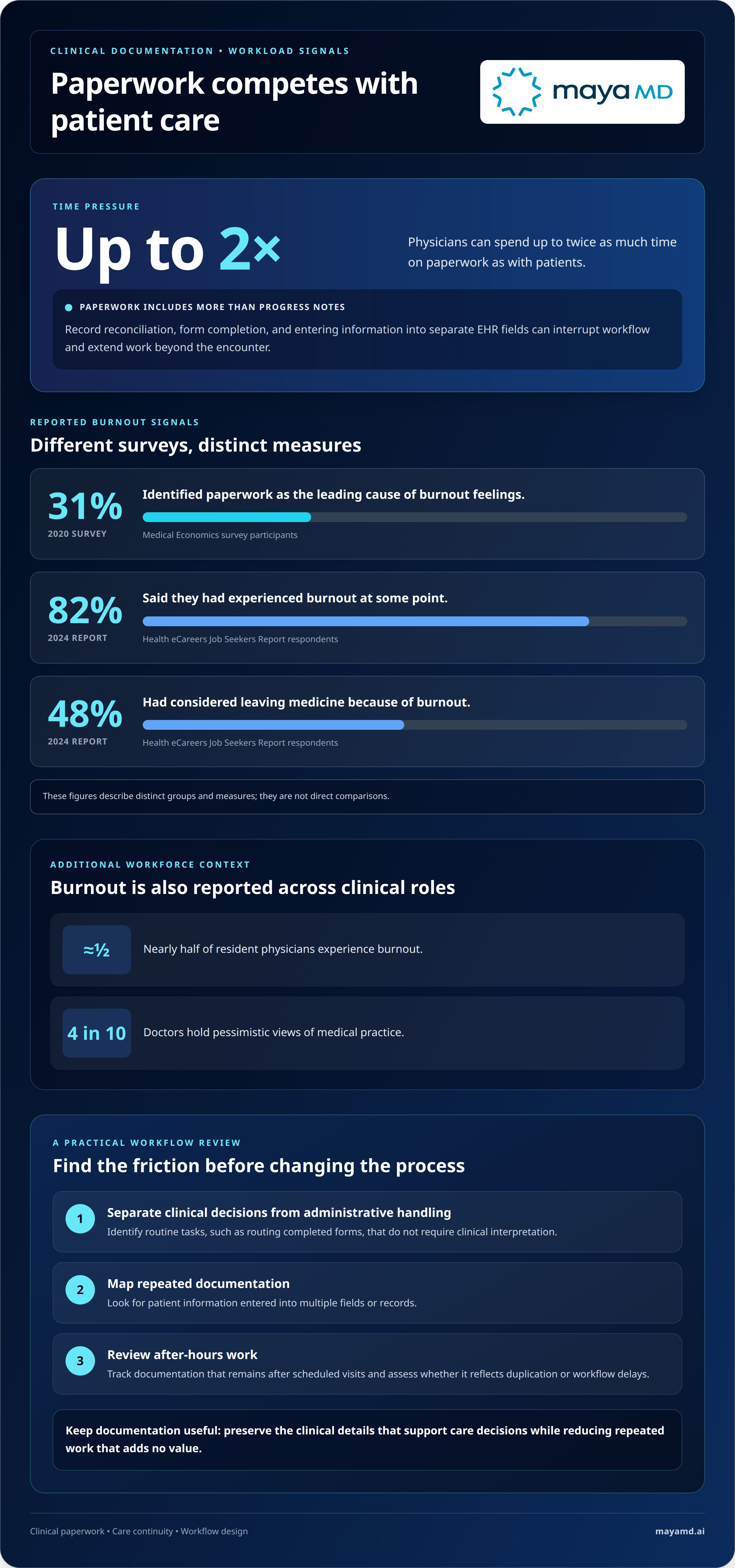
Clinical paperwork competes directly with time for patient care. Physicians can spend up to twice as much time on paperwork as with patients. A 2020 Medical Economics survey found that 31% of participants identified paperwork as the leading cause of burnout feelings. That burden includes more than writing progress notes: clinicians may also need to reconcile records, complete forms, and enter information into separate EHR fields. Each task can interrupt the clinical workflow and extend work beyond the patient encounter.
The reported strain is substantial. In the 2024 Health eCareers Job Seekers Report, 82% of respondents said they had experienced burnout at some point, while 48% had considered leaving medicine because of burnout. Nearly half of resident physicians experience burnout, and four in 10 doctors hold pessimistic views of medical practice. These figures describe distinct groups and measures, but each points to the importance of addressing administrative demands alongside other workplace pressures.
Reducing physician burnout requires examining how work is organized, not simply asking clinicians to work faster. Documentation is one part of a wider system involving staffing, workflow design, and organizational culture. A practical approach to reducing the burden of EHR data entry starts by identifying tasks that consume clinical time but do not require a clinician’s judgment. For example, a practice can review intake, record routing, and form completion to determine which administrative duties nonclinical staff can handle.
Useful workflow changes include:
Separate clinical decisions from administrative handling.
Identify routine tasks, such as routing completed forms, that do not require clinical interpretation.
Map repeated documentation.
Note where staff enter the same patient information into multiple fields or records.
Review after-hours work.
Track which documentation tasks remain after scheduled visits, then assess whether they reflect avoidable duplication or workflow delays.
These steps make the sources of paperwork easier to see. A clinician who spends time re-entering information may need a different workflow from one delayed by incomplete intake or scattered records. Addressing each cause separately avoids treating every documentation problem as an individual productivity issue. It also gives practice leaders a clearer basis for choosing process changes and assessing their effect on daily work.
Efforts to reduce burnout should preserve the purpose of documentation: communicating relevant clinical information and supporting care decisions. Removing useful detail can create new problems, while retaining every repeated field can perpetuate unnecessary work. Practices can review note templates and handoffs together, then identify which information is essential, duplicated, or better handled elsewhere. This gives clinicians and administrative teams a practical starting point for improving documentation without sidelining patient care.
Reducing EHR clinical documentation burden
Reducing clinical documentation work starts with the workflow, not simply by adding an AI tool. Review a typical encounter from intake through the signed note, noting repeated entry, handoffs, and information already stored in the EHR. If medication history appears in the chart and again in a note template, for example, assess whether the second entry adds clinical value. HHS strategy recommendations include aligning EHR design with real-world clinical workflows and using existing EHR data to reduce repeated documentation.
Professional AI documentation tools can organize encounter information into a draft for clinician review. Their value depends on whether they capture relevant details, place them in appropriate fields, and let clinicians correct errors before finalizing the note. A tool should support clinical judgment, not replace it. Practices can start with one note type, compare the draft with the encounter, and refine the workflow before wider use.
In the United States, assess AI documentation workflows against HIPAA privacy and security requirements, based on the information handled and each party’s role. Include access controls, data handling, retention, vendor agreements, and auditability in deployment planning.
Costs for AI medical scribes, human scribes, and EHR automation tools vary by service model and scope; pricing depends on the case and is provided after a quote request. Relevant factors include staffing coverage, usage, integration needs, and the level of implementation support.
No single time-saving figure applies across clinicians or workflows. Measure note-completion time before and after implementation, including review, corrections, and any remaining manual entry. A tool that drafts text quickly may not reduce total workload if clinicians must substantially revise notes or move information between systems.
A clinical AI provider can help streamline workflows by mapping where information is collected, identifying repeated entry, and shaping an approach around existing clinical processes. A workflow review, for example, can distinguish information already in the EHR from encounter-specific details that still require clinician documentation.
Measure impact against a baseline, using consistent follow-up. Track time spent completing notes, after-hours documentation, correction frequency, duplicated fields, and whether clinicians can give patients more attention during visits. Pair workload measures with relevant care indicators, such as note completeness and continuity of documented plans. Review results with clinicians and operational leaders, then adjust templates or processes where friction remains.
AI-supported patient engagement can complement documentation improvements by supporting communication beyond the encounter. Organizations assessing that broader workflow can discuss their clinical workflow priorities.
Automated text for progress notes
Automated text can give clinicians a structured draft to review instead of a blank note. Depending on the workflow, the system may organize encounter information into sections such as history, assessment, and plan. Clinicians remain responsible for confirming that each statement reflects the visit. For example, a draft that captures a medication change but omits the reason for it needs revision before signing. The goal is useful documentation, not simply more text in the record.
Providers can design EHR templates and macros around the clinical decisions and details needed for each visit type. Keep reusable fields focused, distinguish structured entries from narrative context, and test templates against representative encounters. A follow-up template, for instance, can capture the patient’s current concern and plan while leaving room for details that vary between visits. Regular review helps teams remove redundant prompts without losing information needed to understand care.
Auto-populated text should not stand alone. The Centers for Medicare & Medicaid Services says enough free text should describe the patient’s treatment and orders without over-documenting. Add the context a prefilled field cannot convey, such as why a treatment was selected or how an order relates to the assessment. A note should clearly communicate the encounter, rather than repeat chart content without purpose.
AI-generated notes can omit details, misinterpret terminology, or put information in the wrong section. Clinicians should compare the draft with the encounter, correct errors, and confirm that the assessment, treatment, and orders are represented accurately before signing. Human review is essential because fluent wording alone does not establish clinical accuracy.
Build a dependable review workflow into template design:
Check source information.
Confirm that patient details and relevant chart context belong to the current encounter.
Review clinical meaning.
Compare the generated assessment and plan with the clinician’s decisions.
Remove duplication.
Delete repeated history or auto-filled text that adds no useful context.
Complete the narrative.
Add encounter-specific treatment details and orders that structured fields do not explain.
These checks make automated text more useful without treating it as a substitute for clinical judgment. Practices can pilot a template for a defined visit type, gather clinician feedback, and revise unclear prompts before wider use. If a macro repeatedly creates a generic plan, for example, adjust its fields so the clinician can document the specific action and rationale. This disciplined approach helps reduce the burden of EHR data entry while keeping the progress note relevant, readable, and tied to the care delivered.
AI-based document processing and data extraction software can recognize handwritten text and extract patient information. In a progress-note workflow, this may help bring information into a draft, but clinicians should verify that extracted details are relevant and accurately represented before signing. Review is especially important when source information is handwritten: extraction alone does not establish that a detail belongs in the note or conveys the intended clinical meaning.
The HHS strategy recommends harmonizing reporting requirements across federally funded programs that require the same or similar EHR data from providers. Workflows built around harmonized requirements can help teams focus templates on information needed for care, rather than treating repeated reporting fields as a substitute for a clear account of the encounter.
Documentation efficiency and reimbursement
Efficient documentation supports reimbursement when the note accurately reflects the care delivered. A useful progress note connects the patient’s concern, relevant findings, clinical assessment, and resulting plan. Automation can help organize these elements, but it cannot justify documenting services that did not occur. The practical goal is a complete, clear record that supports review without adding repeated or irrelevant text.
Robert Wolf, a family physician, said he could meet criteria for a 99214-level visit in many cases, even for something simple. That example underscores why documentation and coding need clinical context. A code should follow the documented service and applicable criteria, not a template’s default language or an automated suggestion. If a note contains copied-forward details that do not match the encounter, those details can obscure what happened and weaken the record’s usefulness.
To align efficiency with reimbursement, organizations can review the path from encounter to completed claim. Check whether clinicians enter the same information in multiple places, whether required fields reflect actual care, and whether notes clearly support the services recorded. A template that repeats a prior assessment may save keystrokes but create ambiguity if the current plan has changed. Updating the note structure can reduce duplication while preserving the facts needed for accurate coding and review.
Operational reviews can focus on practical indicators:
Completion time
Compare time spent drafting and finalizing notes before and after a workflow change.
Correction patterns
Identify recurring edits, such as missing rationale or outdated copied text.
Documentation alignment
Review whether notes describe the care and orders recorded for each encounter.
Rework
Track notes returned for clarification and identify the fields or processes causing delays.
Use these measures together. Faster note completion alone does not show whether documentation remains clear, accurate, or suitable for the organization’s billing workflow. A review team can sample notes, compare them with encounter details, and share recurring issues with clinicians and administrators. Repeated clarification requests about a treatment plan, for instance, may indicate that the template needs a distinct field for the plan’s clinical rationale.
Payment models can also shape documentation requirements. The HHS strategy recommends waiving documentation requirements when needed to test or administer alternative payment models. This is a policy recommendation, not a general instruction to omit information from routine records. Organizations can evaluate documentation processes in the context of the model being tested while maintaining the clinical detail needed to communicate care. Reducing unnecessary entry and protecting reimbursement integrity are related workflow goals, not competing priorities.
. The study adds a related consideration: each additional hour physicians spent documenting was associated with a 7.1% reduction in the proportion of patients whose outside records were viewed through health information exchange. This association does not establish that documentation time caused the reduction, but it points to a potential trade-off when evaluating workflow changes. Documentation processes can be assessed not only for note completion and claim support, but also for whether they leave clinicians time to consult information relevant to the encounter. The finding underscores the importance of reducing avoidable burden while retaining documentation needed to support care and reimbursement.
What causes the burden of EHR data entry for clinicians?
EHR work can become burdensome when routine clinical actions require repeated navigation and manual entry. A clinician may move between medication lists, encounter notes, orders, and review screens to complete one visit. Each transition interrupts the flow of care and makes it harder to maintain context. Documenting a treatment plan, for example, may involve reviewing medication history, recording a decision, and entering an order elsewhere. The burden comes from how these tasks connect, not just from the number of fields.
Navigation is one measurable source of friction. According to the National Institute of Standards and Technology, one EHR workflow required users to make 8-9 clicks to see whether a patient had received a medication. That example shows how a straightforward verification can involve several interface actions. When similar checks recur during visits, clinicians spend attention moving through screens instead of interpreting information and speaking with patients.
Duplicate documentation adds another layer of work. A patient’s history may already appear in the chart, yet a template can still prompt clinicians to enter the same details again. Repetition can also occur as information moves between intake forms, clinical notes, and orders. This creates extra work and a greater need to reconcile differences, such as a medication list that does not match the current plan. EHR workflows should make relevant existing data available where it is needed.
Interface design can compound duplication. A template with poorly ordered fields may separate related information, while prompts that appear mandatory can encourage unnecessary copy-forward text. Clinicians may then spend time correcting structure instead of clearly recording the encounter. HHS strategy recommendations include aligning EHR design with real-world clinical workflows and harmonizing user actions for basic clinical operations across systems. These changes address friction at the system level rather than asking individuals to adapt indefinitely.
Organizations can locate bottlenecks by tracing a representative encounter from check-in through note completion. Record each screen transition, repeated field, handoff, and point where staff must search for information. Then classify the cause: interface navigation, duplicate entry, unclear responsibility, or a workflow that does not match clinical practice. Medication reconciliation, for example, can reveal whether delays stem from finding the list, confirming its accuracy, or documenting the resulting decision. Each cause calls for a different improvement.
Reducing the burden of EHR data entry therefore starts with specific workflow evidence. Teams can prioritize changes that remove unnecessary navigation or make existing information easier to use, then review whether the revised process fits actual care delivery. To discuss ways to address documentation friction across clinical workflows, connect with the team.
MayaMD
MayaMD helps healthcare organizations address workflow friction through patient-facing AI and communication solutions. Its Clinical AI Agent and AI patient engagement solutions support communication around care, while automated post-discharge communication helps maintain contact after a patient leaves the hospital. These capabilities can complement EHR documentation improvements by supporting related patient communication workflows, rather than replacing clinician review of progress notes.
Consider MayaMD when your organization is evaluating how AI can fit into clinical workflows and patient engagement. Contact MayaMD to discuss your needs.
Make the next workflow decision deliberate
The next step in reducing the burden of EHR data entry is to treat automation as a clinical workflow decision, not just a software deployment. Bring together a cross-functional group to define which documentation tasks need attention, how draft content will be reviewed, and who will incorporate clinician feedback. Include clinical, operational, and information technology perspectives so changes reflect daily practice as well as system requirements.
Begin with a clearly scoped use case and agreed measures of success. The team can document the existing process, introduce a change, then assess whether it fits the encounter and supports clear records. If the approach creates extra review work or disrupts established care processes, refine its scope before expanding it. That discipline helps organizations pursue efficiency while keeping clinical accountability central.
For organizations considering how AI can support connected patient and clinical workflows, discuss your priorities with MayaMD. A thoughtful next step can help your team shape an approach that serves clinicians and patients alike.
Frequently Asked Questions
Which EHR documentation tools should healthcare organizations choose to reduce data entry workload, such as templates, voice dictation, and ambient AI?
Choose tools based on where documentation slows the care team and what information the workflow must preserve. Templates can standardize recurring visit structures, while voice dictation can capture spoken notes. Ambient documentation tools may draft notes from clinical conversations. For a follow-up visit with predictable fields, a template may be practical; for complex conversations, assess whether a draft is easy to review and correct.
How do AI medical scribes and ambient documentation tools work?
AI medical scribes process clinical information and produce a draft note for clinician review. Ambient documentation tools typically use a clinical conversation as input, then organize relevant details into a note structure. The workflow varies by tool. A draft might separate a patient’s reported concern from the clinician’s assessment, for example, but the clinician still needs to confirm details and make corrections before using it.
How much time can EHR automation and medical scribes save clinicians?
No single time-saving figure applies across clinicians or workflows. Measure note-completion time before and after implementation, including review, corrections, and remaining manual entry.




See The MayaMD Difference
Fill the form below
Download Our Apps
MayaMD for patients and MayaPro for physicians - available on iOS and Android.
FOR PATIENTS
MayaMD App
AI-powered symptom assessment, triage, and secure access to your care team.


FOR PHYSICIANS
MayaPro App
MayaPro brings patient vitals, RPM/PCM care plans, and clinical decision support to your pocket.