
Predictive Analytics for Chronic Disease: Risk & Bias

Three in four American adults have at least one chronic condition, according to the Centers for Disease Control and Prevention. Predictive analytics for chronic disease uses health data, such as medical history, comorbidities and sensor readings, to estimate the likelihood of future illness or deterioration. The resulting risk score can help care teams identify patterns earlier and prioritize follow-up.
That score is a decision-support signal, not a diagnosis. Its usefulness depends on the data behind it, how well the model performs for the people it serves, and whether its predictions fit clinical workflows. Missing information or uneven representation across patient groups can affect what the model learns and whose risk it recognizes.
This article explains how predictive analytics works, which data inputs can shape chronic disease risk estimates, and how to interpret measures such as sensitivity and area under the curve. It also examines model validation, bias, and compliance considerations, so you can assess whether a prediction is meaningful enough to inform care. The goal is a clear view of both the potential and the limits of risk assessment, with patient needs at the center.
Key Takeaways
• Understand how health records, clinical indicators, and connected-device data can contribute to a chronic disease risk estimate.
• Look beyond a single accuracy score: assess whether a model identifies true cases, avoids false alerts, and performs reliably in the population it will serve.
• Recognize how longitudinal data can help flag elevated risk or deterioration early, creating an opportunity to prioritize follow-up and support.
• Assess data quality, representation, and subgroup performance to identify potential bias and strengthen responsible use.
• Connect model outputs to clinical workflows so risk signals inform care decisions rather than stand alone as predictions.
Disease probability scores and model performance metrics
Disease probability scores estimate how likely an outcome is for a patient or population. The Centers for Disease Control and Prevention states that 90% of U.S. healthcare expenditures are for people with chronic and mental health conditions, making reliable risk assessment important in chronic disease management.
Disease Probability Scores
A disease probability score is a model-generated estimate of the likelihood that a defined health outcome will occur in a specific context. It helps care teams compare risk and prioritize review, but it is not a diagnosis or a complete care plan. For example, a score might flag a patient for closer assessment, while clinicians consider symptoms, history, and other relevant evidence before acting.
Classification, Regression, and Time-Series Models
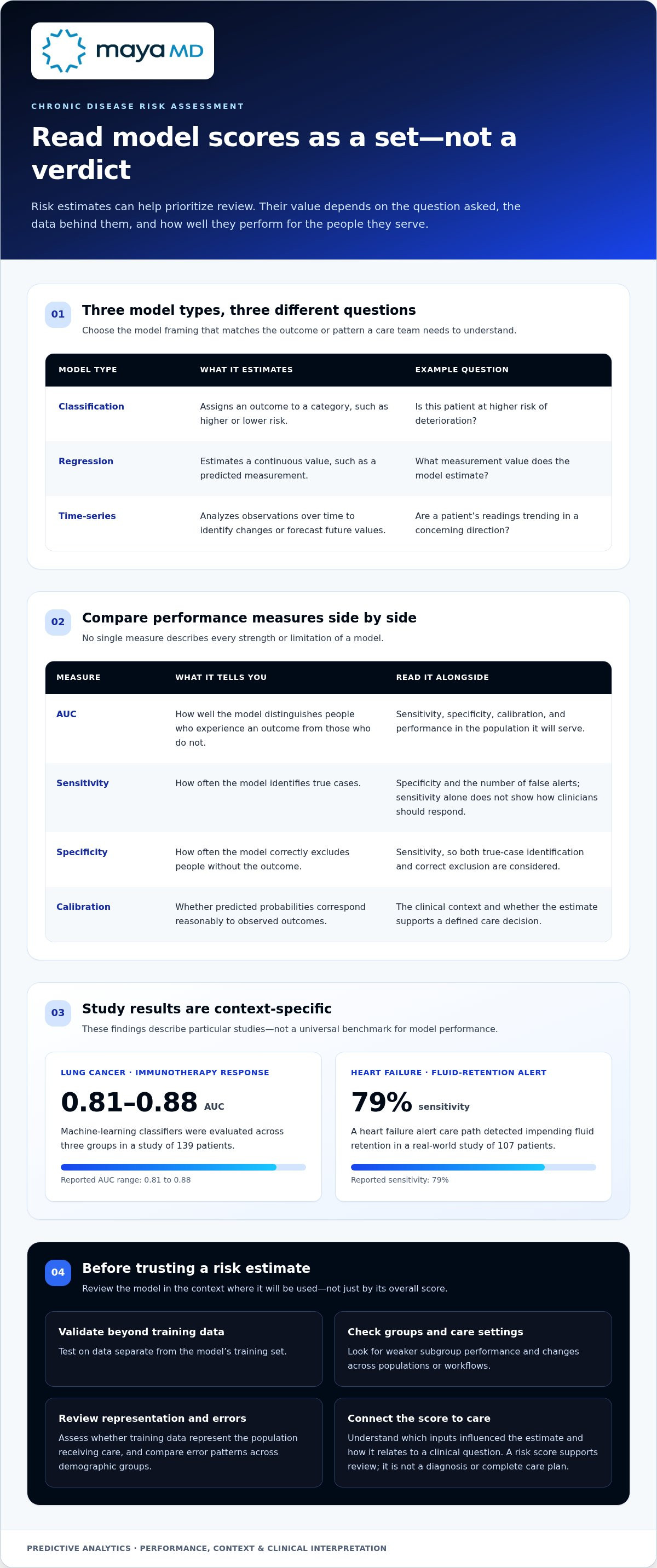
Classification models assign outcomes to categories, such as higher or lower risk, while regression models estimate a continuous value, such as a predicted measurement. Time-series models analyze observations over time to identify changes or forecast future values. Each approach answers a different question: a classification model may flag likely deterioration, while a time-series model can track whether a patient’s readings are trending in a concerning direction.
Performance Across Chronic Conditions
Model performance varies with the condition, outcome, patient group, and data used. In a study of 139 lung cancer patients, machine-learning classifiers predicted immunotherapy response with an AUC of 0.81 to 0.88 across three groups. A 2022 real-world study of 107 patients found that a heart failure alert care path detected impending fluid retention with 79% sensitivity. These results describe specific studies, not a universal benchmark.
Read performance measures together. AUC describes how well a model distinguishes people who experience an outcome from those who do not. Sensitivity measures how often it identifies true cases, while specificity measures how often it correctly excludes people without the outcome. Calibration matters too: predicted probabilities should correspond reasonably to observed outcomes. In a heart failure alert system, sensitivity alone would not show how many alerts were false or how clinicians should respond.
Interpretability supports clinician trust. Teams need to understand which inputs influenced a risk estimate and how the output relates to a clinical question. Validation should test the model on data separate from its training set, then examine results across relevant patient groups and care settings. A strong overall score can conceal weaker performance for a subgroup or after workflows and patient populations change.
Bias, privacy, and security need attention throughout model development and use. Assess whether the training data represent the population receiving care, and compare error patterns across demographic groups. Protect health information through controlled access, secure data handling, and clear governance. These checks help organizations determine whether a model’s predictions are dependable enough to inform decisions, rather than treating a probability score as self-explanatory.
Early diagnosis and risk assessment for chronic disease
Early risk assessment uses existing health information to identify patterns associated with future disease, complications, or acute deterioration. For example, a model can combine a patient’s history and recent measurements to prioritize follow-up before a condition leads to an emergency visit.
Implementation costs in the United States depend on data integration, infrastructure, model validation, privacy safeguards, and workflow changes. A project-specific price is provided after a quote request, with scope and technical requirements shaping the estimate.
Risk scores are most useful when linked to a defined clinical action. A care team might review a flagged record, assess symptoms and treatment history, then decide whether follow-up or further evaluation is appropriate. The model identifies patterns in the inputs; clinicians interpret those insights alongside the patient’s circumstances. This distinction helps prevent a prediction from being mistaken for a diagnosis.
Data quality affects early identification. A useful assessment may draw on longitudinal diagnoses, medication history, laboratory results, and changes in measurements over time. For instance, a single glucose reading offers less context than a pattern considered alongside diabetes history and treatment. Organizations should also examine missing or outdated records, as inconsistent inputs can distort a patient’s risk profile and priority for review.
Severe hypoglycemia illustrates how prediction can focus on a specific, time-bound outcome. A 2024 PLOS Medicine study reported that its best model predicted hospitalization for severe hypoglycemia within one year among older adults with diabetes, with an AUROC of 0.978. That result describes the study’s model and population. Evaluation in practice should also consider whether predictions remain useful across patient groups and whether a flagged risk connects to a clear care response.
Suicide risk analysis requires particular care because a prediction concerns immediate human safety, not simply a chronic disease outcome. In the United States, suicide is the second most common cause of death among people aged 10 to 34. A risk signal should support timely, compassionate assessment by qualified care teams; it must not be treated as a definitive diagnosis or a substitute for direct evaluation. Clear escalation pathways and careful handling of sensitive information matter.
For each use case, teams can define the outcome and time horizon, review which data inputs drive the score, and establish who responds to an alert. They can then monitor whether the signal leads to appropriate assessment, including whether false alarms create unnecessary work or missed cases delay care. These steps connect predictive insights to real decisions instead of leaving them as isolated numbers.
Teams translating early risk insights into chronic-care workflows can discuss implementation needs.
What is predictive analytics?
Predictive analytics applies statistical learning to health data to estimate future outcomes, such as worsening glucose control or hospitalization. Providers compare tools by their intended outcomes, data inputs, validation, and fit with clinical workflows. Examples include forecasting disease progression and using remote monitoring to identify rising risk.
Health Indicators for Predictive Analysis
Health indicators are measurable patient characteristics that models use to estimate risk, so the choice and context of each input matter. Blood pressure can signal cardiovascular strain, while glucose readings help characterize diabetes management. Body mass index (BMI) and age add context, but neither should be interpreted alone. A useful analysis considers how these measures relate to a specific prediction, such as future metabolic deterioration.
Electronic Health Records and Multimodal Data
Electronic health records (EHRs) organize clinical information, while multimodal models combine EHR data with behavioral or sensor inputs. A model might analyze diagnoses, medication history, laboratory results, and wearable activity together. This can reveal patterns that a single data type might miss, such as a change in activity alongside a shift in clinical measurements. In research environments, behavioral analytics platforms like those developed by Ergoneers help teams capture and synchronize complex data streams. Consistent definitions and timing help ensure inputs refer to the same patient and period.
Healthcare Applications and Benefits
Healthcare applications use predictions to support a defined task, such as prioritizing follow-up, anticipating complications, or identifying patients who may need closer monitoring. A React.js interface could let an authorized user enter blood pressure, glucose, BMI, and age, then display the estimate and relevant inputs. The interface itself does not establish clinical accuracy; data validation, model evaluation, and clear presentation remain essential.
When comparing tools, providers should examine what each predicts, which records it can use, and how its outputs fit existing workflows. A tool designed to forecast glucose answers a different question from one that estimates hospitalization risk. The learning method matters, but so do input quality, validation in the intended setting, and whether the result gives care teams a usable next step.
Improving Chronic Disease Outcomes
Predictive applications can support chronic care by connecting early signals with timely follow-up. For example, wearable-based remote patient monitoring was associated with a 15% reduction in total hospitalizations. That finding illustrates a potential care pathway: ongoing measurements reveal a change, the care team reviews the signal, and follow-up can address emerging needs. The prediction contributes value when it informs an appropriate clinical response.
Diabetes care offers another practical example. A pattern in glucose readings may prompt a review of treatment response or related health information. For heart failure, monitoring changes over time can help surface possible deterioration for assessment. In both cases, clinicians need the underlying measurements and patient context, not just a machine-generated label, to turn insights into appropriate care.
Predictive analytics definitions and data inputs
Predictive analytics applies statistical methods and machine learning to historical and current information to estimate the likelihood of a defined future outcome. In predictive analytics for chronic disease, that outcome might be worsening glucose control, a complication, or hospitalization. The model’s usefulness depends on defining the outcome clearly, selecting relevant inputs, and aligning each record with the correct patient and timeframe.
Data inputs become model features after teams assess their meaning, completeness, timing, and relationship to the prediction. For example, a diabetes model might combine glucose measurements, diagnosis history, medications, and age. A laboratory result without a collection date can misrepresent a patient’s status. Teams also distinguish predictors from labels: predictors inform the estimate, while labels record whether the target event occurred.
Common input groups include:
Clinical records
diagnoses, medications, laboratory results, blood pressure, and care encounters from electronic health records.
Longitudinal measurements
repeated glucose readings or weight measurements that show change over time.
Behavioral and sensor signals
activity patterns or connected-device measurements that add context to clinical records.
Population and care context
demographic information, comorbidities, and prior utilization relevant to the prediction.
Combining sources requires careful alignment. A glucose value from a laboratory record may use different units or timing than a connected-device reading. Teams can standardize formats, verify units, remove duplicate records, and document the source and collection time. Missing laboratory values in electronic health records can range from 5% to 40%, depending on the variable. Normalization and missing-value imputation can improve data quality, but teams must preserve distinctions between observed and estimated values.
The prediction target also shapes which inputs belong in a model. To estimate future hospitalization, prior encounters may be relevant; to forecast a change in glucose, measurement sequences and treatment context may matter more. Researchers evaluating high-cost patient prediction used a dataset of 2.3 million patient encounters from Arizona. Their approach added disease-network community membership and high-cost propensity scores as prediction signals, illustrating how related diagnoses and utilization patterns can contribute context.
For chronic disease management, data governance continues after model development. Teams should document how each input is collected, transformed, retained, and accessed. They should also monitor changes in coding, devices, and workflows, because shifts in data capture can alter what the model learns. Clear provenance helps clinicians interpret predictions and helps technical teams trace unexpected outputs to specific inputs or processing steps.
Bias, ethics, and compliance
Bias can enter a predictive model through uneven data, measurement practices, outcome definitions, or deployment decisions. A 2025 systematic review of 76 predictive analytics studies found that 73.7% had a high risk of bias. That finding makes bias assessment part of model evaluation, not a final administrative check. Teams should examine who appears in training data and whether model errors differ across patient groups.
Consider a diabetes risk model trained mostly on records from patients with frequent clinic visits. People with less access to care may have fewer measurements, affecting how the model estimates their risk. Compare false negatives and false positives across relevant groups, then examine whether missing records or different testing patterns explain disparities. Report the results in terms clinicians can interpret, including which populations the model serves and where performance needs attention.
Ethical use also depends on how a prediction affects care. A risk score could influence who receives follow-up, additional monitoring, or clinician review. Define the purpose before deployment, identify who can act on the output, and provide a process for correcting inaccurate patient information. For example, a diabetes alert should support clinical assessment rather than automatically determine treatment. Clear accountability connects algorithmic output with human oversight.
Privacy and security controls should follow data through collection, integration, model processing, and retention. Limit access to authorized roles, document data flows, and protect information during storage and transfer. Teams should also review vendor access and audit logs as part of operational governance. These measures matter when electronic health records connect with wearable or remote-monitoring data, because each integration adds another point where information must be managed securely.
In the United States, healthcare predictive analytics is not regulated by a standard act or government agency as a whole. The FDA’s Clinical Decision Support Software guidance was revised in January 2026. Organizations should assess a system’s intended use and functionality, then determine which regulatory and privacy requirements apply to that context. The relevant analysis can differ between a tool that organizes information for clinician review and software that generates a specific clinical recommendation.
Before deployment, establish a governance review that records the model’s purpose, data sources, validation results, known limitations, access controls, and monitoring plan. Reassess performance when patient populations, clinical workflows, or input systems change. Include clinicians, data specialists, privacy and security leads, and those responsible for the affected care process. This structure makes responsibility clear and creates a record for investigating unexpected outputs.
To discuss how clinical AI workflows can support governed patient engagement, connect with MayaMD.
MayaMD: Clinical AI Agent
MayaMD’s Clinical AI Agent supports patient engagement and communication for care teams managing chronic conditions. Its cloud-based platform combines deterministic logic with generative AI to support structured interactions within patient-care workflows. Healthcare organizations can use this approach to connect digital engagement with ongoing care processes.
AI patient engagement solutions and automated post-discharge communication solutions can help maintain communication as patients move between care settings. They support follow-up and continuity, while clinical teams remain responsible for interpreting patient needs and determining care. These capabilities complement predictive risk assessment by connecting insights with patient communication, not by replacing clinical judgment.
To discuss how MayaMD’s solutions may fit your care workflows, contact MayaMD.
Turn risk insights into connected care
The next step is to define how predictive analytics for chronic disease will connect with your organization’s care pathways. Start with a specific operational question: which patient interactions need better continuity, and how should a risk signal guide follow-up? Aligning that purpose with clinical workflows helps teams move from model outputs to coordinated patient support.
MayaMD offers a Clinical AI Agent, AI patient engagement solutions, and automated post-discharge communication solutions. These capabilities support communication across care journeys and can complement an organization’s use of predictive insights. The focus is on meaningful connections between patients and care teams, with technology supporting established clinical processes.
Consider which workflow would benefit most from more connected engagement, then explore how it could fit your care strategy. Start a conversation with MayaMD about predictive analytics and patient care. A thoughtful next step can help your team shape technology around the people and processes it is meant to support.
Frequently Asked Questions
What is predictive analytics for chronic disease management?
Predictive analytics uses patient information to estimate future health events and help care teams plan where to focus attention. For example, a care program might use a risk estimate to prioritize outreach for patients whose records suggest worsening control. The prediction supports planning, not diagnosis or treatment decisions on its own. Its value depends on connecting the estimate to a clear care process, such as clinician review or patient follow-up.
Which chronic diseases are commonly predicted using analytics?
Analytics can assess risk or forecast events related to diabetes, heart failure, chronic obstructive pulmonary disease, cardiovascular disease, and kidney disease. The target can vary: a model might estimate diabetes complications, heart failure deterioration, or a COPD exacerbation. Disease names alone do not define a model’s purpose. Teams should specify the outcome they want to anticipate, such as hospitalization or a change in disease control.
What data and algorithms are used to predict chronic disease risk?
Models may draw on diagnoses, laboratory results, medications, demographic information, clinical measurements, and connected-device readings. The algorithms depend on the task: Random Forest and Support Vector Machine classifiers can categorize outcomes, while regression estimates continuous values and time-series approaches analyze changes across repeated readings. For instance, a model forecasting a patient’s glucose trend needs time-ordered measurements, while a complication classifier needs a clearly defined outcome label.
How accurate are predictive analytics models for chronic disease?
Accuracy varies by condition, outcome, patient group, and validation setting. Some machine-learning models can predict chronic disease events with accuracy rates of up to 95%, but that figure isn’t a universal benchmark. A provider should review the model’s validation population, sensitivity, specificity, calibration, and false-alert patterns. A model that performs well on historical records may behave differently when patient populations or clinical workflows change.
What HIPAA and other privacy rules apply to health predictive analytics in the United States?
HIPAA is a key privacy framework for healthcare data, but predictive analytics itself is not governed by one standard act or government agency. Organizations should map what health information moves between systems, who can access it, and how it is stored and used. They should also assess other federal and state privacy and security rules that apply to their organization and data flows, documenting controls and responsibilities.
What are the risks of bias and errors in chronic disease prediction models?
A model can miss risk when some patients are underrepresented or have fewer recorded measurements. It can also generate false alerts if its thresholds do not fit the care setting. For example, a diabetes model trained on frequent clinic measurements may perform differently for patients with sparse records. Compare errors across relevant patient groups, investigate data gaps, and monitor outputs after deployment to identify systematic problems.
How can a healthcare organization implement predictive analytics for chronic disease management?
Begin by selecting one clinical outcome and defining who will review a prediction and what action may follow. Then map data sources, prepare and validate records, and test the model with the intended patient population. Before routine use, connect alerts to existing workflows and assign responsibility for follow-up. Ongoing review should track performance, data changes, staff feedback, and whether predictions support the care objective.
How do patients benefit from predictive analytics for chronic disease prevention and care?
Patients may benefit when an early risk signal leads to timely, relevant follow-up or more consistent communication. For example, MayaMD’s Clinical AI Agent supports patient engagement, while its platform also offers automated post-discharge communication solutions. These tools support communication and continuity; clinicians retain care decisions. To discuss MayaMD’s approach, contact +1 (888) 629‑2631 or info@mayamd.ai.




See The MayaMD Difference
Fill the form below
Download Our Apps
MayaMD for patients and MayaPro for physicians - available on iOS and Android.
FOR PATIENTS
MayaMD App
AI-powered symptom assessment, triage, and secure access to your care team.


FOR PHYSICIANS
MayaPro App
MayaPro brings patient vitals, RPM/PCM care plans, and clinical decision support to your pocket.