
Patient Retention Strategies for Primary Care Practices

Retention is a patient’s ongoing choice to receive care from the same primary care practice. Effective patient retention strategies for primary care practices make it easier for patients to stay connected between visits, understand their care, and return when follow-up is needed. The relationship is shaped by more than what happens in the exam room.
Convenient access matters, as do clear communication, thoughtful follow-up, and interactions that reflect each patient’s needs. When these parts of care work together, they can support continuity without making every interaction feel impersonal or routine.
This article explains what patient retention means and how practices can strengthen it through the patient experience, personalized communication, reminders and follow-up, ongoing engagement, and telehealth. You’ll find practical approaches that can fit into primary care workflows and build more consistent connections with patients over time.
Key Takeaways
• Patient retention grows from consistent, respectful experiences, including welcoming environments and feedback that leads to practical improvements.
• Tailor communication to patients’ needs so guidance feels relevant, clear, and supportive of ongoing care.
• Use reminders and follow-up messages to help patients keep appointments and stay connected after visits.
• Make engagement part of care through useful education, attentive listening, and accessible ways to communicate.
• Consider telehealth for routine consultations and follow-ups when an in-person visit isn’t needed, and use digital tools to support ongoing patient communication.
1. How Can Providers Improve Patient Experience in Healthcare?
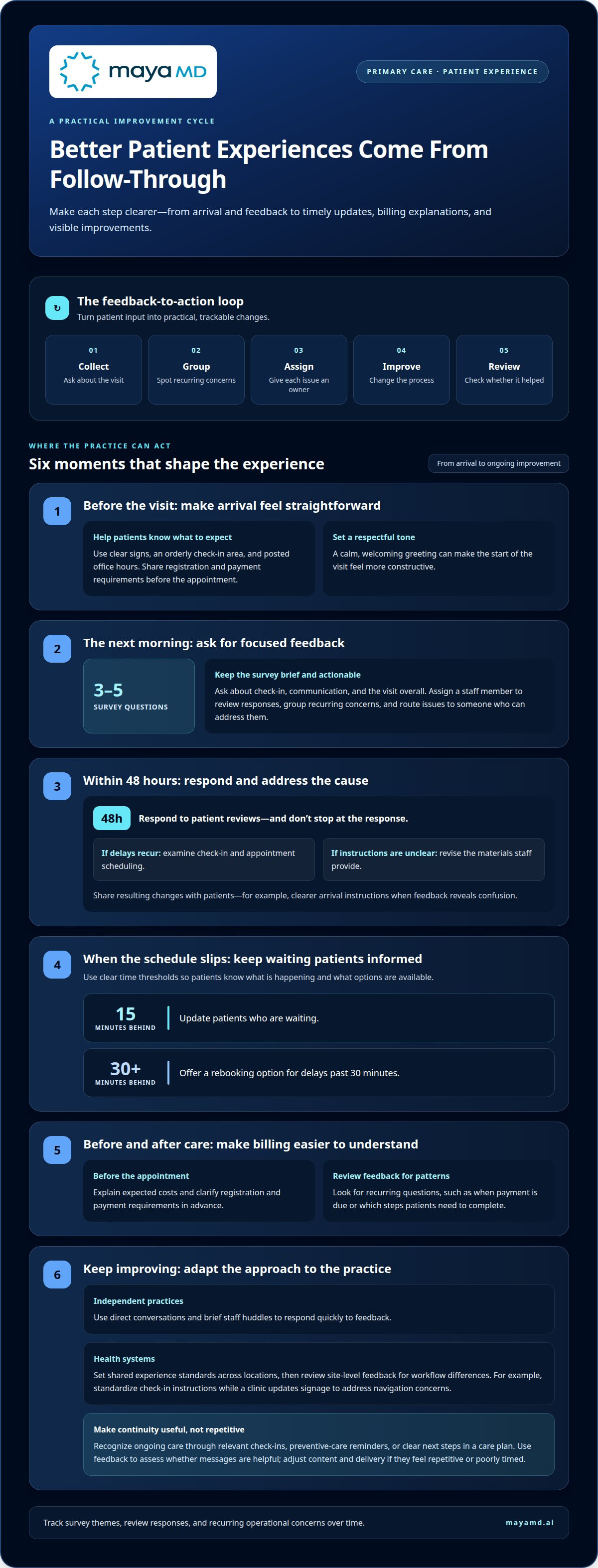
A welcoming office experience begins before the clinical visit. Clear signs, an orderly check-in area, and posted office hours help patients understand where to go and what to expect. Share registration and payment requirements before appointments so patients can prepare instead of resolving administrative questions at the front desk. A calm, respectful greeting also sets a constructive tone for the visit.
Independent practices can use direct conversations and brief staff huddles to respond quickly to patient feedback. Health systems can set shared experience standards across locations, then review site-level feedback to identify differences in workflows. For example, a system might standardize check-in instructions while a clinic updates its signage to address recurring navigation concerns.
Make feedback easy to give and useful to act on. Send a brief post-visit survey with three to five questions the next morning, asking about check-in, communication, and the visit overall. Assign a staff member to review responses, group recurring concerns, and route each issue to someone who can address it. Share resulting changes with patients, such as clearer arrival instructions after feedback reveals confusion.
Close the loop. Respond to patient reviews within 48 hours, and avoid treating a response as a substitute for fixing the underlying issue. If patients repeatedly report delays, examine check-in and appointment scheduling; if they mention unclear instructions, revise the materials staff provide. When the practice is 15 minutes behind, update waiting patients. For delays past 30 minutes, offer a rebooking option.
Billing is part of the patient experience, too. Explain expected costs before appointments and clarify registration and payment requirements in advance. Then review billing feedback for patterns, such as questions about when payment is due or which steps to complete. Clear explanations can reduce avoidable uncertainty and support trust between patients and providers.
Loyalty programs should reinforce a reliable care relationship, not substitute for one. A practice can recognize continuity through relevant check-ins, preventive-care reminders, or clear guidance on the next step in a care plan. Use patient feedback to assess whether these communications are helpful. If messages feel repetitive or poorly timed, adjust their content and delivery rather than simply sending more.
Track what changes after each improvement. Compare survey themes, review responses, and recurring operational concerns over time. When feedback points to a specific obstacle, such as confusing check-in instructions, assign an owner, update the process, and see whether the problem persists. This feedback-to-action cycle helps improve the patient experience and build loyalty through visible, practical changes.
2. Personalized patient interactions
Personalization starts with listening and adapting the next conversation. Ask what the patient wants to understand, what makes care difficult, and how they prefer to receive information. Record relevant preferences in the appropriate clinical workflow so the next interaction reflects their circumstances instead of starting from scratch. For example, a patient managing several medications may benefit from a plain-language explanation and a written summary.
Appointment access also shapes satisfaction. Practices can improve access by offering online booking, simplifying phone systems, and reviewing schedules for bottlenecks. If patients struggle to find suitable appointment times, examine appointment types, staffing patterns, and cancellation openings. Health systems can coordinate access standards across locations; independent practices can adjust scheduling directly to suit their patient community.
Care coordination supports continuity by showing patients how each visit connects to the next. A primary care team can document follow-up needs, identify who owns the next step, and share relevant updates across the care team. For example, after a medication change, the next interaction can ask whether the patient understood the instructions and knows whom to contact with questions. Consistent handoffs help patients avoid repeating their story.
Education works best when it matches a person’s health literacy, condition, and goals. Patients with solid health literacy who understand their medications, conditions, and risk factors are 30% less likely to be readmitted to the hospital. Use teach-back by asking patients to describe the plan in their own words. If a patient cannot explain when to take a medication, clarify the instructions before the visit ends.
Functional medicine practices can personalize care through structured, recurring assessments. Naturopathic physician Rosia Parrish says she spends 45 to 90 minutes with each patient in her functional medicine practice. Kevin Huffman says his practice conducts quarterly osteopathic evaluations for post-bariatric surgery patients. These examples show how scheduled assessment can make room for individual concerns and track changes over time.
Accessibility requires more than offering a digital option. Keep websites and patient technology usable for people with different ages, abilities, and comfort levels. Offer a phone-based alternative alongside online forms, and use clear labels rather than clinical shorthand. After a patient reports difficulty using a portal, staff can explain the relevant steps or discuss another communication method. Patient feedback helps teams identify where the process creates friction.
Personalized interactions should feel positive without becoming intrusive. Ask patients which communication channel works for them, tailor preventive-care messages to their needs, and revisit preferences when circumstances change. These practices can support patient satisfaction while preserving a consistent care relationship. Teams refining their approach to patient engagement workflows can use these questions to identify where more tailored communication would help.
3. Appointment reminders and follow-up messaging
A useful reminder does more than announce an appointment. It gives patients a clear action, such as confirming, rescheduling, or preparing forms. Practices can send reminders one or more days before scheduled visits, using email or text when patients prefer those channels. A confirmation request also helps teams identify openings early and maintain a more accurate schedule.
Keep the message concise and practical. Include the appointment date, time, location, and a simple way to respond or request a change. Digital forms can arrive 48 hours before the appointment, giving patients time to complete them before arrival. Use a separate follow-up message for visit instructions, so scheduling details don’t compete with care guidance.
Missed appointments need a defined response. Contact patients who miss a follow-up within 48 hours, then offer a clear next step for rescheduling. After surgery or a major treatment-plan change, a check-in one or two days later can ask whether the patient understands the instructions and needs assistance. Record the outreach and any agreed follow-up in the patient workflow.
Patient recall can reconnect people who are overdue for routine care. Segment the recall list by care need, such as an outstanding check-up, vaccination, or screening, then send a relevant scheduling prompt. One multi-location group brought back 1,240 overdue patients through SMS recall messages. The group reported that 35% of recipients booked within a month.
Use scheduling data to refine outreach rather than sending identical messages to everyone. Analytics can reveal repeated cancellations, missed visits, or gaps in care. For example, a patient who cancels morning appointments may respond better to an afternoon option. After each outreach cycle, review booking patterns and patient feedback to see which message or channel supports completed appointments.
Protect privacy in every interaction. For HIPAA-sensitive outreach, use discreet messages and include only the details needed to identify or manage an appointment. Obtain patients’ express permission before contacting them, and follow applicable communication rules, including the Telephone Consumer Protection Act (TCPA). Record preferences and contact outcomes in the practice’s established workflow.
Confirmation systems can also improve scheduling visibility. Practices using automated appointment confirmations average a confirmation rate above 75%. Atlas Medical Center reduced its no-show rate from 14.20% to 4.91% using automated reminders and confirmations over three months. These results point to a practical process: send a timely reminder, make confirmation easy, and follow up when a patient doesn’t respond.
Close the loop after each missed or overdue visit. Document whether the patient booked, declined, or needs another contact method. This record helps staff avoid duplicate messages and identify unresolved care gaps. A consistent reminder and recall process supports continuity and makes the next step clear for patients and care teams.
4. Patient engagement and health outcomes
Engagement turns a care plan into actions patients can understand and sustain. Start by agreeing on one practical goal, such as tracking blood pressure or completing a screening. Explain how the action supports the patient’s health, then document the agreed next step. This makes patient engagement an active part of care, rather than a message sent after the visit.
Accessible education helps patients participate in decisions. Offer a visit summary within 24 hours, using plain language to explain the care plan, medication instructions, and follow-up steps. Add a brochure, short video, or workshop when patients need more detail about prevention or wellness. Invite questions and explain the advantages and disadvantages of available treatment options.
Digital tools can connect patients with their care teams between appointments. A useful practice website can bring together appointment availability, frequently asked questions, and online scheduling. Keep the design usable for people with different ages and levels of comfort with technology. A patient who struggles with an online form should still have a clear way to find instructions or communicate with the practice.
Engagement should use more than one channel because patients’ access and preferences differ. Combine in-person conversations with portal messages, educational materials, and relevant follow-up. Give each message a clear purpose, such as explaining a screening recommendation or reinforcing an agreed care goal. A patient who misses a digital message may still benefit from discussing the same next step during a visit.
Continuity also matters for outcomes. A systematic review found that continuity of care is linked to better patient health outcomes. Consistent follow-through helps clinicians interpret changes over time and lets patients build on earlier discussions. For instance, a care team can review a patient’s progress toward a wellness goal at each follow-up, then adjust the plan together.
Case studies have found that Chronic Care Management services can reduce hospital readmissions by 6.2%. Kevin Huffman reports that patients in his practice’s top engagement quartile experienced, on average, 58% fewer hospital readmissions. These findings illustrate why sustained contact and coordinated support matter, particularly for patients managing ongoing health needs. They don’t mean every patient will have the same result.
Measure whether engagement supports meaningful care, not just message volume. Track completion of agreed follow-up, patient questions resolved, and progress toward care-plan goals. Kevin Huffman reports a 72% improvement in 12-month follow-up compliance with expanded EHR screens versus traditional care models. A practice can review similar workflow measures to identify where patients lose connection and improve the next step in care.
5. Telehealth for follow-up and routine consultations
Telehealth gives patients another way to stay in touch with primary care between in-person visits. Offer virtual care for follow-ups and routine consultations when an in-person examination or procedure isn’t required. For example, a clinician can use a video visit to review a patient’s progress, answer questions, and agree on the next step. This can make consistent care easier for people who have difficulty traveling to the office.
Choose the visit format based on its purpose. A portal message can handle a non-urgent question or share routine instructions. A phone call may suit patients who prefer speaking directly or have limited internet access. A video consultation can support a conversation that benefits from face-to-face interaction. Clear scheduling instructions help patients know which option to use and how to join.
Make the process accessible before the appointment begins. Explain how to access the portal or video link, where to direct technical questions, and what information to have ready. Offer a non-digital scheduling route for patients who cannot or prefer not to use online tools. For instance, staff can help a patient arrange a phone follow-up instead of requiring a video visit.
Integrate virtual visits into the same care workflow as in-person appointments. Document the visit, agreed actions, and follow-up plan so the next interaction builds on the previous one. If a patient needs an examination or procedure, arrange an in-person appointment rather than treating telehealth as a substitute. This helps the care team match the encounter to the patient’s needs.
Patient portals and texting can complement telehealth when each channel has a defined purpose. Use a portal for visit summaries or care-plan information, and texts for concise scheduling updates when patients have chosen that channel. Avoid scattering instructions across disconnected systems. A consistent process makes it easier for patients to find relevant information before a virtual consultation.
Review how patients use each option. Track whether scheduled virtual visits take place, whether patients need help joining, and whether follow-up actions are completed. Ask patients which parts of the process created difficulty, then adjust instructions or offer another format. These steps help practices identify barriers without assuming every patient has the same access or preferences.
Telehealth can support retention when it adds practical access while preserving continuity with the care team. Start by identifying follow-up visits that could be virtual, clarifying when an in-person examination is needed, and communicating available formats during scheduling. To discuss digital approaches that support connected patient access, explore options for your care workflow.
MayaMD: Clinical AI Agent
MayaMD’s Clinical AI Agent can support primary care practices looking to strengthen patient communication between visits. Its AI patient engagement solutions and automated post discharge communication solutions can help practices extend communication beyond the exam room and support continuity after discharge.
Consider this approach when staff workflows make consistent outreach difficult or patients need clearer connections to ongoing care. MayaMD works alongside existing clinical teams and programs, supporting communication without replacing staff or clinical decision-making. A focused starting point is a workflow where clearer outreach can address a specific gap, such as post-discharge communication.
To discuss how MayaMD can support your practice’s patient engagement needs, contact MayaMD.
Build the Next Connection
Lasting patient relationships depend on how reliably a practice connects care across everyday interactions. A practical approach to patient retention strategies for primary care practices is to identify one communication gap, assign responsibility for addressing it, and review whether the change makes the next step clearer for patients. This creates a manageable path from intention to workflow improvement.
MayaMD offers a Clinical AI Agent, AI patient engagement solutions, and automated post-discharge communication solutions. Practices can consider where these tools may support existing communication workflows, particularly patient engagement and transitions after discharge. Start with the workflow that matters most to your care team and patients.
Contact MayaMD to discuss your patient retention goals and how these offerings may fit your practice. Thoughtful, sustained improvements can help your team build stronger connections over time.
Frequently Asked Questions
What is patient retention?
Patient retention describes whether people continue receiving care from a practice over time. It’s more than keeping someone’s name in a record: a patient may remain listed but seek care elsewhere. For example, a person who returns for preventive visits and follows up with the same practice demonstrates an ongoing care relationship. Practices can assess retention by defining which patients count as active and tracking return patterns consistently.
How Can Providers Improve Patient Experience in Healthcare?
Practices can improve the experience by identifying friction at each stage, from finding the office to understanding what happens after a visit. Map the patient journey, then ask staff where confusion or delays arise. If patients often arrive without required forms, for example, revise the instructions sent during scheduling. Assign an owner to each change and review patient comments afterward to see whether the issue has improved.
Why Do Patients Leave?
Patients may leave when access, communication, or care coordination repeatedly falls short of their needs. Someone who cannot arrange a suitable appointment may seek care elsewhere; another may feel uncertain when instructions differ between visits. Life changes, insurance changes, and moving can also disrupt an established relationship. Reviewing cancellation patterns and patient comments can help distinguish workflow problems from circumstances the practice cannot directly address.
What patient retention strategies work best for primary care practices?
The most useful approach is a coordinated set of patient retention strategies for primary care practices, chosen to address the practice’s specific obstacles. Start by identifying where patients disengage, such as after an initial visit or during ongoing care. Then align access, communication, and follow-through around that gap. If patients miss follow-up after a care-plan change, for example, assign responsibility for checking whether they understand the next step.
How do primary care practices measure patient retention and attrition rates?
Define the patient cohort and measurement period first, then compare returning patients with the original group. A supplied example begins with 2,000 patients, ends with 2,100, and includes 1,000 new patients; the reported annual retention rate is 55%. Practices can also track attrition by identifying patients from the original cohort who didn’t return. Use the same definitions each time to make comparisons meaningful.
How do patient reminders, follow-ups, and recall systems improve retention?
These systems make the next care step visible instead of relying on patients to remember it alone. A recall workflow can identify people overdue for screenings, while a follow-up process can reconnect with someone after a missed visit. Distinguish these purposes: a reminder supports a scheduled appointment, while recall prompts a new booking. Review whether outreach leads to completed appointments, not just whether messages were sent.
How can primary care practices use patient experience surveys and feedback to reduce churn?
Use feedback to find recurring points of friction, then link each pattern to an operational change. Comments about confusing arrival instructions may call for clearer pre-visit information, while concerns about handoffs may require a review of how teams share next steps. Group responses by issue, assign an owner, and check whether similar concerns continue. This turns patient feedback into specific service improvements instead of a report that sits unread.
How can primary care practices improve retention through phone, text, and patient portal communication?
Offer communication channels for distinct patient needs, and make the next action clear in each message. A phone conversation may help someone discuss a complicated concern; a portal can provide a place to review care information; a text can deliver a concise scheduling prompt. Record channel preferences and avoid sending identical messages through every route. Patients should understand who is contacting them and how to respond.




See The MayaMD Difference
Fill the form below
Download Our Apps
MayaMD for patients and MayaPro for physicians - available on iOS and Android.
FOR PATIENTS
MayaMD App
AI-powered symptom assessment, triage, and secure access to your care team.


FOR PHYSICIANS
MayaPro App
MayaPro brings patient vitals, RPM/PCM care plans, and clinical decision support to your pocket.