
Managing Chronic Care for Underserved Populations

A chronic care plan can falter when the barriers to following it go unrecognized. Managing chronic care for underserved populations means providing ongoing support for people with two or more chronic conditions expected to last at least 12 months, while considering the practical and social factors that shape their care. Conditions may include diabetes, hypertension, and chronic obstructive pulmonary disease (COPD).
Clinical treatment is only part of chronic care. Transportation, food access, medication affordability, and social isolation can all affect a person’s ability to follow a care plan, even when they want to.
This article explains chronic care management, Medicare resources, and the conditions these services can address. It also explores how social determinants of health create barriers and how open-ended questions help care teams understand a patient’s experience without assuming what they need.
Key Takeaways
• See how transportation, food access, and other social factors can affect a person’s ability to manage ongoing care.
• Learn how medication reconciliation and coordination among specialists can help make care plans more coherent.
• Use open-ended questions to uncover barriers without making assumptions about a patient’s circumstances.
• Understand the key eligibility criteria for chronic care management and the range of conditions it can address.
• Explore how a Clinical AI Agent can support patient engagement and continuity of care.
Social determinants of health
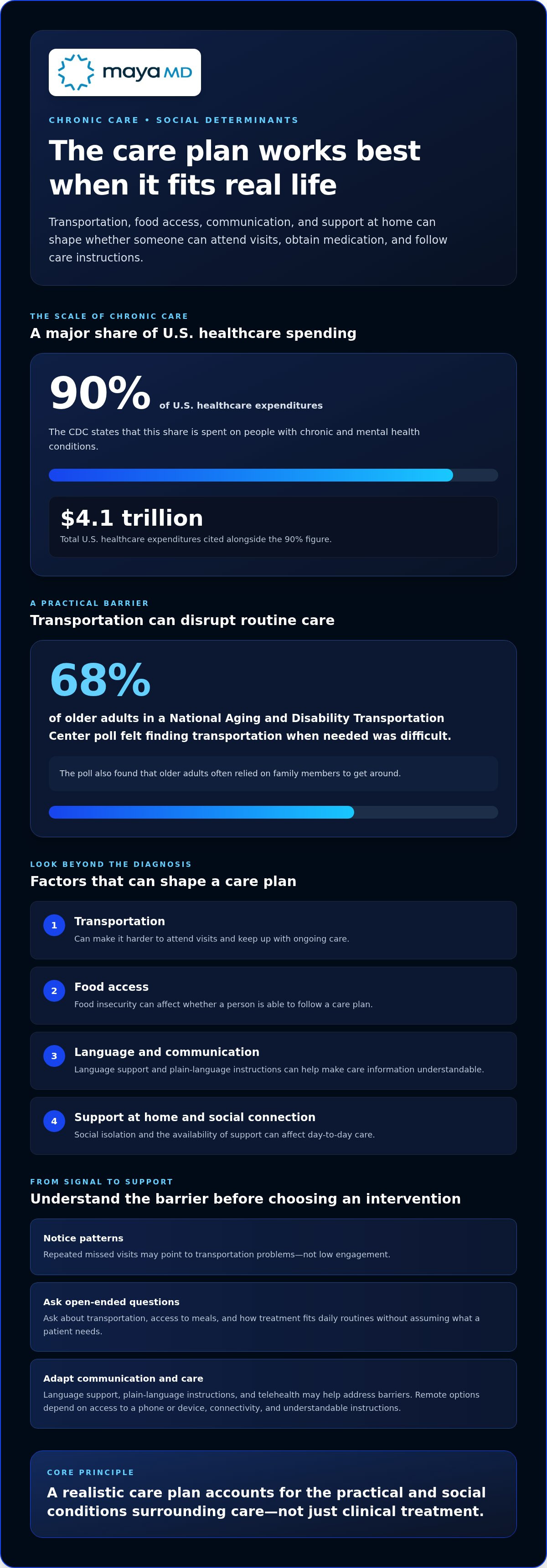
For people with chronic disease, a treatment plan depends on more than clinical care. Managing chronic care for underserved populations means accounting for practical needs such as transportation, food access, language, and support at home. These factors can affect whether a patient can attend visits, obtain medication, or follow care instructions.
The scale of chronic disease care is substantial. The Centers for Disease Control and Prevention states that 90% of the United States' $4.1 trillion in healthcare expenditures are for people with chronic and mental health conditions. Food insecurity can affect whether patients are able to follow a care plan. Asking about access to meals or transportation can help providers make a care plan more realistic.
Population Risk Stratification
Population risk stratification groups patients by clinical needs and potential barriers, helping care teams direct attention and resources. The Centers for Disease Control and Prevention defines population health in terms of health outcomes and their distribution within a population. Comparing outcomes across groups can help identify disparities.
Electronic health records can bring diagnoses, medications, appointment history, and patient-reported needs together for review. Predictive analytics can flag patterns for follow-up, while health professionals interpret each patient’s circumstances and provide personalized support. Repeated missed visits, for example, may signal transportation problems rather than low engagement. Managing chronic care for underserved populations requires teams to understand the cause before choosing an intervention.
Barriers and Remote Care Access
Transportation difficulty, food insecurity, social isolation, and communication challenges can all disrupt ongoing care. A National Aging and Disability Transportation Center poll found that 68% of older adults felt finding transportation when needed was difficult and often relied on family members to get around. Managing chronic care for underserved populations can include asking about these constraints during routine outreach.
Telehealth can reduce travel for some care interactions, while remote patient monitoring can help providers review health information between visits. These approaches require practical access to a phone or device, connectivity, and understandable instructions. Medicare chronic care management services may include 24/7 emergency access to a health care professional, providing a route for urgent concerns outside routine follow-up.
Culturally Appropriate Care and Outcomes
Culturally and linguistically appropriate care adapts communication and education to a patient’s language, preferences, and community context. Providers can offer language support, use plain-language instructions, and ask open questions about daily routines. Asking how a treatment fits with meals, for example, may reveal a food-access barrier without making assumptions.
Health systems can compare follow-up, disease control, and access across patient groups to identify disparities. Teams can review health record data, choose a gap to address, and adapt outreach or education. Tracking access for the affected group helps show whether the change is supporting more equitable care.
What is Chronic Care Management?
Chronic Care Management (CCM) organizes continuing support for people living with complex, ongoing health needs. In the United States, the Centers for Medicare & Medicaid Services (CMS) formally recognizes and reimburses CCM services. A coordinated care team can connect routine follow-up, medication review, and communication between visits, rather than treating each appointment as an isolated event.
Medication reconciliation is a practical part of care coordination. The care team compares the patient’s current medication list with prescriptions in the health record, then documents discrepancies, recent changes, and questions for follow-up. If a patient takes a medication differently than prescribed, for example, the team can record the concern and route it to the appropriate clinician. This keeps the shared plan current.
Specialist coordination is also important. A primary care provider may need a specialist’s treatment plan, test results, or medication changes before the next visit. A shared care plan can clarify who handles follow-up, what information needs to be shared, and how the patient can raise questions. Clear coordination helps reduce conflicting instructions and support continuity across providers.
Medicare CCM Services and Billing
Medicare CCM may be billed for at least 20 minutes of qualifying non-face-to-face staff time in a calendar month. This is a billing threshold, not a requirement that every patient receive the same intervention. The work may include maintaining a care plan, coordinating services, and communicating with the patient between office visits.
Medicare CCM services may include 24/7 emergency access to a health care professional. That access gives patients a defined channel for urgent concerns outside routine care coordination. It does not replace emergency services when a situation requires immediate attention. Staff time and the services delivered should be documented so the record reflects the care provided and supports appropriate billing.
Diabetes Medication, Testing, and Supplies
For someone managing diabetes, continuity involves more than reviewing medication names. The care team can reconcile prescriptions, discuss how treatment fits daily routines, and coordinate follow-up when a medication changes. The Managing Diabetes: Coverage & Resources fact sheet includes information about Medicare coverage of medications, testing, and supplies.
CCM can also help teams develop practical strategies around those needs. They can document a patient’s questions, identify the next follow-up step, and connect relevant information across visits. For practices considering how remote patient monitoring could support chronic care workflows, discuss care coordination needs.
Nearly 80% of adults aged 65 and older in the United States live with two or more chronic conditions, making chronic disease management a foundational element of patient-focused population health programs.
Open-ended questions to identify patient barriers
Effective chronic care planning starts with understanding what makes treatment difficult to follow. Open-ended questions help care teams identify barriers and match support to each patient’s circumstances.
Identifying Patient Barriers
Open-ended questions invite patients to describe their experiences in their own words, revealing obstacles that clinical measures alone may miss. Instead of asking whether a patient takes hypertension medication, a clinician might ask, “What has taking this medication been like for you?”
If a patient says they stopped taking blood pressure medication for four days, the team can ask what changed. Cost, side effects, transportation, or confusion about instructions may call for different responses. The answer can guide the next step without assumptions or blame.
Care Teams and Patient Engagement
An integrated care team brings clinical providers together with social workers or community health workers to coordinate care and patient education. This is especially important when someone leaving the hospital with a new treatment plan needs follow-up, clear explanations, and help fitting the plan into daily routines.
Smaller patient panels and more frequent follow-ups can give teams opportunities to engage patients, revisit questions, and adjust coordination. A team might document a patient’s concern, assign a follow-up action, and review the response at the next contact. Structured chronic care programs can improve outcomes while reducing total cost of care, especially for high-risk populations.
Financial Assistance and Community Care Models
Costs for uninsured and underinsured patients depend on the care required, insurance coverage, and medication needs. Support may include connecting patients with financial assistance resources. Community health centers and federally qualified health centers can provide access to ongoing care, education, coordination, and referrals that address patient needs.
Evidence-based approaches combine planned follow-up, coordinated clinical care, and attention to patient barriers. Community health workers can help patients engage with care and connect with local services. In addition, Section 5313 of the Patient Protection and Affordable Care Act of 2010 provides for grants to promote the community health workforce.
Addressing Social Needs
Addressing social needs means connecting a health plan with practical support for transportation, food insecurity, or housing concerns. This can make treatment and follow-up more manageable for people living with chronic disease.
Care teams can ask which need is most urgent, document the response, and connect the patient with relevant local or state resources. According to the Library of Congress, the law directs community health teams to coordinate chronic disease management with local primary care providers and existing state and community resources. A bus pass is one example of a practical intervention found effective in improving appointment compliance.
Chronic care management definition and eligibility
Chronic care management (CCM) is ongoing, coordinated support for people living with multiple long-term health conditions. In the United States, the defining criteria focus on the number of conditions and how long they are expected to last. Those criteria help distinguish continuing management from care focused on a single, short-term illness or visit.
For CCM, a patient generally has two or more chronic conditions expected to last at least 12 months. The Centers for Medicare & Medicaid Services (CMS) defines qualifying conditions as expected to last at least 12 months or until death. Medicare chronic care management resources are available to beneficiaries with two or more chronic conditions. Conditions may include diabetes, hypertension, heart failure, or COPD; symptoms and treatment needs differ from patient to patient.
Eligibility depends on qualifying chronic conditions, not a person’s income, neighborhood, or ability to describe every barrier. Those circumstances still matter when designing care. A patient with diabetes and hypertension, for example, may need coordinated follow-up for both conditions, while transportation or medication access can affect the plan. Identifying clinical needs alongside practical barriers helps teams tailor support.
Chronic care management (CCM) organizes ongoing care around a patient’s needs. A care team can maintain a shared plan, coordinate communication among providers, and support follow-up between visits. The plan can set out current conditions, treatment priorities, symptoms to monitor, and communication next steps. This structure helps patients and clinicians see how different parts of care connect instead of treating each appointment as an isolated event.
Medicare resource eligibility and the services delivered are related but distinct questions. Having two or more qualifying conditions is the central condition criterion described for Medicare CCM resources; the care plan then reflects the patient’s needs and goals. One patient, for example, may need help coordinating specialist recommendations, while another may need support understanding a medication routine. Programs should make these priorities clear and track relevant outcomes.
Care models can account for barriers that affect participation. Teams can document whether a patient can attend visits, access prescribed treatment, or understand care instructions, then adapt follow-up accordingly. This does not change the condition-based definition, but it can make ongoing support more useful. For underserved patients, connecting clinical coordination with personalized communication can make chronic care more responsive to daily realities.
In practice, consider a Medicare beneficiary with two chronic conditions expected to continue beyond 12 months. The team can use CCM to organize follow-up, record treatment questions, and coordinate care across providers. The patient’s eligibility criteria establish the framework, while symptoms, preferences, and barriers shape the support within it.
Chronic conditions addressed by care management
Diabetes, hypertension, and chronic obstructive pulmonary disease (COPD) are among the conditions chronic care management can address. These diseases affect people across the United States, but available prevalence figures do not establish which most affect underserved communities. A patient’s diagnoses, treatment needs, and access to ongoing care should guide priorities. Condition-specific support is more useful than assuming everyone faces the same risks.
Diabetes illustrates the scale of ongoing care needs. An estimated 29 million people in the United States are living with a diabetes diagnosis, while 8.5 million have diabetes but have not yet been diagnosed. People with diagnosed and undiagnosed diabetes together account for 11% of the U.S. population. Care management can help organize medication follow-up, testing, and communication around an individual’s treatment plan.
Hypertension also requires sustained attention. It affects nearly 50% of U.S. adults, and roughly 40 percent of Black men and women have high blood pressure. By age 55, the rate among Black men and women reaches 75 percent. For a patient with hypertension alongside another chronic condition, coordinated follow-up can keep treatment needs visible across care encounters.
Matching Support to the Condition
COPD affects more than 15 million adults in the United States. Support may include tracking reported symptoms, reviewing the care plan, and coordinating follow-up when a patient describes a change. Remote patient monitoring can give care teams information between visits, while clinical review helps determine an appropriate response for that patient.
Care management can also address conditions that occur together. Someone living with diabetes and hypertension, for example, may have separate prescriptions, appointments, and monitoring needs. A shared plan can organize these responsibilities and highlight where coordination matters. If transportation affects appointment access, follow-up planning should account for it alongside clinical goals.
Support varies because each diagnosis brings different needs. Diabetes care may involve medication, testing, and supplies; COPD follow-up may focus on reported symptoms and changes in health. For hypertension, communication can help the team understand whether treatment fits the patient’s circumstances. Managing chronic care for underserved populations means connecting clinical priorities with barriers to access and follow-through.
Health systems can align follow-up with each patient’s diagnoses and access needs rather than relying on one pathway. A framework for managing chronic care for underserved populations should account for whether a patient can participate in the plan, including transportation and communication needs. Discuss remote monitoring for chronic care when a care team needs support for ongoing visibility between visits.
MayaMD: Clinical AI Agent
MayaMD offers a Clinical AI Agent and AI patient engagement solutions to support communication between care teams and patients. For organizations managing chronic conditions, these tools can complement coordinated care by supporting patient engagement within clinical workflows. Automated post-discharge communication solutions can also help maintain contact as patients transition from hospital to home.
These capabilities can support continuity beyond scheduled visits, including for patients who face barriers to regular in-person care. They support communication and engagement, but do not replace clinical judgment or the relationship between patients and their care professionals.
To discuss how MayaMD’s solutions may fit your care workflows, contact MayaMD.
Build the Next Connection in Care
Progress in managing chronic care for underserved populations can start with one operational question: where does the patient’s care journey lose continuity? A missed handoff, an unanswered question after discharge, or a communication gap between visits can reveal a workflow to improve. Choose one point of friction, assign responsibility for the next step, and decide how the care team will assess whether the change helps patients stay connected.
This focused approach gives clinical and operational leaders a practical starting point. It keeps technology decisions tied to a defined patient need and a clear role in existing care processes. As needs change, teams can reassess priorities and refine how communication supports care.
MayaMD’s digital healthcare capabilities can be considered in that planning conversation, with the intended workflow and patient experience guiding the discussion. Start a conversation about your care coordination priorities and explore a thoughtful next step for your team.
Frequently Asked Questions
What is CCM?
CCM, or chronic care management, coordinates ongoing support for people with complex health needs. It can connect a patient’s care plan with follow-up, communication, and services between appointments. For example, a care coordinator can route a question about a treatment change to the appropriate clinician, then document the response so the care team has a consistent record.
What Medicaid and Medicare policies cover chronic disease management services for low-income patients?
Medicare formally recognizes and reimburses chronic care management services, and Medicare CCM resources are available to beneficiaries with two or more chronic conditions. Medicare CCM may be billed for at least 20 minutes of qualifying non-face-to-face staff time in a calendar month. Medicaid coverage and care-management options depend on the patient’s program and plan; patients can ask their Medicaid plan about covered coordination and referral support.
What are the risks of care fragmentation and medication nonadherence in underserved populations?
Fragmented care can leave clinicians working from different medication lists or unaware of a recent treatment change. Patients may then receive conflicting instructions, miss follow-up, or have a concern go unanswered. Medication nonadherence can interrupt disease control or make it harder to assess whether treatment is helping. A current shared medication record and clear follow-up ownership help teams identify and address these risks.
Which chronic diseases most affect underserved communities in the U.S.?
The conditions discussed include diabetes, hypertension, and COPD. The information here does not establish which most affects underserved communities.
Which local U.S. programs help underserved patients manage chronic conditions?
Community health centers and integrated care teams that include social workers or community health workers can support patients. Community health teams can coordinate care with local primary care providers and existing state and community resources.




See The MayaMD Difference
Fill the form below
Download Our Apps
MayaMD for patients and MayaPro for physicians - available on iOS and Android.
FOR PATIENTS
MayaMD App
AI-powered symptom assessment, triage, and secure access to your care team.


FOR PHYSICIANS
MayaPro App
MayaPro brings patient vitals, RPM/PCM care plans, and clinical decision support to your pocket.