
Improving Patient Adherence with RPM in Las Vegas

More monitoring data doesn’t automatically mean better adherence. When a patient misses a reading, the cause could be unclear instructions, a device or connectivity issue, or a communication approach that doesn’t fit their routine. Treating every missed submission as disengagement can hide the real barrier and delay useful follow-up.
Consistent participation helps care teams interpret remote patient monitoring (RPM) information over time. Improving adherence starts with a repeatable process: explain the plan, identify what’s getting in the way, follow up through a patient’s preferred channel, and connect relevant information to clinician-led care.
This guide covers practical steps for setting expectations, recognizing participation gaps, coordinating outreach, and documenting follow-up. MayaMD’s nationally recognized platform combines protocol-driven conversational AI with communication through an app, phone calls, and two-way text. Patient replies are captured in the same care plan. The AI asks questions; clinicians retain all care decisions. This structured approach supports participation and continuity of care from hospital to home, while helping teams distinguish technical friction from a need for personal follow-up.
Key Takeaways
• Define adherence around the monitoring and communication plan agreed with each patient, then set expectations within the clinician-directed care plan.
• Review connected readings alongside patient communication and clinician follow-up to put monitoring data in context.
• Distinguish received measurements and communication responses from medication-taking behavior. Recorded readings alone can’t establish whether medication was taken.
• Use a consistent workflow to enroll patients, explain the plan, establish communication, review participation, follow up, and document outcomes.
• MayaMD’s hospital-to-home pathway uses the 13-step Project RED discharge protocol to support continuity into remote monitoring and care management.
Why Patient Adherence Matters in Remote Patient Monitoring
Remote patient monitoring (RPM) is most useful when readings and communication are part of an ongoing care relationship, not a disconnected stream of numbers. In this guide, adherence means a patient’s participation in the monitoring and communication plan agreed with the care team. Reviewing participation helps clinicians see what information is available, what may be missing, and where follow-up could support continuity after discharge.
For a foundational overview of the approach, see What is Remote Patient Monitoring? In practice, an RPM plan connects measurements taken at home with a defined process for communication and clinical review. Consistent participation gives clinicians more context for interpreting submitted readings over time. A gap leaves questions: Was the measurement not taken, did the device fail to transmit it, or did the reading not reach the care team?
What patient adherence means in an RPM program
Adherence has several parts, and they shouldn’t be treated as interchangeable. Device use means completing a measurement as instructed. Reading submission means the monitoring program receives it. Responding to a care-team message is another form of participation. A submitted reading documents a measurement; it doesn’t show every aspect of treatment behavior, including whether medication was taken. Keeping these distinctions clear supports an accurate, patient-centered response rather than a broad judgment about engagement.
Adherence is a shared care-process concern. Patients need clear instructions and an understandable reason for the plan. Teams need a consistent way to review participation and respond to questions or gaps. The goal isn’t perfect data for its own sake. It’s a workable connection between home monitoring and clinician-led care.
Why participation can become difficult at home
Leaving the hospital changes the conditions around care. At home, patients may be balancing recovery with daily responsibilities, have trouble recalling instructions, or be unsure why a particular reading matters. Device setup or access can create practical friction. Communication can, too: a patient who rarely checks an app may be more likely to respond to a phone call or text. These are possibilities to explore, not conclusions to draw from a missed reading.
Start by clarifying the barrier. Is the instruction unclear? Is it difficult to fit the measurement into the patient’s routine? Is there a technical or access issue, or a preference about how the team reaches out? A respectful check-in can establish what happened and agree on a next step that fits the care plan. Don’t interpret silence as unwillingness before the team has tried to understand the circumstances.
Effective RPM adherence support isn’t simply about collecting more readings. It’s about sustaining communication from hospital discharge to home. When teams assess participation in context, they can address friction without blame and use available information responsibly in follow-up.
How RPM Supports Patient Adherence Through Data and Communication
Remote patient monitoring works as a connected process: a patient takes an agreed measurement, the reading is transmitted, and the care team can review it alongside relevant communication. Each part serves a different purpose. A device can make submitting a reading easier, but follow-up still depends on clear outreach and clinician-led review. MayaMD’s remote patient monitoring pathway brings connected devices, patient communication, and clinical support into the same care process.
This connection matters during the transition home, when patients are adapting to instructions outside the hospital setting. A systematic review on RPM for Hospital-to-Home Transitions examines remote monitoring in relation to patient safety and adherence during this transition. For care teams, the practical lesson is to use data and outreach together: measurements provide information, while patient responses can clarify context and inform appropriate follow-up.
Make monitoring easier to participate in
MayaMD’s RPM pathway uses FDA-cleared cellular blood-pressure cuffs, scales, and pulse oximeters. The devices transmit readings automatically without requiring patients to pair them with a phone or connect them to Wi-Fi. Fewer setup steps can reduce one source of friction, but patients still need clear instructions and a plan for questions. The devices transmit measurements; they don’t establish whether a patient followed other parts of a treatment plan.
At enrollment, explain which device is part of the patient’s plan, how and when to use it, and what to do if a reading doesn’t appear as expected. A clear explanation gives patients a concrete next step instead of leaving them to troubleshoot alone.
Connect outreach with clinician follow-through
Communication should accommodate how a patient is most comfortable responding. In MayaMD’s pathway, patients can engage through the app, a phone call, or two-way text. Their replies are captured in the same care plan, helping the team maintain continuity across channels instead of treating each exchange as a separate interaction. A patient who doesn’t respond in one channel may still be able to communicate through another.
Protocol-driven Conversational AI asks questions and supports structured outreach; it doesn’t make clinical decisions. When information requires escalation, it reaches clinicians for review. Clinicians retain all care decisions. A prompt or reported concern can support follow-through, but clinical interpretation and decisions remain with the care team.
An effective RPM approach connects manageable participation, accessible communication, and clinician-led follow-up. Teams refining that connection can discuss an RPM care pathway designed to support continuity from hospital to home.
What RPM Adherence Measures, and What It Cannot Prove
RPM data can help care teams see whether expected measurements arrive and whether patients respond to planned outreach. It can’t, by itself, explain why a reading is missing or establish everything a patient did between contacts. Separating observable participation from assumptions about treatment behavior makes the information more useful and keeps clinical interpretation grounded in the patient’s care plan.
This distinction is central to responsible RPM interpretation. A blood-pressure reading documents a submitted measurement. It isn’t evidence that medication was taken, skipped, or taken as prescribed. Likewise, a missing measurement is not the same as an abnormal one: the first is an absence of data, while the second is a received value that may warrant clinical review in context. Medication concerns require their own conversation and assessment.
Choose useful participation indicators
Use plain-language indicators tied to the individual plan: did expected readings arrive, and did the patient respond to planned outreach? Review patterns over time rather than treating a single gap as a conclusion. If submissions are repeatedly missed, use the pattern as a prompt to ask about instructions, access, device setup, or communication fit. Avoid unsupported thresholds or guarantees. The care plan and clinical judgment determine what deserves follow-up.
Useful indicators should make the next action clearer, not reduce participation to a pass-or-fail label. A missed submission can prompt a check-in; on its own, it can’t establish the patient’s reason or intent.
Interpret gaps without overreading the data
Separate three signals: no reading received, a reading received that may need clinical interpretation, and a patient-reported medication concern. They call for different questions and shouldn’t be collapsed into one adherence score. Before inferring disengagement from missing data, consider whether the patient understood the instructions, could access the device, or received outreach in a workable channel.
Then document what is known, what remains uncertain, and the next step. For example, a team might record that an expected reading wasn’t received, note that the reason hasn’t yet been established, and follow up according to the care plan. If the patient reports a concern or a measurement warrants attention, escalation and any care-plan change remain under clinician oversight.
RPM data informs care; it doesn’t replace clinical judgment. Keeping participation indicators in their proper role helps them inform clinician assessment rather than substitute for it.
A Practical RPM Workflow for Improving Patient Adherence
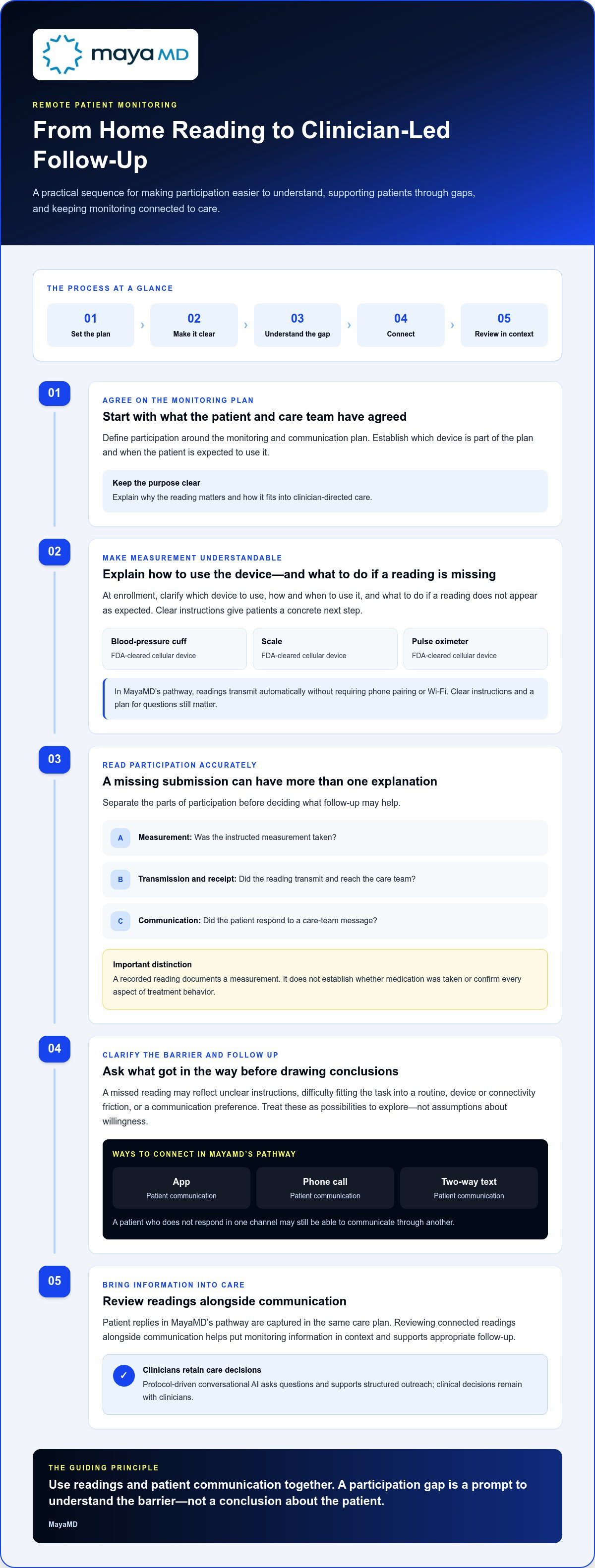
Adherence is supported by a process patients can understand and care teams can repeat. The workflow below links enrollment, clear education, accessible communication, data review, follow-up, and documentation. Each step should fit the patient’s clinician-directed care plan, including which readings are expected and how the team will respond when participation changes.
Set expectations before monitoring begins
Before monitoring starts, explain the purpose of the plan, how to use the assigned device, when readings are expected, and how the patient can reach or respond to the care team. Use plain language and invite questions. Ask the patient to describe the next step in their own words to confirm their understanding. Structured discharge-to-home education, such as the Project RED discharge pathway, can connect instructions given at discharge with ongoing support at home.
Enroll
Confirm that RPM is part of the patient’s care plan and explain what participation involves. Identify the readings and communication process relevant to that plan.
Explain
Describe how and when to take each assigned measurement, why it matters to the care team, and what the patient should do if the device or instructions create difficulty. Don’t rely on a handout alone; leave room for questions.
Establish communication
Agree on a practical way to exchange information, such as the app, a phone call, or two-way text. Explain how the team will reach out and how the patient can reply or raise a concern.
Monitor
Review whether expected readings arrive and whether planned outreach receives a response. Consider the pattern in relation to the plan instead of treating an isolated gap as a conclusion about motivation.
Follow up
If participation changes, use a respectful check-in to understand what happened. Clarify instructions or identify access, setup, or communication barriers, then route readings or patient concerns through the established clinician escalation workflow.
Document
Record available information, outreach attempts and replies, identified barriers, and next steps in the care plan. Clear documentation helps the team maintain continuity and distinguish unresolved questions from clinically reviewed concerns.
Respond consistently when participation changes
A missed reading calls for a different response than a received reading that needs clinical review. Staff can gather context and document what the patient reports. Clinicians assess relevant readings and concerns, determine whether escalation is needed, and retain authority over care decisions and plan changes. Consistent routing makes follow-up easier to coordinate without turning a participation gap into an unsupported clinical conclusion.
A repeatable workflow gives patients understandable next steps and staff a clear path from observation to follow-up. To discuss a clinician-led RPM workflow that supports continuity from hospital to home, Book a 20-minute intro.
How MayaMD Supports RPM Adherence from Hospital to Home
Patient participation doesn’t begin and end with a device reading. It develops through understandable education, accessible communication, and clinician-led follow-through as patients move from hospital discharge to home. MayaMD is a nationally recognized platform focused on this transition and remote monitoring, connecting discharge support with later RPM and care-management support.
The 13-step Project RED discharge protocol provides a structured pathway for patient education and transition planning. That foundation can carry into the home phase, where remote monitoring and communication help maintain continuity beyond the hospital stay. The goal is a consistent care process, not a promise that every patient will participate in the same way or achieve a particular outcome.
Coordinate patient support across channels
MayaMD’s RPM pathway brings together protocol-driven Conversational AI, Companion AI, connected devices, and clinical staff support. Conversational AI follows a protocol-driven question flow, with AI only doing the talking. The Maya app answers questions, sends reminders and education, and checks in day or night. Patients can also reply through the app, voice, or two-way text, with replies captured in the same care plan. This keeps exchanges connected to the broader follow-up process.
Clinical staff support enrollment, outreach, follow-up calls, and EHR documentation. Through the clinician portal, clinicians receive escalations and structured notes, review relevant information, and make all care decisions. Technology supports information gathering and routing, but it doesn’t decide how to interpret a concern or whether the care plan should change.
Build confidence with evidence and a manageable rollout
MayaMD’s platform was built over 11 years with 25,000 physician hours, and 300,000+ patients have been reached through partner practices. In the discharge pathway, 60+ randomized controlled trials underpin the RED discharge protocol. These proof points describe the platform’s development, reach, and protocol foundation; they don’t guarantee adherence or a specific result for an individual patient.
A focused implementation gives teams a defined starting point to align discharge education, monitoring expectations, communication preferences, and escalation processes. Start with one unit and go live in 4-6 weeks. This provides an opportunity to establish responsibilities and workflows for that setting before extending the approach more broadly.
For healthcare teams evaluating a connected hospital-to-home workflow, Book a 20-minute intro. You can also reach MayaMD at +1 (888) 629-2631 or info@mayamd.ai.
Make Your Next RPM Step Count
Improving patient adherence with RPM starts with a practical next step: identify where participation is most likely to break down in your current transition from discharge to home, then align patient communication and clinical follow-up around that point. The aim isn’t to pursue readings in isolation. It’s to make monitoring understandable to patients and useful to the clinicians guiding their care.
MayaMD’s reported outcomes offer relevant context, not a guarantee of future results: Spring Valley Hospital reported 30%+ fewer 30-day heart-failure readmissions, and 100% of surveyed patients preferred Maya for discharge education. These findings can inform discussion about how structured education and follow-through may fit into a care transition strategy.
Consider what a connected hospital-to-home workflow could look like for your team and patients. Book a 20-minute intro to discuss a practical path forward. With a clear starting point and clinician-led follow-through, your team can build a monitoring experience that better supports patients at home.
Frequently Asked Questions
Does RPM confirm whether a patient has taken medication?
No. An RPM reading records a measurement received by the monitoring program; it doesn’t verify whether medication was taken. For example, a blood-pressure reading cannot establish whether a patient took a prescribed dose before measuring. If medication-taking is relevant to care, the patient can discuss it with the care team, which can consider that information alongside readings and the clinician-directed plan.
How often should patients submit readings during an RPM program?
Patients should follow the schedule set by their care team, because reading frequency depends on the individual monitoring plan. There isn’t one schedule that applies to every patient or condition. Before leaving the hospital or starting home monitoring, patients can ask which readings are expected, at what times or intervals, and what to do if a measurement is missed. The team can clarify the plan if instructions are unclear.
Can patients participate in RPM without using a smartphone app?
Yes. MayaMD patients can respond through phone calls or two-way text rather than using the app for every interaction. Its FDA-cleared cellular blood-pressure cuffs, scales, and pulse oximeters transmit readings automatically without pairing or Wi-Fi. At the start of the program, patients can discuss which communication channel works for them and how to respond to outreach, so the team can keep communication connected to the care plan.
Does remote patient monitoring replace follow-up care?
No. RPM supports follow-up by providing readings and patient communication for the care team to review; it doesn’t replace clinician assessment or other planned care. A home measurement may give a clinician information to consider between visits, while a patient’s question may need a separate discussion. Patients should continue following the appointments and instructions in their care plan, and contact their care team with concerns.
What should patients know before RPM begins after discharge?
Before monitoring begins, patients should understand its purpose, which measurements are part of their plan, how to use the assigned device, and how often readings are expected. They should also know how the care team may reach them and how they can respond or ask questions. Raising confusion early can help the team clarify instructions before the patient is managing the process at home.
What happens if a patient repeatedly misses an RPM reading?
Repeated missed readings should prompt a supportive check-in, not an assumption that the patient is unwilling to participate. The care team can ask whether instructions are clear, whether device setup or access is creating difficulty, and whether another communication channel would be easier. Staff can document the patient’s response and route relevant information for clinician review. The clinician determines any appropriate follow-up or care-plan changes.




See The MayaMD Difference
Fill the form below
Download Our Apps
MayaMD for patients and MayaPro for physicians - available on iOS and Android.
FOR PATIENTS
MayaMD App
AI-powered symptom assessment, triage, and secure access to your care team.

FOR PHYSICIANS
MayaPro App
MayaPro brings patient vitals, RPM/PCM care plans, and clinical decision support to your pocket.