
Hybrid Care Model Benefits for Chronic Disease Management

Chronic care shouldn’t stop at the clinic door. The benefits of a hybrid care model for chronic disease come from connecting in-person care with virtual visits and remote monitoring, so support continues between appointments. The model’s value is continuity, particularly after hospital discharge, when clear communication and follow-up help keep care on track.
It makes sense to ask whether hybrid care is the future: people managing ongoing conditions need regular support, but not every check-in requires an in-person visit. Virtual care doesn’t replace examinations or procedures. It adds another way to stay in touch and helps patients and care teams choose the visit format that fits the health need.
This article explains how monitoring, virtual visits, shared electronic health records, and follow-up support chronic disease management. You’ll see how these elements work together to help care teams notice changes, review treatment, and maintain continuity after discharge, as well as where in-person care remains important.
Key Takeaways
• Remote readings are most useful when care teams can interpret changes in context and connect them to timely follow-up.
• Keeping virtual and in-person encounter information connected helps teams maintain a coherent view of a patient’s care.
• Hybrid primary care can make routine follow-ups and treatment discussions more accessible while preserving in-person care for needs that require examination.
• A clear post-discharge follow-up process can help patients and care teams address questions and changes as recovery continues at home.
• Blood pressure, A1C, and hospitalization outcomes depend on how monitoring, clinical review, and ongoing condition management work together.
Remote patient monitoring
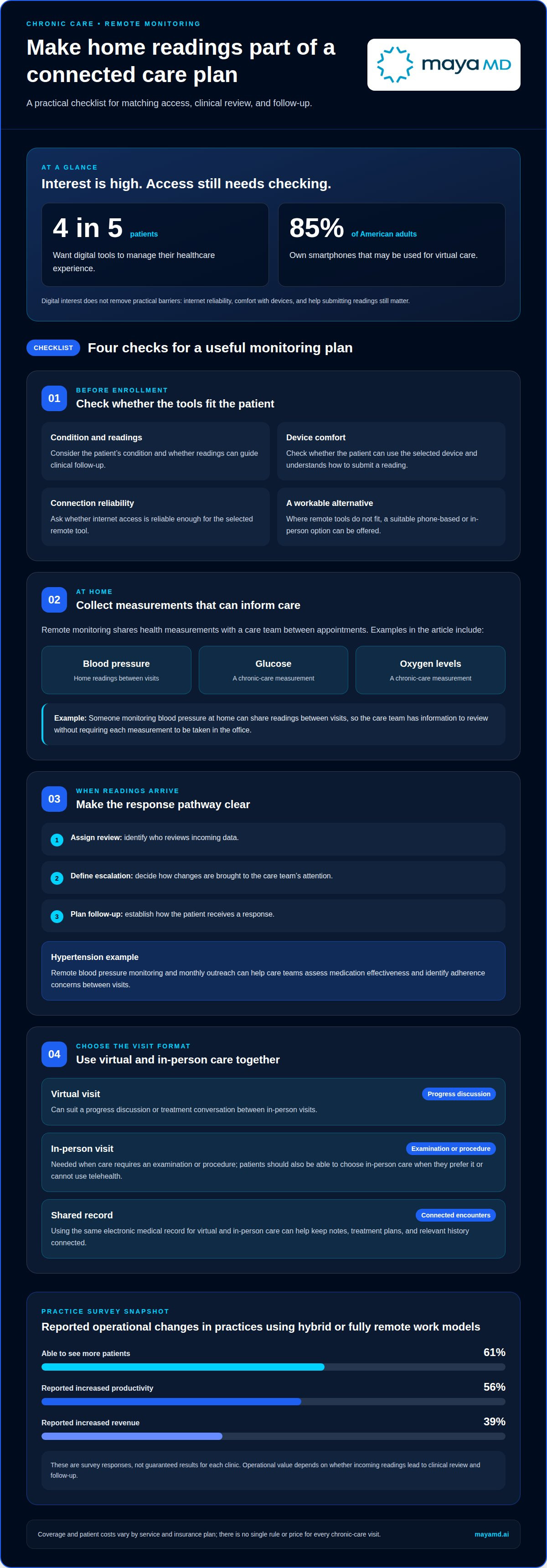
Remote patient monitoring collects health measurements at home and shares them with a care team. For chronic conditions, readings such as blood pressure, glucose, and oxygen levels can inform follow-up between appointments.
Patient Preferences and Technology Access
Patient preference and access to usable technology shape whether remote monitoring fits a care plan. As many as 4 in 5 patients want digital tools to manage their healthcare experience, but that preference does not remove practical barriers. A patient may lack reliable internet, feel uncomfortable using a device, or need help understanding how to submit a reading. Practices can offer a suitable phone-based or in-person alternative where remote tools do not fit.
Technology access is part of eligibility, not an afterthought. Before enrollment, the care team can consider the patient’s condition, ability to use the selected device, connection reliability, and whether readings can guide clinical follow-up. A smartphone is common, but not universal: the guide states that 85% of American adults own smartphones that may be used for virtual care.
Access, Convenience, and Care Continuity
Remote monitoring can reduce the need to travel for every routine check-in. This can matter for patients who live far from a clinic, have transportation difficulties, or need frequent follow-up. For example, someone monitoring blood pressure at home can share readings between visits, giving the care team information to review without requiring each measurement to be taken in the office.
Continuity depends on what happens after a reading arrives. A defined workflow should identify who reviews the data, how changes are escalated, and how the patient receives follow-up. For hypertension, remote blood pressure monitoring and monthly outreach can help care teams assess medication effectiveness and identify adherence concerns between visits.
Medicare and other US insurance coverage for telehealth depends on the service and the patient’s plan. There is no single coverage rule for every chronic-care visit. Patients should establish whether a specific service is covered and whether its cost-sharing differs from an in-person visit.
Hybrid chronic disease care has no single price. Patient costs depend on the services used and insurance coverage. A plan may treat a virtual visit differently from remote monitoring or an in-person appointment.
Monitoring can also give a practice more opportunities to review patient needs between scheduled appointments. In a survey of healthcare providers, 61% of practices using hybrid or fully remote work models were able to see more patients. The same survey reported increased productivity at 56% of practices and increased revenue at 39%.
Those practice-level figures describe survey responses, not guaranteed results for each clinic. Operational value depends on whether incoming readings lead to clinical review and follow-up. Without a clear process, additional data can create work without helping the care team respond to changes in a patient’s condition.
Is Hybrid Care the Future?
Hybrid care combines telehealth with in-person visits, matching the format to the clinical need. Its effectiveness depends on coordination, including a shared record and a clear path between visit types.
Combining Virtual and In-Person Visits
Hybrid care uses telehealth and in-person consultations as complementary options, not competing models. A patient’s care needs can change between appointments, so patients and providers can decide together based on health needs, comfort, and the assessment required. A virtual visit may suit a progress discussion, while an examination or procedure calls for in-person care. Patients should also be able to choose in-person visits when they prefer them or cannot use telehealth.
Comparing Care Models and Outcomes
In-person-only care supports physical examinations but requires travel for each visit. Telehealth-only care makes remote consultations possible but cannot provide in-person examinations or procedures. Hybrid care combines both, allowing the visit format to reflect the patient’s needs and the care being delivered. No format alone guarantees better chronic disease outcomes; continuity depends on sound clinical decisions, follow-up, and information sharing.
Choose a care plan by starting with the task. The patient and provider can identify which needs require physical assessment, which can be addressed through virtual visits, and how to move between formats. For example, a clinic examination can be followed by a telehealth discussion of progress, with another in-person visit if an examination becomes necessary.
Record integration connects encounters. Using the same electronic medical record for telehealth and in-person care can reduce the chance of information being missing or inaccurate as notes move between systems. A clinician reviewing a virtual follow-up can refer to the earlier assessment, treatment plan, and relevant patient history in one record.
Continuity also depends on how teams document each encounter. A virtual visit should capture the patient’s concerns, relevant clinical findings, decisions, and next steps, just as an in-person visit does. Recording a reported change and the resulting plan helps the next clinician understand what happened and why follow-up was arranged.
Virtual visits can follow a consistent structure: review the reason for the visit, discuss symptoms and treatment, invite questions, and summarize the plan. Telehealth visits follow the same privacy rules as in-person care. A clear agenda and documentation help patients understand what comes next, while internet access and comfort with the technology remain practical considerations.
Hybrid care works best when patients know which visit types are available and how transitions happen. For a care model with connected virtual and in-person workflows, discuss care coordination.
Virtual primary care for chronic conditions
Virtual primary care extends chronic disease follow-up beyond clinic visits, supporting discussions, education, and review of patient-reported information. For diabetes, heart disease, and COPD, its value depends on matching remote care to the patient’s condition and including in-person assessment when needed.
Evidence varies by condition and intervention. For people with Type 2 diabetes, higher digital engagement is associated with improved clinical outcomes. In heart failure, meta-analytic evidence found remote patient monitoring reduced hospitalizations by 20%. These findings support specific uses of hybrid care, rather than proving that every virtual-care program produces the same result.
For COPD, hybrid care can include remote tracking of oxygen levels and virtual check-ins, alongside in-person assessment when clinically needed. Monitoring provides information between appointments, which clinicians interpret alongside symptoms, history, and the treatment plan. This helps structure follow-up without treating a home reading as a substitute for clinical judgment.
Missed appointments can interrupt routine chronic care and leave a scheduled visit unused. A missed healthcare appointment leaves a 60-minute physician appointment slot unused. Virtual options can reduce travel and scheduling barriers for suitable follow-ups, such as discussing symptoms or reviewing test results. They do not remove the need to assess which visit format fits the patient’s concern.
Virtual check-ups can support prescription renewals, discussion of lab or test results, and patient questions. Useful follow-up connects the discussion to a clear next step: document the decision, clarify any treatment changes, and arrange further review when needed. Home measurements can add context to that conversation between office visits.
For example, a patient with diabetes might use a virtual appointment to discuss daily self-management challenges, medication questions, or progress toward care goals. Ongoing education, medication monitoring, and care coordination can reinforce self-management. For patients managing weight alongside a chronic condition, a telehealth nutrition visit can help set health goals and develop a nutrition plan around dietary changes.
Virtual primary care can make follow-up easier to fit into daily life, especially when travel or frequent appointments create friction. Access still depends on a usable phone or internet connection, patient comfort, and an appropriate care pathway. A clinician can consider the patient’s needs and appointment purpose when deciding whether a remote discussion, in-person examination, or combination is appropriate.
For chronic disease teams, the practical opportunity is continuity: connect patient questions, monitoring, education, and follow-up instead of treating each appointment as an isolated event. When symptoms or care needs call for direct examination, in-person primary care remains essential.
Post-discharge continuity of care
After a hospital stay, chronic disease care shifts from a supervised setting to everyday routines. The transition works best when the patient, hospital team, and follow-up providers share a clear plan. That plan connects discharge instructions with medication questions, scheduled follow-up, and a way to report new concerns. Without those connections, patients may struggle to understand what to do next.
A hybrid approach can link discharge planning to remote check-ins and in-person follow-up. For example, a care team can review the discharge summary, identify the next appointment, and arrange a virtual conversation to address questions. If symptoms or examination needs call for direct assessment, the plan can shift to in-person care, whether at a clinic or through home healthcare providers such as hakeemathome.com for patients facing mobility challenges. Documenting each transition helps providers see the decisions already made.
Michael, a 50-year-old factory worker in rural Idaho, received a hybrid care plan after knee surgery. His nearest clinic was more than an hour away. The example illustrates why a plan may need to combine remote contact with appropriate in-person care. Distance can make routine follow-up harder, while a virtual check-in can provide another way to discuss recovery and clarify instructions.
For patients managing chronic conditions after a hospital stay, continuity also means connecting new discharge instructions with existing care. A provider reviewing the plan can identify medication changes, follow-up needs, and which team member should address each question. The patient then has a clear account of what changed during hospitalization and how that change relates to ongoing condition management.
Follow-up communication should be specific and useful. A message can reinforce the next appointment, explain how to reach the care team, or invite the patient to share a concern. If the patient reports a change, the team can route it for review and document its response. This creates a traceable sequence from discharge instructions to follow-up action.
Care delivery also depends on coordination across providers. A hospital clinician may document the discharge plan while a primary care provider continues chronic disease management. Sharing encounter information in the patient’s record gives the receiving team context for follow-up. Patients should not have to reconstruct the transition from memory during each conversation.
Reliable continuity is therefore a designed process, not simply a scheduled appointment. A hospital-to-home transition plan can connect discharge education, follow-up communication, and clinical review. The practical test is whether patients receive understandable next steps and whether care providers can act on relevant information as responsibility moves from hospital to home.
How does hybrid care affect chronic disease outcomes such as blood pressure, A1C, and hospitalizations?
Hybrid care can connect home measurements, clinical review, and follow-up, giving care teams information between appointments. Its effect on outcomes depends on how clinicians use those data to guide care. For example, blood pressure readings can be reviewed alongside a patient’s treatment plan, while an A1C result can be discussed during a virtual or in-person follow-up.
For hypertension, remote blood pressure monitoring can help care teams assess medication effectiveness and identify adherence concerns between visits. Readings are most useful when considered as a pattern rather than in isolation. A follow-up discussion can clarify whether the patient is taking medication as planned and whether the care plan needs clinical review.
For diabetes, ongoing education, medication monitoring, and care coordination can reinforce daily self-management behaviors. Higher levels of digital engagement among people with Type 2 diabetes are associated with improved clinical outcomes. In practice, a virtual visit can give a patient and clinician time to discuss barriers to self-management, while glucose data and A1C results add information to the broader care conversation.
Hospitalizations are another outcome teams may monitor, especially for people with heart failure. According to LifeBridge Health, remote monitoring can help providers identify potential problems early, reduce complications, and prevent unnecessary emergency visits. Not every change is an emergency. The care team needs a defined process for reviewing concerning information and deciding whether follow-up should be remote or in person.
To evaluate a hybrid program, practices can connect each outcome to a care process. For example, teams can review whether blood pressure readings reach the right clinician, whether diabetes follow-up incorporates relevant test results, and whether changes in a heart failure patient’s condition prompt timely clinical attention. Process measures show how monitoring connects to care; outcome measures show what changes over time.
Interpretation also requires context. A single blood pressure reading or A1C result cannot describe every aspect of a patient’s chronic disease management. Clinicians consider the patient’s history, treatment plan, symptoms, and available measurements together. In-person assessment remains relevant when examination or other direct evaluation is needed.
For practices building a connected chronic-care workflow, discuss remote monitoring and follow-up needs with the care coordination team.
Remote patient monitoring devices, including glucose meters and blood pressure cuffs, can support virtual check-ins for chronic conditions. Hybrid care may also use remote tools to track glucose, blood pressure, and oxygen levels, helping people with diabetes, heart disease, or cancer stay on track with care.
At the Centro Médico ABC clinics, overweight and obesity affected 87% of the patient population; pre-diabetes affected 32.6%, and Type 1 and type 2 diabetes affected 29.7%. These figures show why connected follow-up may be relevant across a patient population with varied chronic care needs.
MayaMD: remote patient monitoring for chronic care management
MayaMD supports chronic-care teams with remote patient monitoring for chronic care management, connecting patient engagement with ongoing care workflows. It can help practices extend follow-up between appointments and maintain continuity as patients manage conditions at home.
Depending on the care need, teams can also use MayaMD’s Clinical AI Agent, AI patient engagement solutions, or AI symptom checker for diagnosis disease information. These capabilities support communication and access to health information within a broader clinical approach. They do not replace clinician judgment or in-person assessment when needed.
For care teams considering how these capabilities could support their chronic-care model, contact MayaMD.
Build the Next Phase of Connected Chronic Care
Start by identifying where continuity breaks down in your care pathway. Consider which patient interactions need clinical review, where follow-up communication loses momentum, and how information moves across settings. This operational view helps translate the benefits of a hybrid care model for chronic disease into an approach shaped around your patients and workflows.
MayaMD offers a Clinical AI Agent, AI patient engagement solutions, and automated post-discharge communication solutions. These capabilities support communication and follow-up as part of a broader chronic-care strategy. Their role should reflect the clinical processes they support and the needs of the patients those processes serve.
With a clear view of your priorities, you can explore how connected digital support could fit your care model. Contact MayaMD to discuss hybrid care and take a considered next step toward more coordinated chronic disease management.
Frequently Asked Questions
What is hybrid healthcare?
Hybrid healthcare combines in-person services and telehealth as parts of one care approach. For example, a patient might use a virtual visit to discuss a routine concern, then attend an in-person appointment for an examination. The care team considers the purpose of each interaction and the patient’s circumstances. The defining feature is coordination between formats, not offering virtual and clinic visits as disconnected options.
What is a hybrid care model for chronic disease management?
A hybrid chronic disease model organizes ongoing care across clinic visits, virtual contact, and relevant remote information. For example, a care plan can specify how a patient raises a concern, who reviews it, and when an in-person assessment is appropriate. This structure helps patients and clinicians understand how follow-up fits into ongoing management, rather than treating each interaction as a separate episode.
What are the benefits of hybrid in-person and virtual care for chronic disease patients?
The benefits of a hybrid care model for chronic disease include more ways to stay connected with a care team and greater flexibility in how suitable appointments take place. A patient balancing work, mobility challenges, or recurring care needs may find a virtual discussion easier to attend while retaining in-person care for examinations. The approach can support continuity and patient choice without assuming every visit or clinical need can be handled remotely.




See The MayaMD Difference
Fill the form below
Download Our Apps
MayaMD for patients and MayaPro for physicians - available on iOS and Android.
FOR PATIENTS
MayaMD App
AI-powered symptom assessment, triage, and secure access to your care team.


FOR PHYSICIANS
MayaPro App
MayaPro brings patient vitals, RPM/PCM care plans, and clinical decision support to your pocket.