
How to Write a Proposal for a New Clinical AI Tool

A clinical AI proposal doesn’t earn approval by making the technology sound impressive. It earns consideration by showing how the tool will address a defined clinical need, protect patients, and fit the work already being done. If you’re asking how to write a proposal for a new clinical AI tool, start with the decision-makers’ central question: what evidence would make this a safe, useful, and measurable investment?
It’s reasonable to feel pressure to address safety, privacy, accountability, and workflow integration all at once. A clear structure can make those questions manageable. This article will help you build a decision-ready proposal that connects the clinical problem to intended use, safeguards, workflow requirements, and evaluation criteria, without overstating what the AI can do.
You’ll learn how to define the use case and users, present evidence and risks with appropriate balance, assign oversight, and set measurable outcomes for a pilot and implementation plan. The result is a practical foundation for an informed decision, one that keeps clinical judgment and patient experience central.
Key Takeaways
• Start with a defined care problem and clarify whether the proposal seeks approval, funding, procurement review, or a vendor response.
• Separate published evidence, local baseline data, vendor statements, and assumptions so decision-makers can assess the strength of each claim.
• Compare AI options against the same use case, patient population, workflow, oversight needs, and known limitations.
• Learn how to write a proposal for a new clinical AI tool by setting evaluation questions in advance and distinguishing process measures from clinical outcomes.
• Use a staged plan, from baseline assessment and governance review through workflow design and evaluation, to support a clear decision.
Start a clinical AI tool proposal with a defined care problem
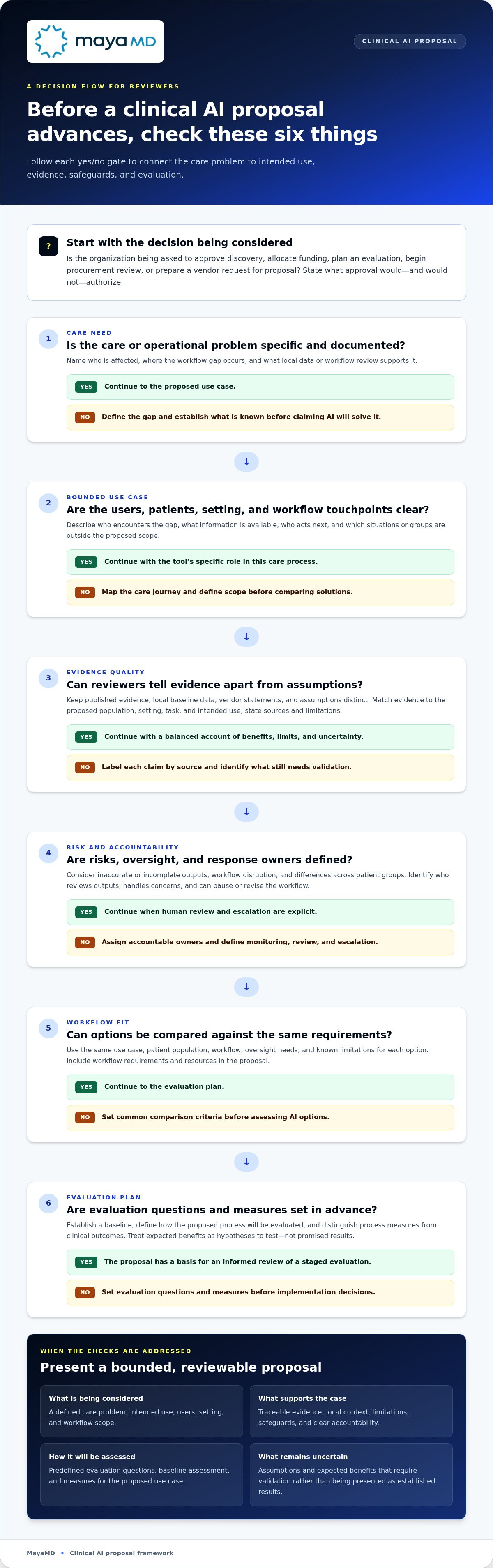
A clinical AI proposal is a decision document, not a technology pitch. It describes a specific care or operational problem, the use case under consideration, and the action leaders are being asked to take. Begin with the problem, such as a gap in patient follow-up after discharge or a documentation task that interrupts a defined care process. Don’t claim that AI will solve it before establishing what is happening now and what evidence supports that conclusion.
A concise problem statement can make the proposal’s logic visible: “For [patient group] in [care setting], [documented workflow gap] affects [care or operational process]. We propose evaluating whether [type of AI support] could help, subject to clinical oversight and evaluation.” Label what is known from local data or documented workflow review separately from assumptions that need validation. That distinction gives decision-makers a sound starting point rather than an implied promise.
Set the proposal’s purpose, audience, and decision
Be explicit about the decision the document seeks. Is the organization being asked to approve discovery, allocate funding, plan an evaluation, begin procurement review, or prepare a vendor request for proposal? These are different decisions, with different evidence and levels of commitment. An internal business case explains why the organization should investigate or adopt a use case; an RFP response or product proposal explains how a vendor’s offering addresses specified requirements.
Name the stakeholders who need to assess the proposal: clinical leaders, operational owners, technical and information security teams, and executives responsible for the decision. Then state what approval would authorize, and what it would not authorize. For example, permission to scope a pilot is not the same as approval for deployment. Clear decision boundaries prevent a preliminary discussion from being mistaken for a clinical or procurement commitment.
Define the clinical use case before describing the tool
Map the affected care journey from the patient and care team’s perspective. Identify who encounters the current gap, where it occurs, what information is available at that point, and who acts next. Specify the intended users, patient population, setting, and workflow touchpoints. Also name exclusions: situations, decisions, or patient groups outside the proposed scope. This helps keep the use case focused and avoids implying that AI will independently diagnose or treat patients.
Clinical AI can support different functions, so define the role before evaluating a solution. A Clinical Decision Support System provides useful context for distinguishing decision support from other software functions. For a proposal considering an agent in primary care, MayaMD’s overview of the Clinical AI Agent role can also help frame questions about intended users and workflow. In each case, tie the proposed role to the local care need, not to a broad claim about what AI can do.
To develop how to write a proposal for a new clinical AI tool into a practical decision document, finish this section with a bounded problem statement: who is affected, where the gap occurs, what support is being considered, and what remains unproven. That gives the next stages of evidence review and evaluation a defined scope.
Build the proposal around clinical need, evidence, and safeguards
Once the use case is bounded, build the case so decision-makers can trace each claim back to its source and each risk to an accountable response. Organize the proposal around clinical need, intended use, evidence, limitations, workflow, resources, and evaluation. Describe potential benefits as hypotheses to test, not promised results. For example, a proposal might ask whether AI-supported patient communication could improve completion of a follow-up process, then specify how that process will be measured.
Keep four kinds of information distinct: published evidence, local baseline data, vendor statements, and assumptions that still require validation. This separation helps reviewers identify what is established, what is specific to the organization, and what remains uncertain. It also makes the proposal more persuasive by showing that the case is built on transparent reasoning rather than broad claims about AI.
Present evidence and limitations with precision
Match evidence to the proposed population, care setting, task, and intended use. For each material claim, record its source, publication or review date, study context, and limitations. Findings from a different patient group or workflow may inform questions, but don’t present them as proof of performance in the proposed setting without a clear rationale.
Local baseline data can clarify the need and establish a comparison point. Identify how it was collected and what it can and can’t show. Alongside expected benefits, describe limitations and foreseeable risks to evaluate, such as inaccurate or incomplete outputs, workflow disruption, or differences in performance across patient groups. Explain how these possibilities will be monitored and what would trigger review or escalation.
Explain governance, privacy, and clinical accountability
Governance should identify who owns the use case, who reviews system outputs, who handles concerns, and who can pause or revise the proposed workflow. Define the human decision points: which outputs require clinician review, how staff can correct or disregard them, and where an unresolved issue is escalated. These responsibilities should be clear before evaluation begins, not left to frontline staff to infer.
Privacy, security, and clinical review are related but distinct workstreams. Assign accountable owners to examine the proposed data flows, access controls, retention questions, and applicable organizational compliance requirements. A platform’s HIPAA-compliant status, for example, doesn’t by itself establish clinical effectiveness or safety. Those questions require separate evidence and review against the intended use.
Clinical review
define oversight, escalation, and response responsibilities.
Privacy and security
document data handling questions and review owners.
Evaluation
connect each expected benefit and identified risk to a measure or monitoring question.
This disciplined structure is central to how to write a proposal for a new clinical AI tool: make evidence, uncertainty, and accountability visible enough for a genuine decision. Teams assessing a clinical AI use case with MayaMD can discuss the proposal criteria in the context of their intended workflow.
Compare clinical AI options by workflow fit and risk
Compare options against the same use case, patient population, workflow, and decision criteria. Otherwise, a tool designed for documentation may appear favorable simply because it’s being assessed against different expectations than a patient engagement or monitoring approach. A consistent comparison makes trade-offs visible, including where evidence is limited or operational questions remain unresolved. The aim isn’t to declare an option risk-free; it’s to determine which approach merits further evaluation for the defined need.
Create a consistent evaluation matrix
Use a shared matrix to capture the practical differences between approaches. Define scoring descriptions before reviewing options, apply the same evidence standard to each, and record gaps instead of treating missing information as a positive or negative finding. For example, “unknown” should remain distinct from “does not meet requirement.” Assign an owner and follow-up question to each unresolved item.
| Criterion | Questions for comparison |
|---|---|
| Intended function | What task is supported, and what is outside the use case? |
| Users and workflow | Who interacts with the tool, at which care touchpoints, and what work may change? |
| Data needs | What information is required, and what data handling questions need review? |
| Oversight and limitations | Who reviews outputs, how are exceptions managed, and what limitations are documented? |
| Feasibility and risk | What technical, operational, privacy, security, or usability dependencies remain? |
Weight clinical relevance, workflow fit, privacy, security, usability, and operational feasibility according to the use case. Keep the scoring definitions consistent, and explain why a criterion matters. A high score for usability, for instance, shouldn’t obscure a material evidence gap or an unresolved oversight responsibility.
Make workflow and human oversight visible
Compare how each approach affects the actual work: who receives or reviews an output, when that review happens, how the care team handles exceptions, and whether documentation, patient engagement, or handoffs change. Note where human judgment remains necessary. A tool’s technical method also matters: deterministic logic follows defined rules, generative AI produces responses from learned patterns, and combined approaches may use both. Assess these characteristics in relation to the task, not as a ranking on their own.
Operational feasibility requires careful scoping. Record integration needs, data dependencies, and training or process changes as questions to resolve, rather than assuming a capability exists. If remote patient monitoring is in scope, connect the comparison to the intended chronic-care workflow and the Remote Patient Monitoring approach. Evaluate what information staff need to act and how responsibilities are assigned.
For how to write a proposal for a new clinical AI tool, a fair comparison is one that shows not only where an option fits, but also what evidence, safeguards, and operational decisions are still needed before moving forward.
Turn the proposal into an evaluation and implementation plan
A proposal becomes decision-ready when it shows how the organization will move from a defined need to an evidence-based next step. Set out a staged sequence: establish a baseline, complete governance review, design the workflow, evaluate the use case, and make a decision. Each stage should have an owner, a clear output, and criteria for proceeding. This keeps evaluation distinct from an assumed rollout.
Choose measures that answer the proposal’s central question
Start with the question the proposed evaluation must answer, then select a small set of measures tied to the use case and baseline. Process measures may track whether a workflow step is completed; clinical outcomes address changes in care. Depending on the use case, consider workflow, patient engagement, safety, and experience measures. Identify data sources and review cadence, and specify how missing data, variation, and unintended effects will be examined.
Define the measure before deployment. For example, if the proposal asks whether an AI-supported communication workflow helps patients complete a follow-up step, state how completion will be identified, what baseline it will be compared with, and who will review exceptions. Don’t treat a process change as proof of a clinical benefit. Measures should reflect what the evaluation can responsibly determine.
Plan a staged decision rather than an assumed rollout
For every decision point, describe what evidence would support proceeding, adapting the workflow, pausing evaluation, or stopping. Clinical owners should oversee appropriate use and review; technical coordinators should track system and data dependencies; operational leaders should capture workflow effects and staff feedback. Assign these responsibilities in advance so findings lead to action rather than an unclear handoff.
Make implementation assumptions visible, including required staff time, training, data access, technical coordination, and workflow changes. Identify contingency steps if outputs are unavailable, unexpected, or unsuitable for the intended task. Set conditions for pausing or revising the evaluation, such as a safety concern, a material change in workflow, or data that cannot support the planned analysis. Avoid promising savings or setting timelines without a sound basis.
Baseline
document current workflow and the measures needed for comparison.
Governance review
assign clinical, privacy, security, and operational review responsibilities.
Workflow design
define human decision points, staff preparation, and exception handling.
Evaluation
review agreed measures and record limitations, variation, and unintended effects.
Decision
proceed, adapt, pause, or stop based on pre-agreed criteria.
This sequence helps teams move from a proposal to a controlled evaluation without treating adoption as inevitable. If you’re developing an evaluation around a MayaMD clinical AI use case, discuss your clinical AI use case with MayaMD.
A practical answer to how to write a proposal for a new clinical AI tool is to make the decision path as explicit as the technology under consideration. Clear measures, responsible owners, and defined pause criteria help leaders determine not only whether to proceed, but what to learn before taking the next step.
Present MayaMD as a clinical AI option against the proposal criteria
After defining the care need and evaluation criteria, assess MayaMD using the same framework applied to other options. The goal isn’t to presume a purchase or deployment. It’s to determine whether the platform’s stated capabilities align with the proposed use case and what further review would support an informed decision. Keep three questions distinct: what the platform does, how it may fit the workflow, and what the organization still needs to evaluate.
Connect platform capabilities to the proposed use case
MayaMD provides a cloud-based, HIPAA-compliant clinical AI platform that combines deterministic logic with generative AI. Those characteristics describe the platform, but they don’t establish clinical effectiveness or safety for a particular use. The proposal should assess them alongside the organization’s requirements for intended use, privacy, security, oversight, and technical feasibility. HIPAA compliance is relevant to compliance review, but it isn’t a substitute for evaluating clinical evidence and risk.
Match the Clinical AI Agent to a defined workflow. MayaMD’s Clinical AI Agent supports patient engagement and clinical documentation, while the platform also supports chronic-care workflows, including remote patient monitoring (RPM), advanced primary care management (APCM), and principal care management (PCM), as well as post-discharge communication. Include only the capabilities relevant to the proposal’s scope. For example, if the identified need concerns patient engagement in chronic care, describe the workflow and intended users first, then assess how the relevant capability could be evaluated against that need.
For teams considering an agent in a patient engagement or documentation workflow, the Clinical AI Agent overview provides context for assessing that solution category. The proposal should still define local evaluation questions, such as where human review occurs, how the workflow is affected, and which measures will indicate whether the use case merits further consideration.
End with a clear decision request and next step
Separate platform facts from expected outcomes. A capability may make a use case suitable for assessment, but it doesn’t guarantee improvements in clinical or operational results. State the evidence needed to evaluate the proposal, identify oversight responsibilities, and name any technical or workflow questions that remain for the appropriate review process. This keeps the recommendation balanced and decision-ready.
Close by specifying the exact approval sought. For example, stakeholders might be asked to approve further evaluation of a defined chronic-care engagement workflow, with clinical oversight and agreed measures, rather than authorize procurement or deployment. Summarize the need, proposed evaluation, safeguards, and decision requested in a few direct sentences. That gives leaders a clear action without implying that the outcome is already settled.
A strong proposal explains why the use case matters, what will be evaluated, and how the organization will make its next decision. To discuss a defined use case in relation to MayaMD’s clinical AI platform, discuss a clinical AI proposal with MayaMD.
Make the next decision a learning step
A clinical AI proposal can do more than request approval. It can establish a shared learning agenda: what the team needs to understand, whose perspective must inform the evaluation, and what findings would change the next decision. That approach keeps progress deliberate. It also gives clinicians and operational leaders a meaningful role in shaping how a proposed use case is assessed.
As you consider how to write a proposal for a new clinical AI tool, treat the document as a foundation for disciplined collaboration, not a promise that adoption is inevitable. The most useful next step may be a focused discussion that tests whether the proposed problem, evaluation questions, and decision criteria are clear enough to move forward.
Explore a clinical AI use case with MayaMD and take the next step with a clear purpose. A thoughtful proposal can help your team turn a complex decision into a practical path for learning.
Frequently Asked Questions
Is a proposal for a clinical AI tool the same as an RFP response?
No. An internal proposal asks an organization to make a decision, while an RFP response answers requirements issued by a prospective buyer. Both may address intended use, evidence, workflow, privacy, security, and implementation, but they serve different audiences. Before drafting, identify the document type and requested action. For instance, an internal request to authorize discovery shouldn’t read like a commitment to procure or deploy a solution.
Can a clinical AI proposal use evidence from a different care setting?
Yes, but explain how the evidence relates to the proposed use. A study of one patient population or task may not apply directly to another setting or workflow. Describe the study context and relevant differences, then identify what local information is needed to assess transferability. If the connection is uncertain, frame it as a question for evaluation. Don’t present findings from a different context as direct proof of local results.
How long should a proposal for a new clinical AI tool be?
There’s no standard length that fits every decision. Keep the main document focused on what reviewers need to decide, such as whether to fund an evaluation or proceed to procurement review. Put supporting material, such as detailed workflow diagrams or technical documentation, in appendices when appropriate. A useful test is whether a decision-maker can quickly locate the requested action, key assumptions, risks, and evidence without searching through unnecessary detail.
What should a clinical AI proposal say about patient data?
Describe the information required for the intended use and how it would move through the workflow. For example, distinguish information entered by a patient from information a care team may review, then identify questions about access, retention, and security for the responsible teams. State what remains unresolved and who will assess it. Don’t use broad assurances in place of a concrete data-flow description, and don’t treat HIPAA compliance as proof of clinical suitability.
Who should review a proposal for a new clinical AI tool?
Reviewers should reflect the proposed use and include people who understand the care workflow, not only those involved in procurement. Clinical leaders and frontline users can assess whether the tool fits actual practice; informatics or IT, privacy and security, compliance, and operational stakeholders can identify other review needs. For example, a clinician who handles exceptions may spot an unclear handoff that isn’t apparent from a technical review alone.
Can generative AI write the proposal for a clinical AI tool?
Generative AI can help organize material or produce an initial draft, but accountable staff must verify every clinical, technical, and compliance claim against reliable sources. Preserve the source of each important claim so reviewers can trace it. Don’t enter patient-identifiable information into a system that hasn’t been approved for that use. Treat generated text as working material, then have appropriate subject-matter experts review and approve the final proposal.




See The MayaMD Difference
Fill the form below
Download Our Apps
MayaMD for patients and MayaPro for physicians - available on iOS and Android.
FOR PATIENTS
MayaMD App
AI-powered symptom assessment, triage, and secure access to your care team.


FOR PHYSICIANS
MayaPro App
MayaPro brings patient vitals, RPM/PCM care plans, and clinical decision support to your pocket.