
How to compare RPM platforms with your practice’s needs

Six in ten U.S. adults live with a chronic condition, according to the CDC, but remote patient monitoring is most useful when readings can guide timely follow-up. Choosing an RPM platform for primary care practices means matching patients’ needs with relevant health data, workable care-team processes, and the right approach to using that data in clinical records.
Monitoring helps only when clinicians can review readings and connect them to appropriate care. This guide explains how to assess platform capabilities, plan workflows, anticipate implementation challenges, and identify patients who may benefit from prevention and earlier intervention. Use these criteria to align an RPM program with your practice’s priorities and the patients it serves.
Key Takeaways
• Assess whether incoming readings can support clinical decisions and fit naturally into existing documentation workflows.
• Plan implementation around staff responsibilities, patient engagement, and reliable follow-up, not technology alone.
• Consider how remote monitoring may complement advanced primary care management while keeping program requirements distinct.
• Define the practice’s care priorities first, then identify patients whose conditions and monitoring needs align with those goals.
• Use trends in patient data to support timely outreach and inform prevention and early-intervention strategies.
1. How a provider handles EHR integration
An RPM platform should make health readings easy to review, support alerts that fit clinical workflows, and provide a clear way to document follow-up. These capabilities help clinicians connect patient data with the clinical record and coordinate care. For example, a physician reviewing a patient’s blood pressure trend needs enough context to decide whether follow-up is appropriate.
Start by deciding which readings and patient information the care team needs, and where staff will find them. Map relevant data, patient identifiers, and monitoring status to the appropriate parts of the clinical record. For a patient with diabetes, for example, glucose readings should be accessible alongside information clinicians use to manage ongoing care.
Then define how the practice will handle readings from receipt through follow-up. Staff should know where data appears, how to find it, and how to document relevant updates. A consistent reporting process helps the team review measurements without treating the clinical record and monitoring platform as separate sources of information.
Set alert rules around the practice’s clinical workflow. Staff need to distinguish readings that warrant review from routine data and know where to route each alert. For example, define how an alert reaches the appropriate physician or staff member and how the resulting action is documented.
Map the path that readings take into the practice’s workflow. The team should understand how data arrives, where it is available for review, and how it is associated with the right patient. Test common scenarios, including whether a reading appears in the intended report and under the correct patient record.
Before launch, test routine tasks: finding a patient, reviewing readings, recognizing an alert, and recording follow-up. Work through each step with the practice team and address gaps before they affect care. Testing can reveal unnecessary switching between systems or duplicate documentation.
Integration breadth matters, but a large connection list alone doesn’t establish fit. The compared RPM platforms provide 8+ EHR integrations in total. A provider should identify which connection supports the practice’s actual EHR, then explain the data flow and the work staff will perform during routine review.
Tie the technical setup to day-to-day operations. An RPM platform for primary care practices should support timely review, useful reporting, and documentation that fits the practice’s reimbursement workflow. Make sure clinicians know how to review trends, staff know how to manage alerts, and the practice has a process for reviewing the workflow after launch.
2. How a provider addresses implementation challenges
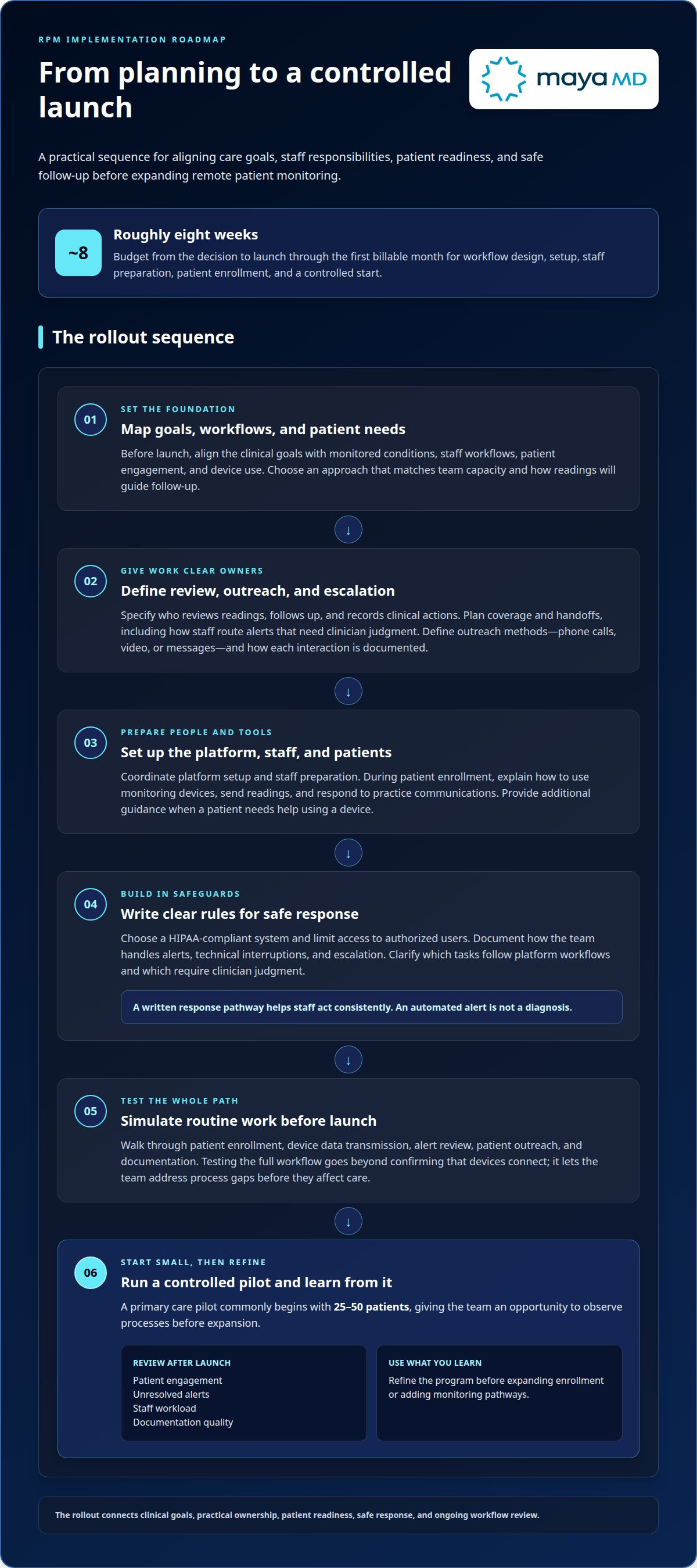
A provider helps your practice select and implement an RPM platform by mapping clinical goals, staff workflows, patient engagement, and device use before launch. The American Telemedicine Association provides guidelines for implementing remote patient monitoring. A structured plan turns those considerations into defined responsibilities, training, and launch criteria.
Implementation takes coordination, not just software configuration. Budget roughly eight weeks from the decision to launch through the first billable month. During that period, the provider can coordinate workflow design, platform setup, staff preparation, patient enrollment, and a controlled start. A primary care pilot commonly begins with 25-50 patients, allowing teams to observe processes before they expand.
Assign clear ownership for monitoring work. RPM and chronic care management require regular review, patient outreach, and accurate documentation. Define who reviews readings, who follows up, and how clinical actions are recorded. For example, designated staff can review alerts and route those needing clinical judgment to the appropriate clinician.
Patient engagement also needs a plan. Patients should understand how to use their monitoring devices, send readings, and respond to practice communications. Include device education during enrollment, with additional guidance when needed. A patient who has trouble using a blood pressure monitor may need support before the readings can inform ongoing care.
Plan staffing around the volume of alerts, patient needs, and the level of automation. Specify coverage, handoffs, and what happens when a reading needs clinical attention. Define outreach methods, such as phone calls, video, or messages, and how each interaction will be documented. Clear processes keep monitoring connected to the patient’s broader care.
Set clear rules for privacy, security, liability, and patient safety. Choose a HIPAA-compliant system, limit access to authorized users, and document how the team handles alerts, technical interruptions, and escalation. Clarify which tasks follow platform workflows and which require clinician judgment. A written response pathway helps staff act consistently without treating an automated alert as a diagnosis.
Before launch, simulate enrollment, device data transmission, alert review, patient outreach, and documentation. Testing the full workflow goes beyond confirming that devices connect. After launch, review patient engagement, unresolved alerts, staff workload, and documentation quality, then use what you learn to refine the program before expanding enrollment or adding monitoring pathways.
For practices planning these operational steps, discuss RPM implementation planning as a practical next step.
3. Advanced primary care management and RPM
RPM platforms for U.S. primary care practices can bring together connected monitoring devices, data review, alerts, and care-management workflows. Choose an approach that matches the conditions being monitored, the care team’s capacity, and how readings will guide follow-up.
Advanced primary care management and RPM support related but distinct parts of ongoing care. RPM collects physiologic readings, such as blood pressure, blood glucose, weight, and pulse oximetry. Advanced primary care management can provide a broader care framework, while RPM gives the team recurring measurements to review. For someone with hypertension, tracking blood pressure between visits may inform follow-up.
Device and data pathways are central to platform fit. The monitoring devices should transmit readings automatically to the platform; manual data entry does not qualify for Medicare RPM reimbursement under the stated 2026 requirements. RPM devices must be FDA-cleared and capable of automatic data transmission for reimbursement. Device selection should reflect the patient’s condition and the measurement the clinician needs to follow.
Medicare’s 2026 RPM billing structure distinguishes short-window and standard monitoring. CPT 99445 applies to readings transmitted on 2-15 days in a 30-day period, while CPT 99454 applies to 16-30 days. Providers bill either code, not both, based on transmitted reading days. CPT 99453 covers initial device setup and patient education, billed once per episode of care.
Management workflows matter as much as measurement. In 2026, CPT 99457 covers the first 20 minutes of monthly treatment management and requires at least one interactive communication with the patient. CPT 99458 covers each additional 20 minutes. A care team should be able to connect readings, outreach, and documentation while keeping the clinical work associated with each program distinct.
Concurrent care programs require deliberate coordination. CMS permits concurrent RPM and chronic care management billing for the same patient in the same calendar month when each program’s requirements are met separately, clinical time is distinct, and documentation is separate. That distinction helps prevent duplicate counting of the same activity. An advanced primary care management approach can help practices consider how monitoring fits broader care coordination.
Platform and service costs depend on the case and are provided after a quote request; relevant factors include device selection, patient enrollment, monitoring scope, integration, and care-team workflows. Compare the operational model alongside the platform, including how patient engagement, readings, and documentation move through the practice. That reveals whether the system can support chronic care without adding disconnected processes.
The best fit is a platform that supports the conditions the practice monitors, uses FDA-cleared devices that transmit readings automatically, and connects readings with alerts, outreach, and documentation. Its workflows should also fit the care team’s capacity and keep RPM activities distinct from other care-management programs.
3. How a provider assesses your practice needs and RPM goals
Begin by connecting your clinical priorities with the needs of your patient population. Many adults live with multiple chronic conditions. Reviewing diagnoses, care gaps, and existing follow-up processes can help identify where remote monitoring may support ongoing care.
Define the program’s goals before selecting a platform. A practice may prioritize better chronic disease management, earlier response to concerning readings, or fewer avoidable hospital readmissions. Each goal points to different workflows and measures. For example, a hypertension program should track blood pressure trends and establish how the team responds to changes.
Patient eligibility involves more than reviewing diagnoses. Consider whether readings can help monitor the patient’s condition, inform clinical care, and be collected with the patient’s participation. Diabetes, hypertension, and COPD are examples of chronic conditions that remote patient monitoring can support. Connect each measurement in the care plan to a clear clinical purpose.
Panel estimates can help set the program’s scope. A typical primary care panel may have 40-60% of patients eligible for RPM. For a 2,000-patient panel, that represents an estimated 400-600 potential candidates. These estimates inform planning, but a provider should refine them using the practice’s diagnoses, patient needs, staffing capacity, and monitoring goals.
Include billing workflows in the assessment. Map patient eligibility, payer requirements, timing, documentation, and staff activity to the intended program. Practices may operate RPM alongside other care-management programs, but each has separate requirements, and the same activity should not be counted twice. Clear documentation links each service to its own clinical work.
Turn the assessment into a practical operating plan before implementation. Identify who enrolls patients, reviews readings, conducts outreach, and records follow-up. Specify how the team will respond when patients stop transmitting data or need a change in monitoring. This connects platform capabilities to daily care rather than treating software selection as a stand-alone decision.
Finally, the provider sets a review point and evaluates the program against its original goals. Reviewing RPM pilot workflows after 60-90 days can help identify enrollment barriers, alert-management bottlenecks, or gaps in patient engagement. The practice can then adjust its processes, refine patient selection, and decide whether to maintain or expand the program based on clinical fit and operational performance.
5. RPM benefits for prevention and early intervention
Remote patient monitoring can extend preventive care beyond scheduled visits by giving care teams recurring readings to review. The Health Resources and Services Administration says RPM can support preventive care for chronic conditions and reduce patients’ travel costs and infection risk. For someone with hypertension, home blood pressure readings can help clinicians follow patterns between appointments.
The value comes from linking a measurement to an appropriate clinical response. A care team can review readings, notice changes from a patient’s established pattern, and decide whether outreach or follow-up is needed. The platform supports the workflow; clinicians interpret readings in the context of the patient’s health and care plan.
Monitoring can make follow-up more focused. If a patient’s blood pressure readings change over time, for example, the care team can review the trend and discuss next steps with the patient. A consistent process for reviewing readings and documenting outreach helps make the data part of ongoing care, rather than an isolated report.
Prevention spans conditions beyond hypertension. The World Health Organization states that at least 80% of premature heart disease, stroke, and type 2 diabetes can be prevented. RPM is one possible component of preventive care, with readings helping clinicians observe selected health measures and support conversations about a patient’s ongoing management.
Patient participation affects how useful monitoring can be. Patients need to know how to take and send readings and how to contact the practice with questions. Pair device education with scheduled check-ins and clear instructions about what happens after readings arrive. Technology can support engagement, but it does not replace the clinical relationship.
Remote monitoring may also reduce practical barriers to follow-up. HRSA identifies reduced travel costs and infection risk as potential benefits of remote care. For patients who find frequent in-person visits difficult, readings from home can give clinicians information to consider between appointments, while preserving in-person care when clinically appropriate.
Choose a platform and workflow that make readings visible, reviewable, and actionable. The care team should know who reviews incoming data, how concerning readings are escalated, and how responses are documented. These decisions connect prevention goals to daily operations and help patients understand how monitoring supports their care.
To discuss how remote monitoring can support prevention and early intervention in your practice, connect with the team about RPM.
MayaMD: remote patient monitoring for chronic care management
MayaMD supports care teams with remote monitoring and chronic care management tools. Its cloud-based clinical AI platform combines deterministic logic with generative AI to support patients with chronic conditions. The Remote care offering brings together tech-enabled APCM, remote monitoring, principal care, and behavioral-health integration to help keep patients stable at home.
Practices planning remote and chronic care can explore MayaMD’s Clinical AI Agent and Remote care offering. The platform supports patient engagement, documentation, and continuity of care, making it relevant for teams looking to strengthen how they support patients between visits.
Contact MayaMD to discuss your practice’s remote monitoring needs.
Turn your RPM decision into a care strategy
Choosing an RPM platform for primary care practices is a starting point for improving support between appointments. Define what continuity of care should look like for patients, how technology will support clinical judgment, and where digital engagement fits into the relationship. These decisions keep the program grounded in the practice’s approach to care, rather than driven by features alone.
MayaMD’s digital healthcare capabilities also include automated post-discharge communication solutions, which can support continued patient connection during transitions from hospital to home. Consider how such capabilities may fit alongside your RPM priorities as your practice plans its next phase of patient support.
Start a conversation about your practice’s goals and discuss your RPM needs with MayaMD. A clear direction can help your team move forward with purpose.
Frequently Asked Questions
Does RPM replace in-person primary care visits?
No. Remote patient monitoring adds health information between appointments; it does not replace physical examinations, diagnostic visits, or other in-person care. Home blood pressure readings, for example, can inform a discussion at a scheduled visit, while new symptoms may still require direct evaluation. The care team decides how readings fit the patient’s care plan and when an office visit is appropriate.
How does RPM help primary care revenue?
RPM may support revenue through reimbursement for eligible monitoring and management services when program requirements are met and documented. It also involves operational work, including reviewing data, communicating with patients, and recording care. Evaluate potential reimbursement alongside staffing capacity, patient participation, device workflows, and billing processes. Revenue depends on delivering and documenting qualifying services, not simply selecting a platform.
How does RPM billing work for providers?
Providers bill applicable RPM codes when eligible patients receive qualifying services and the required data and care-management activities are documented. In 2026, CPT 99457 covers the first 20 minutes of monthly treatment management and requires interactive communication with the patient. CPT 99458 covers each additional 20 minutes. Clinical records should support the service billed, including relevant monitoring activity and communication.
What is RPM?
Remote patient monitoring is the collection and review of a patient’s physiologic health data outside a traditional clinical setting. Examples include blood pressure, weight, blood glucose, and pulse oximetry readings. Care teams can use these measurements to follow changes over time and inform outreach or care decisions. RPM focuses on physiologic data, unlike remote therapeutic monitoring, which focuses on therapy-related information.
What is a remote patient monitoring (RPM) platform for primary care practices?
An RPM platform for primary care practices receives patient health readings and makes them available for clinical review. Depending on its setup, it may also support alerts, reports, and care-team workflows. A practice monitoring hypertension, for instance, could use a platform to organize home blood pressure readings for review between appointments.
How do RPM platforms integrate with primary care EHR systems and workflows?
Platforms connect monitoring data with the practice’s electronic health record through an integration designed for the systems involved. The workflow should clarify where readings appear, how staff locate them, and how follow-up is recorded. For example, a clinician reviewing a patient’s glucose trend needs a way to associate that information with the correct record and document any resulting care action.
What Medicare RPM CPT codes, eligibility rules, and reimbursement rates apply to primary care?
CPT 99445 applies to 2-15 days of readings; 99454 applies to 16-30 days. Providers bill one of those data-day codes, based on transmissions.
What are the requirements for patient consent, monitoring time, documentation, and billing for RPM?
Enrollment records should capture the patient’s participation and applicable consent, while documentation should connect readings, monitoring activity, communication, and clinical management to the billed service. In 2026, CPT 99457 requires 20 minutes of monthly treatment management and at least one interactive communication. CPT 99470 covers a 10-minute increment and also requires real-time interactive communication. Billing must reflect distinct, documented qualifying work.




See The MayaMD Difference
Fill the form below
Download Our Apps
MayaMD for patients and MayaPro for physicians - available on iOS and Android.
FOR PATIENTS
MayaMD App
AI-powered symptom assessment, triage, and secure access to your care team.
FOR PHYSICIANS
MayaPro App
MayaPro brings patient vitals, RPM/PCM care plans, and clinical decision support to your pocket.