
HIPAA Compliant AI Services for Chicago Healthcare EHRs

A “HIPAA-compliant” label alone doesn’t make an AI tool suitable for patient information. AI used to process protected health information (PHI) must meet applicable HIPAA privacy and security requirements, and a written business associate agreement is generally required when a vendor handles PHI on a practice’s behalf. Practices also need to assess the tool’s safeguards and data practices for their specific use.
It’s reasonable to want AI to ease administrative work and support timely patient communication while protecting sensitive information. To evaluate a tool, understand what happens to protected health information (PHI) as it moves through the system: whether it is stored or used to train a model, who can access it, and how activity is tracked.
This guide explains when AI can process patient information, which safeguards and agreements matter, and how to assess integrations with healthcare systems. It also covers how clear usage policies and human review can help practices introduce AI in a controlled way that supports care and clinical workflows.
Key Takeaways
• Before entering patient information into an AI tool, understand how it is stored, retained, accessed, and used for model training.
• Assess security controls and data practices for your specific workflow; a HIPAA-compliant label alone doesn’t establish that a tool is appropriate.
• Map how information moves between AI, EHRs, patient portals, and scheduling systems to identify access points and workflow requirements.
• Determine whether an AI vendor acts as a business associate and whether a written agreement is required; business associates must report a breach within 60 days, according to the Electronic Code of Federal Regulations.
• Use written policies to define approved tools, limit PHI submissions, and specify when human review is needed.
Can doctors put patient information into AI tools?
Yes, AI can be used when the tool and its use meet HIPAA privacy and security requirements for protected health information (PHI). Practices evaluating HIPAA compliant AI for healthcare should assess data handling, safeguards, contracts, and clinical workflows before entering patient details.
AI Vendor Data Storage and Retention
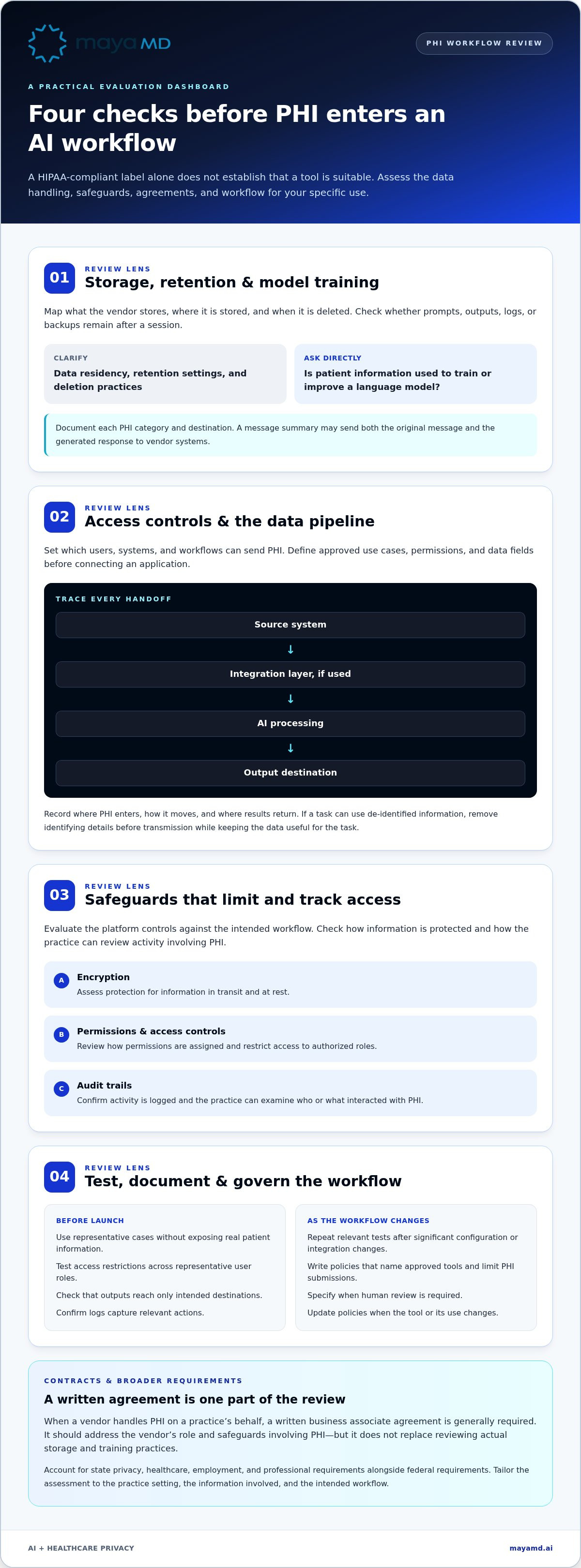
Start by mapping what the vendor stores, where it is stored, and when it is deleted. Find out whether prompts, outputs, logs, or backups remain after a session. Ask how data residency and retention settings work for the specific deployment, and whether the vendor uses patient information to train or improve a language model.
For example, summarizing a patient message may send both the message and the generated response to the vendor’s systems. Document each data category and destination. A written business associate agreement should address the vendor’s role and safeguards involving PHI, but it does not replace a review of actual storage and training practices.
Deployment Control and Secure Data Pipelines
Deployment control means limiting which users, systems, and workflows can send PHI to an AI tool. Define approved use cases, access permissions, and data fields before connecting an application. If a task can be completed with de-identified information, remove identifying details before transmission while ensuring the remaining data supports the task.
Trace the secure data pipeline from the source system through processing to the output. For example, identify whether a patient message passes through an integration layer before reaching an AI service. Record where PHI enters, how it moves, and where results are returned. This helps limit unnecessary exposure and maintain accountability across the workflow.
Privacy, Encryption, and Security Testing
Evaluate encryption for information in transit and at rest, along with access controls and audit trails. Review how permissions are assigned, how access is logged, and how the practice can examine activity. These safeguards help identify who or what interacted with PHI and whether the tool meets the practice’s security requirements.
Before launch, test the complete workflow with representative cases that do not expose real patient information. Check that access restrictions work, outputs reach only intended destinations, and logs capture relevant actions. Repeat testing after significant configuration or integration changes. Written AI policies can specify approved tools, limit PHI submissions, and set when human review is required.
State and Regional Privacy Requirements
Yes. HIPAA is not the only consideration: practices should account for state privacy, healthcare, employment, and professional regulations alongside federal requirements. Specialized behavioral health practices may face AI requirements specific to those settings, so evaluate the service type, information involved, and intended workflow.
For teams assessing HIPAA compliant AI for healthcare, document the use case, affected data, user roles, and decision points. A patient engagement workflow and a clinical support workflow may handle information differently. Tailor the assessment to the practice setting, and update written policies when the tool or its use changes.
Are AI tools automatically HIPAA compliant?
No. A vendor’s HIPAA-compliant label alone does not establish that its AI tool is suitable for a healthcare practice’s use. Healthcare organizations should evaluate vendors based on PHI handling, security controls, contractual terms, and the workflow involved.
HIPAA-Aligned Platform Security Features
Review the controls behind the platform, not just its marketing language. Look for encryption, secure storage, access controls, and audit trails that help limit and track interactions with PHI. Map each control to the intended clinical workflow. For example, a tool summarizing patient messages should restrict access to authorized roles and record relevant activity.
Also examine how the AI platform handles input and output. A protected conversation can expose information through prompts, generated text, or system logs. Document which components process PHI and how each component is secured.
Enterprise Security and Deployment Options
Deployment choices affect where data flows and which teams control configuration. Compare the proposed environment with the practice’s existing systems, identity controls, and data governance. For each option, map the path from user input to model processing and returned output.
Then define permissions for administrators, clinicians, and support personnel. A role-based access plan can prevent broad access to patient conversations. Include configuration ownership, data access boundaries, and vendor responsibilities in the implementation plan.
Security Testing and Compliance Validation
Validate the complete workflow before using live PHI. Test access controls with representative user roles, confirm audit trails capture expected activity, and check that outputs reach only intended destinations. Use synthetic or de-identified examples during initial testing.
After configuration changes, repeat relevant tests and document the results. Review the vendor’s security materials alongside the practice’s own policies and contract terms. Compliance validation means assessing the tool, its deployment, and its actual use, not relying on a label applied to every workflow.
Voice Agent Security and PHI Retention
Voice agents can process spoken details, transcripts, and generated responses. Trace each stage: audio capture, transcription, model processing, storage, and deletion. Determine whether recordings or transcripts persist, where they are retained, and which users can retrieve them.
For a patient scheduling conversation, define whether the system needs the full transcript or only limited details. Set retention rules for each data type, then test whether the configured workflow follows them. This makes voice interactions easier to govern and audit.
Free access or a paid subscription does not, by itself, establish suitability for PHI. Compare the actual security controls, data practices, contractual terms, and deployment configuration. A general-purpose tool may lack the controls or agreement needed for a healthcare workflow, while a paid plan still requires careful assessment.
To discuss how a governed AI workflow could fit your practice, connect with the team about your use case and integration needs.
AI integrations with EHRs, patient portals, and scheduling systems
An AI integration connects a defined task with the systems staff and patients already use. Start by mapping the information that moves between the AI tool, EHR, patient portal, and scheduling workflow.
For each connection, identify the data source, intended output, and person responsible for review. This ties patient data movement to a specific clinical or administrative purpose.
EHR and FHIR Connections
FHIR can support structured exchange between healthcare applications, but data elements and permitted actions still need to be configured. First map the required information, such as appointment details, medication lists, or patient-reported symptoms. Then determine which system supplies each field and how the receiving application interprets it.
Epic and Cerner environments can differ in configuration, interfaces, and organizational workflow. Specify the target environment and integration method during planning. Test with representative records to identify missing fields, mismatched formats, or information that arrives in the wrong context.
Patient Portals and Scheduling Systems
A portal integration may route an incoming patient message to an AI tool for categorization or draft answers for staff review. Define which message types enter the workflow, what information the tool can use, and where the response goes. For example, a request to reschedule should follow a different path from a report of worsening symptoms.
Scheduling connections need clear boundaries. Map appointment availability, visit type, and patient identity to the scheduling system’s fields. Decide whether the AI tool can suggest an appointment or submit a change. Staff review can help prevent an incorrect answer from changing a patient’s schedule.
Write-Back and Record Integrity
Write-back means sending AI-generated information into an EHR or another system. Treat it as a distinct workflow, not an automatic extension of read access. Define which outputs may be saved, who approves them, and whether the record identifies AI-assisted content.
For example, a generated visit summary could remain a draft until a clinician reviews it. Test how edits, rejected suggestions, and duplicate submissions appear in the record. Clear ownership of each action helps staff distinguish source data from generated text.
Integration Planning and Testing
Use a workflow map to document each connection: source system, data transferred, AI processing step, destination, and human review. Include portal messages, scheduling updates, and EHR write-back as separate paths. This helps teams locate where a failed transfer or incorrect answer needs attention.
Before launch, test common cases and exceptions, such as incomplete patient data or a message routed to the wrong queue. Confirm that access permissions match staff roles and outputs reach only intended systems. Document how changes to the AI tool or EHR technology will be assessed against practice policies and applicable regulations.
HIPAA compliance and signed business associate agreements
Yes, some AI vendors sign HIPAA business associate agreements (BAAs). HIPAA generally requires a written BAA when a vendor performs services for a covered entity that involve access to protected health information (PHI).
AI Vendor Contracts and BAAs
A service contract describes the AI tool, its functions, and the parties’ commercial terms. A BAA addresses PHI-related responsibilities when the vendor acts as a business associate. Review both documents together before connecting an AI scribe to patient records, because the service contract alone may not cover sensitive data handling.
Compare each document with the intended workflow. For example, identify whether the tool receives dictated visit notes, creates drafts, or retains transcripts. Confirm that the agreement covers those activities and the applicable safeguards. Keep signed versions with implementation documentation so privacy and security teams can trace the approved use.
Signed Business Associate Agreements
A BAA should be in place before a vendor handles PHI on a practice’s behalf. Identify the covered entity, the vendor, the services, and the information involved. Then confirm authorized uses and disclosures, required safeguards, and how the vendor supports the practice’s HIPAA obligations.
Check that the agreement covers the actual deployment, not just a general AI platform. If a tool processes portal messages and visit notes, both workflows should be represented. Keep the executed agreement with vendor assessments and system records. This connects the legal terms to the controls used in daily operations.
BAAs and PHI Handling
Use the BAA to define how PHI moves through the vendor relationship. Review permitted uses, safeguards, access, subcontractor handling, and what happens when the service ends. For example, specify how patient transcripts or generated summaries are returned or handled after termination.
Set a clear incident pathway. According to the Electronic Code of Federal Regulations, business associates must report a breach within 60 days. The agreement should explain how the vendor notifies the practice and provides information needed to respond. Align that process with internal escalation steps and the AI workflow’s audit records.
Vendor BAA Commitments
Whether an AI vendor signs a BAA depends on its role and the data involved. A vendor performing services for a covered entity that involve PHI generally requires a written agreement. Determine whether the tool creates, receives, maintains, or transmits PHI as part of its function.
Before activation, match the vendor’s commitments to the planned use. For an AI healthcare assistant handling patient questions, document which information it processes and who can access it. Confirm that the agreement addresses safeguards and breach reporting. If the vendor’s terms do not cover the workflow, do not route PHI through that configuration.
HIPAA safeguards for AI processing protected health information
Chicago healthcare organizations can implement AI by defining its purpose, mapping PHI flows, assessing safeguards, and setting human-review rules. Improper handling can expose protected health information and trigger HIPAA penalties; under the 2026 adjusted tiers, uncorrected willful neglect can incur up to $2,190,294 per violation category per year.
Steps for HIPAA-Aligned AI Implementation
Start with one defined workflow, such as sorting portal messages or drafting patient education. Identify the protected information the AI tool receives, creates, maintains, or transmits. Then assess vendor data practices, security controls, and contractual responsibilities before implementation.
Document the approved tool, permitted PHI inputs, and situations requiring human review. Determine whether the vendor acts as a business associate and whether a written agreement applies. Test the workflow with non-live data before activation, then review AI-related policies and the technology stack at least once a year.
Risks of Improper PHI Handling
An AI tool may expose sensitive information through prompts, stored conversations, generated outputs, or connected systems. Incorrect access controls can also let people without a workflow need view patient data. These failures can undermine confidentiality and disrupt clinical processes.
Risk also includes relying on inaccurate AI analysis as a definitive source of truth. For example, a generated symptom summary may omit a detail reported by the patient. Use AI as workflow support, and have clinicians apply their judgment to patient-care decisions. A written policy should identify where review is required.
Build safeguards around the full data lifecycle. Map where PHI enters an AI tool, which processes handle it, and where outputs go. Use encryption, controlled access, and audit trails to protect information and trace activity. Limit submissions to information needed for the task; when de-identified data can serve the purpose, remove identifying details before processing.
Review each integration as part of the same risk assessment. An AI tool connected to an EHR, portal, or scheduling system may create additional pathways for patient data. Document permitted data flows, user roles, output destinations, and the staff responsible for review. Reassess controls after meaningful changes to the tool or workflow.
For clinical use, distinguish generated suggestions from verified patient information. A clinician reviewing an AI-generated answer should be able to trace its source and correct errors before they affect care. Define escalation steps for outputs that appear incomplete, inconsistent, or outside the approved use case.
To discuss safeguards and implementation requirements for your healthcare AI workflow, talk with the team.
MayaMD: Clinical AI Agent
MayaMD’s Clinical AI Agent supports healthcare organizations evaluating AI-assisted patient workflows. Its cloud-based clinical AI platform combines deterministic logic with generative AI to support patients with chronic conditions. AI patient engagement solutions can also support ongoing communication.
Practices focused on continuity after a hospital stay can use MayaMD’s automated post discharge communication solutions to support follow-up workflows. These tools fit into a broader implementation plan that defines data access, human review, and how AI connects with care processes.
To discuss how MayaMD’s offerings may fit your patient engagement or post-discharge workflow, contact MayaMD.
Turn AI evaluation into a practical next step
Move from reviewing AI in the abstract to selecting a defined workflow. Choose a recurring need, identify the people and systems involved, and determine how the technology should support their work. A focused starting point gives clinical, operational, and privacy teams a shared basis for planning.
For teams evaluating HIPAA-compliant AI for healthcare in Chicago, define what success means for the workflow before implementation. Consider whether it should improve patient communication, support continuity after discharge, or reduce friction for care teams. Clarify which decisions remain human-led and how staff will assess the AI’s contribution over time.
MayaMD offers a Clinical AI Agent, AI patient engagement solutions, and automated post discharge communication solutions. These offerings help organizations explore patient-facing and post-discharge workflows as part of a deliberate AI strategy, linking technology decisions with continuity of care and patient experience.
Contact MayaMD about HIPAA-compliant AI to discuss a next step for your workflow. With a clear purpose and thoughtful implementation, healthcare teams can pursue useful innovation while keeping patients and care teams at the center.
Frequently Asked Questions
Can AI voice agents integrate with healthcare EHR systems?
Yes, a voice agent can connect with an EHR when the systems’ interfaces and workflows support integration. For example, a practice might route appointment details into scheduling while keeping clinical notes in a review queue. Plan how patient identity is matched, where summaries appear, and whether staff approve updates before they become part of the medical record.
Does HIPAA Apply to the AI Tool You’re Considering?
HIPAA may apply to an AI workflow when a covered entity or business associate uses a tool to create, receive, maintain, or transmit protected health information. Focus on the tool’s role, not just its name or format. A chatbot handling identifiable patient questions raises different data-handling considerations from an AI tool used only with information that does not identify patients.
Is AI allowed in healthcare?
Yes, healthcare organizations can use AI, with decisions and workflows governed by applicable privacy, security, and professional requirements. For example, AI might help organize incoming patient questions while a clinician reviews information relevant to care. Define which tasks the tool can support, which require human judgment, and how staff will handle inaccurate or incomplete outputs.
What Should You Ask an AI Vendor Before Using Its Tool?
Ask how the tool handles prompts, outputs, logs, and retained data, and whether patient information is used to train models. Clarify the vendor’s role, BAA terms, incident-notification process, and any subcontractors involved in processing. Also ask how configuration changes are managed. For a concrete scenario, have the vendor explain where a portal message goes from submission through staff review.
What makes an AI tool HIPAA compliant for healthcare providers?
Suitability depends on the tool’s safeguards, contracts, data practices, configuration, and intended workflow, not on a marketing label alone. For example, assess whether access controls fit staff roles and whether audit records capture use of a clinical feature. Confirm that the vendor agreement covers the PHI-related service. Evaluate the tool in the context of how the practice will use it.
What HIPAA rules apply to AI tools that process protected health information?
HIPAA governs how covered entities and business associates use and disclose protected health information. Its relevance to an AI workflow depends on whether the tool creates, receives, maintains, or transmits PHI for the organization. If a vendor performs services involving PHI on a covered entity’s behalf, a written business associate agreement is generally required.
How can Chicago healthcare providers assess an AI vendor’s security and privacy safeguards?
Use a documented review that follows a real workflow from input to output. For example, trace a patient portal message through the AI system and into the staff queue. Compare the vendor’s description of access, retention, and security testing with that data path. Record unresolved risks, responsible reviewers, and approval conditions for the specific use case.
What are the costs of HIPAA-compliant AI tools for healthcare practices?
Costs depend on the project’s scope, connected systems, features, implementation needs, and ongoing support requirements. Compare those factors against the workflow the practice wants to improve, rather than treating all AI tools as equivalent. MayaMD pricing depends on the case and is provided after a quote request. Contact MayaMD at +1 (888) 629‑2631 or info@mayamd.ai for pricing details.




See The MayaMD Difference
Fill the form below
Download Our Apps
MayaMD for patients and MayaPro for physicians - available on iOS and Android.
FOR PATIENTS
MayaMD App
AI-powered symptom assessment, triage, and secure access to your care team.


FOR PHYSICIANS
MayaPro App
MayaPro brings patient vitals, RPM/PCM care plans, and clinical decision support to your pocket.