
Healthcare AI for Clinics: Practical Evaluation Guide

A fluent AI response isn’t the same as a dependable clinical workflow. When evaluating a healthcare AI platform for clinics, the key question is whether the technology can support care safely while connecting patient communication, documentation, and ongoing follow-up. It’s reasonable to be cautious: consumer chatbots and hospital systems may not match a clinic’s needs, and generative AI alone can’t guarantee reliable clinical information.
A practical evaluation starts with clinical fit and governance, then considers how the platform supports patients and care teams across the care journey. This guide outlines what to assess, including how deterministic logic can work alongside generative AI, how patient engagement and post-discharge communication fit into daily operations, and how remote patient monitoring can support chronic-care workflows. MayaMD brings these capabilities together in a cloud-based, HIPAA-compliant clinical AI platform. By the end, you’ll have a clear framework for assessing workflow fit, patient-support needs, and a useful next step.
Key Takeaways
• Assess whether a platform coordinates patient and clinical workflows, rather than offering only a standalone chatbot or documentation function.
• Understand how deterministic logic and generative AI can serve different roles in a structured, governed clinical workflow.
• Compare workflow fit, governance, patient engagement, and care continuity, while distinguishing stated capabilities from outcomes that still need evaluation.
• Start readiness planning with a bounded use case, clear users, and defined oversight, then evaluate and refine the approach.
• Choose a platform based on how its capabilities align with your clinic’s workflows and patient-support needs.
What a Healthcare AI Platform for Clinics Should Actually Do
A healthcare AI platform for clinics is a coordinated set of AI-enabled capabilities that supports patient and clinical workflows across interactions, documentation, and ongoing care. Its value depends not on the number of features, but on how well those capabilities support clinic processes while leaving clinical judgment with care professionals.
That distinction matters when evaluating clinic-focused AI. A consumer symptom tool may answer questions directly to an individual, while a single-purpose documentation product may focus on creating notes. A clinic-facing platform should be assessed in relation to the care team’s work and the patient’s path through care, not as a standalone source of medical decisions.
Clinic AI platform versus standalone AI tool
A standalone tool is designed around a discrete task. It may help draft documentation or respond to a particular patient question, but it doesn’t necessarily connect that task to what happens before or after it. A platform can bring multiple capabilities into a broader workflow, though platforms can differ in the modules and functions they provide.
For example, a clinic may want patient engagement to support information gathering, documentation to organize the resulting clinical information, and follow-up workflows to maintain contact beyond the appointment. Map how these activities relate, including who handles each step and what happens next. This helps teams assess whether technology supports continuity or simply completes an isolated task.
For a broader overview of the field’s applications and considerations, see Artificial intelligence in healthcare.
Where clinics may apply healthcare AI
Use cases can address different points in care. Chronic-care engagement supports communication with patients over time; monitoring workflows can help organize information for ongoing care management; and post-discharge communication can support contact as patients transition from hospital to home. These are distinct needs, so define the workflow and intended users before deciding which capabilities matter.
For clinics building ongoing chronic-care processes, remote patient monitoring workflows can be one part of a broader approach to patient support. Assess how monitoring fits with patient engagement and care-team review, rather than treating the presence of a monitoring feature as sufficient on its own.
Patient engagement
Consider how AI supports communication and interaction with patients within clinic workflows.
Documentation
Assess whether the capability supports clinical information management without treating generated content as an independent clinical decision.
Continuity
Consider how chronic-care and post-discharge processes connect with ongoing patient support.
AI can assist with workflow steps, but it doesn’t replace professional judgment. Clinic teams remain responsible for interpreting relevant information and making clinical decisions. A useful evaluation looks at the role of each capability, who oversees its use, and how patient-facing and clinical activities relate to one another. That connected view helps distinguish a clinic-oriented platform from a collection of unrelated tools, while allowing the clinic to focus on functions relevant to its needs.
How Governed Clinical AI Combines Deterministic Logic and Generative AI
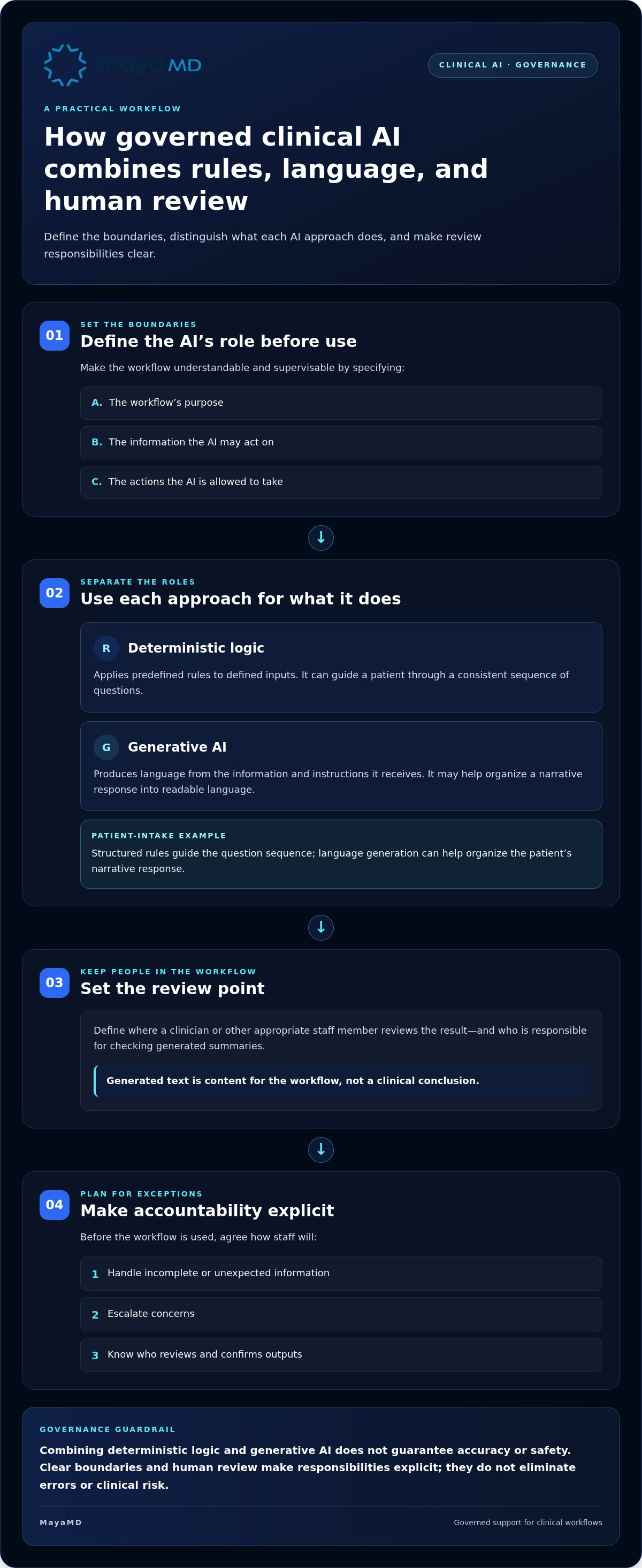
Clinical AI can combine two different approaches: one follows defined rules, while the other generates language. Understanding their distinct roles helps clinics assess what a system is doing, where its limits lie, and how staff should oversee its use. Combining the approaches doesn’t guarantee accuracy or safety. Governance depends on how the technology is bounded within a workflow and how people review its outputs.
What each AI approach contributes
Deterministic logic applies predefined rules to defined inputs; generative AI produces language from the information and instructions it receives. In a patient-intake workflow, for example, rule-based behavior could guide a user through a consistent sequence of questions, while a generative capability could help organize a narrative response into readable language. These examples describe general roles, not a specific system design.
This division can make a workflow easier to interpret: structured steps handle tasks with explicit conditions, while language generation may help communicate or summarize information. But generated text can sound confident without being authoritative. Treat it as content for the workflow, not as a clinical conclusion. When evaluating a clinic platform, identify which actions follow defined rules and which outputs are generated for review.
Why governance matters in clinical settings
Governance turns technical capabilities into a process people can supervise. Before using AI in a clinical workflow, define its purpose, the information it may act on, the actions it can take, and the point at which a clinician or other appropriate staff member reviews the result. Clear boundaries help teams understand when AI is assisting and when a person must make or confirm a decision.
Review and accountability matter at the output level, too. Specify who checks generated summaries, how staff handle incomplete or unexpected information, and how concerns are escalated. These controls don’t eliminate errors or clinical risk; they make responsibilities and review steps more explicit. Ask practical questions: Can staff understand the system’s role? Is there a human review point for consequential content? Is ownership of each workflow step clear?
MayaMD’s cloud-based clinical AI platform combines deterministic logic with generative AI. Its Clinical AI Agent supports clinical workflows, including chronic-condition care, patient engagement, and documentation. Evaluate not only what the AI can produce, but also how its role fits into staff processes and oversight.
A useful starting point is to map one workflow from input to action: identify what information enters, what the system is expected to do, what a person reviews, and what happens when the output needs correction. This simple map can reveal whether the AI’s function is appropriately bounded before a clinic considers broader use. To explore how MayaMD’s approach relates to clinic workflows, review MayaMD’s clinical AI approach.
How Clinics Can Compare Healthcare AI Platforms Beyond the Feature List
A feature list shows what a platform says it can do; it doesn’t show whether those capabilities fit a clinic’s workflows or produce useful results in that setting. Compare platforms against the work your team needs to support, then distinguish stated functions from outcomes that would require evaluation in your clinic. This is more useful than counting features alone.
Checklist: Compare every platform for workflow fit, governance, patient engagement, and continuity of care.
Assess workflow fit and patient engagement
Start by mapping current communication and documentation tasks: what happens before, during, and after an appointment, who performs each step, and where delays or handoffs occur. Then assess whether patient-facing interactions connect with the workflows your clinic intends to support. Treat specific EHR or other system integration requirements as a separate evaluation item rather than assuming a connection is available.
Workflow fit: Assess whether the platform supports the tasks and users you’ve identified, including clinical documentation. A stated documentation capability is not, by itself, evidence of improved note quality or reduced workload.
Governance: Review the platform’s stated security posture, oversight model, and how staff can review or correct outputs. MayaMD describes its cloud-based platform as HIPAA-compliant; consider that as one part of a broader clinic governance review.
Patient engagement: Examine which patient interactions the platform supports and how they relate to clinic processes. A communication feature is a capability; its effect on participation or follow-up should be evaluated in the clinic’s own setting.
Care continuity: Compare support for remote patient monitoring (RPM), Advanced Primary Care Management (APCM), Principal Care Management (PCM), and post-discharge communication as distinct use cases. Assess each capability against the care process it is intended to serve.
Assess governance, privacy, and evidence
For each capability, identify who reviews the information, who is accountable for decisions, and how the clinic will assess performance. Define what evidence would matter before rollout, such as whether a workflow is completed as intended or whether staff find its outputs usable. These are evaluation questions, not assumed outcomes. For additional context on care-management workflows, see this advanced primary care management guide.
Keep claims and evidence separate in your comparison notes. Record what the platform states it supports, what your team observes during evaluation, and what remains untested. For example, support for post-discharge communication doesn’t by itself establish that patients complete follow-up steps. Similarly, an RPM capability doesn’t demonstrate a particular effect on chronic-care outcomes. Those conclusions require evidence from the relevant workflow and clinic setting.
This framework turns platform selection into a focused operational review. Compare the same dimensions across options, document assumptions, and prioritize capabilities tied to a defined care or administrative need. That keeps the decision grounded in clinic fit, responsible oversight, and evidence rather than feature volume.
A Practical Readiness Plan for Introducing Healthcare AI in a Clinic
Successful evaluation begins with a specific workflow, not a broad mandate to “add AI.” Start with a bounded operational or patient-support need, define who is responsible at each step, and decide how the clinic will assess whether the process works as intended. This measured approach helps teams learn before expanding to additional workflows.
Choose a focused use case and define responsibilities
Map the current process from the first patient interaction through staff follow-up. Note where communication, documentation, or chronic-care coordination creates a clear need for support. Keep the initial scope aligned with clinic priorities rather than trying to address every workflow at once.
For a clinic focused on chronic conditions, a starting use case might involve a defined patient-engagement or monitoring process. Specify which tasks the AI-supported process may assist with, who reviews relevant information, and who remains accountable for clinical decisions. This clarity helps staff understand their roles and gives the clinic a practical basis for evaluating workflow fit.
Evaluate performance and refine the workflow
Before introducing the process, select baseline measures that reflect the need you identified. The clinic might track whether workflow steps are completed, how patients engage with a defined communication process, or whether documentation meets internal quality criteria. These measures guide evaluation; they aren’t promises of improvement. Define how information will be collected and who will review it.
Use staff feedback and the selected measures to identify friction points, then refine the workflow under appropriate clinical oversight. If a step is unclear or requires repeated correction, adjust the process before expanding its scope. Claims about time savings or care outcomes should be based on evidence from the specific workflow and setting, not assumed from a feature description.
A practical readiness sequence is:
Identify a workflow
Select one operational or patient-support need with a clear purpose.
Define users
Identify the staff and patients involved, along with each person’s role.
Set oversight
Establish review responsibilities, decision boundaries, and how concerns are handled.
Evaluate
Compare the process with clinic-defined baseline measures and gather operational feedback.
Refine
Adjust the workflow based on what the evaluation reveals before considering broader use.
Apply the same readiness discipline to any healthcare AI evaluation: begin with a clinic-defined need and assess it in the context of actual workflows, rather than assuming a platform will deliver a particular result. A model of AI-governed chronic-care continuity can help frame how patient support and ongoing care processes relate, while the clinic determines the appropriate scope and evaluation criteria.
To discuss how clinical AI could align with a defined clinic workflow, review your clinic’s AI workflow needs with MayaMD.
How MayaMD Connects Clinical AI With Ongoing Patient Support
MayaMD provides a cloud-based, HIPAA-compliant clinical AI platform that combines deterministic logic with generative AI. Its Clinical AI Agent brings together capabilities for chronic-condition support, patient engagement, and clinical documentation. To assess the fit for a clinic, consider which patient interactions need support, what information staff need to review, and where AI-assisted workflows fit into ongoing care.
Connect chronic-care workflows with patient engagement
Chronic care involves more than a single appointment. Patient engagement, monitoring, documentation, and follow-up may all contribute to how a clinic organizes support over time. MayaMD’s platform supports workflows associated with Remote Patient Monitoring (RPM), Advanced Primary Care Management (APCM), and Principal Care Management (PCM), alongside AI-driven patient engagement. Each is a distinct care context, so focus on the capabilities that align with the clinic’s intended processes.
RPM
Supports remote patient monitoring workflows for chronic care management.
APCM and PCM
Supports workflows connected with these care-management approaches.
Patient engagement
Supports AI-driven communication as part of ongoing patient care.
Clinical documentation
Supports documentation workflows for clinical teams.
These capabilities help clinics consider how patient communication and care-team processes relate, but they don’t guarantee a particular clinical result. Their value depends on the clinic’s workflow, oversight, and how teams use and review the information. MayaMD also offers automated post-discharge communication, a separate use case focused on supporting communication as patients transition from hospital to home.
Explore fit with your clinic’s care model
Use the evaluation criteria established earlier to assess fit: identify the workflow the platform would support, define how staff oversee its use, and consider how patient engagement connects with chronic-care or post-discharge processes. Then distinguish stated capabilities from outcomes your clinic would need to evaluate in its own setting. This keeps the discussion specific to clinic priorities instead of assuming a broad feature set automatically meets them.
Relate each capability to a defined care need and the people responsible for that workflow. A clinic prioritizing chronic-condition support may focus on how RPM, APCM, or PCM workflows relate to engagement and documentation. A team focused on transitions may instead examine how post-discharge communication fits its follow-up process.
MayaMD brings these care contexts together within a clinic-oriented platform, while clinical teams retain responsibility for appropriate review and decisions. Discuss your clinic’s needs with MayaMD to explore how the Clinical AI Agent and patient-support capabilities could relate to your workflows.
Make Your Next AI Decision Deliberate
The next step isn’t to make every workflow an AI workflow. Identify where a carefully bounded capability could support the care team while preserving clear responsibility for clinical decisions. Treat the evaluation as a conversation among clinical, operational, and technology stakeholders, not simply a feature comparison.
As clinic priorities evolve, keep asking whether the selected use remains understandable, useful to its intended users, and aligned with the patient experience your team wants to provide. This perspective keeps a healthcare AI platform under consideration in the context of the clinic’s care model, rather than novelty alone. It also gives decision-makers a practical basis for discussing what should remain under human review as workflows develop.
Bring your team’s priorities and the workflow you’re considering to MayaMD. Explore workflow fit with MayaMD and take a considered next step toward clinic-centered AI.
Frequently Asked Questions
Is a healthcare AI platform the same as an AI medical chatbot?
No. A chatbot describes a way to interact with AI, while a platform may support multiple clinic workflows beyond conversation. For example, a patient-facing chat function could be one component of a broader system that also assists with documentation or care-management processes. In an evaluation, trace a sample interaction from the patient’s question to the next clinic workflow step, noting who reviews or acts on any information produced.
Can a healthcare AI platform replace clinicians?
No. AI can assist with defined tasks, but it shouldn’t replace clinician judgment or accountability for care decisions. Before using a capability, document who is responsible for reviewing its output, what happens if information is incomplete, and when a concern is escalated to a clinician. A clear handoff process helps staff understand where AI assistance ends and professional oversight begins.
How does deterministic logic differ from generative AI in healthcare?
Deterministic logic follows set rules, while generative AI creates language-based responses. For instance, a rule-based process might require certain fields to be present before a workflow advances, while generative AI might help draft a plain-language explanation. Neither approach makes an output automatically appropriate for clinical use. Consider how each function is applied, what staff can review, and how corrections are handled.
Is a HIPAA-compliant platform enough to ensure responsible AI use?
No. HIPAA compliance is an important privacy consideration, but it doesn’t by itself establish that every AI-supported workflow is suitable for a clinic. Review the platform’s stated privacy and security posture, then consider who can access information, how staff oversee use, and how outputs are documented or reviewed. MayaMD describes its platform as HIPAA-compliant; clinics should also align use with their own governance policies.
Can healthcare AI support remote patient monitoring for chronic conditions?
Yes, AI-supported workflows can complement remote patient monitoring for chronic care, but the clinic needs to define how information is handled. Before introducing a use case, specify which team members review monitoring-related information, how patient communication is managed, and what follow-up process applies. These decisions connect monitoring to care operations without assuming that technology alone determines the appropriate clinical response.
What should clinics measure when evaluating a healthcare AI platform?
Choose measures that reflect the specific workflow being evaluated, such as completion of intended steps, patient participation in a communication process, or documentation quality. Define how each measure will be assessed and compare results with a baseline from the clinic’s own setting. For a fair evaluation, record workflow changes and staff feedback alongside the measures, and don’t treat results from another organization as a prediction of local performance.




See The MayaMD Difference
Fill the form below
Download Our Apps
MayaMD for patients and MayaPro for physicians - available on iOS and Android.
FOR PATIENTS
MayaMD App
AI-powered symptom assessment, triage, and secure access to your care team.

FOR PHYSICIANS
MayaPro App
MayaPro brings patient vitals, RPM/PCM care plans, and clinical decision support to your pocket.