
Financial Modeling for a New RPM Service Line

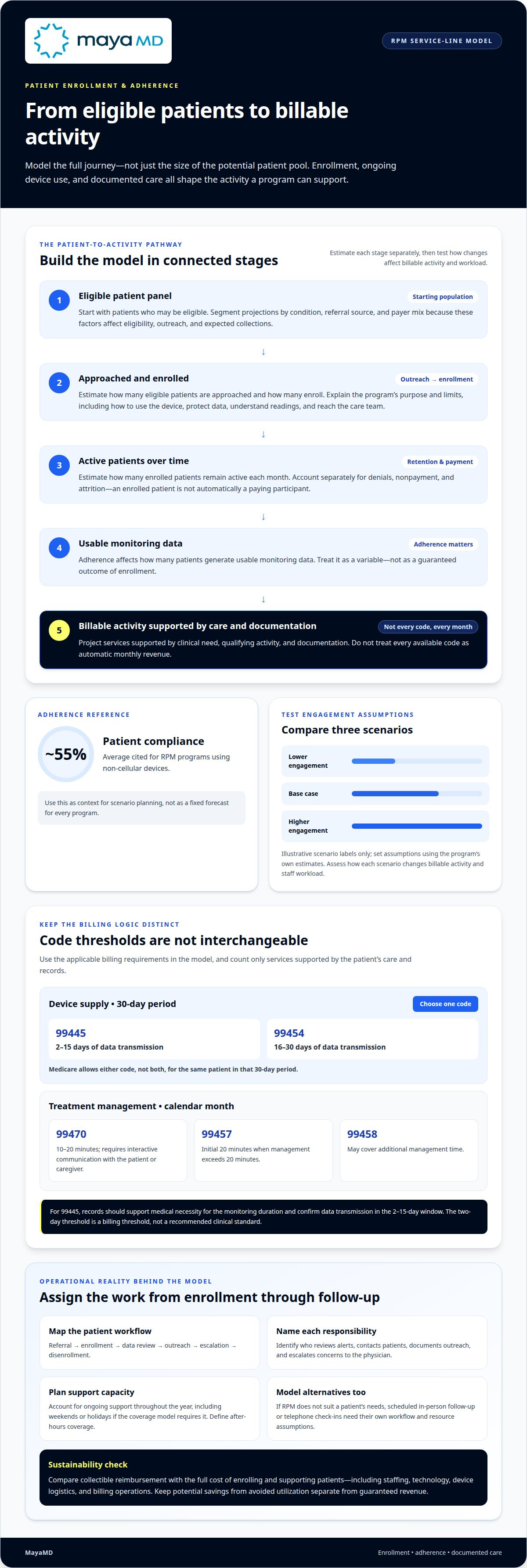
An RPM service line can be financially sustainable, but only when collectible reimbursement exceeds the full cost of enrolling and supporting patients. Financial modeling for a new RPM service line should account for 2026 billing thresholds: CPT 99445 covers device supply for 2-15 days of data transmission in a 30-day period, while CPT 99454 applies to 16-30 days; Medicare allows either code, not both, for the same patient in that period.
Reimbursement is only one part of the calculation. Enrollment and adherence determine how many patients generate billable activity, while payer mix, staff time, technology, device logistics, and billing operations shape the cost of serving each patient. Avoided utilization may also matter when an organization can capture value through a risk-based arrangement, but it should not be treated as guaranteed revenue.
This article shows how to build a practical model around these interacting factors, test different enrollment and adherence scenarios, and assess whether the service line can sustain its clinical and operational workload. It also explains how RPM technology and structured patient engagement can support the workflows behind your assumptions, so projections reflect the care model, not reimbursement alone.
Key Takeaways
• Build revenue projections around eligible, enrolled patients who remain engaged, not the size of the potential patient pool alone.
• Model staffing, technology, device logistics, and billing operations alongside reimbursement to understand the true cost of supporting each patient.
• Compare business models by how they allocate operational responsibility and connect compensation to ongoing care or patient outcomes.
• Separate billable revenue from potential savings through avoided utilization, especially when assessing different payer arrangements.
• Track clinical outcomes, engagement, operational workload, and financial performance together to identify where the service line needs adjustment.
Proposed reimbursement amounts and billing codes
Review risks related to HIPAA and health-data exposure, secure transmission, state licensing, and FDA device status. Medicare requires RPM data to be uploaded electronically to a secure location, and the device must meet the FDA definition of a medical device.
These are approximate 2026 U.S. national non-facility rates.
Billing Codes and Proposed Reimbursement
Billing codes assign reimbursement to distinct RPM or RTM activities, so a financial model should separate device supply, setup, and treatment management. CPT 99445 and 99454 cannot both be billed for the same patient in the same 30-day period. For management, 99470 covers 10-20 minutes in a calendar month and requires an interactive communication with the patient or caregiver. When management exceeds 20 minutes, 99457 covers the initial 20 minutes, with 99458 potentially covering additional time.
RPM and RTM are separate service categories with distinct codes, documentation, and clinical use cases. Medicare does not allow them to be billed together. For CPT 99445, records should support medical necessity for the monitoring duration and confirm data transmission within the 2-15-day window. Two days is a billing threshold, not a recommended clinical standard. Model only services supported by clinical need and documentation, rather than treating every available code as automatic monthly revenue.
Labor and Reimbursement Sensitivity
Sensitivity analysis tests how changes in reimbursement and labor assumptions affect a service line’s projected margin. It shows whether the model remains viable if fewer patients meet a billing threshold or staff need more time for review, outreach, and documentation. Compare a base case with a lower-reimbursement case and a higher-labor case, changing one assumption at a time before testing their combined effect.
Keep labor assumptions tied to the work behind each code. Estimate time for patient engagement, reviewing transmitted data, interactive communication, escalation, and billing documentation. Then compare that workload with expected collections for 99470, 99457, or 99458. A change in reimbursement affects revenue per eligible service; a change in labor affects the cost of delivering it. Separating those drivers makes the analysis more useful for operational planning.
Payer Reimbursement Policies
Private insurance reimbursement depends on each payer’s policy and contract, so don’t automatically use a Medicare rate as the commercial-payer assumption. Build separate payer scenarios based on applicable coverage, coding, and payment terms, and distinguish contracted reimbursement from billed charges. This makes payer mix visible: enrollment shifts between plans can change projected revenue even when patient volume and monitoring workflows stay the same.
State Medicaid RPM billing and reimbursement policies vary. Model Medicaid separately according to the relevant state policy rather than applying a single national assumption. For private insurance and Medicaid, track eligible services, applicable codes, and supporting documentation. Distinguish RPM from RTM, then assess how coverage differences affect expected collections, patient engagement workflows, and the labor required to deliver each service.
Patient enrollment and adherence assumptions
CMS defines remote patient monitoring as connected medical devices collecting and transmitting physiological data to care teams for ongoing clinical management. Model enrollment, device use, data review, patient communication, and clinical follow-up as connected activities, not isolated revenue events.
Start with the eligible patient panel, then estimate how many patients are approached, enrolled, and remain active each month. Segment projections by condition, referral source, and payer mix, since these factors affect eligibility, outreach, and expected collections. Apply separate assumptions for denials, nonpayment, and attrition rather than treating every enrolled patient as a paying participant.
Adherence changes the number of patients who generate usable monitoring data. RPM programs using non-cellular devices average around 55% patient compliance, so model adherence as a variable, not a fixed enrollment outcome. Compare a base case with lower and higher engagement scenarios, then assess how each changes billable activity and staff workload.
Patients may ask how to use a device, how their data is protected, what readings mean, or how to reach the care team. Explain the program’s purpose and limits during enrollment. If remote monitoring does not suit a patient’s needs, describe alternatives such as scheduled in-person follow-up or telephone check-ins. These alternatives need their own workflow and resource assumptions.
Plan capacity for ongoing patient support throughout the year, including weekends or holidays if the practice’s coverage model requires it. Define who reviews alerts, contacts patients, documents outreach, and escalates concerns to the physician. Specify after-hours coverage so the operating model does not imply continuous monitoring without an assigned process.
Map the clinical workflow from referral through enrollment, data review, outreach, escalation, and disenrollment. For each step, identify the responsible role and the documentation created. For example, if a patient stops transmitting data, the team may need to attempt re-engagement before counting that person as inactive. Tracking these transitions makes panel forecasts more credible.
To build a model for a specific U.S. region, define the service area, estimate the eligible patient panel, and segment it by payer and condition. Incorporate local payer policies, referral pathways, staffing capacity, device connectivity, enrollment conversion, adherence, and attrition. Update assumptions as enrollment and billing experience accumulates instead of carrying initial projections forward unchanged.
These assumptions help show whether engagement workflows can support the projected patient panel without exceeding operational capacity. Practices refining enrollment and follow-up processes can discuss RPM workflow planning.
What are business models for RPM that would allow a clinic/practice to make it financially sustainable over time?
An RPM business model connects how an organization is paid with the work required to deliver remote care management. For chronic care, compare reimbursement-based billing, subscription, pay-per-use, value-based arrangements, and turnkey operations. Each allocates revenue, staffing, technology, and financial risk differently. Show who pays, which services are included, and how payment changes as the patient panel grows.
Reimbursement-based care uses eligible billing codes to generate recurring revenue for documented monitoring and management. Project collections by payer and active patient, then subtract enrollment, engagement, data review, and clinical follow-up costs. This model relies on a clear connection between patient activity, clinical work, documentation, and billing. Don’t count every enrolled patient as a billable service each month.
Subscription and pay-per-use models structure payment differently. A subscription model charges a recurring fee, typically covering equipment, data transmission, and monitoring services. A pay-per-use model charges according to actual use, such as a consultation or data transmission. Define the covered services and payment responsibility clearly. Model these approaches separately from insurance reimbursement rather than treating them as interchangeable revenue.
Value-based care links provider compensation to outcomes, such as improved health, fewer hospitalizations, or stronger chronic-condition management. That structure can align financial incentives with sustained patient support, but projections should distinguish contracted payments from potential savings. A 2023 systematic review and meta-analysis found RPM may reduce hospitalizations and length of stay across several chronic conditions, with certainty varying by outcome. Model avoided utilization as a possible value pathway, not automatic revenue.
Quality metrics make value-based arrangements measurable. Organizations can track clinical outcomes, patient engagement, completed escalations, and follow-up reliability alongside financial performance. For example, compare changes in patient readings and outreach completion with program costs over the same reporting period. This can show whether the care model is producing outcomes linked to payment and whether the organization can capture that value under its contract.
Post-acute and transitional care offer another operating context. An RPM program supporting patients after discharge can structure home follow-up, identify concerns, and route relevant information to the care team. Model the transition workflow separately from ongoing chronic care, including enrollment timing, outreach responsibilities, and expected monitoring duration. Hospital, clinic, or health-system partnerships may use licensing or revenue-sharing agreements, so forecast each partner’s role and payment separately.
A turnkey model may allow a practice to implement RPM without building new roles, workflows, or administrative systems. Compare it with an internally operated program by mapping responsibility for technology, patient engagement, clinical review, and billing. The sustainable model is the one whose contracted revenue and operational design support necessary care, documented outcomes, and consistent follow-through.
Payer-mix revenue and avoided utilization
Separate revenue forecasts by payer, and distinguish collected revenue from potential savings. For clinics and health centers, payer mix affects both expected collections and the services each program can support.
Revenue by Payer Mix
Payer mix is the distribution of enrolled patients across Medicare, Medicaid, and commercial plans. It matters because payment policies vary. Build a separate revenue line for each payer rather than applying one blended rate to the entire patient panel.
Estimate active patients by payer, then apply the applicable coverage and billing assumptions to each group. Account for denied claims and nonpayment in expected collections, not just billed amounts. Medicaid RPM reimbursement varies by state, while private insurance policies differ by payer. A forecast should reflect these distinctions and show how enrollment shifts affect monthly revenue.
Avoided Utilization
Avoided utilization is the potential value of reducing hospitalizations, emergency visits, or length of stay. It matters most when an organization can capture that value. Keep it separate from direct RPM reimbursement so the forecast does not treat possible savings as guaranteed program revenue.
A 2023 systematic review and meta-analysis found that remote monitoring may reduce hospitalizations and length of stay across several chronic conditions, with certainty varying by outcome. Use this evidence to frame a potential value scenario, not a fixed savings assumption. For a hospital-at-risk arrangement, model how reduced utilization could affect the organization’s financial exposure, then distinguish that effect from payments received for RPM services.
RPM and CCM Revenue Opportunities
RPM and Chronic Care Management can structure billable, non-face-to-face support for people with chronic conditions. Because reimbursement is monthly rather than tied to episodic visits, forecast active service months, not annual enrollment alone.
For each month, estimate how many patients remain eligible, engaged, and supported by documented work. Forecast RPM and CCM revenue as separate lines, using the applicable payer rules for each service. Medicare allows RPM or RTM alongside specified care management services when time and effort are not counted twice. Don’t count the same staff work toward multiple services, and include only services supported by distinct documentation.
Partnerships can extend a program across hospitals, clinics, and health systems. Agreements may use revenue sharing or licensing, so forecast the partner’s share separately from gross collections. Specify which organization handles enrollment, monitoring, clinical follow-up, and billing. Those responsibilities determine operating costs and the revenue each party retains.
For a useful forecast, compare a base case with lower enrollment or higher attrition, then assess payer mix and avoided utilization separately. This shows whether recurring RPM and CCM collections can support program operations or whether projected sustainability depends on savings the organization may not directly capture.
Clinical, operational, and financial performance measurement
Measure clinical outcomes, patient engagement, operational capacity, and financial performance together. This integrated view shows whether the service line’s resources and care workflows support its intended results.
Operational Overhead and Staffing Risks
Operational overhead includes the staff time and systems needed to run monitoring reliably; it matters because those demands shape service capacity. A 2026 PharmacoEconomics scoping review found staff salaries were reported as an RPM cost component in 62% of included studies.
Map time spent on device onboarding, data review, patient outreach, escalation, and documentation. Include backup coverage and training in staffing assumptions. If alerts increase, for example, added review and outreach may affect capacity before the patient panel generates corresponding revenue. Track workload by role to identify bottlenecks early.
Pro Forma Operational Validation
Operational validation tests whether the pro forma’s staffing, workflows, and expected service volume can work in practice. A financially balanced projection can still fail if teams cannot complete the assumed work.
Walk through a representative patient pathway, from enrollment and device transmission to review, escalation, and follow-up. Compare each step with assigned staff responsibilities and the documentation needed for billing. Then reconcile projected active patients and review workload with actual operational capacity. Medicare RPM and RTM services may be provided by health care personnel under the billing practitioner’s general supervision.
Device, Software, and Platform Costs
Device, software, and platform costs include the technology used to collect, transmit, and manage patient information; they matter because they affect the cost of operating each program. A 2026 PharmacoEconomics scoping review reported equipment or technology as an RPM cost component in 56% of included studies.
Typical costs depend on device arrangements, connectivity, platform functions, implementation needs, and the number of patients supported. Model recurring technology expenses separately from setup and equipment costs. Include device logistics and connectivity in the operational view, then assess how requirements vary across patient groups and service workflows.
Acquisition and Ongoing Support Costs
Patient acquisition, implementation, and support costs cover the work of identifying candidates, enrolling them, and sustaining engagement. Enrollment alone does not deliver ongoing care.
Expenses depend on referral and outreach processes, onboarding effort, training, support needs, and follow-up workload. Track these activities separately from technology expenses. For example, a patient needing repeated onboarding assistance follows a different support pathway from someone who completes setup smoothly. Compare assumptions with actual staffing and engagement data as the service line operates.
Review clinical outcomes, engagement, staffing efficiency, and financial performance together. Discuss RPM performance planning in relation to your care workflows and measurement priorities.
MayaMD
MayaMD helps organizations assess how digital care workflows fit into a sustainable RPM service line. Its Clinical AI Agent and AI patient engagement solutions support patient communication and continuity, which influence enrollment, engagement, and operational capacity. These capabilities are relevant when projections depend on maintaining consistent patient contact alongside clinical workflows.
As you turn reimbursement, staffing, and adherence assumptions into an operating model, consider how patient engagement and post-discharge communication fit your care design. MayaMD’s automated post-discharge communication solutions support follow-up after patients leave the hospital, while your team retains its clinical responsibilities and defines the financial measures.
Discuss your RPM service line with MayaMD and how digital care workflows may fit your planning priorities.
Turn the Model Into an Operating Plan
A projection is useful when it informs how care will work, not just what revenue might look like. Treat financial modeling for a new RPM service line as a living planning tool: compare assumptions with actual operations, identify workflows to adjust, and use the findings to guide implementation.
MayaMD’s Clinical AI Agent, AI patient engagement solutions, and automated post-discharge communication solutions support patient communication across care journeys. Their relevance depends on your service line’s workflows and patient needs. Aligning digital support with clinical operations can help turn a financial plan into a coherent care model.
Explore RPM planning with MayaMD and consider how connected care workflows can support your next steps. A thoughtful model is a foundation for deliberate decisions and sustainable patient support.
Frequently Asked Questions
Is Remote Patient Monitoring Profitable?
RPM can be profitable when collected revenue exceeds the full cost of care. Assess contribution margin per active patient, then determine whether the patient panel covers fixed operating expenses. A program may generate billable activity yet remain financially weak if outreach and review consume too much staff capacity. Separate financial returns to the provider from broader health-system value, such as potential changes in hospital utilization.
How Do You Attribute Avoided Admissions to RPM?
Estimate avoided admissions by comparing outcomes for monitored patients with a defensible baseline or comparable patient group. Account for differences in condition severity, prior utilization, and concurrent care changes before attributing an outcome to RPM. For example, a health system can track admission patterns for enrolled patients and a similar group receiving usual care. Keep estimated savings separate from collected RPM payments, and avoid counting the same avoided event under multiple programs.
How Do You Calculate RPM ROI for a Health System?
Calculate ROI by comparing the program’s financial benefits with its total costs over a defined evaluation period. A common calculation is net financial benefit divided by program costs, expressed as a percentage. Include collected reimbursement and attributable savings, then account for staffing, devices, platform operations, implementation, and administration. State the period and included benefits clearly; otherwise, ROI estimates may appear comparable while measuring different outcomes.
What are the Medicare and commercial payer rules for RPM eligibility, consent, device use, and billing?
Medicare RPM must be medically reasonable and necessary for an acute or chronic condition, and it requires an established patient relationship and consent when services are furnished. Medicare also requires a qualifying medical device, with physiological data electronically collected and automatically uploaded to a secure location. Data collection generally requires 16 days in a 30-day period, except specified treatment-management codes. Commercial coverage and billing rules vary by payer and plan.
What staffing roles and operating costs are needed to launch and run an RPM program?
An RPM program needs clinical oversight from the billing practitioner and personnel to review data, communicate with patients, document work, and manage billing. Medicare permits health care personnel to provide RPM services under the billing practitioner’s general supervision. Budget for staff time, technology, devices, patient onboarding, training, workflow administration, and ongoing support. Assign clear responsibility for alerts and escalation so staffing projections reflect the care delivered.
How can an RPM service line forecast patient enrollment, utilization, revenue, and collections?
Build a monthly cohort forecast that follows patients from referral through enrollment, activation, continued participation, and exit. Financial modeling for a new RPM service line should distinguish expected utilization from completed, documented services and collected claims. Segment patients by payer, and apply assumptions for denials, nonpayment, and attrition. Compare scenarios with different enrollment and engagement patterns, then update the forecast as operating results reveal where projections diverge.
What are the key startup costs, break-even point, and ROI benchmarks for an RPM program?
Startup costs include implementation, devices, software, workflow development, and initial staff preparation. Ongoing costs include monitoring, outreach, and administration. Break-even occurs when contribution from collected revenue and applicable savings covers fixed and variable program expenses. Calculate it using the organization’s actual cost structure and payer assumptions. ROI benchmarks are meaningful only when the population, included costs, outcome measures, and evaluation period align.
How do in-house, outsourced, and hybrid RPM service line models compare financially?
In-house programs retain operational control, while the organization remains responsible for staffing, technology, and workflow ownership. Outsourced models assign defined functions to a partner, so include the contracted scope and retained internal responsibilities in the financial analysis. Hybrid models divide activities between internal teams and external support. Compare each model by total operating obligations, accountability for patient follow-up, documentation processes, and how workload changes as enrollment grows.




See The MayaMD Difference
Fill the form below
Download Our Apps
MayaMD for patients and MayaPro for physicians - available on iOS and Android.
FOR PATIENTS
MayaMD App
AI-powered symptom assessment, triage, and secure access to your care team.


FOR PHYSICIANS
MayaPro App
MayaPro brings patient vitals, RPM/PCM care plans, and clinical decision support to your pocket.