
Fee-for-Service or Value-Based Care: How to Make the Shift

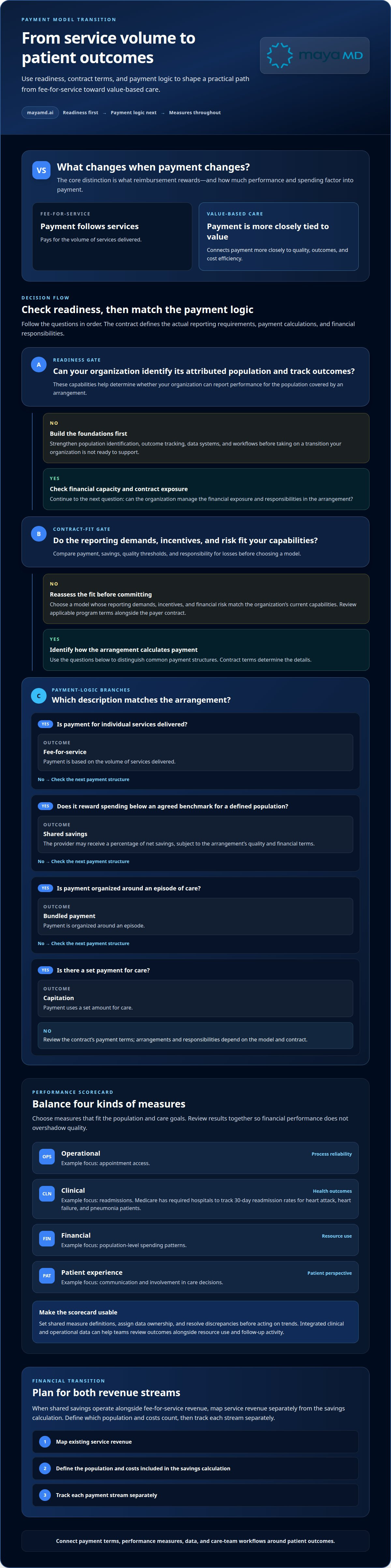
Fee-for-service pays for the volume of services delivered; value-based care ties payment more closely to quality, outcomes, and cost efficiency. To understand how to transition from fee-for-service to value-based care, first assess your organization’s readiness, then align performance measures, data systems, care teams, and payer arrangements around patient outcomes. The shift is operational as well as financial.
Changing payment models affects how care is measured, coordinated, and delivered. A phased approach helps connect the financial model to everyday clinical workflows while keeping the patient experience in view.
This article explains how the two models differ and how metrics, analytics, and team coordination can support a practical transition. It also covers how to assess readiness and use performance data to improve care over time.
Key Takeaways
• Compare payment models by what they reward, how they allocate financial risk, and which outcomes they prioritize.
• Choose clinical, operational, financial, and patient experience measures that reflect your care goals, then review performance regularly.
• Plan how shared-savings payments will work alongside fee-for-service revenue to support a deliberate financial transition.
• Connect care teams, workflows, and patient follow-up so coordination and engagement support measurable outcomes.
• Use analytics to identify care gaps and track performance; digital engagement and post-discharge communication tools can support continuity.
Operational, clinical, financial, and patient experience metrics
A useful scorecard connects clinical outcomes with operating performance and patient experience. Choose measures that reflect the population you serve and your organization’s care priorities.
Operational, clinical, and patient experience metrics
Operational measures show how reliably care moves through the system, while clinical measures assess health outcomes. Patient experience measures capture how patients perceive access, communication, and involvement. For example, track appointment access, condition-specific outcomes, and patient feedback as distinct signals. The Centers for Medicare & Medicaid Services says Medicare has required hospitals to track 30-day readmission rates for heart attack, heart failure, and pneumonia patients. Together, these measures help teams connect hospital processes to results patients experience.
Quality and financial performance by population
Population-level tracking groups patients by a relevant characteristic, such as a chronic condition, then compares quality and financial performance within that group. Teams can review clinical outcomes alongside resource use to see where care patterns differ. Organization-wide averages may hide gaps between populations. Define the group, select comparable measures, and review results together so financial performance does not overshadow quality.
Patient engagement and shared decision-making
Patient engagement measures whether communication and care planning involve patients in decisions that affect them. Shared decision-making connects a patient’s preferences with the clinical options discussed by the care team. Unlike operational measures, which assess processes, engagement measures reflect the patient’s role and experience. Use patient feedback to identify communication gaps, then make care plans easier to understand and discuss during follow-up.
Integrated patient data helps teams interpret measures in context. Electronic health records, analytics tools, and interoperable systems can bring clinical and operational information together for population health reviews. For example, a team can examine readmissions alongside documented follow-up and care-plan activity. Set shared definitions for each measure, assign data ownership, and resolve discrepancies before acting on trends. This creates a more consistent view across departments.
Strong performance can support patient volume when reliable outcomes and a positive experience build confidence in care. Treat volume as a business indicator, not a substitute for quality: growth alone does not show whether care is effective. Compare access and experience measures with clinical outcomes, then identify service bottlenecks teams can address. This helps organizations improve access while keeping patient needs central.
| Metric option | Primary criterion | Example focus |
|---|---|---|
| Operational | Care process | Appointment access |
| Clinical | Health outcome | Readmissions |
| Financial | Resource use | Population-level spending patterns |
| Patient experience | Patient perspective | Communication and involvement |
Choose a balanced set of measures that fits the population, care goals, and available data.
What is value-based care?
Value-based care links reimbursement to care quality, patient outcomes, and efficient delivery, rather than service volume alone. Before selecting a payment model, assess your data, workflows, financial capacity, and contract terms.
Fee-for-service reimbursement and shared savings
Fee-for-service pays for individual services, while shared-savings arrangements reward providers when spending for a defined patient population falls below an agreed benchmark. The provider may receive a percentage of net savings, subject to the arrangement’s quality and financial terms. To account for both models, map existing service revenue alongside the shared-savings calculation, define which population and costs count, and track each stream separately.
Readiness depends on whether your organization can identify its attributed population, track outcomes, and manage financial exposure. Choose a model whose reporting demands, incentives, and risk match those capabilities.
Payment incentives and outcome measures
Value-based care models can use shared savings, bundled payments, or capitation. Their incentives differ: shared savings reward spending below a benchmark, bundles organize payment around an episode, and capitation uses a set payment for care. Quality measures help balance spending reductions with patient outcomes, care coordination, and satisfaction. Choose measures that reflect the population and contract, rather than optimizing a single financial result.
Payment and risk vary by model and contract. Before choosing, compare how each defines payment, savings, quality thresholds, and responsibility for losses.
CMS-led payment reforms and adoption
The Centers for Medicare & Medicaid Services and its Innovation Center are among the organizations advancing payment reform in the United States. Models such as the Medicare Shared Savings Program and ACO REACH connect provider accountability with coordinated care for defined populations. Unlike standard fee-for-service, these models can make performance and spending factors in payment, not just billed services.
Review the applicable CMS program terms alongside the payer contract. Requirements depend on the model, including its reporting measures, participant responsibilities, payment calculations, and risk provisions.
MIPS and advanced alternative payment models
MIPS evaluates performance through program measures, while advanced alternative payment models organize participation through a model-specific arrangement. They therefore differ in how providers engage with payment reform and manage performance expectations. According to the Centers for Medicare & Medicaid Services, Medicare patient encounters under MIPS can carry upside or downside risk of 9%.
Before choosing a pathway, assess your reporting systems, ability to coordinate care, and tolerance for financial risk. Then compare program criteria and payer-contract terms with your operational readiness.
A practical review starts with population attribution, baseline performance, data capability, and contract mechanics. For help aligning care workflows with payment goals, discuss transition planning.
Care coordination and interdisciplinary collaboration
Value-based care depends on coordinated work across clinicians, operations, and community partners. As you transition, map how patients move between settings, assign responsibility for each handoff, and connect those workflows to the payment model’s incentives.
Align roles around the patient population
Start with a defined population, such as patients managing the same chronic condition. Identify the clinicians and support roles involved, then specify who owns each care-plan task. For example, a primary care clinician may manage treatment decisions while a care coordinator tracks referrals and follow-up. Shared expectations reduce duplicated work and make gaps visible to the team.
Accountable care organizations bring providers together to coordinate care for Medicare and Medicaid patients. This structure makes communication across organizations especially important: participating practices need clear processes for sharing relevant information and tracking each patient’s next step. Establish a shared care plan, identify a lead contact, and document how updates reach the other providers involved.
Make communication part of the workflow
Reliable communication takes more than sending a referral. Define what information moves between settings, who sends it, and how the receiving team records action. For example, a hospital discharge should connect medication instructions, follow-up plans, and the next responsible clinician. Automated post-discharge communication can support patient follow-up and help teams maintain continuity after a hospital stay.
Use consistent protocols for routine updates and escalation. An interdisciplinary meeting can review patients whose care plans have stalled, while a shared record can flag referrals awaiting action. Health information exchanges can support information sharing across organizations; communication protocols clarify how teams interpret and act on it. These mechanisms link incentives to practical coordination, not isolated activity.
Adapt coordination during the transition
Fee-for-service workflows often organize tasks around individual encounters. Value-based care also requires teams to manage the patient journey between visits. Review current workflows, identify handoffs without clear ownership, and train staff on their new responsibilities. For example, a practice can assign someone to track follow-up after a hospital discharge and review unresolved tasks during team huddles.
Measure whether coordination processes are working. Teams can review completed referrals, care-plan updates, and patient follow-up records, then discuss barriers in interdisciplinary meetings. Use the findings to refine roles or communication steps. This feedback loop helps clinicians, care coordinators, and operational staff pursue shared population goals without ambiguous responsibilities.
Begin with one population and a defined care pathway. Map each handoff, assign an accountable role, establish communication protocols, and review whether the next step occurred. As the process becomes clearer, extend the approach to other pathways and community partners.
Using analytics to track costs, quality, and performance
Analytics connects clinical activity with contract performance, helping organizations identify trends and focus improvement work. Start with reliable data, clear definitions, and regular reviews.
Administrative complexity and performance tracking
Value-based contracts require organizations to collect, reconcile, and analyze performance data alongside routine billing. A physician may need to connect a procedure, follow-up activity, and patient outcome across separate records. Assign data ownership, document how measures are calculated, and resolve discrepancies before reporting. This adds administrative work, but a defined process helps teams spot missing information and address performance gaps.
Performance measures and metrics
Choose measures that connect quality, patient outcomes, and total cost of care. For example, compare condition-specific outcomes with utilization patterns for the same attributed population and contract period. Define each measure’s denominator, data source, and review schedule before collecting results. This makes comparisons meaningful and helps teams determine whether increased service use reflects necessary care or an opportunity to improve coordination.
Contracts determine which quality measures and cost categories count. Providers can use claims, electronic health records, and clinical data to assess outcomes and spending together, then compare results with contract benchmarks. This helps distinguish a clinical change from a data-capture problem.
MIPS thresholds and financial risk
MIPS links performance assessment to payment adjustments, so teams need to understand applicable measures and reporting rules. According to the Centers for Medicare & Medicaid Services, Medicare patient encounters under MIPS can carry upside or downside risk of 9%. Track performance throughout the reporting period, identify weak measures early, and assign follow-up actions to accountable staff.
Common challenges include incomplete data, workflow disruption, and exposure to financial downside. Address them by validating data sources, training staff on measure definitions, and reviewing performance before submission deadlines. A physician leader and analytics team can investigate outliers together and document corrective steps.
Transition costs and expected financial returns
Transition expenses can include technology, staff training, data integration, and workflow redesign. Financial returns depend on contract terms, baseline performance, patient outcomes, and the organization’s ability to manage care efficiently. Build a financial model that separates implementation costs from potential shared savings or payment adjustments. Review assumptions with finance and clinical leaders before committing resources.
There is no single return figure that applies across organizations because payment models and populations differ. Compare projected costs with contract incentives, then monitor actual spending and quality together. This helps leaders assess whether reduced avoidable utilization supports the model’s goals without compromising care.
Differences between fee-for-service and value-based care
Value-based care ties provider payment more closely to quality and patient outcomes; fee-for-service pays for individual services. The key distinction is what each model rewards: service volume or effective, coordinated care delivered efficiently.
Fee-for-service payment approach
Under fee-for-service, revenue is linked to the number and type of services delivered. A clinic receives payment for visits, tests, or procedures, so increased volume can increase revenue. This makes payment easy to connect to a specific service, but does not directly reward prevention or coordination between visits. Consider whether the incentives support the outcomes your organization wants.
Value-based care payment approach
Value-based care links reimbursement to measures such as quality, patient outcomes, and cost efficiency. Payment models can include shared savings, bundled payments, or capitation, each with different incentives and financial responsibilities. For example, shared savings reward spending below a benchmark, while a bundled payment covers a defined care episode. These models encourage organizations to focus on outcomes and avoid unnecessary care.
| Payment criterion | Fee-for-service | Value-based care |
|---|---|---|
| Primary payment driver | Services delivered | Quality, outcomes, and efficiency |
| Prevention incentive | Not directly rewarded by service volume | Can be supported through model incentives |
| Performance focus | Individual billable services | Defined population or care episode |
| Financial exposure | Revenue follows service volume | Depends on contract and model design |
The difference affects how organizations evaluate clinical decisions. In fee-for-service, each covered service generates payment, but the model does not inherently reward care that prevents a later complication. Value-based care can reward prevention and coordination when contract measures recognize those results. For example, a care team may assess whether follow-up supports a patient’s treatment plan, rather than counting visits alone.
Neither structure guarantees effective care. Fee-for-service can provide straightforward payment for delivered services, but volume-based incentives may encourage unnecessary utilization. Value-based models put performance and outcomes at the center, yet require organizations to manage measurement, coordination, and contract risk. Before deciding whether a model fits your capabilities, compare its benchmarks, covered population, quality measures, and payment rules.
Decision guide: Choose based on your goals and readiness. If your priority is payment for discrete services, fee-for-service aligns directly with activity. If your organization can track outcomes and coordinate care for a defined population, assess a value-based arrangement and its financial terms. Start with a model whose measures and risks match your ability to deliver the required care.
To discuss how digital care capabilities can support outcome-focused workflows, connect with the MayaMD team.
MayaMD: Clinical AI Agent
MayaMD’s Clinical AI Agent supports patient engagement and continuity workflows relevant to value-based care. For organizations focused on chronic conditions, its AI-driven tools support remote patient monitoring and patient engagement beyond office visits. Automated post-discharge communication can support follow-up after a hospital stay, connecting discharge instructions with ongoing patient communication.
Consider these capabilities when your transition plan identifies gaps in outreach, follow-up, or patient engagement. They complement clinical workflows: care teams remain responsible for decisions and for defining how performance is measured.
Contact MayaMD to discuss how its solutions can fit your care model.
Build a transition your teams can sustain
Transitioning from fee-for-service to value-based care is about more than selecting a contract. It also means building an organizational capability that can adapt as clinical priorities, patient needs, and payment arrangements evolve. Establish durable governance: clarify who can make operational decisions, how clinical leaders raise concerns, and how teams turn lessons into workflow improvements.
Begin the next phase by agreeing on a shared implementation priority and assigning an accountable executive sponsor. Keep clinicians and operational leaders involved as responsibilities shift, and make space to address friction before it becomes embedded in daily practice. A transition becomes more manageable when teams understand not only what is changing, but why their work matters to patients.
MayaMD can discuss how its digital healthcare solutions may support patient engagement and continuity within your care model. Contact MayaMD to discuss your care goals, and take the next step with a clear, collaborative plan.
Frequently Asked Questions
What is fee-for-service?
Fee-for-service reimburses a healthcare provider for each covered service delivered, such as an office visit, diagnostic test, or procedure. Payment is tied to the billable service, not directly to whether a patient’s health improves. For example, a practice’s revenue can rise with additional appointments even if those visits do not demonstrate better outcomes. This makes service volume central to the payment calculation.
What are the main value-based payment models in the United States?
Common models include shared savings, bundled payments, and capitation. Shared savings link a provider’s potential reward to spending for a defined population compared with a benchmark. Bundled payments group services around a care episode, while capitation uses a set payment for care over a defined period. Accountable care organizations are provider arrangements that can participate in shared-savings models, rather than a payment method themselves.
What steps should a healthcare practice take to transition from fee-for-service to value-based care?
A practical way to transition from fee-for-service to value-based care is to begin with a readiness review and a clearly defined patient group. Establish a baseline, identify data and workflow gaps, and compare payment options with the practice’s capacity and risk tolerance. Then align contract terms, staff responsibilities, and performance measures before starting. Review early results, address process issues, and expand as operations mature.
What data, analytics, and health IT capabilities are needed for value-based care?
Practices need usable clinical, claims, utilization, and patient experience data connected to the population and contract being measured. Health IT should support consistent patient identification and information exchange across care settings. Analytics can organize these inputs into views of quality, utilization, and spending, helping teams investigate trends. Clear measure definitions and data ownership also matter, so staff can distinguish a true performance change from incomplete records.
How should care teams and workflows change to support value-based care?
Teams should define responsibility for care tasks that extend beyond a single appointment. For a patient leaving the hospital, for example, the workflow can assign someone to track follow-up, confirm instructions reached the patient, and route unresolved concerns to the appropriate clinician. Shared care plans and regular interdisciplinary reviews help prevent handoffs from becoming gaps. Training should clarify each role and how the team responds when a patient’s needs change.




See The MayaMD Difference
Fill the form below
Download Our Apps
MayaMD for patients and MayaPro for physicians - available on iOS and Android.
FOR PATIENTS
MayaMD App
AI-powered symptom assessment, triage, and secure access to your care team.


FOR PHYSICIANS
MayaPro App
MayaPro brings patient vitals, RPM/PCM care plans, and clinical decision support to your pocket.