
Evidence-Based Clinical AI Agents: How to Evaluate Safety, Evidence, and Real-World Fit

When evaluating a clinical AI agent, the most important safety signal may not be how fluent its response sounds. It is whether each action is traceable to evidence, bounded by safeguards, and connected to a real care workflow. A polished answer alone can’t establish clinical reliability, and a strong benchmark result doesn’t guarantee that a tool will work safely in practice. Those limits can make vendors’ evidence-based claims difficult to compare.
This article offers practical criteria for evaluating an evidence based clinical AI agent, from the quality and visibility of its clinical support to its limits, escalation pathways, and human oversight. You’ll learn how to assess workflow fit, including whether an agent can support chronic-care engagement without substituting for clinical judgment.
We’ll also explore how deterministic clinical logic and generative AI can play complementary roles, and what to examine when considering use in Remote Patient Monitoring, Advanced Primary Care Management, Principal Care Management, or post-discharge communication. The goal is a grounded way to assess whether an agent can responsibly support connected care, not just produce convincing responses.
Key Takeaways
• Assess an evidence based clinical AI agent by whether its clinical outputs are traceable to reviewable sources and its actions stay within defined boundaries.
• Distinguish evidence quality, model capability, workflow performance, and patient outcomes. Each answers a different evaluation question.
• Compare claims across evidence provenance, intended use, human oversight, validation, integration, and ongoing monitoring.
• Use a structured implementation process to define the agent’s role, establish guardrails, pilot it within workflows, and assign clinical ownership for review and escalation.
• Explore how deterministic logic and generative AI can complement one another in chronic-care engagement and continuity workflows, including RPM, APCM, PCM, and post-discharge communication.
What Is an Evidence-Based Clinical AI Agent, and What Should It Do?
A clinical AI agent should do more than generate a medically plausible response. It should support a defined care task using reviewable clinical sources, operate within explicit limits, and leave appropriate decisions to qualified professionals.
An evidence-based clinical AI agent is a system whose outputs have traceable evidence provenance, whose actions are bounded by defined oversight, and whose capabilities are evaluated for a specific intended use. This definition helps separate four questions: Is the clinical evidence relevant? Can the model perform the task? Does the tool fit the workflow? Does its use improve patient outcomes? Evidence for one does not automatically establish the others.
The concept builds on Evidence-based medicine, which informs clinical decisions through the considered use of evidence alongside professional expertise and patient circumstances. Grounding an AI answer in evidence can make its basis easier to inspect, but it doesn’t make the system an autonomous clinician or remove the need for human judgment.
How is a clinical AI agent different from a medical chatbot?
A basic chatbot may respond to one prompt with one answer. An agent may coordinate a defined sequence of tasks, such as collecting information, applying a workflow rule, and routing a response for review. That added capability creates more points where boundaries and oversight matter.
These functions can be separated: source retrieval finds relevant material; deterministic rules apply explicitly defined logic; generative language communicates in a conversational format. Tool access and multi-step behavior should stay within the agent’s intended role, with clear escalation routes and human review where the workflow requires it. The label “agent” alone says little about clinical reliability.
What does evidence-based mean in clinical AI?
Evidence grounding means a recommendation can be connected to identifiable clinical sources relevant to the question and intended use. Reviewers should be able to assess which source informed an output, whether it remains current, and whether the system represents its meaning faithfully. A fluent answer without visible, reviewable support is not equivalent to evidence-based guidance.
Consider a patient asking about a care-plan instruction. A plausible-sounding explanation may omit an important qualification or fail to reflect the patient’s context. A more responsible system makes its role and limits clear, uses approved information for its defined task, and routes uncertainty or exceptions according to the care workflow.
For role-specific context, see this clinical AI agent guide. Defining the intended role is the starting point for judging whether evidence, capability, and oversight align in practice.
How Evidence Grounding, Clinical Logic, and Oversight Work Together
Trust depends on more than retrieving a relevant guideline. A clinical AI workflow must connect the question to appropriate sources, keep the response within its intended role, and make the resulting action visible to the care team. Each layer addresses a different part of the risk.
Evidence retrieval helps reduce unsupported answers; action controls help prevent a system from exceeding its defined role. Neither replaces clinical review. Together, they make an evidence based clinical AI agent easier to assess in the workflow where it will be used.
How should an agent retrieve and present clinical evidence?
Retrieval should prioritize sources suited to the clinical question and intended use, then make the supporting references visible for review. Assess relevance against the source’s intended population, purpose, and publication date rather than treating guidance as universally applicable. If sources are incomplete, potentially outdated, or insufficient to support a confident response, the system should communicate that limitation and route the question appropriately instead of filling gaps with plausible language.
Where do deterministic logic and generative AI fit?
Deterministic logic can enforce defined workflow rules, such as which information must be collected or when a response should be escalated. Generative AI can support natural-language exchanges or draft a patient-facing summary. These functions can complement each other, but generated content still needs suitable quality controls and review. A hybrid design does not eliminate errors; it makes responsibilities and boundaries clearer to evaluate.
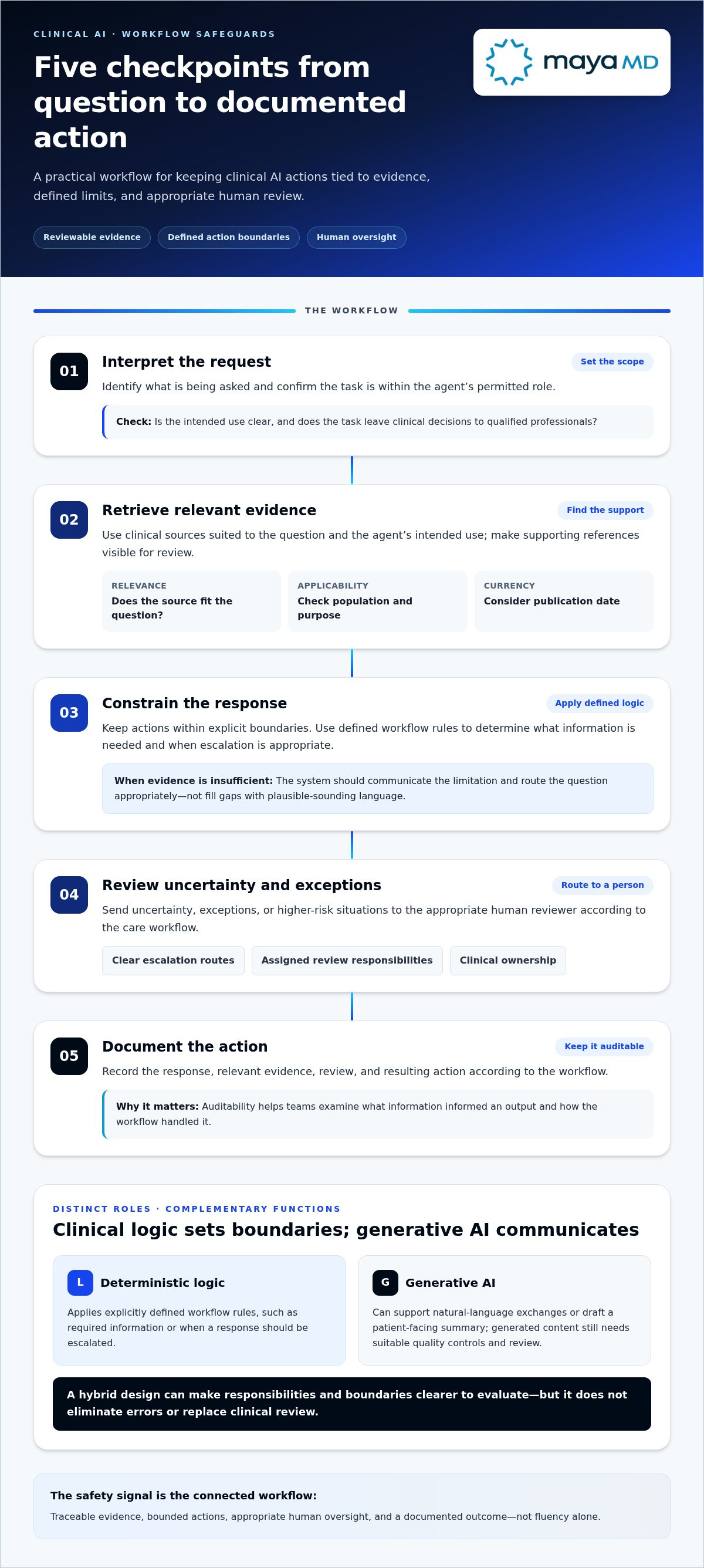
A practical workflow can be mapped as a sequence:
Interpret
Identify the question and the agent’s permitted task.
Retrieve
Find relevant, reviewable clinical sources.
Constrain
Apply defined logic to limit the response or determine whether escalation is needed.
Review
Route uncertainty, exceptions, or higher-risk situations to the appropriate human reviewer.
Document
Record the response, relevant evidence, review, and resulting action according to the workflow.
Governance continues after an answer is generated. Teams need clear ownership of escalation policies and review responsibilities, along with auditability to examine what information informed an output and what happened next. This matters when an agent supports ongoing patient engagement: clinical teams should be able to see where automation ends and their judgment is required. MayaMD’s platform combines deterministic logic with generative AI to support patient engagement and clinical workflows alongside care teams.
To consider how these safeguards fit your care processes, discuss your clinical AI workflow needs with MayaMD.
How to Evaluate Evidence-Based Clinical AI Agent Claims
“Evidence-based” is a claim to investigate, not proof that a system is safe or effective. Evaluate each claim against the agent’s intended task, the evidence supporting it, and the conditions under which it was tested. A benchmark can show performance on a particular task; by itself, it can’t establish improved patient outcomes or suitability for a clinical workflow.
What evidence should an evaluation include?
Use a consistent comparison framework. Check whether the evidence matches the target population, clinical task, and care setting. Examine the methods, comparators, stated limitations, and independent review where available. Evidence retrieval scores and language-model benchmarks are task-specific measures, not substitutes for clinical validation or outcome evidence.
| Evaluation area | What to examine |
|---|---|
| Evidence provenance | Are sources identifiable, relevant to the use case, and suitable for the population? |
| Intended use | Is the agent’s role clearly defined, including what it should not do? |
| Oversight | Are review responsibilities, clinician control, and escalation routes specified? |
| Validation | Were methods, comparators, limitations, and evaluation conditions reported clearly? |
| Integration | Does testing reflect the actual workflow, data, and handoffs involved? |
| Monitoring | Is there a process to detect problems and govern updates after deployment? |
Keep four evidence layers distinct: technical benchmarks measure a defined model task; clinician-reviewed simulations test responses in constructed clinical scenarios; workflow measures assess operational fit, such as review burden and handoff quality; patient outcomes assess effects on care. Results at one layer don’t establish performance at the next.
For example, an alphaXiv paper reports a 3.3% hallucination rate and a 0.914 structured-similarity score for OCR in its evaluation context. Treat these as task-specific findings from that paper, not industry-wide guarantees. Their relevance depends on the evaluated data, methods, and use case; they don’t independently demonstrate safe deployment or better patient outcomes.
How can teams assess safety and real-world fit?
Test representative workflows with clinical and operational stakeholders. Include incomplete information, exceptions, and situations that should trigger escalation. Check whether clinicians can intervene, whether actions are auditable, and how changes to sources or system behavior are governed. Then weigh potential workflow benefits against review effort, integration requirements, and the patient experience.
A credible assessment of an evidence based clinical AI agent connects each claim to its evidence and evaluation conditions. That disciplined comparison is more informative than a label, a single score, or a polished demonstration.
How to Implement and Monitor a Clinical AI Agent Responsibly
Responsible implementation is a managed clinical change, not a software switch. For an evidence based clinical AI agent to support ongoing care, its intended role, handoffs, and performance measures should be clear before patients and care teams rely on it.
Define intended use.
Specify the population, task, setting, and decisions the agent can support. State what falls outside its role.
Map the workflow.
Identify when the agent engages, what information it uses, who receives its output, and where human review or escalation belongs.
Set guardrails.
Establish response limits, escalation conditions, access controls, and clinical ownership of review policies and changes.
Pilot in a defined workflow.
Test realistic cases with clinical and operational stakeholders before expanding use.
Monitor and revise.
Review performance and safety signals on an ongoing basis, then update the workflow, rules, or training as needed.
For care transitions, the hospital discharge conversational-agent study offers an example to examine in context. A study can inform planning, but workflow assessment is still needed to determine how a tool fits a particular program.
What should a clinical AI agent pilot measure?
Choose measures that reflect the stated use case, not only general model performance. For patient engagement, teams might assess response quality, escalation patterns, completion of intended interactions, clinician review burden, and patient engagement. Decide how each measure will be collected and interpreted before the pilot begins.
Set a baseline and follow-up method in advance. This helps distinguish observed changes from assumptions and assess whether the agent is helping, adding review work, or creating friction for patients and staff. Avoid attributing changes to the technology without accounting for the evaluation context.
How should oversight continue after launch?
Assign a clinical owner for escalation policies, review responsibilities, and change management. A documented governance process should capture incidents, clinician corrections, and unexpected outputs, then determine whether they require workflow changes or further evaluation. Reassess source materials, rules, and workflow fit when guidance or intended use changes. Monitoring should cover quality, safety signals, adoption, and operational impact, so issues prompt action rather than simply accumulating in a dashboard.
For a governed implementation, discuss your clinical AI workflow with the MayaMD team.
Where MayaMD Applies an Evidence-Grounded Clinical AI Agent
Evidence-based evaluation is most useful when tied to a specific care context. MayaMD provides a cloud-based, HIPAA-compliant clinical AI platform that combines deterministic logic with generative AI. Its Clinical AI Agent supports patient engagement and clinical workflows alongside care teams, with its role shaped by the workflow rather than autonomous clinical decision-making.
For healthcare organizations, the practical question is how an agent can support continuity while clinical teams retain oversight. MayaMD’s relevant care contexts include Remote Patient Monitoring (RPM), Advanced Primary Care Management (APCM), Principal Care Management (PCM), and post-discharge communication. Each involves distinct patient interactions and handoffs, so teams can define intended use and evaluation measures around the workflow they want to support.
How can an agent support continuous chronic care?
Chronic care extends beyond scheduled visits. Patient engagement and communication between care interactions can help connect people with their care plans and give clinical teams a structured way to support ongoing workflows. In an RPM program, for example, an organization can assess how communications fit into its monitoring process, what requires staff attention, and how escalations are handled. Explore MayaMD’s Remote Patient Monitoring platform for more context on this care setting.
APCM and PCM also involve ongoing care-management activity, while post-discharge communication supports continuity as a patient transitions from a hospital stay to home. These are not claims of autonomous diagnosis or guaranteed clinical outcomes. They are settings where teams can evaluate whether a governed agent supports clear patient engagement and fits existing responsibilities.
What should healthcare teams explore next?
Start with a defined workflow. Identify the intended users, patient interactions the agent may support, where human review is needed, and how exceptions should be escalated. Then agree on measures before implementation, such as response quality, patient engagement, staff review effort, and workflow impact. This makes it possible to assess real-world fit without confusing technical capability with clinical effectiveness.
MayaMD’s Clinical AI Agent can be considered within this broader evaluation: how its combination of deterministic logic and generative AI aligns with the care team’s needs, oversight model, and continuity goals. A collaborative discussion can help teams frame those questions and determine what a meaningful evaluation should include. Discuss an evidence-based clinical AI agent with MayaMD.
Make Clinical AI Fit the Care You Deliver
A trustworthy clinical AI agent is defined not by fluent answers or benchmark scores alone, but by traceable evidence, clear limits, meaningful human oversight, and performance in its intended workflow. Evaluate evidence quality separately from model capability, operational fit, and patient outcomes. Set measures before implementation so teams can monitor and refine responsibly.
MayaMD’s cloud-based platform is HIPAA-compliant and combines deterministic logic with generative AI. Its Clinical AI Agent supports patient engagement and continuity workflows across chronic care, including Remote Patient Monitoring, Advanced Primary Care Management, Principal Care Management, and post-discharge communication. These capabilities support care teams, not replace clinical judgment.
If you’re assessing how an evidence based clinical AI agent could fit your program, start with the workflow, intended users, oversight needs, and evaluation criteria. Discuss an evidence-based clinical AI agent with MayaMD to explore a responsible path toward more connected care.
Frequently Asked Questions
What makes a clinical AI agent evidence-based?
An evidence-based clinical AI agent connects its clinical outputs to identifiable, reviewable sources and stays within a defined intended use. Teams should be able to assess whether those sources are relevant to the clinical question, population, and care setting, and understand how the system handles uncertainty. Evidence grounding supports evaluation, but it doesn’t by itself establish safety, effectiveness, or improved patient outcomes.
How is an evidence-based clinical AI agent different from a medical chatbot?
A medical chatbot typically responds to a prompt, while a clinical AI agent may coordinate defined steps within a workflow, such as gathering information, applying rules, or routing an interaction for review. Those steps require clear boundaries. Source retrieval can locate supporting material, deterministic logic can apply specified rules, and generative AI can communicate in natural language. The agent’s ability to perform tasks doesn’t make it a clinician.
Can a clinical AI agent make decisions without clinician oversight?
Clinical teams should define which workflow tasks an agent can perform and where human review or escalation is required. A system may support bounded operational steps, but that doesn’t mean it should independently make clinical decisions. Oversight should specify who reviews exceptions, how uncertain or concerning interactions are escalated, and how outputs and resulting actions can be audited. The appropriate level of review depends on the agent’s intended use and clinical context.
How do you evaluate whether clinical AI evidence applies to your patient population?
Compare the evidence with the population, clinical task, and care setting where you plan to use the system. Review who was included in the evaluation, what the system was asked to do, which sources or comparators were used, and what limitations the authors reported. Also consider whether the evidence is current and whether local workflow conditions differ. A result from one setting may not transfer directly to another.
Does a high benchmark score prove that a clinical AI agent is safe?
No. A benchmark score describes performance on a particular task under stated evaluation conditions. It doesn’t establish that the agent is safe across different patients, workflows, or real-world situations, nor does it prove improved patient outcomes. Consider benchmarks alongside clinician-reviewed testing, workflow evaluation, failure and escalation handling, and ongoing monitoring. Ask what was measured and what the result does not demonstrate.
How can a clinical AI agent support chronic care management?
A clinical AI agent can support patient engagement and continuity workflows between care interactions, while clinical teams retain oversight. MayaMD’s Clinical AI Agent supports chronic-care engagement across Remote Patient Monitoring, Advanced Primary Care Management, Principal Care Management, and post-discharge communication. Teams can assess how patient communication fits their care-management process, what interactions need staff review, and how concerns are routed without assuming the agent independently diagnoses or determines treatment.
What should healthcare teams monitor after deploying a clinical AI agent?
Monitor measures tied to the system’s intended use, including response quality, safety signals, escalation patterns, clinician corrections, review burden, adoption, and workflow impact. Establish baseline and follow-up methods before deployment so teams can interpret changes responsibly. Governance should also track incidents and unexpected outputs, review whether sources and rules remain suitable, and assign ownership for changes. Patient experience and integration friction matter alongside technical performance.




See The MayaMD Difference
Fill the form below
Download Our Apps
MayaMD for patients and MayaPro for physicians - available on iOS and Android.
FOR PATIENTS
MayaMD App
AI-powered symptom assessment, triage, and secure access to your care team.


FOR PHYSICIANS
MayaPro App
MayaPro brings patient vitals, RPM/PCM care plans, and clinical decision support to your pocket.