
Creating Patient-Centered Remote Care Plans

A remote care plan is patient-centered when monitoring information helps shape what happens next. Creating a patient-centered remote care plan means connecting a person’s goals and chronic care needs with ongoing support, relevant measurements, and clear follow-up actions. The plan should reflect the patient’s circumstances, not simply the information collected about them.
Monitoring can make care more responsive, but readings alone do not create continuity. Patients and care teams need shared goals, a practical way to stay connected, and a clear process for reviewing changes and agreeing on next steps.
This article explains what to include in a patient-centered care plan and how collaborative goal-setting, chronic care management, and remote patient monitoring can work together. Practical examples show how patient priorities and monitoring information can guide support over time.
Key Takeaways
• Build the care plan around the patient’s health history, daily circumstances, and support needs, not just clinical measurements.
• Set shared goals that fit the patient’s priorities and translate them into clear, manageable next steps.
• Use chronic care management to support continuity, coordination, and follow-up between appointments.
• Make ongoing communication part of the plan so patients can raise concerns and care teams can respond to changing needs.
• Review remote monitoring trends in context and connect relevant changes to appropriate follow-up actions.
What is a Patient-centered Care Plan?
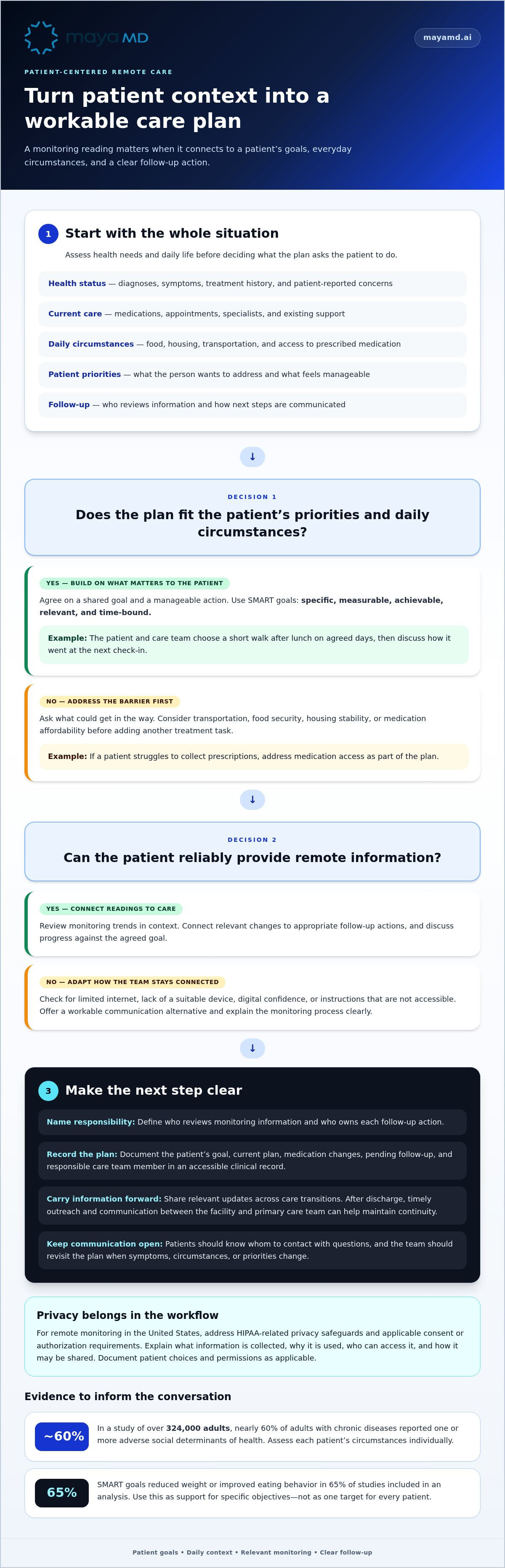
A patient-centered care plan turns clinical priorities into actions that fit a person’s health needs and daily life. Creating a patient-centered remote care plan means assessing the whole situation, agreeing on goals, and deciding how monitoring information will guide follow-up. A diagnosis matters, but so do the conditions that affect whether a patient can carry out each step.
Start with a structured assessment. Review the patient’s medical history, current conditions, medications, symptoms, care team, and recent transitions between settings. Then discuss practical circumstances that could affect care, including transportation, food security, housing stability, and medication affordability. These factors help determine whether a plan is workable as well as clinically appropriate.
Health status
Record diagnoses, symptoms, treatment history, and patient-reported concerns.
Current care
Capture medications, appointments, specialists, and existing support.
Daily circumstances
Ask about access to food, housing, transportation, and prescribed medication.
Patient priorities
Document what the person wants to address and what feels manageable.
Follow-up
Define who reviews monitoring information and how the team communicates next steps.
A study of over 324,000 adults found that nearly 60 percent of adults with chronic diseases reported one or more adverse social determinants of health. Use that finding as a prompt to assess individual circumstances, not as a substitute for asking each patient. For example, a patient who struggles to collect prescriptions may need a plan that addresses medication access before adding another treatment task.
Information sharing should support each care transition. Record the patient’s current plan, medication changes, pending follow-up, and the responsible care team member in an accessible clinical record. After discharge, timely outreach and communication between the facility and primary care team can help carry relevant information forward. Patients also need to know whom to contact with questions.
For remote monitoring in the United States, address HIPAA-related privacy safeguards and applicable consent or authorization requirements in the workflow. Explain what information is collected, why it is used, who can access it, and how it may be shared. Document patient choices and permissions as applicable.
Technology access can limit participation. A patient may lack reliable internet, a suitable device, digital confidence, or accessible instructions. Offer a workable communication alternative and explain the monitoring process clearly. A remote plan should not depend on information a patient cannot reliably provide.
Example: A patient with chronic disease has limited transportation and difficulty obtaining medication. The care team records these barriers, reviews the treatment plan with the patient, and coordinates follow-up across the care journey. The result is a plan built around identified needs, with responsibilities and communication steps clearly set out.
Collaborative goal-setting and patient agency
Patient agency grows when the care team turns clinical recommendations into goals the patient helps choose. Ask what change matters most, what feels achievable, and what could get in the way. Then connect that priority to a clinical objective and agree on how to review progress. Shared decisions make the plan a collaboration, not a list of instructions.
Use SMART goals to make the agreement actionable: specific, measurable, achievable, relevant, and time-bound. “Improve activity” is difficult to assess. A more useful goal might be, “Take a short walk after lunch on agreed days, then discuss how it went at the next check-in.” The patient and care team should choose the activity and schedule together.
Ask
Invite the patient to identify a meaningful health priority and explain why it matters.
Agree
Translate that priority into an observable action the patient considers realistic.
Record
Document the goal, the patient’s preferred support, and how progress will be discussed.
Revisit
Adjust the plan when symptoms, circumstances, or patient priorities change.
Evidence supports specific goal-setting. SMART goals effectively reduced weight or improved eating behavior in 65% of studies included in an analysis. That finding supports using measurable objectives, not imposing the same target on every patient. The patient’s starting point, preferences, and ability to carry out the action should shape the agreed measure.
Patient experience also reflects whether clinicians consider personal context. Patients may feel more positive about their care when clinicians consider their health history and life circumstances. A practical step is to ask patients what the care team should understand about their routines before setting a target.
Coordination keeps shared goals consistent across clinicians. Identify who owns each follow-up action, where progress is documented, and how relevant updates reach the wider care team. For example, a patient managing blood pressure may prioritize a sustainable daily routine. The clinician can align the goal with the treatment plan, while the care team records progress and discusses obstacles during follow-up. The patient remains involved in deciding whether the approach works for them.
Care teams building structured patient engagement workflows can connect goal-setting with consistent communication. Discuss patient engagement workflows as a way to support coordinated conversations while keeping patient priorities central.
Continuity of treatment through Chronic Care Management
Chronic Care Management (CCM) supports continuity between appointments for people living with ongoing conditions. According to the Centers for Medicare & Medicaid Services, Medicare Part B CCM is a program for patients with two or more chronic conditions. Clinical staff can engage eligible patients for at least 20 minutes per month under the described CCM model. These touchpoints help connect care activities that might otherwise remain separate.
A useful CCM workflow assigns responsibility at every step. Identify who reviews patient updates, who coordinates with other clinicians, and where decisions are recorded. Link each contact to an action, such as reconciling a medication list, arranging follow-up, or addressing a new concern. Clear ownership helps patients understand what happens next and helps the care team maintain a consistent record.
Coordinate
Share relevant updates among the primary care team and involved specialists.
Document
Record patient contacts, care decisions, and outstanding follow-up in the clinical record.
Reassess
Use new symptoms, treatment changes, and monitoring information to determine whether the plan needs adjustment.
Close the loop
Tell the patient what action was taken and who will follow up.
Continuity matters especially after a hospital stay. The transition process can include timely outreach, medication reconciliation, and communication between the discharging facility and primary care team. Each step helps prevent a changed prescription or pending appointment from being overlooked between settings. The care plan should show what information was received, what needs action, and who is responsible.
Telehealth and remote monitoring costs depend on service scope, staffing, technology, and patient needs; pricing is provided after a quote request. Medicare Part B CCM is designed for patients with two or more chronic conditions, according to the Centers for Medicare & Medicaid Services. Coverage and patient responsibility depend on the applicable benefit and service, so distinguish CCM from other telehealth or monitoring arrangements.
Example: A patient with multiple chronic conditions returns home after a hospital admission with medication changes and a follow-up appointment to arrange. The care team reconciles the medication list, communicates with primary care, and assigns responsibility for contacting the patient. The result is a documented transition with clear next steps, rather than disconnected instructions.
For ongoing CCM, each contact should move care forward. A team member can document a symptom update, route it for review, and record the resulting action. If monitoring information changes the clinical picture, the team can include it in follow-up and keep the patient informed. This creates a traceable link between communication, coordination, and treatment decisions.
Ongoing emotional and clinical support
A remote care plan should address physical symptoms and emotional strain together. For example, a patient managing heart failure may report fatigue as well as worry about daily activities. Ask about both during follow-up, then document how each concern affects treatment, routines, and the patient’s ability to participate.
Use a repeatable conversation structure so support does not depend on a single appointment. Ask what has changed, what feels difficult, and what help the patient wants. Clarify whether the concern involves a new symptom, a treatment obstacle, emotional distress, or a practical need. Route each issue to the appropriate clinical team member and record the agreed next step.
Review physical changes
Discuss symptoms, medication difficulties, sleep, mobility, and daily function.
Invite emotional concerns
Ask about stress, isolation, fear, or frustration linked to the patient’s condition.
Identify practical barriers
Explore whether caregiving demands, transportation, or daily routines disrupt the plan.
Agree on follow-up
Record who will respond, what information is needed, and how the patient will receive an update.
Specific questions can reveal needs that a measurement alone cannot show. A patient whose readings appear stable may still feel overwhelmed by medication routines or uncertain about symptoms. Ask the patient to describe a typical day, then identify one point where support could make the care plan more manageable. This keeps the conversation grounded in the patient’s experience.
Emotional support should lead to a defined clinical response. If a patient reports persistent worry, the care team can acknowledge the concern, assess its effect on self-management, and determine appropriate follow-up. If the patient describes a new or worsening physical symptom, route the information through the practice’s clinical review process. The plan should explain how patients can raise concerns and how staff document responses.
Example: A patient with diabetes feels discouraged after struggling to maintain a new routine. The care team asks which part feels hardest and learns that the schedule conflicts with work. Together, they discuss a more practical routine and arrange a follow-up conversation. The result is a documented adjustment based on the patient’s experience, rather than an assumption about motivation.
Care plans also need a way to revisit emotional and physical needs as circumstances change. At each planned check-in, compare the patient’s current concerns with previous notes. Record what improved, what remains difficult, and whether the agreed support helped. This creates continuity across conversations and gives the care team a clearer basis for adapting its approach.
When a patient reports several concerns, prioritize them together instead of presenting a long task list. Agree on the most urgent issue, name the next action, and confirm the patient understands how to follow up. This focused sequence supports meaningful engagement while preserving clinical oversight.
Remote patient monitoring data
Remote patient monitoring data is useful when it informs a defined care decision. A reading without context may not show whether a patient’s condition is changing or whether follow-up is needed. Connect each measure to the patient’s goals, clinical record, and review process before using it to update the plan.
Set a review schedule that reflects the patient’s condition, the information being collected, and the care team’s response workflow. Assign responsibility to a specific role, such as a designated clinical team member, and state how that person records findings and routes concerns. Include the schedule and responsibilities in the plan rather than leaving them implicit.
Review individual readings alongside patterns. Compare current information with the patient’s previous measurements, reported symptoms, treatment changes, and relevant clinical history. Check for missing or inconsistent entries before drawing conclusions. A single unusual value may need context, while a sustained change across several readings may prompt clinical review under the care team’s established process.
Confirm context
Check the date, completeness, and patient-reported circumstances linked to a reading.
Compare trends
Review changes against the patient’s baseline and agreed monitoring objectives.
Route findings
Document who reviews the information and how relevant concerns reach the clinical team.
Close the loop
Record the decision, communicate the next step, and update the care plan when needed.
Outcome measurement starts with a clear baseline and a question the plan is meant to answer. Choose measures connected to the patient’s goal, such as changes in symptoms, daily function, or a monitored trend. Review them alongside the patient’s reported experience. If results do not show the intended progress, examine the intervention, barriers to participation, and whether the goal still fits.
Update the plan when new information changes the care picture. Record what changed, why the team adjusted the approach, and who will follow through on the revised action. For example, if a patient’s readings shift while symptoms also worsen, the reviewer documents both signals and routes them for clinical assessment. The care plan then captures the decision and follow-up, not just the raw measurement.
Electronic health record information, social determinants of health, and remote monitoring biometrics can help identify chronic patients at risk of a 30-day hospital readmission. Used together, these inputs add context to risk assessment. They do not replace clinical review; their value depends on accurate information and a clear process for acting on findings.
For example, a patient’s monitoring entries become incomplete after a change in routine. The assigned team member notices the gap, documents it, and discusses the barrier with the patient. The team can then adjust the monitoring approach and review whether the revised process provides useful information.
Build a monitoring workflow that connects data review with coordinated chronic care management. Discuss remote monitoring workflows for your care program.
MayaMD: Clinical AI Agent
MayaMD’s Clinical AI Agent supports patient engagement and communication across remote care journeys. For care teams managing chronic conditions, it helps connect patient interactions with ongoing support. Automated post-discharge communication solutions support follow-up after patients transition home.
These capabilities can support practices seeking more consistent communication alongside established clinical workflows. The Clinical AI Agent supports patient interactions, while clinicians retain responsibility for care decisions and follow-up. This connects digital engagement to the patient-centered plan rather than treating outreach as a separate process.
To explore how MayaMD can support your patient engagement and post-discharge workflows, contact MayaMD.
Move from plan design to a connected care pathway
Make the care plan part of how your team works. Identify where patient communication fits into existing workflows, how information reaches the right team members, and how staff will document actions. A clearly defined pathway helps turn a written plan into a consistent part of care delivery.
Start with a patient population or workflow that needs stronger continuity. Map where patients need support, then consider how digital engagement can complement clinical oversight. As the process develops, use team feedback to refine handoffs and clarify responsibilities. This practical foundation helps organizations approach creating a patient-centered remote care plan as ongoing care design, not a one-time document.
MayaMD’s Clinical AI Agent and AI patient engagement solutions can support digital communication, while its automated post-discharge communication solutions address follow-up after discharge. To discuss how these capabilities may fit your care program, contact MayaMD about remote care.
Thoughtful workflow design gives care teams a clear place to begin. Keep the patient’s experience at the center as your approach evolves.
Frequently Asked Questions
What are the key components of a patient-centered remote care plan?
A practical plan connects clinical priorities with patient-specific actions and an accountable care team. Include the patient’s preferred communication method, the purpose of each monitoring measure, instructions for submitting information, and the process for reviewing it. Add a version date and identify who updates the plan. For example, a patient who shares readings by phone needs the same clear review pathway as someone using a digital portal.
How do you assess a patient's needs, goals, preferences, and barriers for remote care?
Use a focused conversation alongside the patient’s clinical record. Ask what they want help with, which routines are difficult, and how they prefer to communicate. Explore practical factors such as device access, internet reliability, language needs, accessibility, and confidence using digital tools. Ask the patient to describe how they would complete a monitoring task. This walkthrough can reveal obstacles that a general question might miss.
How do you set measurable goals and choose remote monitoring tools for a care plan?
Choose a goal that reflects a patient priority and a clinical objective, then define what observable change would count as progress. Select monitoring tools based on the measure needed, the patient’s ability to use them, and how clinicians will interpret the information. For example, if a plan tracks a symptom, specify how the patient records it and how the care team considers that report alongside other clinical information.
What are the steps to create and implement a remote care plan with a patient and care team?
Begin by agreeing on the patient’s priority and confirming the clinical objective. Next, assign team responsibilities, select the monitoring approach, and explain how information will be reviewed. Document the plan in the clinical workflow, then walk the patient through the first reporting task. For instance, ask the patient to demonstrate how they will submit an update and clarify whom to contact if the process becomes difficult.
What are best practices for communicating with patients during remote care?
Use the patient’s preferred channel and keep each message focused on one clear action. Explain why information is requested, how the team will use it, and what to do if a task cannot be completed. Use accessible language and invite questions instead of relying on one-way instructions. For example, after sending a monitoring reminder, provide a clear way for the patient to report a problem or request assistance.
What privacy, consent, and HIPAA rules apply to remote patient monitoring in the United States?
For remote monitoring in the United States, address HIPAA-related privacy safeguards and applicable consent or authorization requirements in the workflow. Explain what information is collected, why it is used, who can access it, and how it may be shared. Document patient choices and permissions as applicable.




See The MayaMD Difference
Fill the form below
Download Our Apps
MayaMD for patients and MayaPro for physicians - available on iOS and Android.
FOR PATIENTS
MayaMD App
AI-powered symptom assessment, triage, and secure access to your care team.

FOR PHYSICIANS
MayaPro App
MayaPro brings patient vitals, RPM/PCM care plans, and clinical decision support to your pocket.