
Common Mistakes in Chronic Care Management Billing

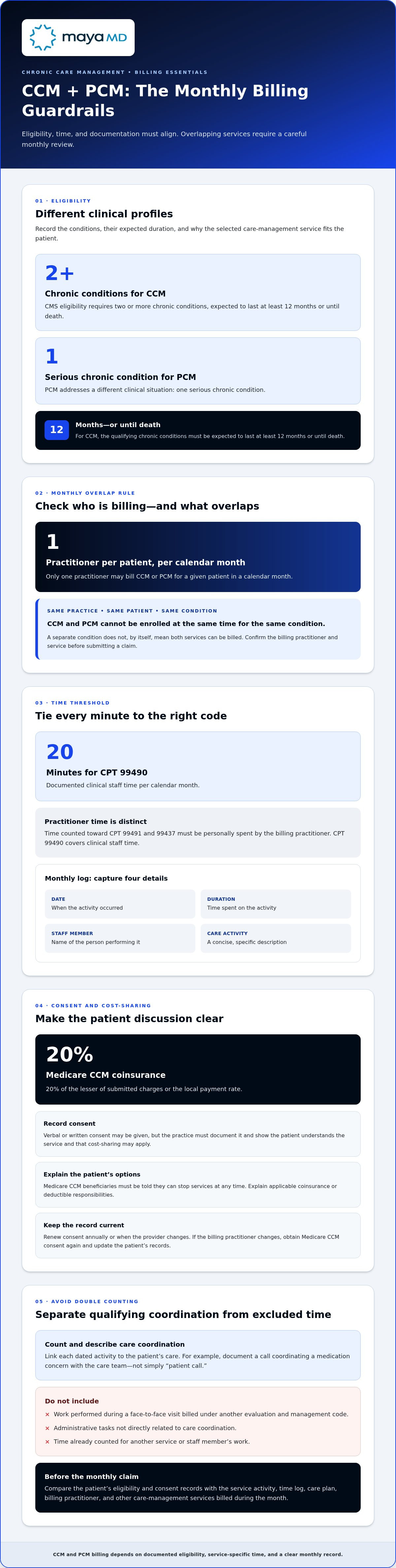
CCM and PCM cannot be billed by the same practice for the same patient and the same condition at the same time. Only one practitioner may bill CCM or PCM for a given patient in a calendar month, and the Centers for Medicare & Medicaid Services says CCM eligibility requires two or more chronic conditions. These rules make overlapping services a central source of common mistakes in chronic care management billing.
It’s understandable to focus on whether a patient qualifies for each program. But eligibility alone doesn’t determine which service can be billed when care overlaps, or whether the monthly record supports the claim.
This article explains how CCM and PCM eligibility differs, what consent, time tracking, and documentation require, and which overlapping services may conflict in the same month. It also offers practical ways to keep care coordination and billing records aligned.
Key Takeaways
• Document patient consent and cost-sharing discussions clearly, including the patient’s understanding of their options.
• Keep monthly time records tied to specific dates, staff members, durations, and care activities.
• Match the service code to the patient’s eligibility, the work performed, and the applicable time threshold.
• Review other services billed during the month to identify periods or activities that may overlap with CCM.
• Coordinate care-team documentation so the same work or staff time isn’t counted more than once.
1. Can CCM and PCM Be Billed for the Same Patient in the Same Month?
The same practice cannot enroll a patient in CCM and PCM at the same time for the same condition. Having a separate condition does not, by itself, mean both services can be billed. Only one practitioner can bill CCM or PCM for a given patient in a calendar month, so identify the billing practitioner and service before submitting a claim. A common mistake is assuming that eligibility for two programs makes both automatically billable.
Start with the condition criteria. According to the Centers for Medicare & Medicaid Services, a patient must have two or more chronic conditions to qualify for CCM. Those conditions must be expected to last at least 12 months or until death. PCM addresses a different clinical situation: one serious chronic condition. Record the disease or conditions supporting the selected program, their expected duration, and why the care-management service fits the patient.
Document consent separately and clearly. A patient may give verbal or written consent for CCM or PCM, but the practice must record it. The record should show that the patient understands the service and that cost-sharing may apply. Medicare CCM beneficiaries must also be told they can stop services at any time. Explain applicable coinsurance or deductible responsibilities during the consent discussion, and document what was communicated rather than relying on a generic enrollment status.
Medicare CCM coinsurance is 20% of the lesser of submitted charges or the local payment rate. This cost-sharing responsibility makes clear disclosure important; consent does not mean the patient has agreed to pay an unspecified amount without explanation. Document the discussion alongside the consent, including the patient’s understanding that cost-sharing may apply. If the billing practitioner changes, obtain Medicare CCM consent again and update the patient’s records.
Centralized patient information helps teams apply these rules consistently. Maintain one record of the patient’s conditions, selected program, consent date and form, billing practitioner, and any enrollment changes. Before preparing the monthly claim, compare this record with service activity and other care-management enrollment. For example, a patient listed in both CCM and PCM tracking should prompt a review of whether the same condition is involved and which practitioner is billing.
Keep consent and eligibility records current, not just complete at enrollment. The consent record should be renewed annually or when the provider changes. Teams organizing related care-management pathways can also review the requirements for advanced primary care management without treating that program as a substitute for confirming CCM or PCM billing rules.
2. Monthly time tracking and service documentation
A monthly CCM record should show what care coordination occurred, who performed it, and how long it took. For CPT code 99490, the documented threshold is 20 minutes of clinical staff time per calendar month. A time total without dated activities gives reviewers little context for how the service supported the patient’s care.
Use a consistent log for each patient. Record the date, duration, staff member’s name, and a concise description of the activity. For example, document a call coordinating a medication concern with the care team, rather than entering only “patient call.” Specific entries link time to care coordination and help distinguish clinical work from routine administration.
Keep practitioner time separate where the code requires personal work. Time counted toward CPT codes 99491 and 99437 must be personally spent by the billing practitioner. By contrast, CPT code 99490 covers clinical staff time. If several people contribute, document each activity accurately and avoid adding time that does not meet the applicable code’s requirements.
Exclude time that belongs to another billed service. Medicare CCM time doesn’t include work performed during a face-to-face visit billed under another evaluation and management code. It also excludes administrative tasks not directly related to care coordination. A scheduling entry alone, for example, should not count as CCM time without a qualifying coordination activity.
Eligibility records should explain why the patient qualifies, not merely show an active enrollment flag. Document the chronic conditions, whether they’re expected to last at least 12 months or until death, and the care plan that guides coordination. Keep the comprehensive care plan accessible to the care team and provide it to the beneficiary or caregiver. These records connect eligibility to the services delivered during the month.
Use acceptable certified EHR technology to record patient health information. For each PFS payment year, the stated timing requirement is that the information be recorded using acceptable certified EHR technology as of December 31 of the calendar year before that payment year. Keep the care plan and monthly activity documentation organized so staff can trace a service from the patient’s needs to the recorded work.
A final monthly review can compare time logs, care-plan activity, and the claim code before submission. This makes missing dates, unclear activity descriptions, and duplicated time easier to identify. Practices refining documentation and coordination workflows can discuss their CCM workflow needs with MayaMD.
3. Medicare CCM eligibility and reimbursement framework
For Medicare CCM, the Centers for Medicare & Medicaid Services requires two or more chronic conditions. Those conditions must be expected to last at least 12 months or until death. The patient also needs documented consent and a comprehensive care plan. The plan should guide the clinical work, not simply accompany the claim.
Start eligibility review with the patient’s clinical profile, then connect it to the service provided. Record each qualifying condition and its expected duration, and explain how it affects care coordination. A Medicare initiating visit may be an evaluation and management visit, an initial preventive physical examination, or an annual wellness visit. Document the visit alongside the care plan and consent records.
Choose CPT codes according to the work, time, and complexity documented for that patient. CPT code 99490 covers clinical staff time, while 99439 is its add-on for each additional 20 minutes. For practitioner-provided time, 99491 covers 30 minutes per month, and 99437 adds each additional 30 minutes. Don’t combine time across codes without verifying that the work qualifies for each code.
Complex CCM uses a different threshold and decision-making standard. CPT code 99487 covers 60 minutes of clinical staff time and requires moderate-to-high complexity medical decision-making. CPT code 99489 adds each additional 30 minutes when used with 99487. The record should support both the documented time and the complexity; a higher time total alone doesn’t establish complex CCM.
PCM addresses a distinct eligibility profile: one serious chronic condition expected to last at least 3 months. Its codes also distinguish who provides the work. CPT code 99424 covers the first 30 minutes of physician or qualified healthcare professional time per calendar month. CPT code 99426 covers the first 30 minutes of clinical staff time under physician or qualified healthcare professional supervision. Code 99427 adds each additional 30 minutes to 99426.
Medicare CCM may be billed by physicians, nurse practitioners, physician assistants, certified nurse midwives, and clinical nurse specialists. Clinical staff may perform qualifying work under the applicable supervision structure, but the billing practitioner remains responsible for code selection and oversight. Medicare CCM also requires 24/7 access for patients’ urgent chronic care needs. Build that access into the program workflow.
A practical claim review follows the evidence: confirm the patient’s condition criteria, initiating visit, consent, care plan, code, time, and decision-making level. Then compare the claim with the monthly record. This sequence helps providers distinguish routine CCM from complex CCM or PCM and ensures the code matches the documented clinical service.
4. Services that may conflict with CCM billing in the same month
A claim can meet CCM’s time threshold and still conflict with another service billed for the patient. Review the full calendar month and each overlapping service period before submitting the claim. Home health oversight and Transitional Care Management (TCM) are among the services identified as potential same-month conflicts. Check service dates and codes; looking only at the month-end total can hide an overlap.
TCM requires careful attention because the relevant timing rules describe both a calendar-month conflict and an allowance during a service period. CCM may be billed during the 30-day TCM service period for CPT codes 99495 and 99496. These statements make it important to distinguish the TCM service period from the calendar month, rather than treating every TCM encounter as an automatic bar or assuming every overlap is permitted. Record the applicable TCM code, dates, and CCM activities, then assess the specific overlap.
End-stage renal disease services have a separate restriction. CCM cannot be billed during the same service period as CPT codes 90951–90970 for certain ESRD services. The conflict is defined by the service period, not simply the date a claim is processed. Compare the patient’s ESRD service-period records against CCM dates before billing.
Monthly time requirements also depend on the CCM code selected. CPT code 99490 covers 20 minutes of clinical staff time per calendar month, while CPT code 99487 covers 60 minutes and complex medical decision-making. The broader stated CCM program requirement describes 20–60 minutes of clinical staff time per patient per calendar month. Match the documented work to the chosen code; don’t use a qualifying time total to support a service that conflicts with another billing rule.
Reimbursement depends on the applicable code and Medicare payment framework. Don’t treat an approximate monthly figure as a universal expectation: code selection, documented work, and whether the claim meets requirements determine the billed service. The care plan should also connect monthly coordination to the patient’s chronic needs and expected clinical outcomes, rather than serve as a stand-alone billing document.
Use a monthly reconciliation process. Compare the CCM log with claims and service records for home health oversight, TCM, and relevant ESRD codes. Confirm whether a conflict applies to a calendar month or a service period, and retain the codes and dates supporting that decision. Check that the practitioner and staff time are assigned to the correct service, too. This review can reveal duplicate billing and prevent valid CCM activity from being reported alongside a conflicting service.
5. Overlapping care management services
Overlapping programs create a coordination problem before they create a billing problem. A patient may receive several kinds of ongoing support, but each activity needs a clear service purpose and record. For CCM and PCM work in the same calendar month, map activities to the relevant condition and program before preparing claims. This helps distinguish separate care needs from duplicated documentation.
Take particular care when work is shared. If multiple care-team members meet about one patient, count only one auxiliary staff member’s or authorized billing provider’s time. Don’t add each attendee’s minutes for the same activity. For example, if a physician and clinical staff member discuss one care-plan update together, identify whose time is counted rather than combining both participants’ time.
Keep staff and practitioner time streams distinct. For CCM or PCM service activities, auxiliary personnel and authorized billing provider time cannot be reported separately in the same calendar month. Attribute each meeting, phone call, or coordination task to one time entry. For separate activities involving the same patient, document each independently and identify its participants, purpose, and duration.
Code selection also limits overlap. A practitioner cannot report non-complex CCM and complex CCM for the same patient in the same calendar month. CCM and complex CCM cannot be combined for that month, and CCM and CCCM cannot be billed together. A 20-minute entry associated with CPT code 99490, for example, doesn’t justify adding a second overlapping CCM type for the same patient.
Use one shared monthly view across the care team. Include the patient, condition, service type, practitioner, staff member, activity, date, and counted time. Before claim submission, compare records across programs and remove duplicate entries. This is especially important when one staff member supports several patients or multiple professionals contribute to one patient’s ongoing plan. A centralized view makes each time entry easier to trace.
Separate clinical support from billable time in the workflow. Remote patient monitoring may provide information relevant to chronic care, but monitoring data alone does not prove that a CCM activity occurred. Record the actual coordination work, such as reviewing a patient concern and documenting the care-team response. Link the work to the care plan and keep service records distinct.
The practical rule is simple: assign each activity once, to the appropriate service and time record. That protects revenue integrity without counting the same team effort twice. If your team is refining how chronic care workflows connect with monitoring, discuss your care coordination needs.
MayaMD: Clinical AI Agent
MayaMD’s Clinical AI Agent supports patient engagement for people managing chronic conditions. It can help healthcare teams provide more consistent digital communication alongside established care-management workflows. Patient engagement solutions support ongoing connection, while automated post-discharge communication helps maintain communication after a patient leaves the hospital.
These tools support care delivery, but they don’t replace billing review. Eligibility, code selection, time records, and service overlap still require clinical and billing oversight. Keep those responsibilities clear when evaluating where digital support fits your program.
To discuss how MayaMD’s Clinical AI Agent could fit your patient engagement workflow, contact MayaMD.
Build a More Reliable CCM Workflow
Reducing common mistakes in chronic care management billing starts with treating accuracy as an ongoing workflow, not just a final claim review. Clarify responsibilities across clinical, operations, and revenue-cycle teams. Assign each role a defined point for resolving documentation gaps or service overlaps, then use recurring reviews to spot patterns and improve handoffs.
Digital support can complement this work by helping teams maintain patient communication across care transitions. MayaMD offers a Clinical AI Agent, AI patient engagement solutions, and automated post-discharge communication solutions. These capabilities support engagement workflows; your practice’s billing processes remain responsible for code selection and claim review.
Use the next workflow review to identify where coordination breaks down, then decide which process changes will make records and responsibilities clearer. Contact MayaMD to discuss CCM billing and how digital patient engagement may fit your care model. A deliberate, team-based approach can help your program move forward with greater clarity.
Frequently Asked Questions
Can CCM and PCM Be Billed for the Same Patient in the Same Month?
Generally, only one practitioner may bill CCM or PCM for a patient in a calendar month. The same practice also cannot enroll a patient in both programs at the same time for the same condition. For example, if records show active CCM and PCM enrollment for one condition, reconcile the condition, program, and billing practitioner before submitting a claim. Separate diagnoses alone don’t establish that both claims are appropriate.
How Many Chronic Conditions Are Required to Bill CCM?
CCM eligibility requires two or more chronic conditions, according to the Centers for Medicare & Medicaid Services. The conditions must be expected to last at least 12 months or until death. For example, a record listing only one ongoing condition doesn’t meet CCM’s condition-count threshold. Principal Care Management has a different profile, addressing one serious chronic condition, so the program should match the patient’s documented clinical needs.
What Are the Most Common CCM Program Pitfalls?
Frequent pitfalls include choosing a code that doesn’t match the documented work, counting time twice, and missing conflicts with other services. A monthly review can catch these issues before claim submission. Compare the patient’s care activities with the code, time log, and other billed services. For instance, don’t count two team members’ time for the same meeting as separate patient-care time.
What Can (and Should) Providers Do to Avoid CMS and DOJ Scrutiny With Regard to CCM Billing?
Providers can strengthen billing integrity by making each claim traceable to the patient’s eligibility, consent, care plan, and documented monthly services. Use a defined review process to compare codes with time logs and identify duplicated work or overlapping services. If an entry lacks a clear activity or responsible staff member, resolve it before billing. Accurate, consistent documentation helps explain why each service was reported.
What Are the Most Common Chronic Care Management Billing Mistakes?
Common mistakes in chronic care management billing include billing without adequate eligibility records, reporting unsupported time, and overlooking services that conflict with CCM. Another risk is relying on a generic note that doesn’t connect an activity to the patient’s care. Review each claim against the clinical record and monthly activity log, then resolve discrepancies before submission.
What Patient Consent and Care Plan Documentation Are Required for CCM Billing?
Document the patient’s verbal or written consent, including their understanding that cost-sharing may apply and that they may stop Medicare CCM services at any time. Keep the comprehensive care plan accessible to the care team and provide it to the beneficiary or caregiver. For example, the care-plan record should identify patient needs and guide coordination, not merely confirm that a plan exists.
How Should Practices Track and Document Time for Chronic Care Management Claims?
Record each activity’s date, duration, staff member, and description of the care coordination performed. Separate qualifying work from face-to-face visits billed under another evaluation and management code and from unrelated administrative tasks. If a physician and staff member participate in one meeting, identify whose time is counted. This creates a clear record linking reported time to the patient’s care.
What Are the CMS Time Thresholds and Billing Codes for CCM?
CPT code 99490 covers 20 minutes of clinical staff time per calendar month, and 99439 adds each additional 20 minutes with 99490. Code 99491 covers 30 minutes of practitioner time; 99437 adds each additional 30 minutes. Complex CCM code 99487 requires 60 minutes of clinical staff time and moderate-to-high complexity decision-making. Code 99489 adds each additional 30 minutes with 99487.




See The MayaMD Difference
Fill the form below
Download Our Apps
MayaMD for patients and MayaPro for physicians - available on iOS and Android.
FOR PATIENTS
MayaMD App
AI-powered symptom assessment, triage, and secure access to your care team.


FOR PHYSICIANS
MayaPro App
MayaPro brings patient vitals, RPM/PCM care plans, and clinical decision support to your pocket.