
Clinical AI Platform: Guide for Healthcare Organizations

What should happen after a clinical AI platform identifies a patient need? The answer matters as much as the AI output. Healthcare organizations need to know how recommendations are governed, who reviews them, and how they connect with established care workflows. Separate AI tools may generate useful insights, but without coordinated processes, those insights can be difficult to act on.
That’s why evaluating a platform takes more than comparing features. Governance, workflow fit, and continuity of care all deserve close attention. This guide explains the core components and boundaries of a clinical AI platform, then offers a practical framework for assessing whether its capabilities align with your organization’s needs.
You’ll also see how AI can support chronic-care and post-discharge workflows through patient engagement, monitoring, and documentation. MayaMD’s cloud-based, HIPAA-compliant platform combines deterministic logic with generative AI to support ongoing patient care. The goal is not to replace clinical judgment, but to connect governed AI capabilities with the work of care teams.
Key Takeaways
• Assess whether a platform connects AI capabilities to clinical workflows, rather than simply grouping separate tools.
• Understand how deterministic logic and generative AI can serve different roles within defined workflows and human oversight.
• Use a practical evaluation framework to compare workflow fit, oversight, integrations, patient experience, and operational visibility.
• See how a clinical AI platform may support connected chronic-care and post-discharge processes without conflating RPM, APCM, and PCM.
• Start with a focused care need, map the workflow, and identify measures that can guide a responsible evaluation.
What Is a Clinical AI Platform, and What Should It Connect?
A clinical AI platform connects AI capabilities with clinical workflows and patient-care processes. Rather than simply producing an answer or automating a task, it places AI-supported activity within a defined care context, with appropriate users, review steps, and information flows.
A clinical AI platform connects AI-supported tasks to care workflows while keeping clinical judgment and human oversight central. Its role depends on who uses it, the care setting, and what happens before and after an AI capability is used. An overview of the field’s applications and ethical considerations is available in Artificial intelligence in healthcare.
Which capabilities belong in a clinical AI platform?
Capabilities can address different parts of care. To assess a platform, consider which tasks it supports and how information moves from one task to the next:
Clinical documentation
Supports the capture or organization of information for care-team use.
Patient engagement
Facilitates communication, education, or follow-up between care teams and patients.
Workflow support
Helps route information or tasks to the appropriate point in a care process.
Monitoring and care management
Connects remote monitoring information with ongoing follow-up workflows for chronic care.
These capabilities are distinct, even when they work together. Collecting patient-reported information is not the same as documenting a clinical encounter. Neither task alone defines how a team reviews the information or acts on it.
How is a platform different from a single-purpose AI tool?
A standalone chatbot may handle a conversation, a documentation tool may assist with notes, and a patient-facing app may provide a digital point of interaction. A platform is distinguished by how capabilities connect across tasks: what information moves between steps, which users receive it, and how each task fits into the care process. The label alone doesn’t establish that those connections exist.
Consider a patient sharing information during ongoing care. A connected workflow might support engagement, make relevant information available for care-team follow-up, and fit within a broader monitoring or care-management process. When evaluating this kind of workflow, map who receives the information, who reviews it, and what follow-up is expected. Explore MayaMD’s clinical AI agent for primary care.
How Clinical AI Platforms Combine Logic, Generative AI, and Oversight
Different AI methods can support different steps in a care workflow. Deterministic logic applies predefined rules consistently, while generative AI produces context-responsive content, such as a draft summary or patient communication. A clinical AI platform can combine these approaches, but their roles and boundaries should be explicit: which inputs each capability uses, what it can produce, and when a person reviews or acts on the result.
AI outputs require appropriate review within the clinical workflow for which they’re intended. Review is one part of oversight, not a substitute for sound design, governance, or ongoing quality assessment.
What role can deterministic logic play in clinical AI?
Rule-based processing can support repeatable steps, such as applying defined criteria to route information or prompt a workflow action. This can make processes more consistent when the rules reflect the intended use and are designed, validated, and maintained appropriately. Rules can still encode omissions or outdated assumptions, so predictable behavior alone doesn’t establish clinical accuracy or safety.
Where can generative AI assist, and where are its limits?
Generative AI may assist with drafting patient-facing communication, summarizing information, or supporting documentation workflows. Because its outputs depend on context and may need correction, organizations should define permitted uses, review expectations, and how generated content enters the care process. It should not be treated as an independent clinical decision-maker.
These controls operate at distinct levels:
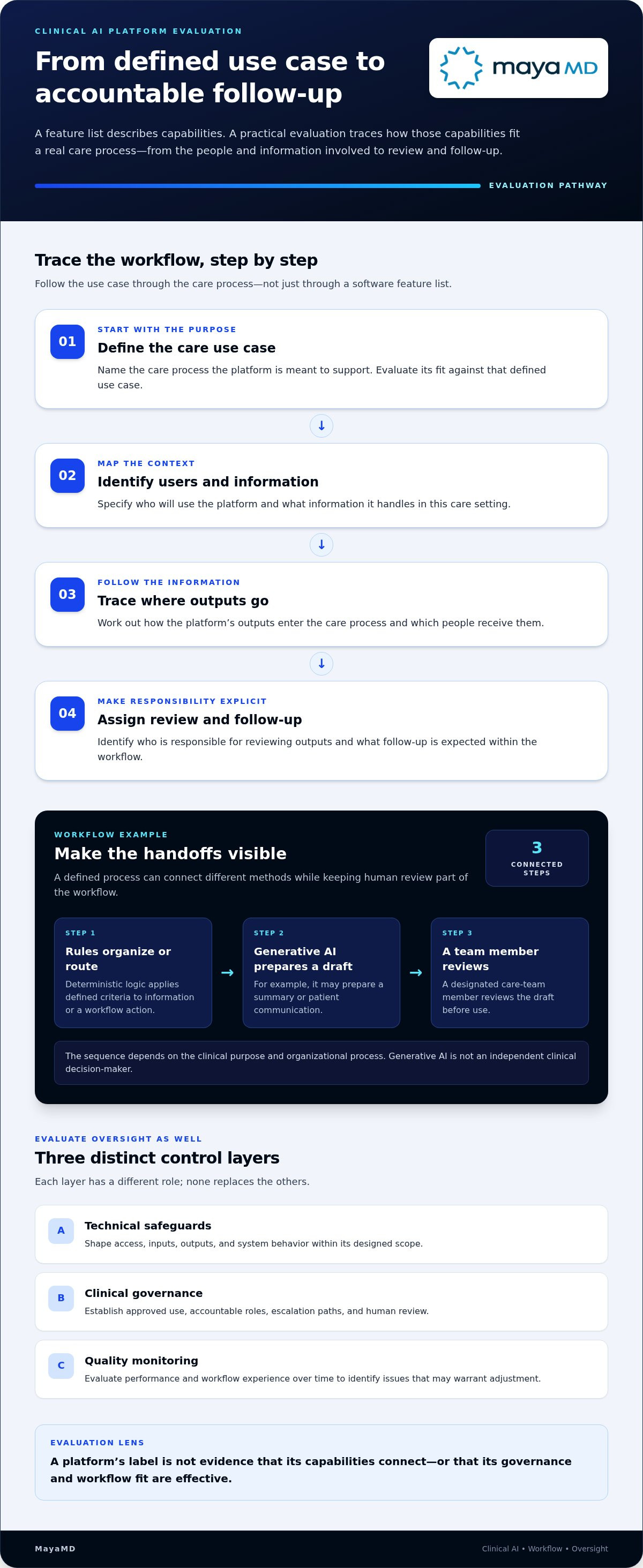
Technical safeguards
shape access, inputs, outputs, and how the system behaves within its designed scope.
Clinical governance
establishes approved use, accountable roles, escalation paths, and human review.
Quality monitoring
evaluates performance and workflow experience over time, helping teams identify issues that may warrant adjustment.
None replaces the others. A defined workflow might use rules to organize or route information, generative AI to prepare a draft, and a designated care-team member to review it before use. The sequence depends on the clinical purpose and organizational process. MayaMD’s platform combines deterministic logic with generative AI to support ongoing care workflows. Read more about AI clinical documentation and workflow automation.
To explore how these capabilities could fit a specific care-team need, discuss clinical AI workflows with MayaMD.
How to Evaluate a Clinical AI Platform Beyond Feature Lists
A feature list shows what software can do, but not whether it fits your care processes. Evaluate a clinical AI platform against a defined use case: who will use it, what information it handles, where outputs go, and who is responsible for review and follow-up. AI branding alone isn’t evidence of effective governance or practical workflow fit.
Use consistent criteria to compare capabilities against your needs:
| Evaluation area | What to assess |
|---|---|
| Workflow fit | Does the process align with existing roles, handoffs, and documentation practices? |
| Oversight | Are review responsibilities, escalation paths, and permitted uses clearly defined? |
| Integrations | Can information move between the platform and the systems used in the intended workflow? |
| Patient experience | Are communications understandable, appropriate to the care context, and connected to follow-up? |
| Operational visibility | Can the organization see how work is routed, reviewed, and completed? |
What governance and security questions should an evaluation address?
Review how access is managed, what data is handled, how AI outputs are used, and who oversees the process. Clarify the responsibilities of the vendor and the organization during implementation and routine operation. MayaMD’s cloud-based platform is HIPAA-compliant. HIPAA compliance is an important consideration, but it doesn’t by itself prove that a particular use is clinically effective, appropriately governed, or suitable for your workflows. Assess the proposed use and your organization’s requirements separately.
Which integration and workflow criteria deserve comparison?
Map the process before assessing connectivity. Identify users, existing EHR or EMR systems, information exchanged, handoffs, and documentation needs. Then determine whether standards such as FHIR or HL7 are relevant to that environment and the intended data flows. A standard mentioned in a capability description doesn’t by itself establish that a specific workflow will connect as required.
For example, a monitoring workflow may involve patient engagement, review of monitoring information, documentation, and care-team follow-up. Assess how those steps fit together rather than evaluating each feature in isolation. Learn more about MayaMD’s remote patient monitoring platform for chronic-care support.
Finally, define evaluation measures before implementation. These might include whether information reaches the intended role, whether review steps are followed, and whether patients can engage with the process. Select measures that reflect the use case. Compliance, integration, and oversight each answer different questions, so none should stand in for the others.
Where Clinical AI Platforms Fit in Chronic and Coordinated Care
Chronic and post-discharge care unfold over time, across patient interactions and care-team actions. A clinical AI platform may help connect engagement, monitoring information, documentation, and follow-up within an established workflow. Its role is to support continuity, not to treat a message or data point as a diagnosis or treatment decision.
A practical sequence might look like this:
Patient interaction
A patient shares an update, responds to outreach, or provides information as part of an ongoing care process.
Information capture
Relevant engagement or monitoring information is organized for the workflow.
Care-team review
Information is routed or made available for review according to the organization’s process.
Follow-up
The appropriate team member determines next steps and documents relevant actions.
This sequence can vary by care program. Remote patient monitoring (RPM), advanced primary care management (APCM), and principal care management (PCM) are distinct contexts, not interchangeable labels. Each has its own program design and operational requirements. AI-supported communication or documentation may fit into these workflows, but it doesn’t define or replace their requirements.
How can AI support remote patient monitoring workflows?
Monitoring information is one input to ongoing care, not a substitute for clinical review. Patient communication can complement monitoring by supporting engagement and connecting information with care-team follow-up. Make clear within the workflow how information is reviewed and acted upon. MayaMD provides remote patient monitoring for chronic-care management.
How do APCM and PCM relate to clinical AI?
APCM and PCM are different care-management contexts where coordination and continuity matter. Workflow support can help organize patient engagement, documentation, and follow-up within each program, while the care team remains responsible for decisions and program-specific processes. MayaMD supports RPM, APCM, and PCM workflows. Learn more about advanced primary care management.
After a hospital stay, automated post-discharge communication can also support continuity by sharing follow-up information or maintaining a communication pathway with the patient. It should complement the organization’s discharge and follow-up processes, not act as autonomous diagnosis or treatment. Connect with MayaMD to discuss how these workflows could align with your care model.
Moving from Clinical AI Evaluation to Practical Next Steps
A productive evaluation starts with a care need, not a broad technology mandate. Choose a focused use case, such as supporting patient engagement in a chronic-care workflow, then determine how AI could fit without disrupting clinical responsibilities. A staged approach makes it easier to define the intended role, identify gaps, and decide what evidence would support wider adoption.
What should a clinical AI platform evaluation plan include?
Build the plan around the people and processes involved. Document the intended users, patient population, use case, workflow touchpoints, information handled, and oversight responsibilities. Map where outputs go and who reviews them. This turns a feature evaluation into an assessment of how the technology would operate in practice.
Next, establish baseline measures that reflect the selected workflow. Depending on the use case, these could include documentation steps, completion of planned outreach, or the status of follow-up tasks. Define how the organization will collect and review those measures, who will assess outputs, and how concerns will be escalated. Choose measures for their relevance, not simply because a platform makes them easy to report.
Before expanding beyond the initial use case, schedule stakeholder reviews to assess workflow fit, patient and care-team experience, and any needed process changes. Use what the review shows to refine the workflow and evaluation criteria. Expansion should follow evidence that the initial approach fits the organization’s needs, not simply the availability of additional features.
How can MayaMD support a connected care approach?
MayaMD’s Clinical AI Agent supports chronic-care engagement and connected care-team workflows. Its capabilities support patient engagement, clinical documentation, and care-management contexts, including RPM, APCM, and PCM. These workflows remain distinct, and organizations can assess how each capability aligns with their care processes and responsibilities.
MayaMD combines deterministic logic with generative AI. These approaches can serve complementary roles within a defined workflow, while review and governance remain important. Neither approach eliminates the need to assess output quality and suitability for its intended use.
For a practical next step, bring together the stakeholders responsible for the care workflow, patient experience, and oversight. Identify the focused use case and measures that matter to your organization, then discuss your clinical AI needs with MayaMD.
Make Your Next Clinical AI Step Deliberate
A successful evaluation begins with the care need, not the technology label. Define the workflow, clarify who reviews AI-supported outputs, and select measures that reflect patient and care-team priorities. Then start with a focused use case before considering broader adoption.
A clinical AI platform should connect capabilities to governed care processes. MayaMD’s cloud-based platform is HIPAA-compliant and combines deterministic logic with generative AI. It supports RPM, APCM, and PCM workflows, helping organizations consider AI in the context of ongoing patient engagement and care management. HIPAA compliance is an important consideration, but it doesn’t by itself establish clinical effectiveness or workflow fit.
With clear goals and appropriate oversight, healthcare organizations can explore how AI may support continuity while keeping clinical judgment central. Discuss your clinical AI needs with MayaMD and identify a practical next step for your organization’s care workflows.
Frequently Asked Questions
What is a clinical AI platform?
A clinical AI platform connects artificial intelligence capabilities with healthcare workflows and patient-care processes. Depending on its design, it may support documentation, patient engagement, monitoring, or care coordination. Organizations should assess intended users, oversight responsibilities, integrations, and workflow fit rather than relying on the platform label alone. The goal is to understand how its capabilities support a defined care process.
How is a clinical AI platform different from an EHR?
An EHR primarily maintains and provides access to electronic health records, while a clinical AI platform applies AI capabilities to defined tasks or workflows. The systems may complement one another when appropriately integrated, but their roles vary by product and implementation. Assess what information moves between systems, who reviews AI-supported outputs, and how the workflow preserves existing clinical responsibilities. An AI platform doesn’t automatically replace an EHR or its recordkeeping role.
Is a clinical AI platform HIPAA compliant?
Compliance depends on the platform, its implementation, and how the organization uses and configures it. MayaMD’s cloud-based platform is HIPAA-compliant. Organizations still need to assess their responsibilities for access, data handling, oversight, and vendor arrangements. HIPAA compliance is important, but it doesn’t by itself demonstrate clinical effectiveness, interoperability, or suitability for a particular workflow. Evaluate those factors separately against the intended use.
Can generative AI be used safely in clinical workflows?
Generative AI may assist with defined tasks, such as drafting communication or supporting documentation, when the workflow includes appropriate context, controls, and review. Safety depends on the use case, governance, and how people interact with outputs. Organizations should define where AI contributes, who reviews its work, and what happens if information needs correction or escalation. No architecture or product label eliminates errors or the need for appropriate human oversight.
How do clinical AI platforms integrate with EHR systems?
Integration approaches vary with the platform and an organization’s technical environment. Start by mapping the systems involved, the information that needs to move, user workflows, and handoffs. Then assess whether standards such as FHIR or HL7 are relevant to the intended data exchange. Mentioning a standard alone doesn’t establish that a specific implementation will support the workflow. Evaluate how information enters, is reviewed, and is documented across the systems in scope.
Can a clinical AI platform support chronic care management?
A clinical AI platform may support chronic-care workflows through patient engagement, monitoring, documentation, and follow-up capabilities. The appropriate role depends on the platform and care program. MayaMD supports workflows related to Remote Patient Monitoring (RPM), Advanced Primary Care Management (APCM), and Principal Care Management (PCM). These are distinct contexts, so assess how the technology fits each program’s processes. AI can support workflow activity, but it doesn’t replace clinical care or review.
What should healthcare organizations consider when choosing a clinical AI platform?
Start with a defined care problem and the users who need support. Compare workflow fit, governance, security responsibilities, interoperability, patient experience, and operational visibility. Determine how outputs will be reviewed and how the platform fits existing systems and handoffs. Set relevant baseline measures, such as completion of planned outreach or documentation steps. A focused use case with clear objectives offers a more practical basis for evaluation than feature counts or broad AI claims.




See The MayaMD Difference
Fill the form below
Download Our Apps
MayaMD for patients and MayaPro for physicians - available on iOS and Android.
FOR PATIENTS
MayaMD App
AI-powered symptom assessment, triage, and secure access to your care team.
FOR PHYSICIANS
MayaPro App
MayaPro brings patient vitals, RPM/PCM care plans, and clinical decision support to your pocket.